
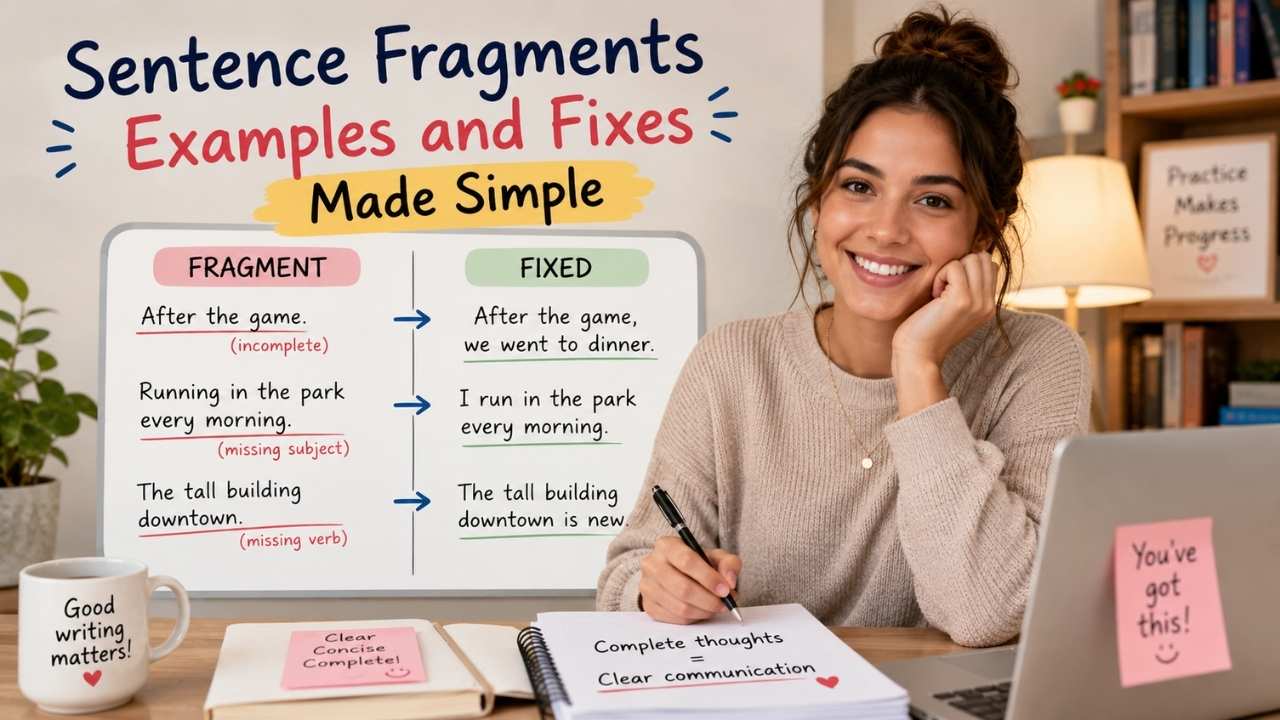
Sentence Fragments Examples and Fixes Made Simple
Many English learners struggle with sentence fragments because they often sound complete in conversation. However, in writing, a fragment usually feels unfinished. It leaves readers waiting for more information.
Today, sentence fragments examples and fixes matter more than ever. People write constantly through emails, texts, school assignments, and social media posts. Because of that, understanding complete sentences helps communication stay clear and natural.
In everyday American English, fragments sometimes appear on purpose. Writers use them for style, emphasis, or dramatic effect. Still, knowing the standard grammar rule comes first.
Quick Answer
Sentence fragments examples and fixes involve learning how to identify incomplete sentences and turn them into complete thoughts. A complete sentence needs a subject, a verb, and a finished idea.
TL;DR
- A sentence fragment is an incomplete sentence.
- Most fragments are missing a subject, verb, or complete thought.
- Fragments are common in casual speech and texting.
- Formal writing usually avoids fragments.
- You can fix fragments by adding missing information.
- Modern American English sometimes uses fragments for style.
What Sentence Fragments Are
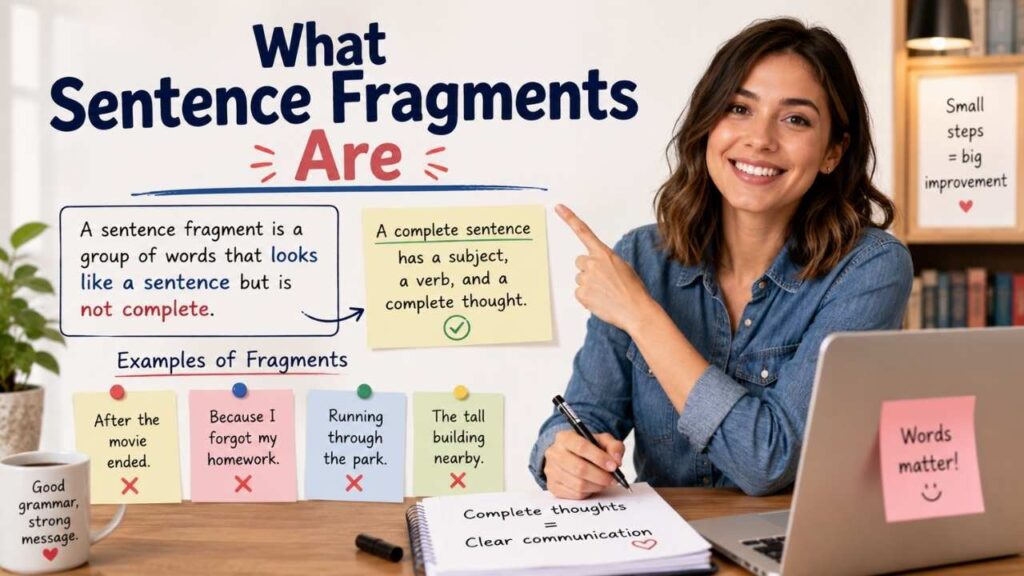
A sentence fragment is a group of words that looks like a sentence but is not complete. It may begin with a capital letter and end with punctuation. However, it still lacks something important.
Most fragments miss either a subject, a verb, or a complete idea. Because of that, readers feel like the thought stops too early. For example, “After the movie ended.” sounds incomplete. The reader naturally asks, “What happened after the movie ended?”
How Complete Sentences Work
A complete sentence expresses a full thought. It normally contains a subject and a verb. For example, “The movie ended late” works because the meaning feels complete.
In contrast, “When the movie ended” creates expectation. The word “when” signals that another idea should follow. Therefore, it becomes a fragment unless completed.
Why Fragments Happen So Often
Fragments appear frequently because spoken English works differently from written English. During conversation, tone and context fill missing gaps naturally. In writing, readers cannot hear tone or ask quick questions.
Also, texting and online communication encourage shorter wording. As a result, fragments appear everywhere in modern digital writing.
The Main Types of Sentence Fragments
Several common patterns create fragments. Understanding them makes editing much easier.
Missing Subject Fragments
Some fragments lack a clear subject. For example, “Ran across the street quickly” does not say who ran. The action exists, but the sentence feels incomplete.
Adding a subject fixes the issue immediately. “The child ran across the street quickly” forms a complete sentence.
Missing Verb Fragments
Other fragments contain a subject but no main verb. For example, “The tall building near downtown” describes something but never explains what happens.
Adding a verb completes the thought. “The tall building near downtown collapsed during the storm” works correctly.
Dependent Clause Fragments
Dependent clauses are one of the most common fragment types. Words like “because,” “although,” “when,” and “if” often create incomplete thoughts.
For example, “Because I forgot my keys” feels unfinished. However, “Because I forgot my keys, I returned home” becomes complete.
Sentence Fragments Examples and Fixes in Everyday Writing
Fragments appear in many forms of communication. Some are accidental, while others are intentional.
| Context | Fragment Example | Correct Version | Notes |
| School writing | Because the test was difficult. | Because the test was difficult, many students studied harder. | Dependent clause fragment |
| Looking forward to your reply. | I am looking forward to your reply. | Missing subject | |
| Texting | So excited for tonight! | I’m so excited for tonight! | Common informal fragment |
| Storytelling | A loud crash in the hallway. | There was a loud crash in the hallway. | Missing verb |
| Social media | Best day ever. | This was the best day ever. | Intentional casual style |
Fragments in Text Messages
Texting often ignores traditional grammar rules. Short fragments feel quick and natural. For example, “On my way” technically lacks a subject and verb combination.
Still, most readers understand the meaning instantly. Therefore, fragments remain common in casual communication.
Fragments in Professional Writing
Professional writing usually follows stricter grammar rules. Business emails, reports, and academic papers generally avoid fragments because clarity matters more than style.
However, marketing and advertising sometimes use fragments intentionally. Short phrases can sound dramatic and memorable.
The History of Sentence Fragments in English
Fragments are not new to English. In fact, incomplete structures have appeared in literature for centuries.
Early English grammar rules became stricter during the eighteenth and nineteenth centuries. Teachers and publishers wanted more standardized writing. As a result, complete sentence structures became heavily emphasized in schools.
Literary Use Through History
Many famous authors used fragments creatively. Writers such as Ernest Hemingway and James Joyce sometimes broke traditional grammar rules for style and rhythm.
These fragments often reflected human thought patterns. Real thinking does not always arrive in perfectly complete sentences.
Modern Changes in Usage
Today, fragments appear more openly in digital communication. Social media platforms encourage quick emotional expression. Therefore, fragments now feel more accepted in casual writing than before.
Still, schools and professional settings continue teaching complete sentence structure as the standard.
How American English Uses Sentence Fragments Today
Modern American English balances grammar rules with natural communication. Context matters greatly.
In formal American writing, fragments are usually corrected. Academic essays and workplace documents still value complete sentences. Readers expect polished structure in those settings.
Informal American Usage
In casual speech, Americans use fragments constantly. Someone might say, “Sounds good” or “Maybe later.” Grammatically, these may be incomplete. Yet they sound perfectly normal in conversation.
Television, movies, and online posts also encourage fragment use. As a result, younger writers often see fragments as natural communication patterns.
Educational Standards in the USA
American schools still teach fragments as grammar mistakes in formal writing. Students learn to identify incomplete thoughts and revise them carefully.
However, modern teaching often explains that fragments are not always “wrong.” Instead, they may simply fit certain contexts better than others.
British vs American Views on Sentence Fragments
British and American English largely agree about fragments. Both varieties consider them incomplete in formal writing.
However, American media sometimes embraces fragments more aggressively in advertising and entertainment. Short dramatic statements appear often in headlines and commercials.
Formality Differences
British formal writing can sound slightly more traditional in structure. In contrast, American business writing occasionally allows conversational fragments for tone.
Even so, the grammar foundation stays mostly the same across both varieties.
Common Sentence Fragment Mistakes
Many fragment errors repeat across all skill levels. Certain patterns appear especially often.
Starting With Subordinating Words
Words like “because,” “although,” “while,” and “since” frequently create fragments. Writers begin a thought but forget to finish it.
For example, “Although the weather improved” needs another idea attached to it.
Adding Extra Details Without Completion
Writers sometimes add descriptive phrases without creating a full sentence. “The old house at the end of the road” describes something but never completes the thought.
Checking for both subject and verb helps catch this problem quickly.
Mistaking Long Phrases for Sentences
Length does not create completeness. Some long fragments still lack a finished idea.
For example, “After walking through the crowded store during the holiday sale” remains incomplete despite many words.
How to Fix Sentence Fragments Easily
Most fragments can be fixed quickly once identified. The key is finding what is missing.
Add the Missing Subject or Verb
If the fragment lacks a subject, add one clearly. If it lacks a verb, include an action word that completes the thought.
For example, “Running late again” becomes “She is running late again.”
Attach the Fragment to a Nearby Sentence
Dependent clauses often connect naturally to complete sentences. Combining them creates smoother writing.
For example, “Because the roads were icy” can join with “school closed early.”
Rewrite the Entire Sentence
Sometimes rewriting works best. Instead of patching an awkward fragment, creating a new sentence may improve clarity.
Professional editors often choose this approach for smoother flow.
Intentional Fragments in Modern Writing
Not every fragment is a mistake. Skilled writers use them deliberately for emphasis.
Fragments for Dramatic Effect
Short fragments can create emotional impact. For example, “No second chances.” feels stronger because of its abrupt style.
Advertising frequently uses this technique. Movie trailers and headlines also depend on short dramatic phrasing.
Fragments in Fiction
Fiction writers often mimic natural thought patterns. Human thinking rarely follows perfect grammar rules.
Therefore, fragments help dialogue sound realistic. They also create pacing and tension during emotional scenes.
When Intentional Fragments Become Confusing
Too many fragments can weaken clarity. Readers may struggle to follow ideas if every sentence feels incomplete.
Because of that, effective writers balance fragments with complete sentences carefully.
Sentence Fragments in Digital Communication
Digital communication changed grammar expectations significantly between 2025 and 2026. Shorter writing styles now dominate many platforms.
Social Media Language
Platforms encourage fast emotional responses. Fragments feel conversational and immediate.
Posts like “Best weekend ever” or “Finally finished” appear everywhere online. Although incomplete grammatically, they communicate emotion efficiently.
Workplace Messaging Apps
Modern workplace chats also use fragments often. Quick updates save time and feel less formal.
Still, important business documents usually maintain standard sentence structure.
Confusing Fragments With Run-On Sentences
Fragments and run-on sentences represent opposite grammar problems. Fragments contain too little information, while run-ons contain too much without proper punctuation.
How Fragments Differ From Run-Ons
A fragment lacks completion. A run-on joins complete thoughts incorrectly.
For example, “Because I was tired” is a fragment. Meanwhile, “I was tired I went home early” is a run-on sentence.
Why Writers Sometimes Make Both Errors
Writers focusing on ideas may ignore structure temporarily. Some writers stop thoughts too early. Others continue too long without punctuation.
Learning sentence boundaries helps solve both issues.
How Teachers and Editors Identify Fragments
Editors often use simple strategies to spot fragments quickly.
Reading Aloud
Reading aloud helps writers hear incomplete thoughts. Fragments often sound abrupt or unfinished during speech.
This method remains one of the most effective editing techniques today.
Checking for Complete Meaning
Editors ask whether the sentence can stand alone clearly. If readers still expect more information, the sentence may be a fragment.
This strategy works especially well for dependent clauses.
Are Sentence Fragments Always Wrong?
Grammar discussions increasingly recognize context. Many experts now explain that fragments are tools rather than automatic mistakes.
Formal Rules Still Matter
Formal writing still expects complete sentences most of the time. Academic and professional standards continue emphasizing clarity and structure.
Therefore, students should master standard sentence rules first.
Modern Language Is Flexible
At the same time, language evolves constantly. Digital communication changed expectations about grammar flexibility.
Today, fragments can sound natural, expressive, and effective in the right setting.
FAQs
What is a sentence fragment?
A sentence fragment is an incomplete sentence. It may lack a subject, verb, or complete thought.
Are sentence fragments ever acceptable?
Yes, fragments can work in casual writing, fiction, and advertising. However, formal writing usually avoids them.
How do I identify a fragment quickly?
Check whether the sentence contains a subject, a verb, and a complete idea. If something feels unfinished, it may be a fragment.
Why are fragments common in texting?
Texting favors speed and short expression. Because of that, fragments feel natural in digital conversations.
Can a single word be a fragment?
Yes, one-word responses can technically be fragments. For example, “Absolutely” lacks full sentence structure but still communicates meaning.
What is the easiest way to fix fragments?
Adding missing information usually works best. Sometimes combining the fragment with another sentence also solves the problem.
Conclusion
Understanding sentence fragments examples and fixes helps writers communicate more clearly and confidently. Fragments happen when a sentence lacks a complete thought, subject, or verb. However, modern English also uses fragments intentionally for style and emphasis.
Today’s American English balances grammar rules with natural communication. Formal writing still values complete sentences, while casual writing allows more flexibility. Because of that, context matters greatly.
The best approach is learning standard sentence structure first. Then, you can decide when fragments strengthen your writing and when they create confusion.