
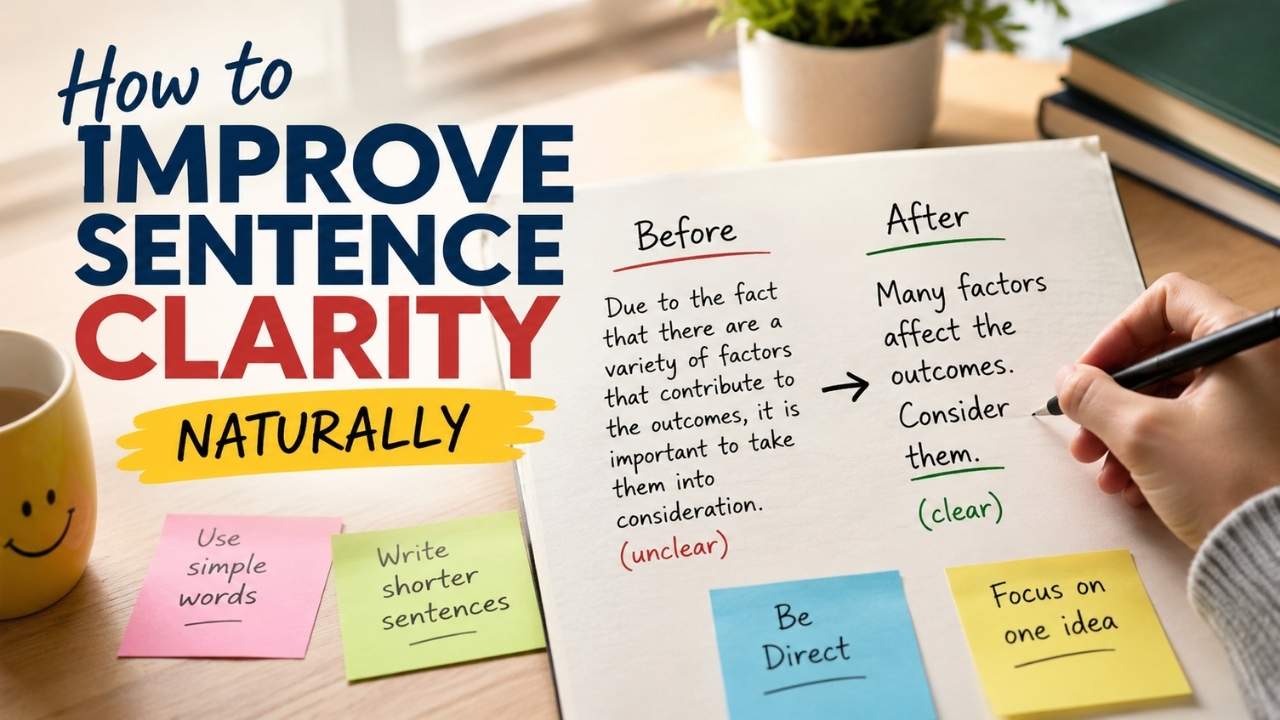
How to Improve Sentence Clarity Naturally
Clear writing helps people understand ideas quickly. It reduces confusion, improves flow, and makes communication feel more confident. Today, many people want to know how to improve sentence clarity because modern communication moves fast.
Sentence clarity matters in emails, school papers, text messages, social media posts, and work documents. Even strong ideas can sound weak when sentences feel crowded or unclear. However, clear sentences make writing sound natural and trustworthy.
English grammar has always balanced precision and flexibility. Over time, writers changed sentence structures to match how people actually speak. As a result, modern American English often favors shorter, cleaner sentences over long and formal ones.
Quick Answer
If you want to learn how to improve sentence clarity, focus on strong sentence structure, simple wording, and direct ideas. Clear sentences usually place the subject first, avoid extra words, and connect ideas logically.
TL;DR
- Clear sentences are easy to read and understand.
- Shorter sentence structures often improve readability.
- Strong verbs make writing more direct.
- Extra words can weaken meaning.
- Modern American English favors natural flow and simplicity.
- Good clarity improves both formal and casual communication.
What Sentence Clarity Really Means
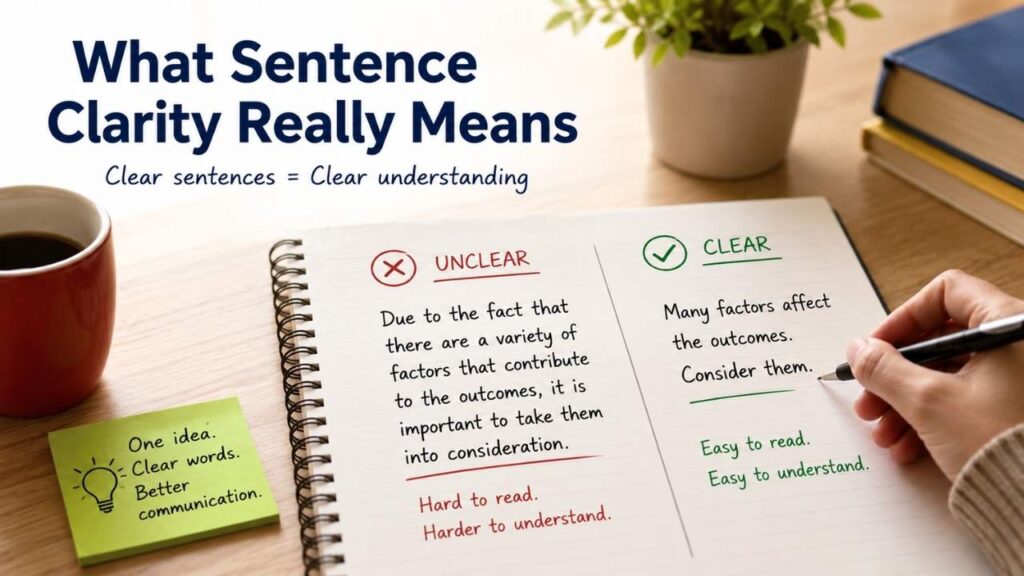
Sentence clarity refers to how easily readers understand a sentence. A clear sentence expresses one main idea without confusion. Readers should know who is acting, what is happening, and why it matters.
In English grammar, clarity depends on structure, word order, punctuation, and tone. Because English follows a fairly fixed word order, changing sentence parts can sometimes create confusion. For example, unclear pronouns or misplaced phrases often make readers stop and reread.
Why Clarity Matters in Everyday English
Modern communication happens quickly. People read emails on phones, skim messages online, and scan information at work. Therefore, unclear writing can easily frustrate readers.
Clear writing also improves credibility. In professional settings, sentence clarity often makes writers sound more organized and thoughtful. In personal communication, it reduces misunderstandings and awkward interpretations.
Clear vs Unclear Writing
| Context | Correct Usage | Example | Notes |
| Direct wording | “I attached the report yesterday.” | Simple and clear | |
| Academic writing | Specific subjects | “The study showed higher results.” | Avoids vague wording |
| Texting | Short structure | “I’ll call after work.” | Natural and easy |
| Social media | Focused ideas | “This update changes everything.” | Quick readability |
| Business writing | Active voice | “The manager approved the plan.” | Stronger meaning |
The History of Clear Writing in English
English writing was not always direct and concise. Earlier forms of English often used long and highly formal sentences. Writers in the seventeenth and eighteenth centuries sometimes created paragraphs with only one sentence.
Latin strongly influenced older English grammar styles. Because Latin used complex structures, educated English writers copied those patterns. As a result, formal writing became dense and difficult for average readers.
The Shift Toward Simplicity
During the nineteenth and twentieth centuries, writing styles slowly changed. Newspapers, public education, and mass communication encouraged shorter sentences and clearer language. American English especially moved toward practical and direct communication.
Today, digital communication continues that trend. Readers usually prefer concise sentences with strong organization. However, longer sentences still appear in literature, law, and academic writing when complexity is necessary.
How Sentence Structure Affects Clarity
Sentence structure shapes readability more than many people realize. Even correct grammar can sound confusing if ideas appear in the wrong order.
Most clear English sentences follow a simple pattern: subject, verb, and object. Readers naturally expect information in that order. Therefore, unusual structures may slow understanding.
Simple Sentences Create Stronger Meaning
Simple sentences are not childish. In fact, many professional writers rely on them. A direct sentence often communicates ideas faster than a complicated one.
For example, “The team finished the project early” sounds clearer than “The project was completed at an earlier point in time by the team.” The second version adds unnecessary complexity.
Long Sentences Are Not Always Wrong
Long sentences can still be clear when organized carefully. Skilled writers use transitions, commas, and logical flow to guide readers through complex ideas.
However, unclear long sentences usually contain too many ideas at once. Breaking them into smaller parts often improves readability immediately.
Why Strong Verbs Improve Clarity
Verbs drive sentence meaning. Weak verbs often make writing sound vague or indirect. Strong verbs create sharper and more energetic sentences.
For example, “She made a decision” sounds less direct than “She decided.” The second version uses fewer words while keeping the same meaning.
Common Weak Verb Patterns
Many unclear sentences rely on phrases like “there is,” “there are,” or “it was.” These openings delay the real subject. Because of that, readers may lose focus before reaching the main point.
Strong verbs also reduce wordiness. Modern American English usually prefers active verbs because they sound natural in conversation and writing.
The Role of Word Choice in Clear Writing
Word choice affects clarity as much as grammar does. Some words sound impressive but weaken communication. Clear writing often uses familiar and specific language.
For example, “use” usually sounds clearer than “utilize.” Similarly, “help” often works better than “facilitate.” Simpler vocabulary makes sentences easier to process.
Specific Words Reduce Confusion
Vague wording creates uncertainty. Readers may not understand what the writer truly means. Therefore, specific nouns and verbs improve accuracy.
Instead of writing “things changed,” a clearer sentence might say “the schedule changed.” Small adjustments like this make writing feel more precise.
Common Grammar Problems That Hurt Clarity
Several grammar mistakes regularly reduce sentence clarity. Some errors confuse sentence meaning directly, while others interrupt reading flow.
Run-on sentences are one major issue. They connect multiple ideas without proper punctuation or conjunctions. As a result, readers struggle to follow the sentence.
Sentence Fragments and Missing Ideas
Fragments also create confusion. A sentence fragment lacks a complete thought. Although fragments sometimes appear in casual writing, they may sound unfinished in formal contexts.
Pronoun confusion is another common problem. Readers should always know what words like “he,” “she,” “they,” or “it” refer to.
Misplaced Modifiers
Misplaced modifiers happen when descriptive phrases appear near the wrong word. These errors can accidentally create strange meanings.
For example, “She almost drove her kids to school every day” suggests she nearly drove them but never actually did. A clearer version would say, “She drove her kids to school almost every day.”
Active Voice vs Passive Voice
Active voice usually improves sentence clarity because it identifies the action clearly. In active voice, the subject performs the action directly.
For example, “The editor changed the article” sounds more direct than “The article was changed by the editor.”
Why Passive Voice Still Exists
Passive voice is not automatically wrong. Sometimes writers use it intentionally to focus on the action instead of the subject.
Scientific writing often uses passive voice to sound objective. However, overusing it can make writing feel distant or unclear. Modern American English generally prefers active voice in daily communication.
How Punctuation Improves Readability
Punctuation guides readers through sentences. Without it, even simple ideas can become confusing. Commas, periods, and semicolons help organize meaning.
Commas are especially important in English. They separate ideas, clarify pauses, and prevent misunderstanding. However, too many commas can also interrupt flow.
Periods Create Cleaner Rhythm
Shorter sentences often improve clarity because periods give readers time to process information. Long blocks of text can feel overwhelming, especially online.
Today, digital writing frequently uses shorter sentences and paragraphs. This style matches how people read on screens and mobile devices.
Formal vs Informal Clarity
Clear writing looks different depending on context. Formal writing often uses more detailed explanations, while informal writing sounds conversational.
However, both styles still need logical structure and understandable wording. Even casual texting benefits from clarity.
Clarity in Professional Communication
Business writing usually values directness. Emails, reports, and presentations should avoid unnecessary complexity. Readers often prefer concise sentences that reach the point quickly.
At the same time, professional clarity does not mean sounding cold. Natural wording often feels more approachable and effective.
British and American Differences in Clear Writing
American English generally favors shorter and more direct sentence styles. British English sometimes keeps slightly more formal structures, especially in academic or institutional writing.
However, the differences are smaller today than in the past. Global internet communication has influenced writing styles across English-speaking countries.
Punctuation and Style Variations
American English uses punctuation differently in some situations. For example, periods and commas usually appear inside quotation marks in the United States.
These differences rarely change sentence clarity dramatically. Still, understanding regional conventions helps writers match audience expectations.
How Digital Communication Changed Sentence Clarity
Technology has transformed modern English writing. Texting, social media, and online messaging encourage faster and shorter communication styles.
As a result, many people now prefer concise sentences with quick readability. Long introductions and highly formal wording appear less often in casual communication.
Clarity in Social Media and Texting
Digital writing often removes unnecessary words completely. However, excessive shortening can sometimes create confusion instead of clarity.
For example, abbreviations and missing punctuation may save time, but they can also weaken meaning. Clear digital writing balances speed with readability.
Why Readers Struggle With Unclear Sentences
Readers usually struggle when sentences overload working memory. If too many ideas appear together, comprehension slows down.
Because of this, writers often improve clarity by separating information into logical steps. Transition words also help readers follow connections between ideas.
Cognitive Load and Reading Flow
Psychologists and linguists often discuss “cognitive load,” which describes mental effort during reading. Simpler sentence structures reduce that effort.
Modern writing advice increasingly reflects this idea. Clear writing supports comprehension without oversimplifying meaning.
Practical Ways to Make Sentences Clearer
Improving sentence clarity usually requires revision. Strong first drafts are helpful, but editing often creates the clearest writing.
Reading sentences aloud can reveal awkward rhythm or confusing wording. If a sentence sounds unnatural when spoken, it may need revision.
Focus on One Main Idea
Clear sentences usually contain one central point. Trying to combine too many ideas often weakens readability.
Writers also benefit from removing unnecessary filler phrases. Expressions like “in order to” or “due to the fact that” often become clearer when shortened.
Use Natural Rhythm
Good clarity sounds conversational without becoming careless. Modern American English values writing that feels smooth and human.
Therefore, many writers now prefer plain language over overly formal wording. Clear communication helps readers stay engaged longer.
Misunderstandings About Good Writing
Some people believe complex writing sounds smarter. However, confusing sentences often hide weak organization rather than intelligence.
Strong writers usually communicate difficult ideas in accessible ways. Clarity requires careful thinking and precise structure.
Simplicity Is Not Weakness
Short sentences can sound powerful and professional. Many respected journalists, authors, and public speakers rely on concise wording.
At the same time, clear writing still allows personality and style. Simplicity does not mean removing creativity from language.
How Sentence Clarity Continues to Evolve
English constantly changes. Writing styles that sounded normal decades ago may now feel overly formal or outdated.
Today, readers generally expect faster communication and cleaner structure. Because of that, clarity standards continue shifting toward accessibility and readability.
The Future of Clear Communication
Modern tools now check grammar and readability automatically. However, software cannot fully replace human judgment. Context still matters.
Writers must balance grammar rules with tone, audience, and purpose. Clear communication depends on flexibility as much as correctness.
FAQs
What is sentence clarity in grammar?
Sentence clarity means writing in a way readers easily understand. Clear sentences use logical structure, direct wording, and organized ideas.
Why are short sentences usually clearer?
Short sentences reduce mental effort for readers. However, sentence length matters less than organization and flow.
Does passive voice always hurt clarity?
No, passive voice is sometimes useful. Still, active voice often sounds more direct in everyday American English.
How can I make confusing sentences clearer?
Start by removing extra words and focusing on one idea at a time. Reading the sentence aloud can also help identify awkward phrasing.
Is formal writing supposed to sound complicated?
Not necessarily. Strong formal writing usually values precision and organization more than complexity.
Why do modern writers prefer simpler language?
Digital communication encourages faster reading habits. Readers often respond better to concise and natural wording today.
Conclusion
Learning how to improve sentence clarity helps writers communicate more effectively in every situation. Clear sentences make ideas easier to understand, whether in school, work, or casual conversation.
Modern American English increasingly favors direct structure, strong verbs, and natural wording. However, clarity is not about making writing overly simple. Instead, it means helping readers follow ideas smoothly and confidently.
The best writing respects readers’ time and attention. When sentences sound clear and natural, communication becomes stronger, faster, and more meaningful.