

Skip to content
Write With English

Write With English

Write With English

Write With English

  • Home
  • About Us
  • Contact Us
  • Privacy Policy
  • Home
  • About Us
  • Contact Us
  • Privacy Policy
Close

Search

Choosing between any way or anyway can be confusing because they look and sound almost the same.

Any Way or Anyway Which One Is Correct With Examples 

Choosing between any way or anyway can be confusing because they look and sound almost the same. However, they have different meanings and are used in different…

Read More

Language Tips
July 31, 2026
When it comes to dialog vs dialogue, many writers stop and wonder: Which spelling is correct? Is dialog wrong?

Dialog vs Dialogue: What’s the Difference & Which Should You Use

When it comes to dialog vs dialogue, many writers stop and wonder: Which spelling is correct? Is dialog wrong? Or is dialogue just the British version? The truth is…

Read More
Language Tips
July 30, 2026
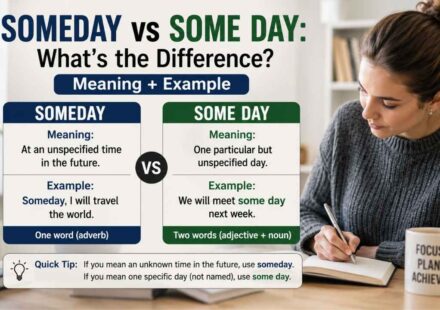
Knowing the difference between someday vs some day can help you avoid common grammar mistakes and make your writing clearer. 

Someday vs Some Day: What’s the Difference? Meaning, Example 

Have you ever wondered whether you should write “someday” or “some day”? Although they look almost identical, they have different meanings and…

Read More
Language Tips
July 29, 2026
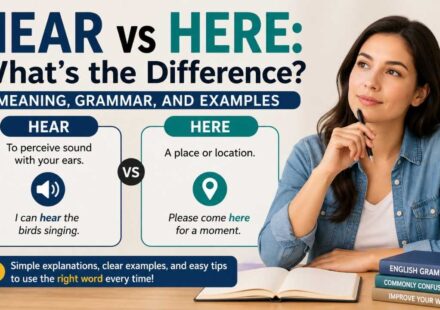
Have you ever stopped while writing and wondered whether you should use hear or here? You're not alone. These two words sound exactly the same, but they have completely different meanings and uses in English grammar. That's why hear vs here is one of the most common examples of confusing English words and homophones. Hear relates to listening or sound, while here refers to a place or location. Using the wrong word can quickly change the meaning of your sentence and make your writing look less polished. In this guide, you'll learn the difference between hear and here, their meanings, pronunciation, grammar rules, and plenty of hear vs here examples. You'll also discover simple memory tricks, common mistakes to avoid, and practical tips to help you choose the correct word with confidence in everyday English. Quick Answer Hear and here are homophones, meaning they sound the same but have different meanings. Hear is a verb that means to perceive sound or listen, while here is usually an adverb that refers to a place or location. Understanding the difference between hear and here helps you avoid common spelling mistakes and use the correct word confidently in everyday English. Hear vs Here: The Main Difference at a Glance Although hear and here sound exactly alike, they have different meanings and serve different purposes in a sentence. This is why they are called homophones—words with the same pronunciation but different spellings and meanings. Hear is a verb that means to notice or receive sound through your ears. Here is usually an adverb that refers to a place or location. Knowing the difference between hear and here helps you avoid common spelling mistakes and write with confidence. The table below gives you a quick comparison. If you enjoy learning about confusing English words, you may also like our guides on Shined vs Shone, Orientated vs Oriented, and Is It Correct to Say Most Recent. Feature Hear Here Meaning To notice or receive sound A place or location Part of Speech Verb Usually an adverb Related To Hearing and listening Position or place Example I can hear the birds singing. Please come here. What Does "Hear" Mean? Hear is a verb that means to notice, receive, or recognize sound with your ears. Whenever you talk about listening to music, hearing someone's voice, or noticing a noise, hear is the correct word to use. Unlike listen, which describes making an effort to pay attention, hear often happens naturally. This makes it one of the most common verbs in everyday English. Understanding the hear meaning makes it easier to avoid mixing it up with here. Here are a few hear vs here examples: I can hear the rain outside. Did you hear what the teacher said? She heard a strange noise last night. In each sentence, hear relates to sound, not a place. What Does "Here" Mean? Here usually refers to a place, position, or location. It tells someone where a person or thing is and is most often used as an adverb. You can use here when inviting someone closer, pointing to a location, or describing where something happens. Learning the here meaning is simple because it always relates to place rather than sound. For example, you can say, Please sit here, I left my keys here, or My family lives here. In each sentence, here answers the question "Where?" Understanding this simple rule makes the difference between hear and here much easier to remember and helps you choose the correct word in everyday writing and conversation. Why Do "Hear" and "Here" Sound the Same? Many learners wonder why hear and here sound exactly alike even though they have different spellings. The reason is that they are homophones. In English, homophones are words that share the same pronunciation but have different meanings and spellings. Both hear and here are pronounced /hɪr/ in most forms of American English, so you cannot tell which word someone means by sound alone. Instead, you must rely on the context of the sentence. If the sentence is about sound or listening, use hear. If it talks about a place or location, use here. Understanding this pronunciation rule makes choosing the correct word much easier and reduces common grammar mistakes. Hear vs Here in Sentences The easiest way to understand the difference between hear and here is by seeing both words in real sentences. Remember that hear is used when talking about sound, while here refers to a place or location. Looking at different examples helps you choose the correct word without hesitation. Here are a few hear vs here examples: I can hear the birds singing every morning. Did you hear the good news? Please come here for a moment. Your package is here on the table. Can you hear me clearly during the meeting? We are here to support you. Each sentence shows that hear relates to listening, while here always points to a specific place. Common Mistakes People Make Many people confuse hear and here because they are homophones. Since they sound the same, writers sometimes choose the wrong spelling without noticing. The best way to avoid this mistake is to think about the meaning of your sentence before you write. Ask yourself, "Am I talking about sound or a place?" If the sentence is about hearing, listening, or noise, use hear. If it refers to a location, use here. ❌ Incorrect ✅ Correct Come hear for a minute. Come here for a minute. I can here your voice. I can hear your voice. Please stay hear. Please stay here. Did you here that sound? Did you hear that sound? Checking the meaning instead of the pronunciation will help you avoid these common spelling mistakes. Easy Trick to Remember Hear vs Here A simple memory trick can help you remember the difference between hear and here every time you write. Look at the word hear. It contains the word ear, and you use your ears to hear sounds. This makes it easy to connect hear with listening. Now think about here. It begins with "H" and is commonly used when pointing to this place or this location, such as "Come here." Whenever you're unsure which spelling to use, ask yourself one quick question: Is this about sound or about a place? If it's about sound, choose hear. If it's about location, choose here. This small trick works well for students, ESL learners, and everyday writers. Hear, Hear vs. Here, Here: Which Is Correct? The correct expression is "Hear, hear," not "Here, here." People use "Hear, hear" to show that they strongly agree with something another person has said. The phrase has been used for many years, especially in British Parliament, where members would say "Hear, hear!" instead of applauding a speech. Because the words sound the same, many people mistakenly write "Here, here." However, this spelling is almost always incorrect unless you are literally talking about a place. For example, "Hear, hear! That was an excellent idea." is correct, while "Here, here!" is usually a spelling mistake. Knowing this difference will improve your grammar and writing accuracy. Hear vs Here Quiz Test your understanding of hear vs here by choosing the correct word to complete each sentence. Can you ______ the music from outside? Please come ______ and sit beside me. I could ______ someone knocking at the door. Your glasses are right ______ on the desk. Did you ______ what the coach said? Answers hear here hear here hear If you answered all five correctly, you've mastered the basic hear vs here grammar rule. If you missed any, review the meanings and remember the simple trick: hear = sound, here = place. FAQs Is it hear or here? Use hear when talking about sound or listening. Use here when referring to a place or location. Are hear and here homophones? Yes. They are homophones because they have the same pronunciation but different meanings and spellings. Is hear a verb? Yes. Hear is a verb that means to notice or receive sound with your ears. What part of speech is here? Here is most commonly an adverb, although it can also be used as an interjection in some situations. What does "Hear, hear!" mean? "Hear, hear!" is an expression used to show agreement with what someone has said. How can I remember the difference between hear and here? Remember that hear contains ear, which helps you connect it with hearing sounds. Here refers to a place. Conclusion The difference between hear and here is simple once you focus on their meanings instead of their pronunciation. Use hear whenever you're talking about hearing, listening, or sound, and use here when referring to a place or location. Since these words are homophones, it's normal to confuse them at first, but a little practice goes a long way. Reading examples, using the memory trick, and checking the context before you write will help you choose the correct word every time. With this guide, you can confidently use hear and here correctly in everyday conversations, emails, school assignments, and professional writing.

Hear vs Here: What’s the Difference? Meaning, Grammar & Example 

Have you ever stopped while writing and wondered whether you should use hear or here? You’re not alone. These two words sound exactly the same, but they have…

Read More

Language Tips
July 26, 2026
If you've ever wondered, "Is it correct to say most recent?", you're not alone.

Is It Correct to Say Most Recent? Meaning, Grammar, & Examples

If you’ve ever wondered, “Is it correct to say most recent?”, you’re not alone. This common English phrase appears in business writing,…

Read More

Language Tips
July 24, 2026
When it comes to orientated vs oriented, many English learners and even native speakers wonder which word is correct.

Orientated vs Oriented: What’s the Difference & Which Is Correct?

When it comes to orientated vs oriented, many English learners and even native speakers wonder which word is correct. The good news is that both words are…

Read More

Language Tips
July 22, 2026
Many English learners and native speakers get confused by shined vs shone because both forms appear in books, websites, and everyday conversations. 

Shined vs Shone: What’s the Difference and Which One Is Correct?

Have you ever stopped while writing and wondered whether “shined” or “shone” is the correct word? You’re not alone. Many English…

Read More

Language Tips
July 21, 2026
In this guide, you'll discover the Paucity Meaning, its definition, pronunciation, sentence examples, synonyms, antonyms, and the difference between paucity and similar words like scarcity

Paucity Meaning Explained: Definition, Examples, Synonyms 

If you’ve come across the word paucity while reading a book, news article, or academic paper, you may be wondering, what does paucity mean and how to use it…

Read More

Language Tips
July 20, 2026
Have you ever wondered whether you should say "at the weekend" or "on the weekend"? If so, you're not alone.

At the Weekend vs On the Weekend: What’s the Difference?

Have you ever wondered whether you should say “at the weekend” vs “on the weekend”? If so, you’re not alone. Many English learners,…

Read More
Language Tips
July 19, 2026
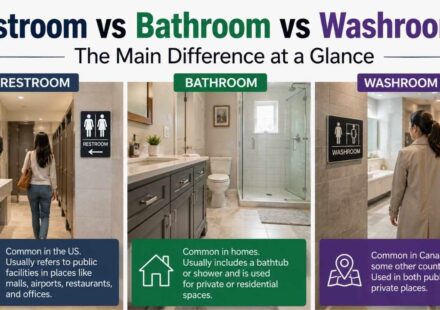
The difference between Restroom vs Bathroom often depends on the location, culture, and even the type of English vocabulary people use. 

Restroom vs Bathroom vs Washroom: What’s the Difference?

Have you ever wondered whether you should say restroom, bathroom, or washroom? Although these words are often used to describe the same place, they don’t always…

Read More
Language Tips
July 18, 2026
1 2 3 … 13 Next »

Recent Posts

  • Any Way or Anyway Which One Is Correct With Examples 
  • Dialog vs Dialogue: What’s the Difference & Which Should You Use
  • Someday vs Some Day: What’s the Difference? Meaning, Example 
  • Hear vs Here: What’s the Difference? Meaning, Grammar & Example 
  • Is It Correct to Say Most Recent? Meaning, Grammar, & Examples

Categories

  • Blog
  • Language Tips
  • Master English

Latest Pages

  • About Us
  • Contact Us
  • Home
  • Privacy Policy
  • Terms and Conditions

Categories

  • Blog
  • Language Tips
  • Master English
Copyright 2026 — Write With English. All rights reserved.