
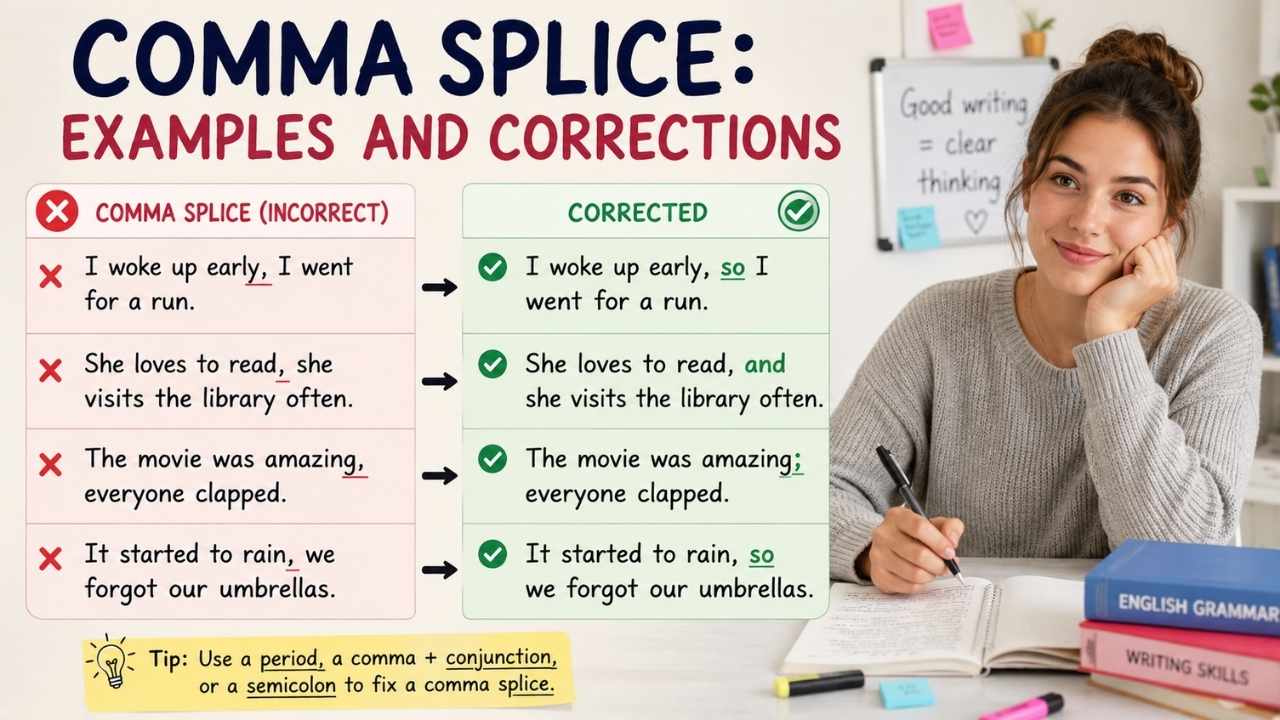
Comma Splice: Examples and Corrections
A comma splice happens when two complete sentences are joined with only a comma. It is one of the most common punctuation mistakes in modern English writing. Many people make this error in emails, texts, essays, and even professional documents.
Today, readers often write quickly. Because of that, sentence boundaries can become unclear. A comma splice usually appears when a writer wants ideas to flow smoothly but accidentally creates a grammatical problem instead.
In American English, teachers and editors still consider comma splices incorrect in formal writing. However, they also appear often in creative writing, advertising, and online communication. Understanding how they work helps people write more clearly and naturally.
Quick Answer
A comma splice occurs when two independent clauses are connected with only a comma. The mistake can usually be fixed by adding a conjunction, replacing the comma with a semicolon, or splitting the sentence into two separate sentences.
TL;DR
- A comma splice joins two complete sentences with only a comma.
- It is considered incorrect in formal English writing.
- Writers can fix it with a conjunction, semicolon, or period.
- Comma splices are common in texting and casual communication.
- American English style guides usually discourage them.
- Some creative writers use them intentionally for rhythm or tone.
What Is a Comma Splice?
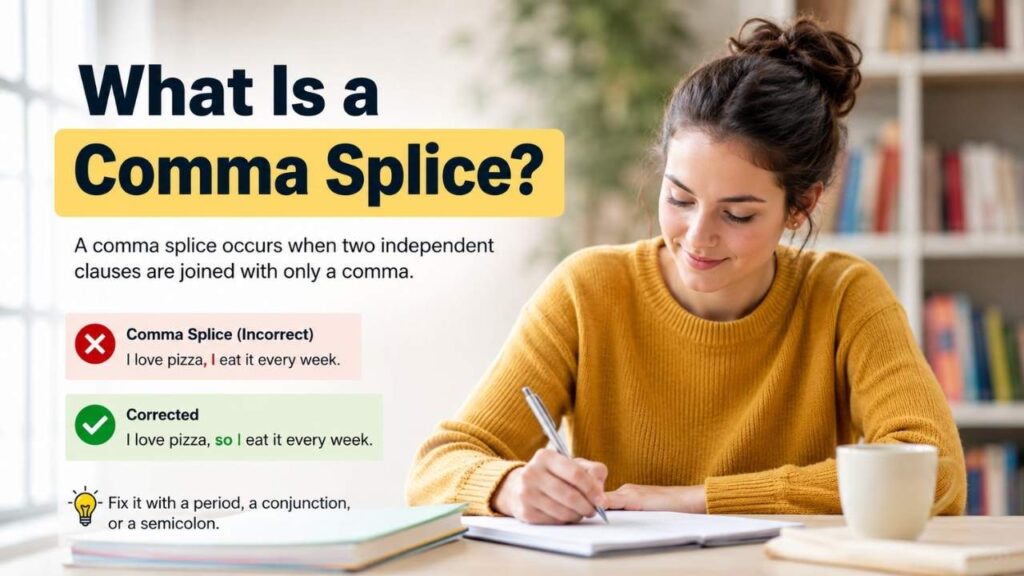
A comma splice joins two independent clauses with only a comma. An independent clause contains a subject and a verb and can stand alone as a complete sentence.
For example, this sentence contains a comma splice:
I finished my homework, I watched a movie.
Both parts can stand alone. Because of that, the comma alone is not strong enough to connect them.
In standard English grammar, commas mainly separate items, phrases, or dependent information. They do not normally join two complete thoughts without extra support. That is why grammar teachers often mark comma splices as punctuation errors.
Why Independent Clauses Matter
An independent clause expresses a full idea. It does not rely on another clause for meaning. Because it already works as a sentence, it needs stronger punctuation when connected to another full sentence.
For example:
| Context | Correct Usage | Example | Notes |
| Two separate thoughts | Use a period | I was tired. I went to bed early. | Most formal choice |
| Connected ideas | Use a conjunction | I was tired, so I went to bed early. | Smooth flow |
| Closely related ideas | Use a semicolon | I was tired; I went to bed early. | More formal tone |
| Incorrect form | Comma splice | I was tired, I went to bed early. | Grammar error |
The History of Comma Splice in English
The term “comma splice” became common in grammar instruction during the nineteenth and twentieth centuries. However, the punctuation issue itself is much older than that.
Early English writing did not always follow strict punctuation rules. In fact, writers in the Middle Ages used punctuation more for pauses in speech than for grammar structure. Because of this, sentence boundaries often looked inconsistent by modern standards.
Later, English grammar became more standardized. Printers, teachers, and editors began creating clearer punctuation systems. As formal education expanded in Britain and the United States, grammar books started warning against comma splices.
Changes in Writing Style Over Time
Modern American English prefers shorter and clearer sentences than older styles. Because of that, comma splices became easier to identify and correct.
However, famous authors have still used them intentionally. Writers sometimes use comma splices to create speed, emotion, or a conversational rhythm. Even so, most academic and business writing still treats them as mistakes.
How Comma Splices Happen in Everyday Writing
Many comma splices appear because people naturally pause between ideas while writing. Since commas often represent pauses in speech, writers may insert one where stronger punctuation is needed.
This happens especially in fast communication. Texting, social media posts, and online messaging encourage speed over careful editing. As a result, comma splices appear frequently in digital writing.
Common Situations That Cause Comma Splices
People often create comma splices when two ideas feel closely connected. For example, someone may write:
She loves coffee, she drinks it every morning.
The ideas clearly relate to each other. However, the sentence still needs better punctuation.
Another common cause involves sentence length. Writers sometimes combine short sentences because separate sentences feel repetitive. Instead of using a conjunction or semicolon, they insert only a comma.
How to Fix a Comma Splice
Fortunately, comma splices are usually easy to correct. Writers have several standard options depending on tone and style.
Use a Period
The simplest fix is separating the clauses into two sentences.
Incorrect:
The store was closed, we went home.
Correct:
The store was closed. We went home.
This method creates clarity and works well in formal writing.
Add a Coordinating Conjunction
A coordinating conjunction connects two independent clauses correctly when paired with a comma.
Incorrect:
The movie ended late, we missed the train.
Correct:
The movie ended late, so we missed the train.
Common coordinating conjunctions include and, but, so, or, yet, for, and nor.
Use a Semicolon
A semicolon connects closely related independent clauses without a conjunction.
Correct:
The weather changed quickly; everyone rushed inside.
Semicolons create a slightly more formal tone. Therefore, they appear often in academic or professional writing.
Comma Splice vs Run-On Sentence
People often confuse comma splices with run-on sentences. Although they are related, they are not exactly the same thing.
A run-on sentence happens when two independent clauses are joined incorrectly. A comma splice is actually one specific type of run-on sentence.
For example:
Comma splice:
I love music, I listen every day.
Fused sentence:
I love music I listen every day.
Both sentences are run-ons. However, the comma splice includes a comma, while the fused sentence has no punctuation at all.
Why the Difference Matters
Teachers and editors sometimes use these terms differently. Some grammar guides treat “run-on sentence” as a broad category. Others separate fused sentences and comma splices into distinct errors.
In modern American classrooms, students usually learn that a comma splice is one form of run-on sentence.
Comma Splices in American English
American English grammar instruction strongly discourages comma splices in formal writing. Schools, universities, publishers, and workplaces generally expect writers to avoid them.
However, spoken American English often sounds more flexible than written grammar rules suggest. People naturally pause between ideas while speaking, and commas sometimes reflect those speech patterns.
Informal Communication Today
Text messages and social media posts frequently contain comma splices. Many readers accept them in casual communication because the meaning remains clear.
For example:
I’m exhausted, I need coffee.
In a text conversation, most people would understand the sentence instantly. Still, the same structure could look careless in an academic essay or business report.
British vs American Views on Comma Splices
British and American English generally agree that comma splices are incorrect in formal writing. However, stylistic preferences can differ slightly.
British writing sometimes allows longer sentence structures with more varied punctuation. Meanwhile, modern American writing often favors direct and concise sentences.
Despite those differences, grammar guides on both sides of the Atlantic usually recommend fixing comma splices in professional contexts.
Literary Exceptions
Some British and American novelists intentionally use comma splices to create voice or rhythm. This technique appears especially in stream-of-consciousness writing or dialogue.
However, intentional stylistic choices differ from accidental grammar mistakes. Skilled writers break rules deliberately and with clear purpose.
Common Comma Splice Mistakes
Many writers repeat the same comma splice patterns. Recognizing these patterns makes editing easier.
Connecting Cause and Effect
Writers often connect related ideas with only a comma.
Incorrect:
The roads were icy, several schools closed early.
Correct:
The roads were icy, so several schools closed early.
Joining Short Sentences
Short clauses can feel harmless because they read quickly.
Incorrect:
She smiled, he waved.
Even though the sentence is short, it still contains two complete clauses.
Confusing Commas With Pauses
Speech pauses do not always match grammar rules. A speaker may pause naturally between ideas, but written punctuation follows sentence structure instead of breathing patterns.
Real-Life Examples of Comma Splices
Comma splices appear everywhere in daily life. They often show up in personal writing because people focus on meaning more than punctuation.
Emails and Workplace Writing
Employees sometimes write:
The meeting ran long, we started lunch late.
In professional settings, this can make writing appear rushed or unpolished.
Social Media and Texting
Online writing tends to be less formal. Many users intentionally ignore strict punctuation rules for speed or style.
For example:
It’s raining again, I’m staying inside.
Most readers accept this casually online, although it remains grammatically nonstandard.
Student Essays
Students frequently create comma splices while trying to avoid short sentences. Teachers often encourage sentence variety, but beginners may join clauses incorrectly while attempting more advanced writing.
Why Some Writers Intentionally Use Comma Splices
Although grammar guides discourage comma splices, creative writers sometimes use them for artistic reasons.
A comma splice can create momentum. It can also imitate fast thinking or emotional speech. Because commas produce a softer pause than periods, the sentence may feel more fluid.
For example:
She ran through the station, her heart pounded, the train doors closed.
This structure creates urgency and movement.
Style vs Error
Intent matters. Professional authors may use comma splices carefully for effect. However, unintentional comma splices usually weaken clarity instead of improving style.
In formal writing, readers generally expect standard punctuation unless a clear artistic purpose exists.
The Debate Around Comma Splices
Grammar discussions about comma splices continue today. Some language experts argue that traditional grammar rules can be too rigid for modern communication.
Others believe punctuation standards still matter because they improve readability and clarity.
Modern Digital Communication
Digital writing has changed punctuation habits dramatically. Online messages often favor speed, emotion, and conversational tone over strict correctness.
Because of that, comma splices appear more accepted socially than they were decades ago.
Still, most editors and educators continue teaching standard punctuation rules. Formal writing expectations have not disappeared, especially in education and business communication.
How Students Learn About Comma Splices
Students in the United States usually encounter comma splice lessons in middle school or early high school grammar classes.
Teachers often explain the concept using independent clauses because understanding sentence structure is essential for punctuation.
Why the Rule Feels Difficult
Many students understand the meaning of a comma splice even while making the mistake repeatedly. The problem often comes from writing by sound instead of structure.
Because spoken English flows naturally between ideas, sentence boundaries can feel artificial at first.
However, practice helps students recognize complete clauses more quickly during editing.
How Comma Splice Rules Have Changed
Grammar instruction has become more flexible over time. Older grammar books sometimes treated punctuation mistakes very harshly. Modern teaching often focuses more on clarity and audience expectations.
Today, many teachers explain that comma splices are inappropriate mainly in formal contexts rather than treating them as absolute language failures.
Language Continues to Evolve
English punctuation rules continue changing slowly. Informal online communication influences how people read and write every day.
Even so, standard edited English still avoids comma splices in most professional situations. Clear punctuation remains important for academic and workplace writing.
FAQs
Is a comma splice always wrong?
In formal writing, most grammar guides consider it incorrect. However, creative writers sometimes use comma splices intentionally for style or rhythm.
Why do people make comma splices so often?
People naturally pause between ideas while speaking. Because commas often represent pauses, writers sometimes use them where stronger punctuation is needed.
Can I use a semicolon instead of fixing the sentence completely?
Yes. A semicolon correctly joins two closely related independent clauses without a conjunction.
Are comma splices common in texting?
Yes, they appear very often in texts and social media posts. Casual communication usually follows looser punctuation standards.
What is the difference between a comma splice and a fused sentence?
A comma splice uses a comma incorrectly between two complete clauses. A fused sentence joins the clauses with no punctuation at all.
Do professional writers ever use comma splices?
Yes, some novelists and creative writers use them intentionally for tone or pacing. However, editors still avoid them in most formal writing.
Conclusion
A comma splice happens when two complete sentences are connected with only a comma. Although the mistake is common, it is usually simple to fix with a period, conjunction, or semicolon.
Modern English continues evolving, especially in digital communication. Still, formal American writing generally expects clearer punctuation between independent clauses.
Understanding comma splices helps writers create smoother and more professional sentences. Once people learn to recognize independent clauses, editing these mistakes becomes much easier and more natural.