

Bourgeois vs Bourgeoisie: What’s the Difference?
Many people struggle to understand the difference between bourgeois and bourgeoisie because the two words look similar and come from the same French origin. However, they do not mean exactly the same thing. If you have ever wondered, “What is the difference between bourgeois vs bourgeoisie?”, you are not alone. These terms often appear in discussions about social class, capitalism, Marxism, history, and even everyday conversations.
In simple terms, bourgeois usually refers to an individual person from the middle class or describes attitudes and values associated with that group. On the other hand, bourgeoisie refers to the middle class as a whole social group. This distinction makes it important to know which word fits your sentence.
Understanding the bourgeois vs bourgeoisie meaning can improve your vocabulary and help you use both words correctly. In this guide, you will learn the bourgeois definition, the bourgeoisie definition, their key differences, grammar rules, sentence examples, common mistakes, and how these terms relate to Karl Marx, the proletariat, and modern society.
Quick Answer
The main difference between bourgeois and bourgeoisie is that bourgeois refers to an individual middle-class person or describes middle-class values, while bourgeoisie refers to the middle class as a social group. Bourgeois can function as both a noun and an adjective, whereas bourgeoisie is only a noun. In simple terms, bourgeois = one person or characteristic, and bourgeoisie = the entire middle class collectively.
Bourgeois vs Bourgeoisie: Quick Comparison
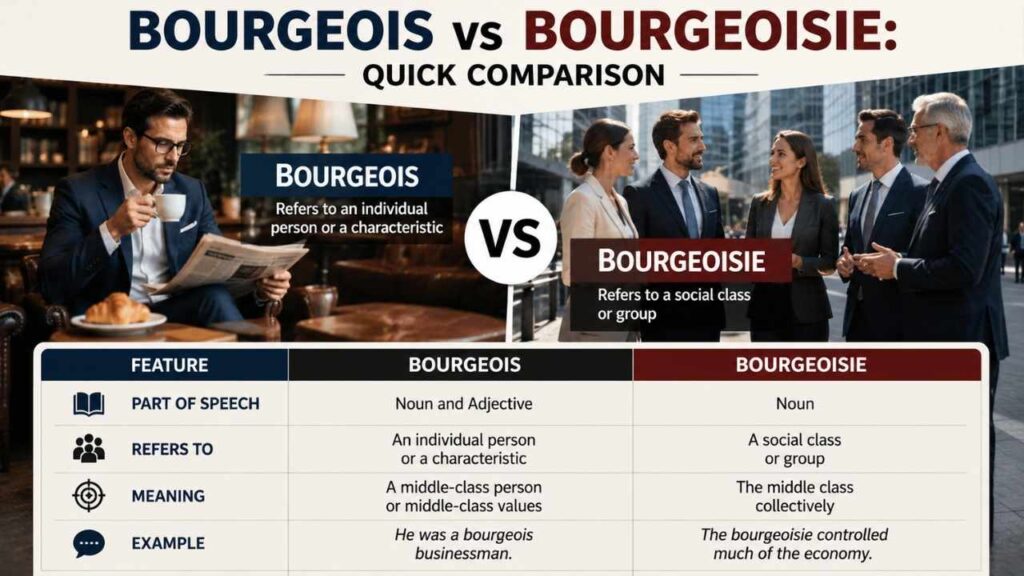
If you need a quick answer, this bourgeois vs bourgeoisie comparison makes the difference easy to understand. Although both words relate to the middle class, they serve different purposes in English.
| Feature | Bourgeois | Bourgeoisie |
| Part of Speech | Noun and Adjective | Noun |
| Refers To | An individual person or a characteristic | A social class or group |
| Meaning | A middle-class person or middle-class values | The middle class collectively |
| Example | He was a bourgeois businessman. | The bourgeoisie controlled much of the economy. |
The simplest way to remember the difference is that bourgeois often describes one person or something connected to the middle class, while bourgeoisie describes the entire social class. Understanding this distinction will help you avoid common grammar mistakes and use both terms confidently in academic, historical, and everyday contexts.
What Does Bourgeois Mean?
The bourgeois definition refers to a person who belongs to the middle class. The word can also work as an adjective that describes attitudes, lifestyles, values, or behaviors commonly associated with middle-class society. Because of this flexibility, bourgeois functions as both a noun and an adjective.
Historically, the term described merchants, business owners, and other people who held a comfortable economic position. Today, people often use bourgeois when discussing social status, culture, or personal values. Depending on the context, the word can be neutral, positive, or slightly negative.
Bourgeois as a Noun
As a noun, bourgeois refers to an individual member of the middle class.
Examples:
- The bourgeois invested in local businesses.
- He was a successful bourgeois merchant.
- Many bourgeois citizens supported economic reforms.
Bourgeois as an Adjective
As an adjective, the word describes things associated with middle-class lifestyles.
Examples:
- They criticized bourgeois values.
- The neighborhood had a bourgeois atmosphere.
- Some people viewed his tastes as overly bourgeois.
Modern Meaning of Bourgeois
In modern English, bourgeois meaning often extends beyond social class. Some speakers use it to describe conventional thinking, materialism, or a focus on financial success. However, the meaning still depends heavily on context.
Pronunciation of Bourgeois
Bourgeois is usually pronounced:
boor-ZHWAH
The final “s” remains silent, which often surprises English learners encountering the word for the first time.
What Does Bourgeoisie Mean?
The bourgeoisie definition refers to the middle class as a whole social group rather than a single individual. When people ask, “What is bourgeoisie?”, they are usually referring to a social class that occupies an important position within a capitalist economy.
Unlike bourgeois, the word bourgeoisie functions only as a noun. You cannot use it as an adjective. Instead, it represents a collective group of people who share a similar economic and social position.
Bourgeoisie as a Collective Noun
The term refers to a group rather than one person.
Examples:
- The bourgeoisie gained economic influence.
- The bourgeoisie expanded during industrial growth.
- Historians often study the role of the bourgeoisie.
Bourgeoisie in Sociology
In sociology, the bourgeoisie represents the middle or capitalist class within a society. Sociologists often examine how this group influences culture, politics, and economic systems.
Bourgeoisie in Modern Usage
Today, the term appears frequently in discussions about social class, economic status, and inequality. Writers, historians, and political commentators continue to use it when discussing class structures.
Pronunciation of Bourgeoisie
Bourgeoisie is commonly pronounced:
boor-zhwah-ZEE
Learning the correct pronunciation helps you use the term confidently in both academic and professional settings.
Bourgeois vs Bourgeoisie: Key Differences Explained
Many learners confuse these words because they share the same origin. However, the distinction becomes clear once you understand their functions.
Individual vs Collective Group
The biggest difference involves number and scope.
- Bourgeois = one person or a characteristic
- Bourgeoisie = an entire social class
Adjective vs Noun Usage
Bourgeois can act as both a noun and an adjective.
Examples:
- He is bourgeois. (noun)
- They criticized bourgeois values. (adjective)
Bourgeoisie only functions as a noun.
Grammar Differences
You can describe a person as bourgeois, but you cannot describe someone as bourgeoisie.
Correct:
- He is a bourgeois businessman.
Incorrect:
- He is a bourgeoisie businessman.
Meaning Differences
Although both terms connect to the middle class, bourgeois focuses on an individual or characteristic, while bourgeoisie focuses on the group as a whole.
Examples of Bourgeois in Sentences
Learning through examples remains one of the best ways to master vocabulary. These examples show how writers commonly use bourgeois.
- The bourgeois investor funded several new companies.
- He came from a bourgeois family.
- The city developed a strong bourgeois culture.
- Critics attacked bourgeois attitudes toward wealth.
- The neighborhood reflected bourgeois tastes.
- She preferred a bourgeois lifestyle.
- Many bourgeois citizens benefited from economic growth.
- Historians studied the rise of the bourgeois merchant class.
- The politician appealed to bourgeois voters.
- The building displayed bourgeois elegance.
These examples demonstrate that bourgeois can describe either a person or qualities associated with the middle class.
Examples of Bourgeoisie in Sentences
The following examples show how bourgeoisie functions as a collective noun.
- The bourgeoisie gained power during industrialization.
- Karl Marx frequently discussed the bourgeoisie.
- The bourgeoisie controlled important economic resources.
- Many political movements criticized the bourgeoisie.
- Historians examined the growth of the bourgeoisie.
- The bourgeoisie shaped modern capitalist societies.
- Economic reforms benefited parts of the bourgeoisie.
- The bourgeoisie influenced cultural trends.
- The bourgeoisie expanded alongside urban development.
- The conflict between the bourgeoisie and working class became a major political issue.
Notice that every example refers to a group rather than a single person.
Can Bourgeois and Bourgeoisie Be Used Interchangeably?
No, bourgeois and bourgeoisie cannot be used interchangeably.
This mistake appears frequently because both words relate to the middle class, but they serve different grammatical and social functions.
Use bourgeois when discussing:
- An individual person
- Personal characteristics
- Middle-class values
- Descriptive qualities
Use bourgeoisie when discussing:
- A social class
- Economic groups
- Political theory
- Collective social structures
For example:
Correct:
- He was a bourgeois merchant.
- The bourgeoisie controlled major industries.
Incorrect:
- He was a bourgeoisie merchant.
- The bourgeois controlled society as a class.
Choosing the correct word improves clarity and demonstrates a stronger understanding of English vocabulary.
Common Mistakes People Make
Many learners make the same errors when using these terms.
Using Bourgeoisie for One Person
Incorrect:
- He is a bourgeoisie.
Correct:
- He is a bourgeois.
Using Bourgeois as a Social Class
Incorrect:
- The bourgeois dominated society.
Correct:
- The bourgeoisie dominated society.
Confusing Grammar Functions
Remember:
- Bourgeois = noun or adjective
- Bourgeoisie = noun only
A quick grammar check before publishing or speaking can prevent these common mistakes.
Bourgeois vs Bourgeoisie in Marxism
The terms gained significant attention through the writings of Karl Marx and Friedrich Engels. In Marxism, the bourgeoisie refers to the capitalist class that owns the means of production, such as factories, businesses, and major resources.
The Bourgeoisie According to Karl Marx
Marx argued that the bourgeoisie controlled economic power in capitalist societies. He believed this class influenced political systems and social structures.
Bourgeoisie vs Proletariat
Marx divided society into two major groups:
- Bourgeoisie – owners of capital and production
- Proletariat – working-class laborers
According to Marxist theory, these groups often have competing economic interests.
Why This Context Matters
Many modern uses of these words still reflect ideas from Marxism, capitalism, and class struggle. Understanding this background helps readers understand historical and political discussions more clearly.
Synonyms and Related Terms
Although no synonym perfectly matches these words, several related terms can help clarify their meanings.
Synonyms of Bourgeois
- Middle-class person
- Business owner
- Merchant
- Property owner
- Capitalist (in some contexts)
Synonyms of Bourgeoisie
- Middle class
- Capitalist class
- Economic elite
- Ownership class
Related Social-Class Terms
- Proletariat
- Working class
- Upper class
- Social hierarchy
- Economic class
- Class structure
These related terms often appear in discussions about society, politics, and economics.
FAQs
Is bourgeois singular or plural?
Bourgeois usually refers to an individual person, although context determines its exact usage.
Is bourgeoisie singular or plural?
Bourgeoisie is a collective noun that refers to a social class as a group.
Is bourgeois an insult?
Sometimes. Some people use it negatively to suggest materialism, conventional thinking, or excessive concern with social status.
What is the opposite of bourgeoisie?
In Marxist theory, the opposite group is often the proletariat, or working class.
What does bourgeois mean in modern English?
Today, the word often refers to middle-class values, lifestyles, or social attitudes.
Why are both words French?
Both terms originated in French before entering English vocabulary through historical, political, and academic discussions.
Conclusion
Understanding bourgeois vs bourgeoisie becomes much easier once you recognize their different roles. Bourgeois usually describes an individual person or a characteristic associated with the middle class, while bourgeoisie refers to the middle class as a collective social group.
Although the words share a common origin, they serve different grammatical and social functions. Knowing the difference helps you avoid mistakes, improve your vocabulary, and communicate more clearly in academic, historical, political, and everyday contexts.
Whenever you feel uncertain, remember this simple rule: bourgeois refers to the individual, while bourgeoisie refers to the group. This quick distinction will help you use both terms correctly every time.