
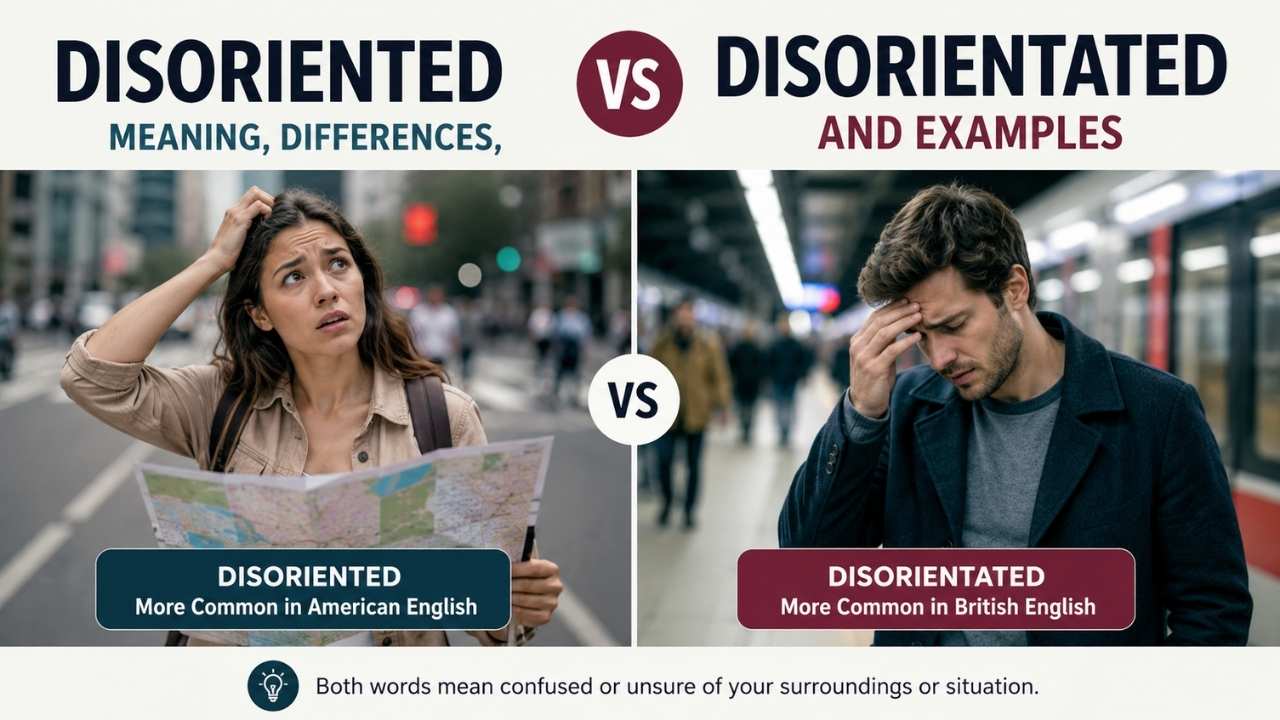
Disoriented vs Disorientated: Meaning, Differences, and Examples
Many people feel confused when they see the words “disoriented” and “disorientated” because both words look and sound similar. This often leads to questions like: “Is disorientated correct?” or “Which one should I use: disoriented or disorientated?”
The good news is that both disoriented vs disorientated are correct English words. They have the same basic meaning: feeling confused, lost, or unable to understand your surroundings, situation, or direction. The main difference comes from regional preference. Disoriented appears more often in American English, while disorientated is more common in British English and some other varieties.
In this guide, we will explain the difference between disoriented and disorientated, their meanings, correct usage, examples, and when you should choose each word. Understanding this small vocabulary difference can help you write clearer and more natural English.
Quick Answer
Yes, disoriented and disorientated mean the same thing in most situations. Both words describe a person who feels confused, uncertain, or unable to understand their position, surroundings, or circumstances.
The main difference between disoriented vs disorientated is not meaning but usage. Writers and speakers in the United States usually prefer disoriented, while people in the United Kingdom often use disorientated.
For example:
- After waking up from surgery, he felt disoriented.
- After waking up from surgery, he felt disorientated.
Both sentences are grammatically correct and communicate the same idea.
So, when someone asks, “Are disoriented and disorientated the same?”, the answer is yes. They are interchangeable in meaning, but your choice may depend on your audience and regional English style.
What Does “Disoriented” Mean?
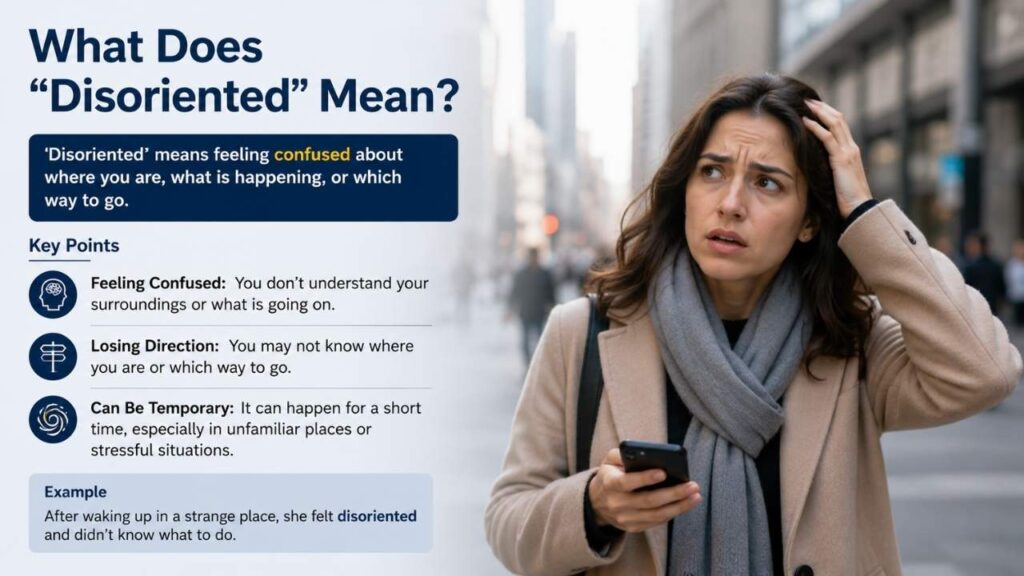
The word disoriented means feeling confused, lost, or unaware of your surroundings, position, or situation. The disoriented meaning often relates to a temporary state where someone struggles to understand what is happening around them.
The word comes from the verb “disorient,” which means to make someone lose their sense of direction or awareness.
People commonly use disoriented when talking about travel, health, emotions, or unfamiliar situations.
Examples:
- I felt disoriented after walking through the unfamiliar city streets.
- The patient became disoriented after the medication.
- She looked disoriented after hearing the unexpected news.
The term does not always mean someone is physically lost. A person can also feel mentally or emotionally disoriented when they experience sudden changes, stress, or confusion.
Because of its frequent use in American English, disoriented is the more common choice for many international readers.
What Does “Disorientated” Mean?
The disorientated meaning is the same as disoriented. It describes someone who feels confused, uncertain, or unable to understand their surroundings or situation.
The word comes from the verb “disorientate,” which has the same meaning as “disorient.” Some English speakers prefer adding the ending “-ate” because it follows a pattern found in other words, such as orientate and disorientate.
Examples:
- The sudden change in plans left him disorientated.
- She felt disorientated when she entered the unfamiliar building.
- The long journey made the travelers feel disorientated.
Many people ask, “Is disorientated a real word?” The answer is yes. Dictionaries recognize disorientated as a correct English adjective.
Although some speakers consider it less common, especially in American English, it remains a standard and accepted form, particularly in British English.
Disoriented vs Disorientated: Key Differences
The difference between disoriented and disorientated mainly depends on regional usage rather than meaning. Both words function as adjectives and describe a state of confusion or lack of awareness.
| Feature | Disoriented | Disorientated |
| Meaning | Confused or unable to understand surroundings | Confused or unable to understand surroundings |
| Grammar | Correct adjective | Correct adjective |
| Root verb | Disorient | Disorientate |
| Common usage | More common in American English | More common in British English |
| Frequency | Used more widely | Used less frequently |
When choosing between disoriented or disorientated, consider your audience. If you are writing for American readers, disoriented will usually sound more natural. If your audience follows British English, disorientated is completely acceptable.
The key point is that neither word is wrong. Both communicate the same idea clearly.
Is “Disorientated” a Real Word or a Mistake?
Many people wonder, “Is disorientated correct?” because they hear disoriented more often. However, disorientated is not a mistake. It is a recognized English word with a clear meaning.
Some speakers believe disorientated sounds unusual because American English commonly favors shorter forms. However, English often allows multiple forms of the same word. Regional preferences naturally develop over time.
For example:
- Disoriented → More common in the United States
- Disorientated → More common in the United Kingdom
Both words appear in dictionaries and professional writing.
The idea that disorientated is always wrong is a common misconception. Instead, think of it as a regional variation. The best choice depends on the type of English you are using and the readers you want to reach.
Why Do British People Say “Disorientated” Instead of “Disoriented”?
Many people ask, “Why do British people use disorientated?” The answer comes from differences in English word formation.
British English often uses verbs ending in “-ate”, such as:
- orientate
- disorientate
From these verbs, speakers naturally create the adjective disorientated.
However, British English also accepts disoriented, so both forms can appear. The preference depends on personal style, region, and context.
For example:
- The traveler became disorientated after losing the map.
- The traveler became disoriented after losing the map.
Both sentences sound correct.
Language changes naturally across countries. Just as British and American English have different spellings and vocabulary choices, they may also prefer different versions of certain words.
Why Do Americans Prefer “Disoriented”?
Americans generally prefer disoriented because it comes directly from the verb “disorient,” which is the more common form in American English.
American English often favors shorter word patterns, and disoriented has become the standard choice in everyday speech and writing.
Examples:
- The child looked disoriented after waking from a nap.
- I became disoriented while trying to find the address.
This preference does not mean disorientated is incorrect. It simply reflects common usage patterns.
When writing for American readers, choosing disoriented will usually make your writing feel more natural. However, international writers should recognize that both forms are valid and understood by English speakers worldwide.
Disorient vs Disorientate: Understanding the Root Verbs
To fully understand disoriented vs disorientated, it helps to look at their root verbs: disorient and disorientate.
Both verbs mean to confuse someone or cause them to lose their sense of direction or awareness.
| Verb | Meaning | Example |
| Disorient | To confuse or make someone lose direction | The unfamiliar environment disoriented me. |
| Disorientate | To cause confusion or uncertainty | The sudden noise disorientated the visitors. |
The adjectives follow these verbs:
- Disorient → Disoriented
- Disorientate → Disorientated
Although the forms look different, they express the same idea. Understanding the root words makes it easier to use both correctly.
Disoriented vs Disorienting vs Disorientation
These three words are related but have different uses.
Disoriented describes a person’s condition or feeling.
Example:
- She felt disoriented after the long flight.
Disorienting describes something that causes confusion.
Example:
- The unfamiliar city was disorienting at first.
Disorientation refers to the state or experience of being confused.
Example:
- The patient experienced temporary disorientation.
Understanding these differences helps you choose the correct word in different situations.
For example:
- A person can feel disoriented.
- A situation can be disorienting.
- The feeling itself is called disorientation.
These related terms expand your vocabulary and improve writing accuracy.
Common Mistakes When Using Disoriented and Disorientated
Many writers make mistakes because they assume one form must be incorrect. However, the biggest mistake is believing that disorientated is wrong.
Common mistakes include:
❌ “Disorientated is not an English word.”
✅ Disorientated is a correct and accepted English word.
❌ Using disoriented only for physical direction.
✅ You can use it for mental, emotional, and situational confusion.
❌ Mixing regional styles without reason.
✅ Choose the form that matches your audience.
Remember, disoriented and disorientated are not competing words. They are simply different versions used in different English varieties.
Using them correctly depends on understanding meaning, audience, and context.
Which Word Should You Use in Writing?
When deciding between disoriented or disorientated, consider who will read your content.
Use disoriented when:
- Writing for American audiences
- Following US English conventions
- Choosing the more common global form
Use disorientated when:
- Writing for British audiences
- Following UK English style
- Matching regional vocabulary preferences
If your audience includes international English readers, disoriented may be the safer choice because more people recognize it.
However, both forms are grammatically correct. The most important thing is consistency. Avoid switching between the two without a reason.
FAQs
Is disorientated grammatically correct?
Yes. Disorientated is grammatically correct and appears in standard dictionaries. It is especially common in British English.
Are disoriented and disorientated synonyms?
Yes. They are synonyms because both describe a feeling of confusion, uncertainty, or loss of direction.
Can I use disoriented and disorientated interchangeably?
Yes. In most situations, you can use them interchangeably. Your choice mainly depends on regional preference.
Is disoriented more common than disorientated?
Yes. Disoriented is generally more common, especially in American English and international writing.
What is the difference between disorientation and disoriented?
Disorientation is the condition of confusion, while disoriented describes the person experiencing that confusion.
Conclusion
The difference between disoriented vs disorientated is mainly about regional preference, not meaning. Both words describe a person who feels confused, lost, or unable to understand their surroundings.
Disoriented is more common in American English, while disorientated is widely used in British English and other varieties. Neither form is incorrect, and both can be used in everyday communication and formal writing.
When choosing between them, consider your audience and maintain consistency. Understanding this small difference will help you write clearer English and avoid common vocabulary mistakes.