
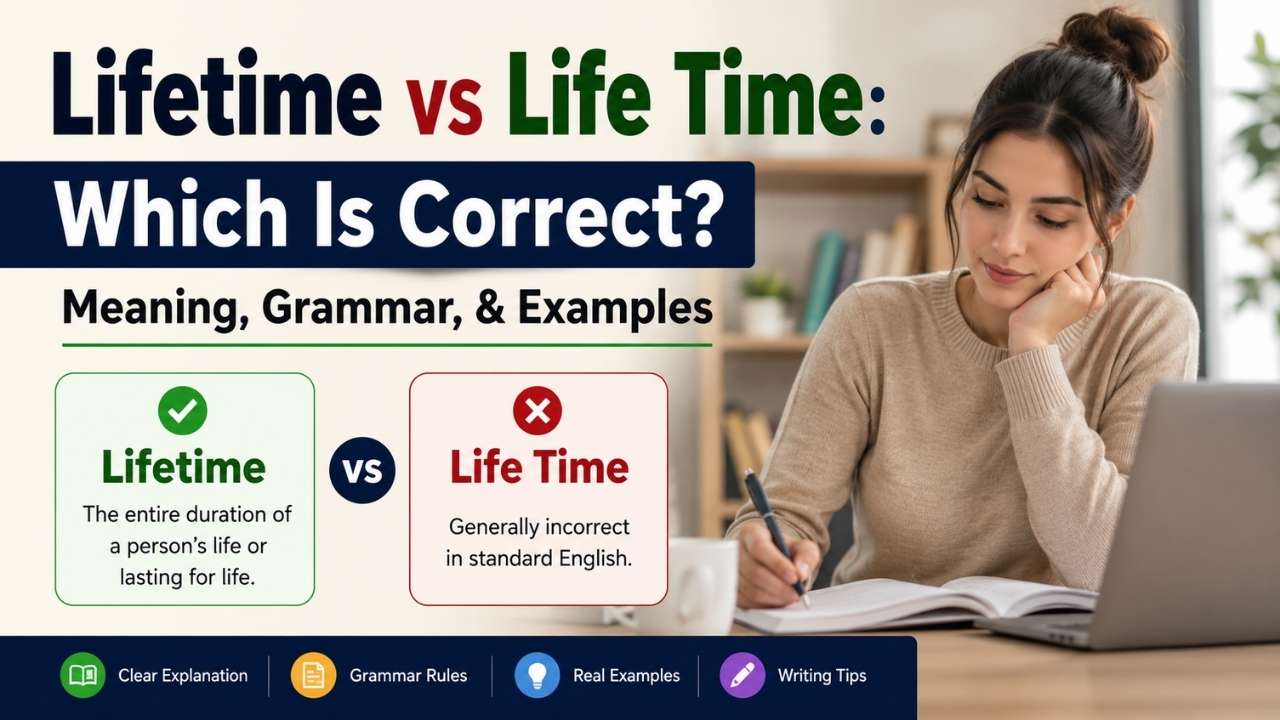
Lifetime vs Life Time: Which Is Correct? Meaning, Grammar, & Examples
Have you ever wondered whether you should write lifetime vs life time? Many English learners and even native speakers get confused because both forms seem logical at first glance. However, only one is considered the correct spelling in most situations. Understanding the difference between lifetime and life time can help you avoid common writing mistakes and improve your English grammar.
In this complete grammar guide, you’ll learn what “lifetime” means, why it is written as one word, whether “life time” is ever correct, and how to use the word confidently in everyday writing. You’ll also find clear explanations, practical examples, and simple tips to help you choose the right form every time.
Quick Answer
Lifetime is the correct spelling in almost every situation. It is a closed compound word used to describe the entire duration of a person’s life or something that lasts for life, such as a lifetime warranty, lifetime membership, or lifetime achievement award. Life time (two words) is generally incorrect in modern English and appears only in very rare or literal contexts. For most writing, always choose lifetime as one word.
Lifetime vs Life Time at a Glance
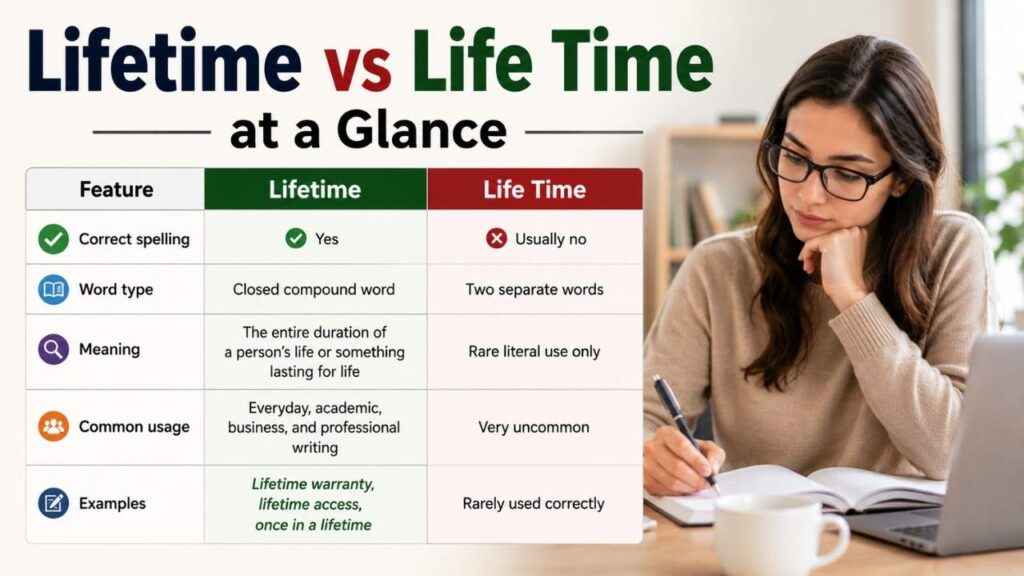
The table below gives a quick comparison between lifetime and life time to help you understand the difference at a glance.
| Feature | Lifetime | Life Time |
| Correct spelling | ✅ Yes | ❌ Usually no |
| Word type | Closed compound word | Two separate words |
| Meaning | The entire duration of a person’s life or something lasting for life | Rare literal use only |
| Common usage | Everyday, academic, business, and professional writing | Very uncommon |
| Examples | Lifetime warranty, lifetime access, once in a lifetime | Rarely used correctly |
In modern English grammar, lifetime is the accepted form. If you’re unsure which spelling to use, choose lifetime in almost every situation.
What Does “Lifetime” Mean?
The word lifetime means the whole period of a person’s life. It can also describe something that continues throughout life or lasts for as long as someone owns or uses it. For example, a lifetime membership gives benefits for life, while a lifetime warranty promises long-term protection.
Lifetime can also refer to an important period connected with a person, object, or product. You may hear phrases like lifetime achievement, lifetime opportunity, or once in a lifetime. These expressions are common in everyday English because they describe something valuable or memorable.
Learning the meaning of lifetime makes it easier to use the word correctly in both speaking and writing.
Why Is “Lifetime” Written as One Word?
Lifetime is written as one word because it is a closed compound word. A compound word forms when two separate words join together to create a new meaning. In this case, life and time combine to form lifetime, which has its own meaning in standard English.
Many English words have changed this way over time. Words like notebook, football, and sunlight also began as separate words before becoming one. The same happened with lifetime. Today, major dictionaries and style guides recognize lifetime as the standard spelling. That is why using life time in normal writing is usually considered a spelling mistake rather than a correct alternative.
Is “Life Time” Ever Correct?
In most situations, life time is not the correct spelling. If you are writing about the entire duration of a person’s life or using common expressions like lifetime warranty or lifetime access, you should always write lifetime as one word.
However, there are a few rare exceptions. In very literal or technical writing, someone may use life and time separately because each word has its own meaning in the sentence. Even then, this usage is uncommon and may sound unnatural to most readers. For everyday writing, school assignments, business documents, and professional communication, lifetime is the correct and widely accepted choice.
Lifetime as a Noun
As a noun, lifetime refers to the entire length of a person’s life or the period during which something exists or remains useful. It answers the question of how long someone lives or how long something lasts.
Examples:
- She traveled to many countries during her lifetime.
- This discovery changed medicine within his lifetime.
- The machine has a long lifetime with proper care.
In each example, lifetime names a period of time, so it functions as a noun. Understanding this grammar rule helps you use the word correctly in different sentences and avoid confusing it with the incorrect form life time.
Lifetime as an Adjective
Lifetime can also work as an adjective when it describes another noun. In this role, it tells us that something lasts for life or is connected to a person’s entire life. It usually comes before the noun it modifies.
Examples:
- We received a lifetime warranty on the product.
- She earned a lifetime achievement award.
- The company offers lifetime support to its customers.
- He bought a lifetime membership for the club.
When lifetime describes a noun, it stays as one word. Writing life time warranty or life time membership is considered incorrect in modern English. Keeping this simple rule in mind will improve your grammar and writing.
Common Expressions That Use “Lifetime”
The word lifetime appears in many common English expressions. These phrases are used in everyday conversations, advertisements, and professional writing. Since lifetime is a closed compound word, it should always be written as one word in these expressions.
Some popular examples include:
- Once in a lifetime – a rare event that may never happen again.
- Lifetime warranty – a guarantee that lasts for life.
- Lifetime membership – membership with no renewal period.
- Lifetime achievement award – an award for long-term success.
- Lifetime access – permanent access to a product or service.
- Chance of a lifetime – an unforgettable opportunity.
Learning these expressions will help you use lifetime naturally and avoid the incorrect spelling life time.
Lifetime vs Lifespan vs Lifelong
Although these words are related, they have different meanings. Knowing the difference helps you choose the right word in every sentence.
| Word | Meaning | Example |
| Lifetime | The entire period of someone’s life or something lasting for life | She saved money throughout her lifetime. |
| Lifespan | The length of time a person, animal, or object lives or exists | The average human lifespan has increased. |
| Lifelong | Lasting for a person’s whole life | Reading has been his lifelong hobby. |
Lifetime often acts as a noun or adjective, while lifelong is mainly an adjective. Lifespan usually refers to the measured length of life.
Common Mistakes Writers Make
Many writers mistakenly separate lifetime into life time because both words make sense on their own. However, in modern English grammar, this is one of the most common spelling mistakes. If you mean the entire duration of a person’s life or something that lasts for life, always write lifetime as one word.
Another mistake is confusing lifetime with lifespan or lifelong. While these words are related, they are not interchangeable. It is also incorrect to write phrases like life time warranty, life time achievement, or life time membership. Reading your work carefully before publishing can help you catch these small but important errors.
How Major Dictionaries and Style Guides Treat “Lifetime”
Leading dictionaries and style guides agree that lifetime is the standard spelling. Trusted references such as Merriam-Webster, Cambridge Dictionary, Oxford English Dictionary, and Collins Dictionary all list lifetime as a closed compound word.
These references define lifetime as the period of a person’s life or something that lasts for life. They do not recommend life time as the normal spelling because it is not accepted in everyday English.
Following dictionary guidance is a good way to improve your writing and avoid common grammar mistakes. If you are writing an essay, business document, or online article, using lifetime will match modern standard English.
Real-World Examples from Different Contexts
The word lifetime is used in many different situations, making it a useful part of everyday English.
Business: The company offers a lifetime warranty on all products.
Education: Winning the scholarship was a once in a lifetime opportunity.
Marketing: Buy today and enjoy lifetime access to all future updates.
Awards: She received a lifetime achievement award for her outstanding work.
Daily conversation: I met my best friend during my lifetime, and I will always value that friendship.
These examples show that lifetime works naturally in formal and informal writing. In every case, the correct spelling is lifetime, not life time.
FAQs
Is lifetime one word or two?
Lifetime is one word and is the correct spelling in almost every situation.
Is life time ever correct?
Only in very rare, literal contexts. Most writers should use lifetime.
Can lifetime be a noun?
Yes. It refers to the entire duration of a person’s life.
Can lifetime be an adjective?
Yes. It describes nouns like lifetime warranty or lifetime membership.
Why is lifetime one word?
Because it has become a closed compound word in modern English through common usage.
Conclusion
When comparing lifetime vs life time, the answer is clear. Lifetime is the correct spelling and the form accepted in modern English grammar. It works as both a noun and an adjective, making it useful in many situations, from everyday conversations to professional writing.
The spelling life time is rarely correct and should generally be avoided. Whether you are writing lifetime warranty, lifetime membership, lifetime achievement, or once in a lifetime, always keep the word together. Remember this simple rule: if you are talking about someone’s whole life or something that lasts for life, lifetime is almost always the right choice.