
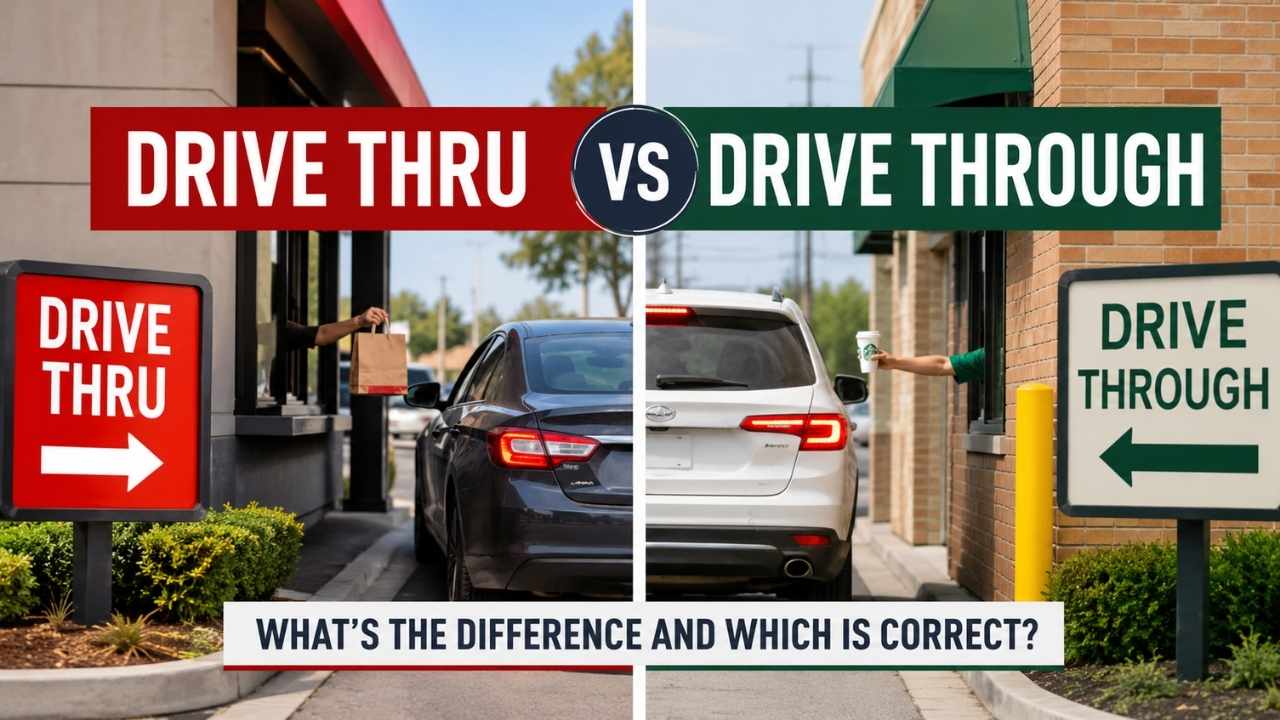
Drive Thru vs Drive Through: Which One Is Correct?
Have you ever wondered whether Drive Thru vs Drive Through is the correct spelling? If so, you’re not alone. Many people notice both versions on restaurant signage, websites, advertisements, and even in dictionaries, which often leads to confusion. You may also come across drive-through and wonder if it’s different from drive through or drive-thru.
The short answer is that all three forms exist, but they serve different purposes. Drive through is the standard spelling in formal writing, while drive-through usually works as a compound noun or compound adjective. On the other hand, Drive Thru is an informal spelling that businesses often use for branding, marketing, and commercial signage because it is shorter and easier to read.
In this guide, you’ll learn the difference between Drive Thru and Drive Through, understand the grammar rules, explore real-life examples, discover when to use each spelling, and find out why restaurants prefer “Drive Thru.” By the end, you’ll know which form fits professional writing, everyday English, and business branding with confidence.
Quick Answer
Drive Through is the correct and standard spelling in formal writing, school assignments, news articles, and professional documents. It follows standard English grammar and appears in major dictionaries and style guides. If you want clear and correct writing, drive through is the safest choice.
Drive Thru, however, is an informal spelling that many fast-food restaurants and businesses use for branding and restaurant signage. The shorter spelling is easier to read from a distance and fits better on signs, menus, and advertisements. Well-known brands use Drive Thru because it is simple, memorable, and works well in marketing.
Drive Thru vs Drive Through
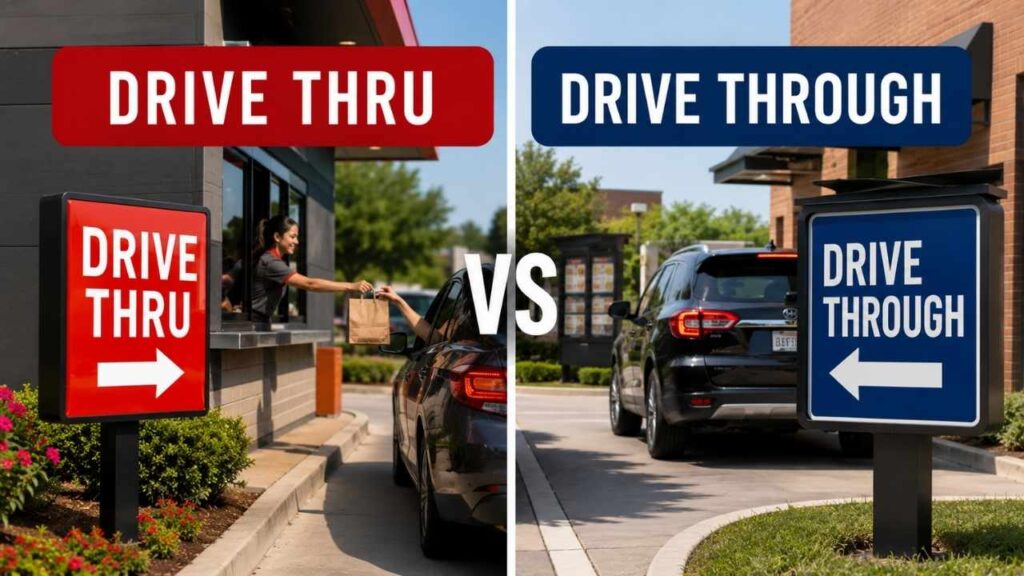
The main difference between Drive Thru and Drive Through is their usage rather than their meaning. Both describe a service that lets customers stay in their vehicle while ordering and picking up food or other items. However, they are not always suitable in the same situations.
Use Drive Through when writing essays, business documents, reports, or other forms of formal writing. It follows standard English and looks more professional. Use Drive Thru when referring to a business name, restaurant branding, or advertising. Many companies choose this spelling because it is short, eye-catching, and easy to remember.
Although the meanings are the same, choosing the correct spelling depends on whether you are writing formally or referring to a brand or sign.
Comparison Table
| Feature | Drive Through | Drive Thru |
| Meaning | A service where customers stay in their vehicle while ordering | Same meaning as Drive Through |
| Spelling | Standard English spelling | Informal spelling |
| Best For | Formal writing, reports, essays, and professional documents | Restaurant branding, signs, menus, and advertisements |
| Grammar | Preferred in standard English | Common in business branding |
| Common Usage | Books, newspapers, websites, and official documents | Fast-food restaurants and commercial signage |
| Professional Writing | ✅ Yes | ❌ No |
| Marketing & Branding | Sometimes | ✅ Very common |
| Examples | Drive through lane, drive through service | McDonald’s Drive Thru, Drive Thru Menu |
What Does Drive Through Mean?
Drive Through refers to a service that lets customers stay in their vehicle while ordering, paying for, and collecting food, drinks, medicine, or other products. It is the standard spelling in English grammar and the preferred choice for formal writing, school assignments, news articles, and business documents. In this form, drive through works as a verb phrase, describing the action of driving through a place.
You can also see drive-through with a hyphen when it acts as a compound noun or compound adjective. For example, “The drive-through was busy,” or “The restaurant has a drive-through lane.” If you are writing professionally, use drive through or drive-through, depending on the sentence. These forms follow standard English and appear in major dictionaries and editorial style guides.
What Does Drive Thru Mean?
Drive Thru has the same meaning as Drive Through, but it uses an informal spelling. Many fast-food restaurants and businesses choose this version for branding, marketing, and restaurant signage. The word “thru” is shorter than “through,” making it easier to fit on signs, menu boards, and advertisements. It is also quick for drivers to read while passing by.
Although Drive Thru is common in business names, it is not the preferred spelling in formal writing or academic work. You should avoid using it in essays, reports, or professional documents unless you are referring to a company’s official brand name. In everyday conversation and advertising, however, Drive Thru is widely accepted because it is simple, familiar, and easy to remember.
Drive Through vs Drive-Through vs Drive Thru
Many people think these three forms are the same, but each one has a different grammar role. Drive through is a verb phrase that describes an action. For example, “We will drive through the restaurant.” Drive-through is a compound noun or compound adjective. You can say, “The drive-through is open,” or “The drive-through lane is busy.”
Drive Thru is an informal spelling that businesses use for branding and commercial signage. It appears on restaurant signs because it is shorter, easier to read, and works well in marketing. If you are writing an essay or business document, choose drive through or drive-through. If you mention a restaurant’s official sign or brand, Drive Thru is the correct choice.
Which One Is Correct?
The answer depends on where and how you use it. If you are writing a school paper, business report, article, or any other type of formal writing, choose Drive Through. It follows standard English, matches most dictionary spellings, and fits professional writing. When you need a compound noun or compound adjective, use drive-through with a hyphen.
Use Drive Thru only when talking about restaurant branding, advertising, or a company’s official sign. Many well-known restaurants use this spelling because it is short, memorable, and easy to recognize. Both forms describe the same service, but they serve different purposes. Choosing the right spelling shows that you understand English usage, grammar rules, and the difference between formal language and business branding.
Why Do Restaurants Spell It Drive Thru?
Many people ask, “Why do restaurants use Drive Thru instead of Drive Through?” The main reason is branding. The word “thru” is shorter, so it fits better on restaurant signage, menu boards, and advertisements. Drivers can also read it more quickly while passing by. This makes it a smart choice for businesses that want clear and memorable signs.
Another reason is marketing. Drive Thru looks simple, modern, and easy to remember. Many fast-food restaurants use this spelling to create a friendly brand image. Although Drive Thru is popular in advertising, it is still an informal spelling. For formal writing, Drive Through remains the preferred choice because it follows standard English and most editorial style guides.
Grammar Rules You Should Know
Understanding the grammar rules makes it easy to choose the correct form. Use drive through as a verb phrase when describing an action. For example, “We drove through the restaurant to pick up dinner.” Use drive-through with a hyphen when it works as a compound noun or compound adjective. For example, “The drive-through is open,” or “The restaurant has a drive-through lane.”
Use Drive Thru only when referring to branding, business names, or commercial signage. It is not the preferred spelling in formal writing because it does not follow standard English spelling. Remember this simple rule: drive through for actions, drive-through for nouns and adjectives, and Drive Thru for brands and marketing.
Style Guide Recommendations
Most style guides and dictionaries recommend Drive Through or drive-through in formal writing. They treat through as the standard spelling in English grammar. If you are writing an essay, business document, newspaper article, or professional email, this is the safest choice.
The spelling Drive Thru is different because businesses use it as part of their branding. Many fast-food restaurants choose this version for signs and advertisements, but that does not make it the standard form for everyday writing. When you follow editorial style guides, you show clear and professional writing. A simple rule is to use Drive Through in formal situations and Drive Thru only when mentioning a company’s official name, sign, or marketing material.
Formal vs Informal Usage
Knowing the difference between formal and informal usage helps you choose the right spelling. Use Drive Through in formal writing, including school assignments, business reports, research papers, and professional websites. It follows standard English, making your writing clear and correct.
Use Drive Thru in informal settings, such as advertisements, social media posts, restaurant signs, or when referring to a company’s official branding. Many businesses prefer this spelling because it is short, attractive, and easy to read from a distance.
Before writing, ask yourself where your content will appear. If you want professional and polished writing, choose Drive Through. If you are talking about a restaurant’s sign or brand, Drive Thru is the better option. Matching the spelling to the situation improves both grammar and English usage.
Common Mistakes
Many writers confuse Drive Through, drive-through, and Drive Thru because they look similar. The biggest mistake is using Drive Thru in formal writing. Although it appears on restaurant signage, it is an informal spelling and does not fit essays, reports, or business documents.
Another common mistake is leaving out the hyphen when drive-through works as a compound noun or compound adjective. For example, write, “The drive-through is busy” or “The drive-through lane is open.” However, when you describe an action, write, “We will drive through the restaurant” without a hyphen.
Always choose the spelling based on the sentence. Following these simple grammar rules helps you write clearly and avoid common English usage mistakes.
Real-Life Examples
Looking at real-life examples makes it easier to understand the difference between these spellings. In formal writing, you might write, “The new restaurant offers a drive-through service.” If you describe an action, you can say, “We drove through the restaurant to pick up our order.”
For branding, many fast-food restaurants use Drive Thru on signs, menus, and advertisements. You may see messages like, “Drive Thru Open 24 Hours” or “Use the Drive Thru for Quick Pickup.” These examples follow the company’s official style rather than standard grammar.
The meaning stays the same in every example. The only difference is how the spelling is used. Choose Drive Through for professional writing and Drive Thru when referring to a brand or commercial sign.
Similar Word Pairs
The difference between Drive Thru and Drive Through is similar to other commonly confused words in English. For example, Through vs Thru follows the same rule. Through is the standard spelling, while thru is an informal spelling often seen on signs and in advertising.
Other examples include Everyday vs Every Day, Into vs In To, and Onto vs On To. These word pairs have different meanings or grammar rules, even though they look almost the same. Learning these differences helps you improve your English grammar and avoid simple writing mistakes.
When you understand how these words work, you can choose the correct spelling with confidence. Paying attention to small details makes your writing clearer, more professional, and easier for readers to understand.
FAQs
Which is correct: Drive Thru or Drive Through?
Drive Through is the preferred spelling in formal writing, while Drive Thru is common in branding and restaurant signage.
Is Drive Thru grammatically correct?
It is acceptable as an informal spelling and as part of a business name, but it is not the standard choice for professional writing.
Is “Thru” a real word?
Yes. Thru is a recognized alternative spelling of through, but most style guides recommend through in formal writing.
Is drive-through hyphenated?
Yes. Use drive-through with a hyphen when it acts as a compound noun or compound adjective, such as drive-through lane or drive-through service.
Can I use Drive Thru in an essay?
No. Use Drive Through instead unless you are referring to a company’s official brand name.
Conclusion
The difference between Drive Thru and Drive Through is simple once you understand their purpose. Drive Through is the standard spelling for formal writing, professional documents, and everyday English usage. When it works as a compound noun or compound adjective, use the hyphenated form, drive-through.
Choose Drive Thru only when referring to restaurant branding, advertising, or a company’s official sign. Although it is popular with fast-food restaurants, it remains an informal spelling that is best suited to marketing rather than academic or professional writing.
A simple way to remember the rule is this: Drive Through for formal communication, drive-through for nouns and adjectives, and Drive Thru for brands. Using the correct form will improve your grammar, make your writing more professional, and help readers understand your message clearly.