
Relate To or Relate With: Which Is Correct? Meaning, Grammar, & Examples
Have you ever stopped and wondered whether you should say “relate to” or “relate with”? You’re not alone. Many English learners and even fluent speakers get confused because both expressions sound similar. However, they are not used in the same way, and choosing the wrong one can make your writing or speech sound unnatural.
In modern English grammar, “relate to” is the phrase you’ll hear most often. It is widely accepted in American English, British English, business English, and academic writing. On the other hand, “relate with” appears much less frequently and is only appropriate in a few specific situations.
In this guide, you’ll learn the difference between “relate to” and “relate with,” their meanings, grammar rules, and correct usage. You’ll also discover practical sentence examples, common mistakes to avoid, and simple tips to help you choose the right phrase with confidence. By the end, you’ll know when to use “relate to,” when “relate with” may be acceptable, and which expression native speakers naturally prefer.
Quick Answer
“Relate to” is the correct and most common expression in modern English grammar. It means to understand, identify with, or feel connected to someone or something. “Relate with” is much less common and is only used in limited contexts. If you’re unsure whether to use “relate to or relate with,” choose “relate to” for everyday conversation, professional writing, and academic writing.
Relate To vs. Relate With at a Glance
If you’re unsure whether to use “relate to” or “relate with,” this quick comparison makes the choice easier. In modern English grammar, “relate to” is the correct and preferred expression in most situations. It means you understand, identify with, or feel connected to someone or something. “Relate with” is much less common and usually refers to interacting or building a relationship, though native speakers rarely use it this way today.
| Feature | Relate To | Relate With |
| Common in modern English | ✅ Yes | ❌ Rare |
| Grammatically accepted | ✅ Yes | ✅ Limited use |
| Best for daily conversation | ✅ Yes | ❌ No |
| Used in business and academic writing | ✅ Yes | ❌ Rarely |
| Preferred by native speakers | ✅ Yes | ❌ No |
What Does “Relate To” Mean?
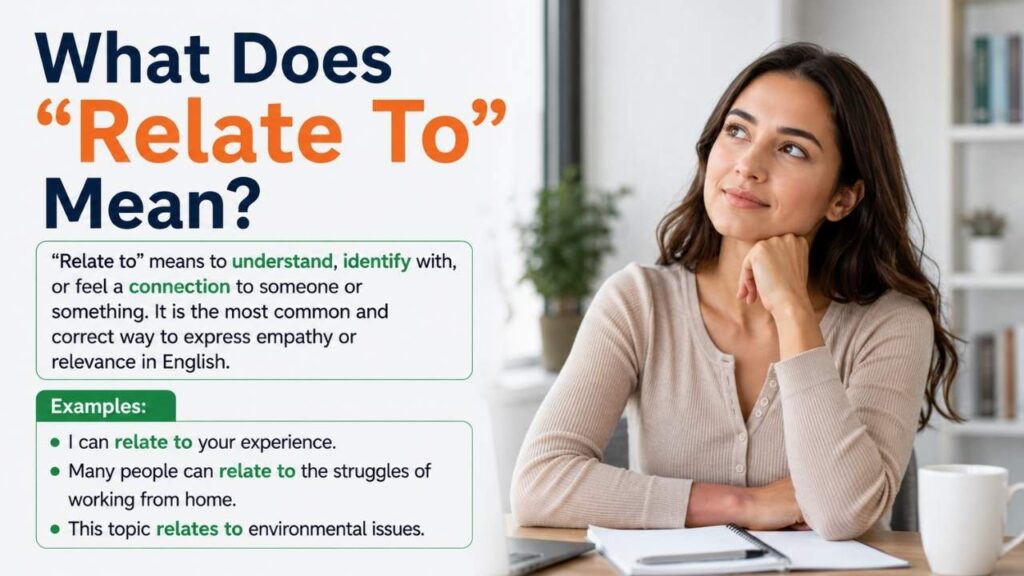
“Relate to” means to understand, identify with, or feel a connection to someone, their experiences, or a situation. It can also mean that something is connected to a particular topic or subject. This is the meaning most people use in everyday conversation, professional writing, and academic writing. Because it is the standard expression, you’ll hear it often in both American English and British English.
Here are a few examples:
- I can relate to your experience because I went through the same thing.
- This chapter relates to climate change.
- Many students relate to the challenges of online learning.
If you want to sound natural and grammatically correct, “relate to” is almost always the right choice.
What Does “Relate With” Mean?
“Relate with” is a much less common expression in modern English. It is sometimes used to describe interacting, communicating, or building a relationship with another person. However, most native speakers would still choose “relate to” instead, even in these situations. Because of this, “relate with” may sound unusual or old-fashioned in everyday speech.
For example, someone might say:
- She relates with her students in a friendly way.
Today, many people would naturally say:
- She relates to her students well.
Unless you are writing about a specific relationship or using older styles of English, “relate to” is the safer and more natural option.
What’s the Difference Between “Relate To” and “Relate With”?
The main difference between “relate to” and “relate with” is how they are used. “Relate to” means you understand, identify with, or are connected to someone or something. It is the standard phrase used by native speakers in almost every situation. “Relate with,” on the other hand, is uncommon and usually refers to interacting or forming a relationship, although this meaning is rarely used today.
Think of it this way:
- Relate to = Understand or connect with an experience.
- Relate with = Interact with someone (rare usage).
If you are writing an essay, email, or report, choosing “relate to” will almost always be the correct and more natural option.
Is “Relate With” Grammatically Correct?
Yes, “relate with” is grammatically correct, but that does not mean it is the best choice. In modern English usage, it appears far less often than “relate to.” Most dictionaries and style guides show that “relate to” is the preferred expression when talking about understanding someone’s feelings, experiences, or ideas.
You may still find “relate with” in older books, regional writing, or special contexts where it means to communicate or build a relationship. Even then, many native speakers would naturally replace it with “relate to.”
So, if you are asking “Is relate with grammatically correct?” the answer is yes—but it is rarely the most natural expression in modern English.
When Should You Use “Relate To”?
You should use “relate to” whenever you want to show that you understand, identify with, or feel connected to someone or something. It is the preferred phrase in everyday conversation, business English, professional writing, and academic writing. It is also used when discussing a topic or explaining that one thing is connected to another.
Use “relate to” in situations like these:
- I can relate to your feelings.
- This lesson relates to English grammar.
- Many parents relate to the challenges of raising teenagers.
- The report relates to last year’s sales figures.
When you’re unsure whether to choose “relate to” or “relate with,” “relate to” is the expression that sounds the most natural and correct.
When Can You Use “Relate With”?
Although “relate with” is uncommon today, there are a few situations where it may still appear. In some older books, regional varieties of English, or literary writing, it can mean to communicate with, interact with, or build a relationship with someone. Even in these cases, many native speakers now prefer “relate to” because it sounds more natural.
For example:
- The counselor relates with children through fun activities.
- Older: The counselor relates with children well.
- More natural: The counselor relates to children well.
If you’re writing for a general audience, choosing “relate to” is the safest option. It is clearer, more familiar, and widely accepted in modern English.
Relate To vs. Relate With in American and British English
In both American English and British English, “relate to” is the expression used most often. Whether you’re writing an email, preparing a report, or having a casual conversation, native speakers naturally choose “relate to.” It clearly expresses understanding, connection, or reference to a topic.
“Relate with” is much less common in both varieties of English. While you may occasionally find it in older writing or certain regional contexts, it is rarely used in modern communication.
If you want your writing to sound natural and professional, follow this simple rule:
- American English: Prefer “relate to.”
- British English: Prefer “relate to.”
This makes your grammar clear and easy for readers to understand.
Common Mistakes People Make
Many learners make small mistakes when using “relate to” and “relate with.” The most common error is replacing “relate to” with “relate with” in situations where it doesn’t sound natural. Since both phrases look similar, it’s easy to confuse them.
Here are some examples:
❌ I relate with your problem.
✅ I relate to your problem.
❌ This article relates with grammar.
✅ This article relates to grammar.
Another mistake is assuming that “relate with” is always wrong. It isn’t, but its use is very limited in modern English. When in doubt, choose “relate to.” It is the expression that native speakers use most often in everyday writing and speech.
Similar Expressions and Better Alternatives
Sometimes another expression may fit your sentence better than “relate to.” Choosing the right phrase depends on what you want to say. These alternatives are common, natural, and easy to understand.
- Identify with – to share someone’s feelings or experiences.
- Connect with – to build a relationship or communicate well.
- Resonate with – to create a strong emotional response.
- Empathize with – to understand another person’s emotions.
- Associate with – to connect one thing with another.
For example, instead of saying, “I relate to her story,” you could say, “I identify with her story,” or “Her story resonates with me.” These expressions add variety while keeping your writing clear and natural.
Real-Life Examples in Different Contexts
Understanding the difference between “relate to” and “relate with” becomes easier when you see them in real situations. In everyday English, “relate to” is the expression you’ll use almost every time.
Everyday Conversation:
I can relate to your experience.
Workplace:
Our team can relate to the client’s concerns.
School:
Many students relate to this lesson because it uses simple examples.
Academic Writing:
The research relates to language learning strategies.
While you may occasionally read “relate with” in older or special contexts, replacing it with “relate to” usually makes the sentence sound more natural. Practicing these examples will help you use the correct phrase with confidence.
FAQs
Is it “relate to” or “relate with”?
“Relate to” is the correct and preferred expression in modern English.
Is “relate with” grammatically correct?
Yes, but it is uncommon and used in only a few specific situations.
Can I say “relate with someone”?
You can, but “relate to someone” sounds much more natural and is the choice most native speakers make.
Why is “relate to” more common?
It clearly expresses understanding, connection, or reference, making it the standard phrase in modern English.
Which phrase should I use in exams or professional writing?
Always choose “relate to.” It is widely accepted in academic writing, business English, and formal communication.
Expert Tips to Remember the Difference
A simple way to remember the difference is to think about the meaning. If you want to say that you understand, identify with, or feel connected to someone or something, use “relate to.” This rule works in almost every situation.
Keep these tips in mind:
- Choose “relate to” for everyday conversations.
- Use “relate to” in business, school, and formal writing.
- Remember that “relate with” is rare in modern English.
- Listen to how native speakers use the phrase in books, podcasts, or videos.
- Practice writing your own example sentences to build confidence.
Following these simple habits will help you avoid common grammar mistakes and improve your English naturally.
Conclusion
If you’re still deciding between “relate to” and “relate with,” the answer is simple. In almost every situation, “relate to” is the better choice. It is the standard expression in modern English grammar and is widely used in American English, British English, professional writing, academic writing, and everyday conversation.
Although “relate with” is not completely incorrect, it is rare and can sound outdated or unnatural to many readers. Unless you are referring to a very specific or historical context, there is little reason to use it.
To keep your English clear, natural, and grammatically correct, remember this easy rule: when in doubt, always choose “relate to.” It’s the expression native speakers know, trust, and use every day.