
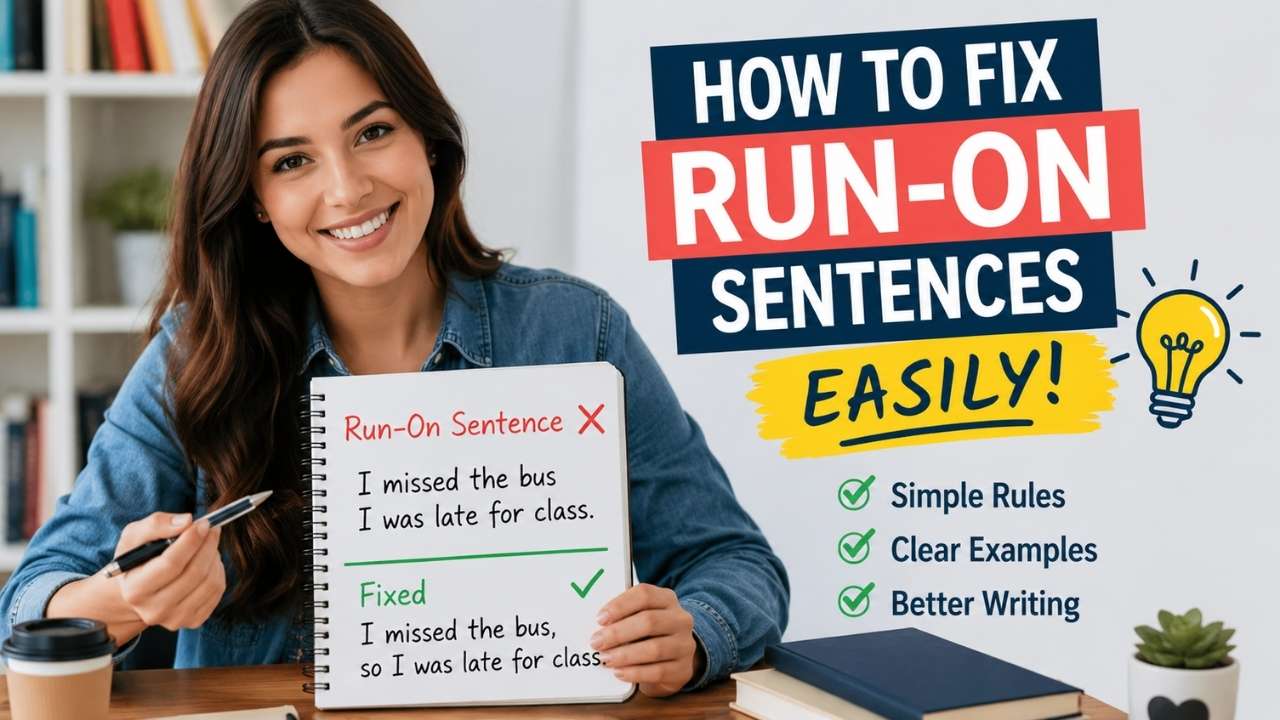
How to Fix Run-On Sentences Easily
Run-on sentences are one of the most common writing problems in English. They appear in school essays, work emails, social media posts, and even professional articles. Many writers use them without realizing it because the ideas sound correct when spoken aloud.
Learning how to fix run on sentences can make your writing clearer and easier to read. It also helps readers follow your ideas without confusion. In modern American English, shorter and more direct sentences are usually preferred, especially online.
Today, run-on sentences are everywhere because digital communication moves fast. People often type thoughts quickly and skip punctuation. However, understanding the basic rules can instantly improve your writing.
Quick Answer
If you want to learn how to fix run on sentences, separate independent ideas correctly. You can use a period, a comma with a coordinating conjunction, a semicolon, or rewrite the sentence for clarity.
TL;DR
- Run-on sentences join complete ideas incorrectly.
- A period is the simplest fix.
- Commas alone usually do not fix the problem.
- Semicolons can connect related ideas smoothly.
- Modern American writing favors shorter sentences.
- Clear punctuation improves readability and flow.
What Is a Run-On Sentence?

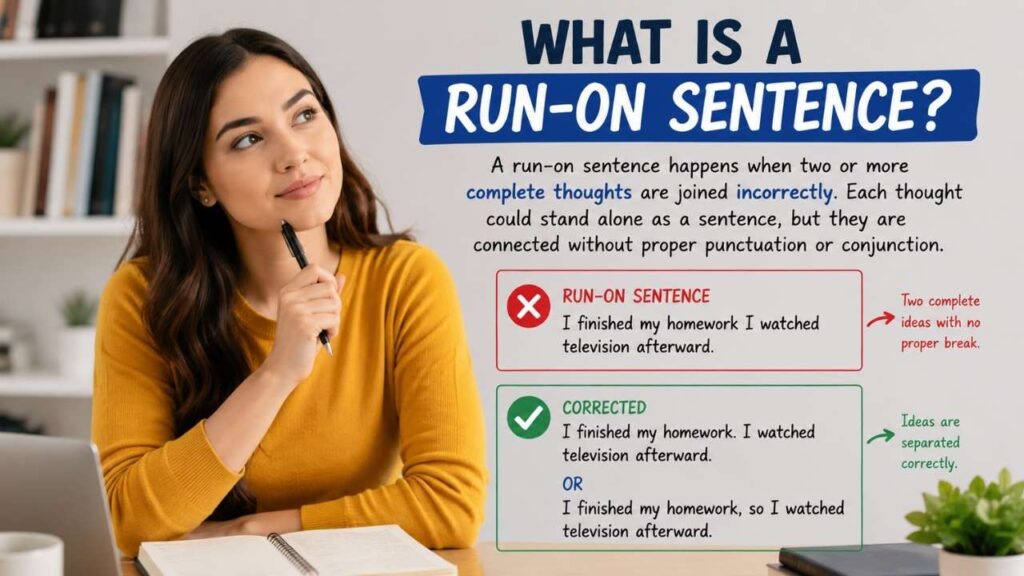
A run-on sentence happens when two or more complete thoughts are joined incorrectly. Each thought could stand alone as a sentence, but the writer combines them without proper punctuation or connection.
For example, this sentence is a run-on:
I finished my homework I watched television afterward.
Both parts are complete sentences. However, they are pushed together without a period or conjunction. Because of that, readers may pause or reread the sentence.
How Run-On Sentences Work
Run-on sentences usually contain multiple independent clauses. An independent clause has a subject and a verb and can stand alone as a complete sentence.
In spoken English, pauses and tone help listeners understand meaning. In writing, punctuation performs that job. Without punctuation, ideas blur together.
Why Writers Create Them
Many people write exactly the way they speak. Fast digital communication also encourages long strings of thoughts. Texting and social media often ignore grammar rules, so run-ons have become more common in casual writing.
However, formal American English still expects clear sentence structure. Schools, workplaces, and publishers generally treat run-on sentences as grammar mistakes.
The History of Run-On Sentences in English
Run-on sentences are not a modern invention. Early English writing often used long sentence structures with fewer punctuation rules. In fact, medieval manuscripts sometimes contained extremely long passages without periods.
During the 17th and 18th centuries, English grammar became more standardized. Printers and educators developed clearer punctuation systems. As literacy increased in Britain and later in the United States, shorter and more organized sentences became popular.
Changes in American English
American writing styles shifted strongly during the 20th century. Newspapers, advertising, and business communication encouraged concise sentences. Clear writing became associated with professionalism and education.
Today, American English values readability more than elaborate sentence length. Because of that, run-on sentences are usually corrected quickly in editing.
The Main Types of Run-On Sentences
Not all run-on sentences look the same. Some are easy to notice, while others seem almost correct.
Fused Sentences
A fused sentence joins two complete thoughts with no punctuation at all.
Example:
The weather changed suddenly we canceled the picnic.
This structure often appears in rushed writing because the pause is missing completely.
Comma Splices
A comma splice happens when a writer joins complete sentences with only a comma.
Example:
The weather changed suddenly, we canceled the picnic.
Although the comma creates a pause, it is not strong enough by itself.
Overloaded Sentences
Some sentences become run-ons because they continue too long without clear structure. Writers may add idea after idea using repeated conjunctions.
Example:
I went to the store and I bought snacks and I met my friend and we talked for hours and then we watched a movie.
This type may technically avoid grammar errors, but it still feels exhausting to read.
How to Fix Run-On Sentences Correctly
Several grammar tools can repair run-on sentences. Each method changes the flow slightly, so writers choose based on tone and style.
Use a Period
The easiest fix is creating two separate sentences.
| Context | Correct Usage | Example | Notes |
| Formal writing | Separate ideas fully | She studied hard. She passed the exam. | Very clear |
| Casual writing | Short direct sentences | I was tired. I went home early. | Natural tone |
| Related thoughts | Use a semicolon | He loves music; he plays guitar daily. | Smooth connection |
| Combined ideas | Use conjunctions | I was hungry, so I made lunch. | Common in conversation |
Using periods creates clarity immediately. American business writing especially favors this approach.
Use a Comma and Conjunction
Writers can also connect ideas with words like and, but, or so.
Example:
I was tired, so I went to bed early.
This method works well when ideas are closely connected.
Use a Semicolon
Semicolons connect related complete sentences.
Example:
The concert ended late; everyone left quietly.
In modern American English, semicolons appear more often in formal writing than casual texting.
Rewrite the Sentence
Sometimes the best fix is rewriting entirely.
Instead of:
I missed the train I called a taxi.
You could write:
After I missed the train, I called a taxi.
This method improves flow and avoids repetition.
Why Run-On Sentences Cause Problems
Run-on sentences confuse readers because they remove natural stopping points. Readers may struggle to identify where one idea ends and another begins.
In digital communication, readers scan quickly. Long unbroken sentences slow comprehension. Because of that, editors often shorten complicated sentence structures.
Effects on Clarity
Clear punctuation guides readers smoothly through information. Without it, writing can feel chaotic or rushed.
Run-on sentences may also weaken important ideas. If everything flows together endlessly, nothing stands out.
Effects in Professional Writing
In workplaces, grammar affects credibility. Emails with repeated run-ons may appear careless or unprofessional.
Academic writing also treats run-on sentences seriously because they interfere with logical organization.
How Run-On Sentences Appear in Everyday Life
Run-on sentences are common in daily communication. Many people use them naturally while texting or posting online.
Text Messages and Social Media
Online writing often ignores punctuation for speed.
Example:
im running late traffic is terrible ill be there soon
Readers usually understand the meaning because context helps. However, this style rarely appears in formal situations.
Emails and Workplace Writing
Professional communication usually requires cleaner structure.
Instead of:
I reviewed the report it needs more data.
Most editors would prefer:
I reviewed the report, and it needs more data.
School Assignments
Students often create run-ons while trying to sound sophisticated. They may believe longer sentences sound smarter.
However, teachers generally reward clarity more than sentence length.
Run-On Sentences in American vs British English
American and British English mostly share the same grammar rules for run-on sentences. Both varieties consider them errors in formal writing.
However, style preferences sometimes differ.
American Preferences
American writing often favors shorter sentences and direct wording. News writing especially avoids long sentence chains.
Because of this preference, American editors may break sentences apart more aggressively.
British Preferences
British writing occasionally tolerates slightly longer sentence structures, especially in literary styles. Even so, true run-on sentences are still corrected.
The difference is usually stylistic rather than grammatical.
Common Mistakes People Make
Many writers misunderstand punctuation rules. They may know a sentence feels wrong but choose the incorrect fix.
Using Only a Comma
This is the most common mistake.
Incorrect:
She loves coffee, she drinks it daily.
Correct:
She loves coffee, and she drinks it daily.
Overusing Conjunctions
Some writers connect too many ideas with repeated conjunctions.
Example:
I woke up and I showered and I ate breakfast and I left for work.
Although grammatically possible, this style feels repetitive.
Ignoring Sentence Rhythm
Good writing balances short and medium-length sentences. Constantly connecting ideas creates exhausting rhythm patterns.
Modern American style guides often recommend varying sentence length for readability.
How Teachers Explain Run-On Sentences Today
Grammar instruction has changed over time. Older classrooms sometimes focused heavily on memorizing rules. Today, many teachers emphasize clarity and communication.
Students now learn grammar through real examples rather than isolated drills.
Modern Classroom Approaches
Teachers often ask students to read sentences aloud. Hearing the missing pauses helps identify run-ons naturally.
Digital grammar tools also highlight sentence problems instantly. However, students still need to understand why the structure is incorrect.
Why Grammar Still Matters
Some people believe grammar rules are becoming less important online. Yet strong writing still influences school success, career opportunities, and communication skills.
Clear sentences help readers trust the writer’s message.
Run-On Sentences and Creative Writing
Creative writers sometimes break grammar rules intentionally. Novelists may use run-on sentences to show emotion, panic, excitement, or stream-of-consciousness thinking.
For example, a character experiencing fear might think rapidly without pauses.
Intentional Rule Breaking
Writers occasionally use long flowing sentences for artistic effect.
Example:
She ran through the rain she couldn’t stop she couldn’t think everything blurred together.
This technique creates urgency and emotional intensity.
Why Context Matters
Intentional run-ons differ from accidental mistakes. Skilled writers understand the rule before breaking it.
In academic or business writing, intentional run-ons are much less acceptable.
How Digital Communication Changed Sentence Structure
Technology has influenced modern grammar habits dramatically. Texting, messaging apps, and social media encourage fast communication.
Because of that, punctuation often disappears in casual writing.
Shortcuts and Informal Writing
Many younger writers grew up reading messages without periods or commas. This style feels natural online.
However, formal writing still expects proper punctuation. Switching between casual and formal styles is now an important communication skill.
Voice Typing and AI Tools
Voice typing software sometimes creates run-on sentences automatically if pauses are unclear. Editing remains necessary even with modern technology.
AI grammar tools can help detect problems, but human judgment still matters.
The Debate Around Grammar Rules
Some linguists argue that language naturally changes over time. They believe strict grammar rules should adapt to real communication habits.
Others believe punctuation rules remain essential for clarity.
Prescriptive vs Descriptive Grammar
Prescriptive grammar focuses on established rules. Descriptive grammar studies how people actually speak and write.
Run-on sentences sit between these ideas because informal communication often accepts them while formal writing rejects them.
Modern American Standards
Despite evolving language trends, most American schools and workplaces still expect traditional sentence structure. Clear punctuation remains the standard in professional contexts.
How to Recognize Run-On Sentences Quickly
Many writers struggle to identify run-ons during proofreading. However, a few habits make detection easier.
Read Aloud Slowly
Reading aloud helps reveal missing pauses. If you naturally stop between ideas, punctuation may be needed.
Look for Multiple Subjects and Verbs
Two complete thoughts often signal a possible run-on.
Example:
The movie ended everyone clapped.
Both sections contain subjects and verbs, so they likely need separation.
Check Sentence Length
Long sentences are not automatically wrong. However, very long sentences deserve closer inspection.
If readers become lost halfway through, rewriting may help.
Examples of Corrected Run-On Sentences
Seeing examples side by side helps writers understand the difference clearly.
Example One
Incorrect:
I love winter the cold weather feels relaxing.
Correct:
I love winter because the cold weather feels relaxing.
Example Two
Incorrect:
She practiced daily, she improved quickly.
Correct:
She practiced daily, and she improved quickly.
Example Three
Incorrect:
The meeting lasted hours nobody complained.
Correct:
The meeting lasted hours; nobody complained.
These examples show how punctuation changes readability immediately.
FAQs
What is the easiest way to fix a run-on sentence?
The simplest fix is adding a period between complete thoughts. This creates two clear sentences that readers can follow easily.
Are run-on sentences always grammar mistakes?
In formal writing, they are usually considered errors. However, creative writers sometimes use them intentionally for artistic effect.
What is the difference between a comma splice and a run-on sentence?
A comma splice is one type of run-on sentence. It happens when two complete thoughts are joined with only a comma.
Do run-on sentences appear in texting?
Yes, they appear constantly in digital communication. Many people skip punctuation while texting because speed matters more than grammar.
Can long sentences still be correct?
Yes, long sentences are acceptable if punctuation and structure are handled correctly. Length alone does not create a run-on sentence.
Why do students often create run-on sentences?
Students sometimes try to combine too many ideas into one sentence. They may also write the way they speak naturally.
Conclusion
Understanding how to fix run on sentences helps writers communicate clearly and confidently. Proper punctuation separates ideas so readers can follow the message without confusion.
Although run-on sentences appear frequently in texting and casual online communication, formal American English still values structure and clarity. Learning a few simple fixes can improve essays, emails, and everyday writing almost instantly.
The best approach is simple: read carefully, notice complete thoughts, and choose punctuation that matches the relationship between ideas. Over time, recognizing and correcting run-on sentences becomes natural.