
Is It Correct to Say These Data? Meaning, Grammar and Examples
Have you ever wondered, “Is it correct to say these data?” If so, you’re not alone. Many English learners, students, researchers, and professionals are confused about whether they should write “these data” or “this data.” The confusion comes from one simple question: Is data singular or plural?
Traditional grammar says that data is the plural form of datum, so “these data” and “data are” are grammatically correct. However, in modern English, many people treat data as a singular or mass noun, making “this data” and “data is” common in everyday writing.
So, which form should you use? In this guide, you’ll learn the correct use of data, understand the difference between “these data” and “this data,” explore real-life examples, and discover which form works best in academic, business, and everyday English.
Quick Answer
Yes, “these data” is grammatically correct. In traditional English grammar, data is the plural form of datum, so “these data” and “data are” are the correct choices, especially in academic writing and scientific writing. However, in modern English, data is often treated as a singular or mass noun, making “this data” and “data is” widely accepted in business writing, technology, and everyday English.
Is “Data” Singular or Plural?
One of the biggest reasons people ask “Is it correct to say these data?” is because they are unsure whether data is singular or plural. In traditional grammar, data is the plural form of datum, which means more than one piece of information.
Because of this, phrases like “these data” and “data are” are grammatically correct, especially in academic English and scientific writing. However, in modern English, many people use data as a singular or mass noun, similar to words like information.
That is why you often hear “this data” and “data is” in business, technology, and everyday conversations. Both forms are accepted today, but the right choice depends on the context and the style of writing.
“These Data” vs. “This Data”: What’s the Difference?
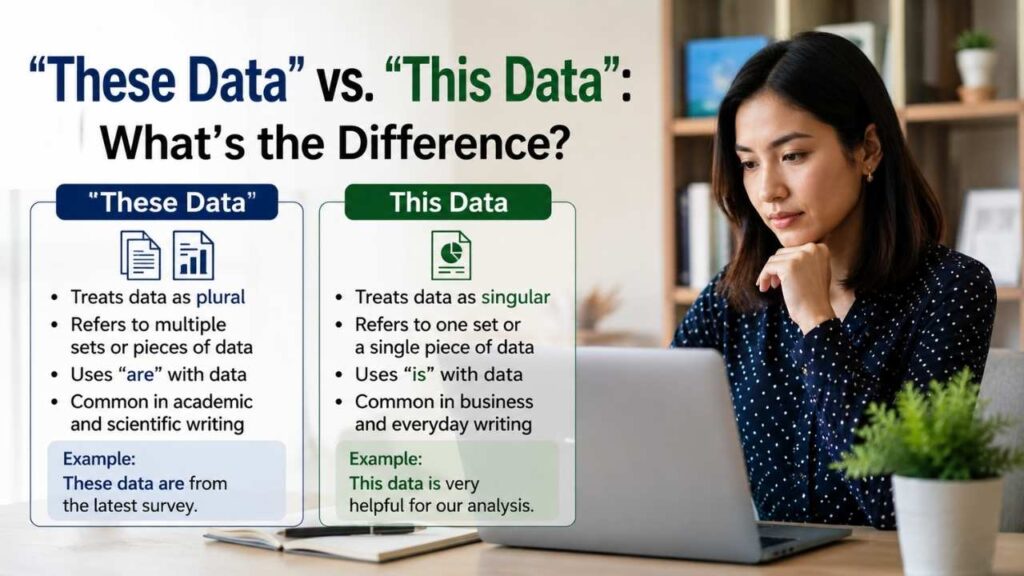
The difference between “these data” and “this data” mainly depends on how you treat the word data. If you follow traditional English grammar, data is plural, so you should write “these data” and “data are.” This style is common in research papers, scientific writing, and some formal writing.
On the other hand, if you treat data as a singular mass noun, then “this data” and “data is” are correct. This usage is very common in business writing, technology, and everyday English. If you’re unsure which form to choose, consider your audience. For formal academic work, “these data” is usually safer, while “this data” sounds more natural in daily communication.
| These Data | This Data |
| Traditional and plural | Modern and singular |
| Common in academic writing | Common in everyday English |
| Uses data are | Uses data is |
| More formal | More conversational |
Why Do People Say “This Data” If “Data” Is Plural?
Many people wonder why “this data” is so common if data is traditionally a plural noun. The answer is that English changes over time. Today, many native speakers think of data as a single collection of information instead of separate facts.
Because of this, they naturally say “this data” and “data is.” This change is especially common in business, technology, marketing, and everyday English. Even many companies and news websites prefer the singular form because it sounds simpler and more natural.
This is similar to other grammar changes in English, where common usage becomes widely accepted. Understanding these changes can also help you with similar grammar topics, such as I’ve Added vs I Added, where context affects which form is more appropriate.
When Should You Use “These Data”?
Use “these data” when you are writing in situations that follow traditional grammar rules or require a more formal style. This includes academic writing, scientific writing, research papers, and some professional reports.
Many universities, journals, and researchers still prefer treating data as a plural noun, so phrases like “these data suggest” or “data are collected” are often expected. If your audience values formal grammar, using “these data” can make your writing sound more precise and professional.
However, always check the style guide or instructions you are following, because some organizations now accept the singular form as well. Choosing the correct form depends more on context than on a single grammar rule.
When Should You Use “This Data”?
Use “this data” when writing for a general audience or in situations where modern English is preferred. It is widely accepted in business writing, technology, marketing, journalism, and everyday communication. Since many people now treat data as a mass noun, phrases like “this data shows” and “data is accurate” sound natural and are easy to understand.
If your goal is clear and friendly communication rather than strict academic grammar, “this data” is often the better choice. As with other common English expressions, usage depends on the situation.
For example, understanding tone also matters in everyday phrases like Thank You Very Much vs Thank You So Much, where both expressions are correct but fit different contexts and levels of formality.
What Do Major Style Guides Recommend?
If you’re still asking “Should I say these data or this data?”, it helps to look at major style guides. Many academic guides, such as APA and Chicago, allow both forms, but they recommend staying consistent throughout your writing. In scientific writing, many journals still prefer “these data” and “data are” because they follow the traditional rule that data is the plural of datum. However, AP Style and many business publications often treat data as a singular or mass noun, making “this data” and “data is” acceptable. The best choice depends on your audience, the type of document, and the style guide you are following.
Is “Data Is” or “Data Are” Correct?
Both “data is” and “data are” can be correct, but they are used in different situations. If you treat data as a plural noun, then “data are” is the correct choice. This is common in academic English, research writing, and many scientific fields.
If you treat data as a singular mass noun, then “data is” is correct and sounds more natural in modern English, business writing, and everyday communication.
Instead of asking which form is always right, ask yourself who will read your work. Matching your grammar to your audience is the best way to use data correctly and keep your writing clear.
Common Mistakes People Make with “Data”
Many writers make simple mistakes because they are unsure whether data is singular or plural. One common error is writing “these data is”, which mixes a plural subject with a singular verb. Another mistake is “this data are,” which does the opposite. Some people even write “datas,” but this word is not correct in standard English.
Another mistake is switching between “data is” and “data are” in the same article without a reason. To avoid confusion, choose one style and use it consistently. Whether you write “these data” or “this data,” consistency is just as important as following grammar rules.
Examples of Correct Usage
Looking at examples is one of the easiest ways to understand the correct use of data.
Academic Writing
- These data support the research findings.
- The data are collected from 500 participants.
Scientific Writing
- These data show a clear improvement.
- The data are available for further analysis.
Business Writing
- This data helps us improve customer service.
- The data is stored securely in the system.
Everyday English
- This data looks accurate.
- The data is easy to understand.
These examples show that the correct form depends on the context, not just one grammar rule.
Why Has the Meaning of “Data” Changed Over Time?
Language changes as people use it differently, and data is a good example. In the past, data was almost always treated as the plural of datum, especially in formal writing. Over time, however, people began thinking of data as one collection of information rather than many separate facts.
As a result, “this data” and “data is” became common in modern English. Today, both forms are widely accepted, although academic and scientific writing often keep the traditional plural usage. This change does not mean the old rule is wrong. It simply shows how English evolves to match the way people naturally communicate.
Quick Decision Guide: Which One Should You Use?
If you’re unsure which form to choose, use this simple guide.
| Situation | Best Choice |
| Academic papers | These data |
| Scientific journals | These data |
| Research reports | These data |
| Business writing | This data |
| Marketing content | This data |
| Technology articles | This data |
| Everyday English | This data |
A simple rule to remember is this: if you’re writing for a formal academic audience, “these data” is usually the safer option. If you’re writing for the general public, “this data” is often more natural and easier to read.
FAQs
Is it correct to say “these data”?
Yes. “These data” is grammatically correct because data is traditionally the plural form of datum.
Is data singular or plural?
It can be both. In traditional grammar, it is plural. In modern English, it is often treated as a singular mass noun.
Should I say “this data” or “these data”?
Use “these data” in academic or scientific writing. Use “this data” in business writing and everyday English.
Is “datum” still used today?
Yes, but mostly in scientific, technical, and research fields. In everyday English, most people simply use data.
Can I use “this data” in formal writing?
Yes, if the style guide or organization accepts it. Just make sure you stay consistent throughout your document.
Conclusion
So, is it correct to say “these data”? Yes, it is. In traditional English grammar, data is the plural of datum, making “these data” and “data are” the correct choice, especially in academic and scientific writing. At the same time, modern English widely accepts “this data” and “data is” because data is often treated as a singular mass noun.
Neither form is always wrong—the best choice depends on your audience, writing style, and purpose. When in doubt, follow your organization’s style guide and use the same form consistently. Clear, consistent writing will always make a stronger impression than focusing on one grammar rule alone.