
Affect vs Effect │ Easy Difference, Definitions + Examples (2026)
Many English learners and native speakers struggle with affect vs effect because the words sound similar and often appear in related situations. However, they usually play different roles in a sentence.
Today, this pair remains one of the most searched grammar questions in American English. You’ll see these words in emails, school writing, business reports, news articles, texting, and social media posts. Because both words connect to change or results, confusion is common.
The good news is that the difference becomes much easier once you understand how each word works in a sentence. In most cases, one is a verb and the other is a noun.
Quick Answer
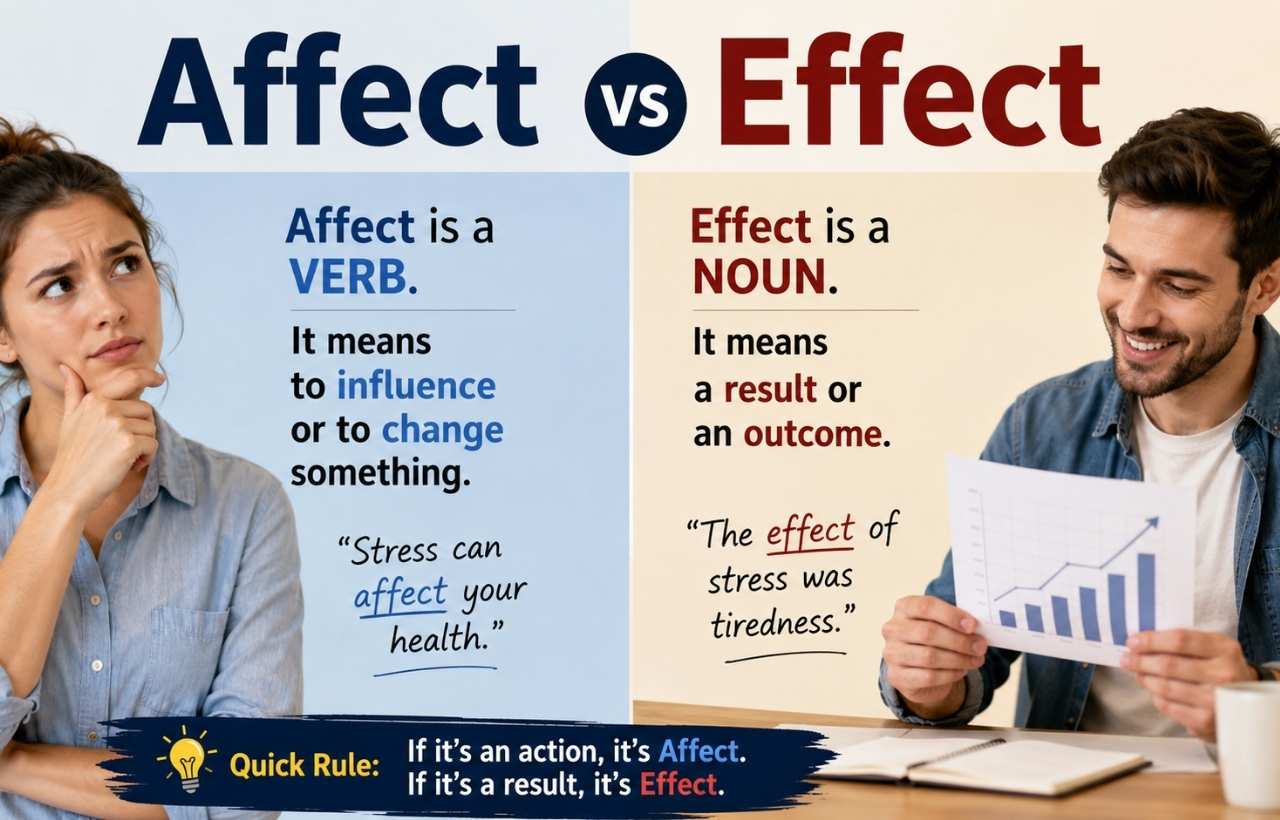
In the affect vs effect debate, affect is usually a verb meaning “to influence,” while effect is usually a noun meaning “a result or outcome.”
For example:
- “Stress can affect sleep.”
- “The effect of stress was obvious.”
TL;DR
- Affect usually means “to influence.”
- Effect usually means “a result.”
- Affect is commonly a verb in American English.
- Effect is commonly a noun in both formal and casual writing.
- Rare exceptions exist, especially in psychology and formal language.
- Most everyday English follows the simple verb-versus-noun rule.
What Affect and Effect Mean

People often confuse these words because they both describe change. However, they work differently in sentence structure.
What Does “Affect” Mean?
In modern American English, affect usually functions as a verb. It describes an action that changes, influences, or impacts something.
For example, weather can affect travel plans. Noise can affect concentration. Social media can affect mood.
The key idea is influence. Something happens that changes another thing in some way.
What Does “Effect” Mean?
Effect is usually a noun. It refers to the result that comes after a change or action.
For example, a medicine may have side effects. A new law may have positive effects on traffic safety. A teacher’s encouragement may have a lasting effect on students.
Here, the focus is not the action itself. Instead, the focus is the outcome.
The Core Rule at a Glance
The easiest way to remember these words is through their sentence roles.
| Word | Usually Functions As | Main Meaning | Example |
| Affect | Verb | To influence | “Cold weather affects mood.” |
| Effect | Noun | A result or outcome | “The effect was immediate.” |
This rule works in most everyday situations. Because of that, many teachers and style guides still recommend it as the fastest memory tool.
However, English also contains exceptions. Those exceptions appear less often, but they still matter in advanced writing and specialized fields.
The History of Affect and Effect
These words entered English through Latin and later French. Interestingly, both developed from related roots connected to action and influence.
Latin Origins
Affect comes from the Latin word afficere, which meant “to influence” or “to act upon.” The idea of emotional or physical impact remained part of the word as English evolved.
Effect comes from the Latin effectus, meaning “accomplishment” or “result.” Even centuries later, English still uses the word with nearly the same meaning.
Because both words grew from related ideas, their overlap makes historical sense.
How Usage Changed Over Time
In older English writing, the boundaries between these words were sometimes less strict. Writers occasionally used effect as a verb more freely than today.
Over time, American English became more standardized. Schools, newspapers, and publishing guides pushed clearer distinctions between the two words. As a result, the modern verb-versus-noun pattern became dominant.
Today, that pattern remains the standard in most American writing.
How Americans Use Affect and Effect Today
Modern American English strongly favors the traditional distinction.
Everyday Speech
In casual speech, people often use these words correctly without thinking about grammar rules. Native speakers naturally say things like:
“Will this affect my grade?”
“The new schedule had a good effect.”
However, confusion appears more often in writing because people must choose the correct spelling.
Workplace and Academic Writing
Formal writing in the United States usually follows strict usage standards. Business reports, college essays, and professional emails nearly always use:
- affect as a verb
- effect as a noun
Because of that, mixing them up can make writing seem less polished.
For example:
“Budget cuts affected hiring.”
“The effect of inflation increased costs.”
These patterns appear constantly in American news and business communication.
Affect as a Verb
Understanding affect becomes easier when you focus on action.
Affect Shows Influence
When one thing changes another thing, affect usually fits.
For example:
“Lack of sleep affects memory.”
“Rain affected the baseball game.”
“Online reviews affect customer choices.”
In each sentence, something creates influence or change.
Sentence Position
Because affect is commonly a verb, it usually appears after the subject.
For example:
“Stress affects performance.”
Here, “stress” performs the action. “Affects” explains what stress does.
This structure helps readers quickly identify the correct word.
Effect as a Noun
Unlike affect, effect usually names a thing rather than an action.
Effect Means Result
An effect is what happens after something changes.
For example:
“The effect was surprising.”
“One effect of exercise is better sleep.”
“The movie’s special effects looked realistic.”
In all these examples, effect identifies a result or produced condition.
Common Phrases With Effect
American English uses many standard expressions with effect.
People often say:
- “side effects”
- “cause and effect”
- “take effect”
- “in effect”
These phrases appear frequently in medicine, law, education, and news reporting.
Rare Exceptions Most People Don’t Learn
English grammar includes a few unusual exceptions that confuse even advanced writers.
When “Effect” Is a Verb
Although uncommon, effect can function as a verb meaning “to bring about” or “to cause.”
For example:
“The committee hopes to effect change.”
This usage sounds formal and appears mostly in legal, political, or academic writing.
In everyday American English, many people avoid this form because it sounds stiff or old-fashioned.
When “Affect” Is a Noun
In psychology, affect can be a noun describing emotional expression.
For example:
“The patient showed little affect.”
Mental health professionals may use this meaning in clinical settings. However, average daily conversation rarely uses affect this way.
Because these exceptions are uncommon, beginners should first master the standard rule.
Affect vs Effect in Real-Life Communication
Grammar becomes easier when connected to daily situations.
Emails and Workplace Messages
Professional communication often uses these words when discussing change, results, or performance.
For example:
“The delay may affect delivery times.”
“The effect on customer service was noticeable.”
Clear usage helps workplace writing sound more confident and precise.
Texting and Social Media
Informal digital communication sometimes ignores strict grammar rules. Even so, many users still notice mistakes involving these words.
Because spellcheck tools cannot always catch word-choice errors, writers often confuse them online.
For example:
- Incorrect: “That effected my mood.”
- Correct: “That affected my mood.”
Today, grammar discussions about these words regularly appear on TikTok, Reddit, and language forums.
Common Mistakes and Why They Happen
Most confusion comes from pronunciation and meaning overlap.
Similar Sound, Different Job
The two words sound close in many American accents. Also, both relate to change and consequences.
Because of that, writers sometimes focus only on meaning instead of sentence structure.
However, asking one simple question often solves the problem:
“Is this word doing an action or naming a result?”
That approach works surprisingly well.
Confusing Verb and Noun Roles
Many mistakes happen because writers forget to identify the grammatical role.
For example:
- Incorrect: “The storm had a bad affect.”
- Correct: “The storm had a bad effect.”
Here, the sentence needs a noun because it names a result.
Meanwhile:
- Incorrect: “The storm effected travel.”
- Correct: “The storm affected travel.”
This sentence needs a verb because the storm performs an action.
British vs American Usage
American and British English generally follow the same grammar rules for these words.
Shared Standard Rules
Both language varieties usually treat:
- affect as a verb
- effect as a noun
Because of that, international English learners rarely need separate rules for the USA and the UK.
Minor Style Differences
British writing may sometimes preserve slightly more formal wording in academic or government contexts. However, everyday usage remains nearly identical.
Modern internet communication has also reduced many regional grammar differences.
How Grammar Experts View the Debate Today
Most grammar experts agree that the traditional distinction remains useful and clear.
Why the Rule Still Matters
Some language rules change over time. However, the difference between affect and effect still helps readers understand meaning quickly.
Clear distinctions reduce confusion in professional and academic writing.
Because of that, style guides continue teaching the standard pattern.
Evolving Language and Flexibility
At the same time, linguists recognize that real language use changes naturally. Some writers occasionally blur the line in casual communication.
Still, the standard distinction remains dominant in edited American English.
For most situations, following the traditional rule is the safest choice.
Memory Tricks That Actually Help
Simple memory tools can make these words easier to remember.
The “A” and “E” Trick
Many students use this pattern:
- Affect = Action
- Effect = End result
Both words begin with matching letters, which helps people remember their roles.
The Sentence Test
You can also test the sentence by replacing the word.
If “influence” fits, use affect.
If “result” fits, use effect.
For example:
“The weather affected traffic.”
“The result of the storm was severe.”
These substitutions often reveal the correct answer immediately.
Why This Pair Still Confuses Native Speakers
Even fluent English speakers make mistakes with these words.
English Contains Many Similar Pairs
English has many confusing word pairs, including:
- than vs then
- its vs it’s
- compliment vs complement
Because spelling and pronunciation don’t always match perfectly, confusion becomes normal.
School Rules vs Natural Speech
People rarely pause during conversation to analyze grammar structure. Instead, they rely on instinct.
Writing slows the process down. As a result, people become more aware of uncertainty.
That’s why grammar checkers frequently flag these two words.
FAQs
Is affect always a verb?
No. In psychology, affect can be a noun describing emotional expression. However, everyday American English usually treats it as a verb.
Is effect always a noun?
No. Effect can sometimes be a verb meaning “to bring about.” Still, this use is formal and uncommon.
Which word is more common in daily speech?
Both appear often, but affect commonly appears in actions while effect appears in results. Their frequency depends on context.
Why do grammar checkers miss these mistakes?
Spellcheck tools mainly check spelling, not sentence meaning. Since both words are real English words, software may miss the error.
Do Americans and British speakers use these words differently?
Not very differently. Both varieties mostly follow the same grammar rule.
Is “cause and affect” correct?
Usually no. The standard phrase is “cause and effect” because the second word names the result.
Conclusion
Understanding affect vs effect becomes much easier once you focus on sentence function. In most modern American English, affect acts as a verb meaning “to influence,” while effect acts as a noun meaning “a result.”
Although English includes a few rare exceptions, everyday writing usually follows this simple pattern. That’s why professional editors, teachers, and style guides still recommend the traditional distinction.
The next time you feel uncertain, look at the word’s role in the sentence. If it shows action, affect is probably correct. If it names a result, effect likely fits best.