
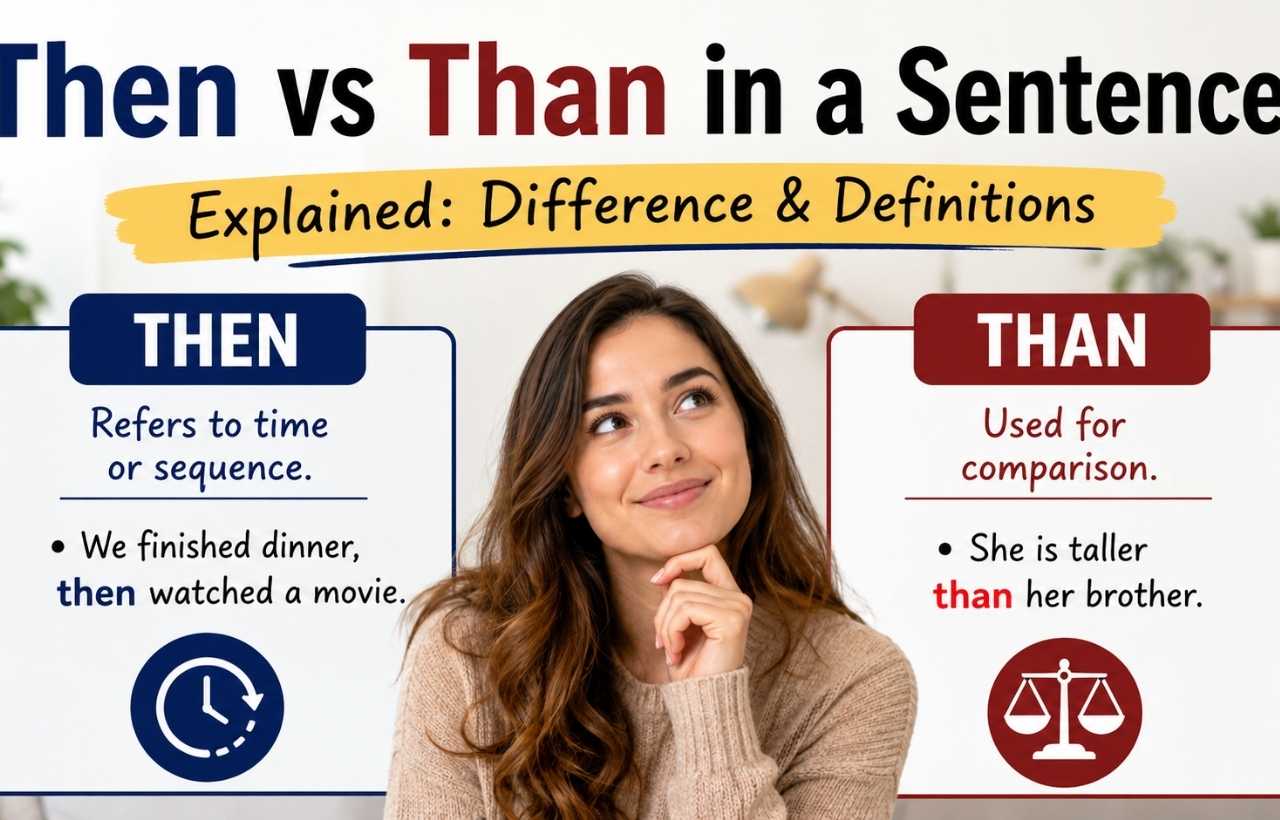
Then vs Than in a Sentence Explained: Difference & Definitions
Many English learners mix up “then” and “than” because the words look and sound similar. However, they serve very different purposes in grammar. Understanding then vs than in a sentence helps your writing sound clearer and more natural.
Today, these two words appear everywhere. People use them in emails, school essays, text messages, and social media posts. Even native English speakers sometimes confuse them when typing quickly.
The good news is that the difference is simple once you understand the role each word plays. One relates to time or sequence, while the other relates to comparison.
Quick Answer
When using then vs than in a sentence, remember this simple rule: “than” is used for comparisons, while “then” relates to time, order, or results.
For example:
- “She is taller than her brother.”
- “We ate dinner, then watched a movie.”
TL;DR
- “Than” compares two things.
- “Then” usually refers to time or sequence.
- “Than” often follows comparative words like “better” or “smaller.”
- “Then” can mean “next,” “afterward,” or “in that case.”
- Native speakers still confuse these words in casual writing.
- American English follows the same core rule as British English.
What Then and Than Mean
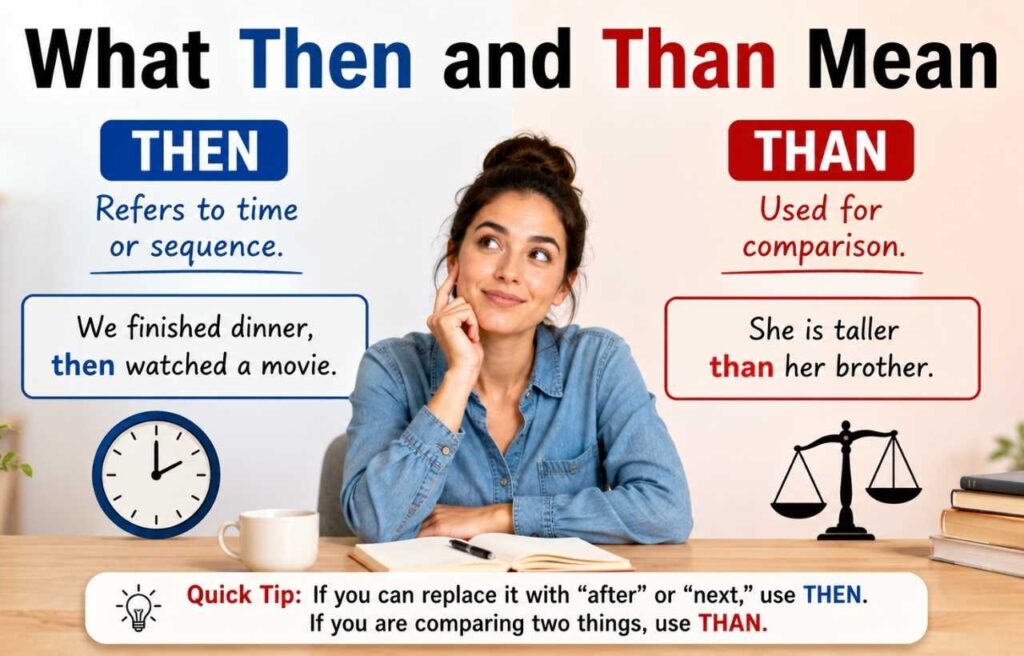
The words “then” and “than” may differ by one letter, but their meanings are completely different. Because of this, using the wrong one can confuse readers.
What “Than” Means
“Than” is a conjunction or preposition used to compare things. It usually appears after comparative adjectives or adverbs.
For example, people say:
“Coffee is stronger than tea.”
In this sentence, “than” connects two things being compared. Without it, the comparison feels incomplete.
You’ll often see “than” after words like “more,” “less,” “better,” “worse,” “older,” and “faster.” Because comparison is its main job, “than” rarely appears outside that role.
What “Then” Means
“Then” usually relates to time, sequence, or consequence. It tells readers what happens next or what happened at another time.
For example:
“We finished work, then went home.”
Here, “then” shows order. One action happened after another.
Sometimes “then” also means “in that case.” For example:
“If you’re tired, then go to bed.”
In modern English, this use remains common in conversation and writing.
The Core Grammar Rule at a Glance
The easiest way to remember these words is to connect them with their purpose.
Use “Than” for Comparisons
If you compare two people, ideas, places, or actions, use “than.”
Examples include:
“He runs faster than I do.”
“This movie is better than the first one.”
The comparison may involve size, quality, speed, amount, or preference.
Use “Then” for Time or Order
If something happens next, later, or afterward, use “then.”
Examples include:
“First mix the flour, then add the eggs.”
“We lived in Chicago back then.”
Because “then” often relates to time, many teachers connect it to the word “when.” Both words contain the letter “e.”
The History of Then and Than
English has changed greatly over centuries, and these words developed from older forms in Germanic languages.
Early Origins in Old English
The word “then” comes from Old English forms connected to time and sequence. Early speakers used it to show when events happened.
Meanwhile, “than” developed from forms used in comparisons. In older English, the distinction between the two words was less fixed than it is today.
During Middle English, spelling variations were common. Writers often spelled words differently because standard dictionaries did not yet exist.
How the Meanings Became Separate
Over time, English grammar became more standardized. Printers, dictionaries, and schools helped separate the functions of “then” and “than.”
By the eighteenth and nineteenth centuries, grammar guides strongly emphasized the difference. Modern English now treats them as completely separate words with distinct grammatical roles.
Then vs Than in American English
In the United States, both words follow the same grammar rules taught in schools nationwide. However, confusion still happens often in casual writing.
Everyday Spoken English
In speech, “then” and “than” may sound similar depending on accent and speed. Because of this, listeners usually rely on context.
For example:
“She’s smarter than me.”
“Finish your homework, then relax.”
Even if pronunciation varies slightly, the meaning remains clear from sentence structure.
Digital Communication and Fast Typing
Today, many mistakes appear because people type quickly on phones or computers. Autocorrect can also create problems.
On social media, someone might accidentally write:
“I’d rather stay home then go out.”
Most readers still understand the intended meaning. However, formal writing requires the correct word.
In professional emails or academic work, mixing them up may make writing appear careless.
Common Sentence Patterns With Than
Understanding common patterns makes “than” much easier to use correctly.
Comparative Adjectives
The most common structure uses comparative adjectives followed by “than.”
Examples include:
- “My car is newer than yours.”
- “Winter feels colder than fall.”
- “This test was easier than expected.”
In each sentence, two things are compared directly.
Comparative Adverbs
“Than” also follows comparative adverbs.
For example:
“She speaks more clearly than before.”
The comparison here involves how an action happens rather than describing a noun.
Expressions of Preference
Americans often use “than” when expressing preferences.
For example:
“I’d rather read than watch television.”
This structure appears frequently in conversation.
Common Sentence Patterns With Then
“Then” appears in several sentence types connected to time or consequence.
Sequence and Order
One major use shows steps happening in order.
For example:
“Brush your teeth, then go to bed.”
Recipes and instructions often use this structure because it guides readers through steps.
Referring to a Past Time
Sometimes “then” refers to a specific period in the past.
For example:
“We were living in Texas back then.”
This use is common in storytelling and conversation.
Cause and Result
“Then” may also introduce a result.
For example:
“If the store is closed, then we’ll come back tomorrow.”
This structure appears in both formal and informal English.
Why People Confuse Then and Than
The confusion comes from several factors working together.
Similar Spelling
The words differ by only one letter. Because of this, quick readers and writers often overlook the difference.
Similar Pronunciation
In many American accents, unstressed vowel sounds become softer. As a result, “then” and “than” can sound alike in rapid speech.
Typing Habits
Modern communication encourages speed. People text quickly, edit less carefully, and rely on autocorrect tools.
Because both words are valid English words, spellcheck programs may not catch the mistake.
Common Mistakes and How to Fix Them
Many errors follow predictable patterns. Recognizing them helps writers avoid future mistakes.
| Context | Correct Usage | Example | Notes |
| Comparison | than | “She is taller than him.” | Comparing two people |
| Sequence | then | “We ate, then left.” | Shows order |
| Preference | than | “I’d rather drive than walk.” | Shows choice |
| Result | then | “If it rains, then stay inside.” | Shows consequence |
| Past time | then | “Life was different back then.” | Refers to earlier time |
Mistake: Using “Then” After Comparative Words
Incorrect:
“He is smarter then me.”
Correct:
“He is smarter than me.”
Because the sentence compares two people, “than” is required.
Mistake: Using “Than” for Sequence
Incorrect:
“We cleaned the kitchen than watched TV.”
Correct:
“We cleaned the kitchen, then watched TV.”
Here, the sentence describes actions happening in order.
Formal vs Informal Usage
The grammar rules stay mostly the same across formal and informal English. However, style and tone can affect sentence structure.
Formal Writing
In academic or business writing, writers usually follow standard grammar closely.
For example:
“The second proposal was more effective than the first.”
Formal writing also avoids incomplete comparisons.
Informal Conversation
Casual speech allows more flexibility.
Someone may say:
“She’s older than me.”
Traditional grammar books once preferred:
“She’s older than I am.”
Today, the shorter version sounds natural in everyday American English.
British and American Differences
American and British English generally treat “then” and “than” the same way. However, pronunciation may differ slightly.
Pronunciation Differences
Some British accents pronounce “than” with a broader vowel sound. In contrast, many Americans use a softer vowel in quick speech.
Still, grammar usage remains consistent across regions.
Writing Standards
Both American and British grammar guides teach the same distinction:
- “Than” for comparison
- “Then” for time or sequence
Because of this, learners can apply the same rule in both varieties of English.
Then and Than in Modern Online Communication
Digital writing has changed how people notice grammar mistakes.
Social Media and Texting
On platforms like texting apps or social networks, people often prioritize speed over accuracy. Small grammar errors appear more frequently there.
However, readers still notice repeated mistakes. Using the correct word can make writing look more polished and thoughtful.
Memes and Internet Humor
Online jokes often play with the confusion between these words. Some memes intentionally misuse them for humor.
Even so, standard English still treats the words differently in professional settings.
Gray Areas and Grammar Debates
Some grammar questions related to “than” remain debated among writers and teachers.
“Than Me” vs “Than I”
Both forms appear in modern English.
“She is taller than me” sounds natural in conversation. Meanwhile, “She is taller than I am” sounds more formal.
Most modern American grammar experts accept both forms depending on context and tone.
Elliptical Comparisons
English often leaves out repeated words after “than.”
For example:
“He works harder than his brother.”
The sentence technically omits “does,” but native speakers understand the meaning easily.
How Usage Has Changed Over Time
English grammar continues evolving, especially in spoken communication.
Greater Acceptance of Informal Structures
Older grammar books sometimes treated conversational forms as incorrect. Today, many modern style guides recognize natural spoken English more openly.
For example, “than me” is now widely accepted in everyday American English.
Increased Visibility of Mistakes
Digital communication exposes people to more writing than ever before. Because of this, grammar mistakes spread more visibly online.
At the same time, grammar awareness has also grown. Many people actively search for explanations of confusing word pairs like these.
Real-Life Examples of Then vs Than
Seeing these words in realistic situations helps the rule feel natural.
Workplace Communication
In an email:
“This option costs less than the previous plan.”
In instructions:
“Submit the form, then wait for confirmation.”
School and Academic Writing
Students often use comparisons in essays.
For example:
“The novel was more emotional than the film adaptation.”
They also use sequence words during explanations:
“First gather evidence, then write your conclusion.”
Everyday Conversation
People naturally use these words dozens of times daily.
For example:
“I’d rather cook than order takeout.”
“We’ll stop at the store, then head home.”
These patterns become automatic with practice.
FAQs
Is “than” only used for comparisons?
Yes, almost always. “Than” mainly connects two things being compared. If no comparison exists, “than” is usually incorrect.
Can “then” mean something other than time?
Yes. It can also show consequence or logical result. For example: “If that’s true, then we need a new plan.”
Why do native speakers confuse then and than?
The words look and sound similar. Also, fast typing and autocorrect often create mistakes in casual writing.
Is “better then” ever correct?
Usually no. Because “better” creates a comparison, it should almost always be followed by “than.”
Correct example:
“This pizza is better than the other one.”
Which is more formal: “than me” or “than I am”?
“Than I am” sounds more formal and traditional. However, “than me” is extremely common in modern American English.
Do grammar checkers always catch these mistakes?
Not always. Since both words are spelled correctly, software may miss the error if the sentence still appears grammatically possible.
Conclusion
Understanding then vs than in a sentence becomes much easier once you focus on their jobs in grammar. “Than” compares things, while “then” relates to time, order, or results.
Although the words sound similar, their sentence roles are completely different. That’s why choosing the correct one matters in both casual and professional writing.
With regular reading and practice, the difference soon feels natural. When in doubt, ask yourself one question: are you comparing something, or describing what happens next?