
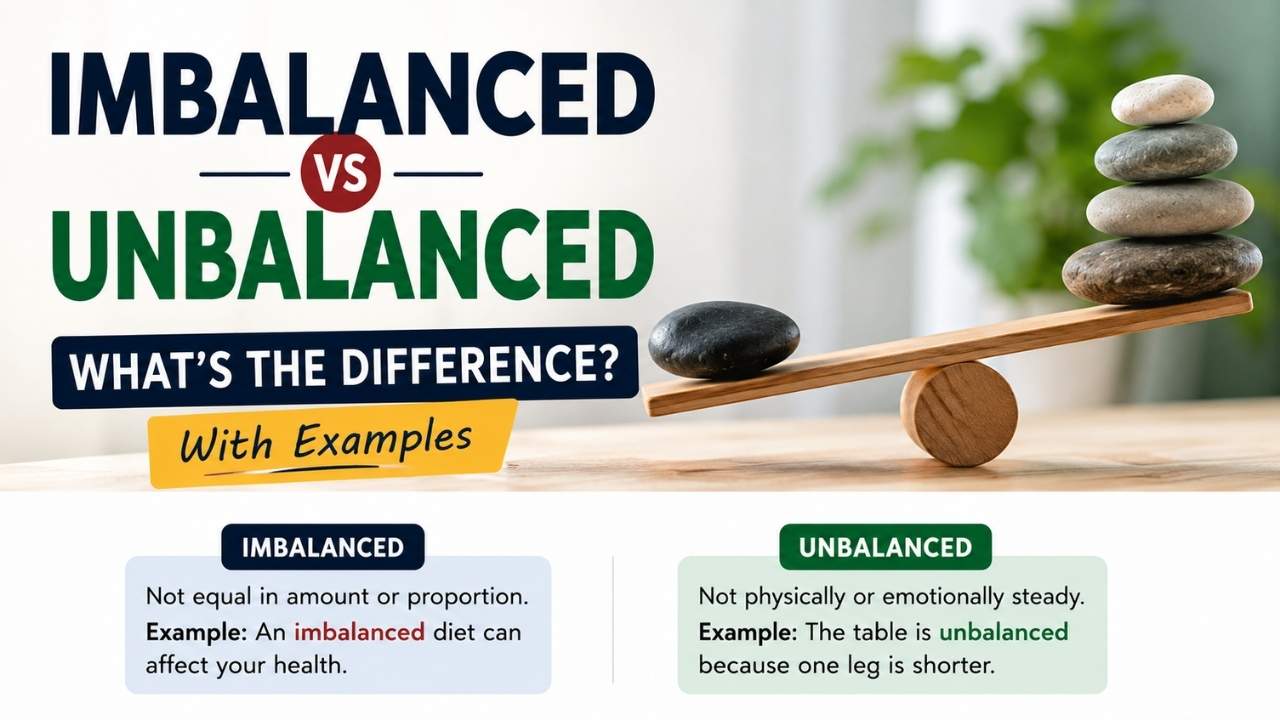
Imbalanced vs Unbalanced: What’s the Difference? With Examples
Many English learners wonder about the difference between imbalanced vs unbalanced because both words relate to the idea of something not being balanced. At first glance, they seem interchangeable, but they are not always used in the same situations. Choosing the right word depends on the meaning, context, and the message you want to communicate.
In general, imbalanced describes something that is unequal, disproportionate, or lacking the right balance, such as an imbalanced diet, an imbalanced workload, or an imbalanced economy. In contrast, unbalanced often refers to something that is physically unstable, emotionally unstable, or off balance, such as an unbalanced chair, an unbalanced load, or an unbalanced person.
In this guide, you’ll learn the difference between imbalanced and unbalanced, discover when to use each word, explore real-life examples, avoid common grammar mistakes, and understand which term sounds more natural in different contexts. By the end, you’ll know exactly which word to choose with confidence.
Quick Answer
The main difference between imbalanced and unbalanced is the type of imbalance they describe. Imbalanced usually refers to something that is unequal, disproportionate, or lacking the right balance, especially in areas like nutrition, finance, statistics, science, or workload. In contrast, unbalanced often describes something that is physically unstable, emotionally unstable, or not evenly supported.
Although both words suggest that something is not balanced, they are not always interchangeable. Choosing the correct word depends on the context and the message you want to express. If you are talking about an unequal distribution, use imbalanced. If you are describing a person, object, or situation that is off balance or unstable, unbalanced is usually the better choice.
Imbalanced vs Unbalanced at a Glance
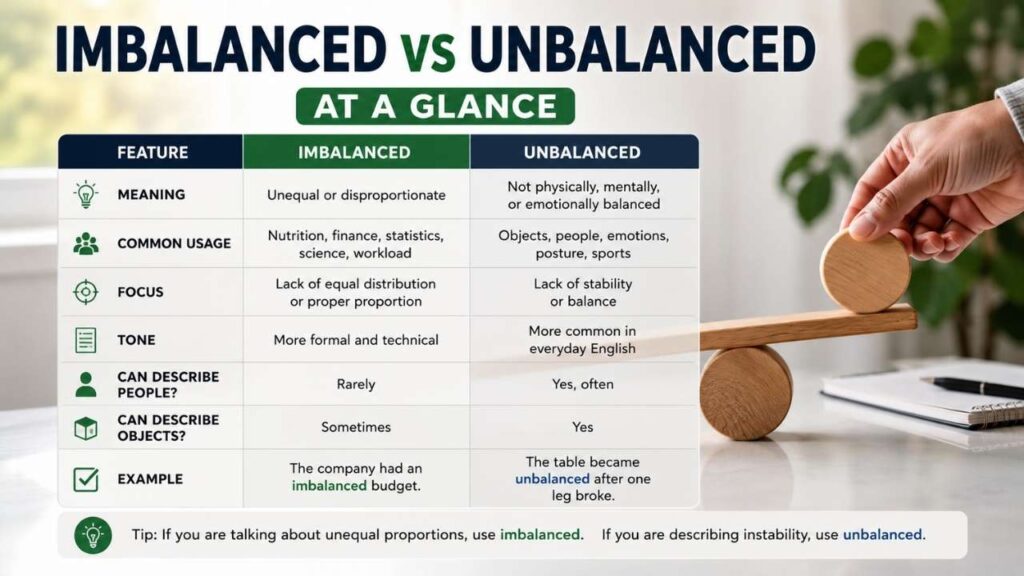
The table below highlights the key differences between imbalanced and unbalanced to help you choose the right word with confidence.
| Feature | Imbalanced | Unbalanced |
| Meaning | Unequal or disproportionate | Not physically, mentally, or emotionally balanced |
| Common Usage | Nutrition, finance, statistics, science, workload | Objects, people, emotions, posture, sports |
| Focus | Lack of equal distribution or proper proportion | Lack of stability or balance |
| Tone | More formal and technical | More common in everyday English |
| Can Describe People? | Rarely | Yes, often |
| Can Describe Objects? | Sometimes | Yes |
| Example | The company had an imbalanced budget. | The table became unbalanced after one leg broke. |
Tip: If you are unsure which word to use, ask yourself whether you are talking about unequal proportions or physical or emotional stability. That simple question will usually lead you to the correct choice.
What Does “Imbalanced” Mean?
Imbalanced means not properly balanced in amount, proportion, or distribution. People often use this word when one part of something is greater, smaller, or stronger than another. It usually appears in formal writing, academic discussions, and professional fields such as health, finance, economics, science, and statistics.
For example, an imbalanced diet does not provide the right nutrients, while an imbalanced workload means that work is not shared fairly among people. The word focuses on inequality rather than physical stability.
If something has uneven proportions or lacks the right mix, imbalanced is the correct choice. It describes a problem with distribution, quantity, or overall balance, not whether something can stand upright.
Examples:
- The doctor warned that an imbalanced diet could affect your health.
- The team struggled because of an imbalanced workload.
- The report showed an imbalanced distribution of resources.
- An imbalanced economy can create financial challenges.
What Does “Unbalanced” Mean?
Unbalanced means not stable, not steady, or not emotionally or physically balanced. Unlike imbalanced, this word often describes people, objects, or movements. For example, a chair with a broken leg is unbalanced because it cannot stand evenly.
A person may also feel unbalanced after losing their footing or experiencing emotional stress. In everyday English, this word is much more common because it fits many situations. You may hear it in conversations about sports, engineering, health, emotions, or daily life.
While unbalanced can sometimes describe unequal situations, its main idea is instability rather than unequal proportions. It often suggests that something needs support, adjustment, or better control.
Examples:
- The ladder became unbalanced on the uneven ground.
- She felt unbalanced after spinning around quickly.
- The heavy bag made the bicycle unbalanced.
- His unbalanced emotions affected his decision-making.
Imbalanced vs Unbalanced: Key Differences
Although imbalanced and unbalanced both describe something that is not balanced, they emphasize different ideas. Imbalanced focuses on unequal amounts, proportions, or distribution.
It is common in subjects like nutrition, economics, mathematics, business, and science. Unbalanced, however, focuses on stability. It usually describes people, objects, emotions, or physical movement. Another important difference is usage. Imbalanced sounds more formal and often appears in professional or academic writing, while unbalanced is more common in everyday English.
Learning this distinction will help you choose the right word in both writing and conversation and avoid one of the most common English vocabulary mistakes.
| Imbalanced | Unbalanced |
| Describes unequal proportions | Describes lack of stability |
| Common in formal writing | Common in everyday speech |
| Used in finance, health, science, and statistics | Used for people, objects, emotions, and movement |
| Focuses on distribution | Focuses on physical or emotional balance |
When to Use “Imbalanced”
Use imbalanced when you want to describe something that has unequal parts, uneven proportions, or an incorrect distribution. This word works best when discussing nutrition, finances, workloads, statistics, education, science, or business. It tells readers that something needs a better balance because one part outweighs another.
You can also use imbalanced in reports, essays, and professional writing because it sounds more precise in formal contexts. Before choosing this word, ask yourself if you are describing quantity, ratio, or distribution instead of physical stability. If the answer is yes, imbalanced is usually the correct choice.
Examples:
- The project failed because of an imbalanced budget.
- An imbalanced diet may lead to health problems.
- The survey revealed an imbalanced distribution of income.
- The manager corrected the imbalanced workload by assigning tasks more fairly.
When to Use “Unbalanced”
Use unbalanced when you want to describe something that is not steady, stable, or properly supported. This word is common in everyday English and often refers to people, objects, emotions, or physical movement.
For example, you can describe an unbalanced chair, an unbalanced washing machine, or an unbalanced person who is struggling emotionally. The word can also describe sports, engineering, and daily situations where something is off balance.
Before using unbalanced, ask yourself whether you are talking about stability rather than unequal proportions. If the answer is yes, unbalanced is usually the better choice. It sounds more natural in conversations and is easy for native speakers to understand.
Examples:
- The table became unbalanced after one leg broke.
- She felt unbalanced after stepping onto the moving boat.
- The heavy suitcase made the cart unbalanced.
- His unbalanced emotions affected his judgment.
Can They Be Used Interchangeably?
Sometimes imbalanced and unbalanced can describe a similar idea, but they are not true synonyms. In many cases, replacing one with the other changes the meaning or makes the sentence sound unnatural. For example, an imbalanced diet is the correct phrase because it refers to unequal nutrition, not physical stability.
On the other hand, an unbalanced chair is correct because the chair is not steady. While both words suggest that something is not balanced, each one fits different contexts.
To avoid common grammar mistakes, think about what kind of balance you are describing. If it involves distribution or proportion, choose imbalanced. If it involves stability or support, choose unbalanced.
| Correct Usage | Why? |
| Imbalanced diet | Refers to unequal nutrition. |
| Imbalanced workload | Refers to unfair distribution of work. |
| Unbalanced chair | Refers to physical instability. |
| Unbalanced emotions | Refers to emotional instability. |
Common Collocations
Learning common collocations helps you sound more natural because native speakers often use certain word combinations together. Imbalanced usually appears with words related to distribution, quantity, and systems, while unbalanced often appears with words connected to stability, movement, and emotions.
Using these natural combinations improves both your writing and speaking skills. Instead of translating directly from your first language, try to remember these common pairs. They appear frequently in books, articles, and everyday conversations. Knowing them will also help you choose the correct word without stopping to think every time.
Common Collocations with Imbalanced
- imbalanced diet
- imbalanced workload
- imbalanced budget
- imbalanced economy
- imbalanced distribution
- imbalanced ratio
- imbalanced growth
Common Collocations with Unbalanced
- unbalanced person
- unbalanced emotions
- unbalanced chair
- unbalanced load
- unbalanced wheel
- unbalanced posture
- unbalanced machine
Real-World Examples
Seeing these words in real-life situations makes their meanings much easier to understand. Imbalanced often appears in professional fields such as health, business, finance, education, and science because these areas deal with numbers, proportions, and distribution.
In contrast, unbalanced is more common in everyday conversations because it describes physical objects, people, or emotions. Paying attention to these contexts will help you choose the correct word naturally. The more examples you read, the easier it becomes to remember the difference between imbalanced and unbalanced.
Imbalanced
- The report showed an imbalanced distribution of resources.
- Doctors recommend avoiding an imbalanced diet.
- The company suffered from an imbalanced budget.
- The teacher noticed an imbalanced workload among students.
Unbalanced
- The washing machine became unbalanced during the spin cycle.
- The child looked unbalanced while learning to ride a bicycle.
- Strong winds made the ladder unbalanced.
- He seemed emotionally unbalanced after the stressful event.
Common Mistakes to Avoid
Many English learners confuse imbalanced and unbalanced because both words contain the idea of balance. However, using the wrong one can make your sentence sound unnatural or even change its meaning.
The easiest way to avoid mistakes is to remember that imbalanced focuses on unequal proportions, while unbalanced focuses on stability. Before choosing a word, think about what you are describing. Is it a distribution problem or a stability problem? That simple question will help you select the correct word in most situations.
| ❌ Incorrect | ✅ Correct |
| Unbalanced diet | Imbalanced diet |
| Unbalanced workload | Imbalanced workload |
| Imbalanced chair | Unbalanced chair |
| Imbalanced emotions | Unbalanced emotions |
Better Alternatives and Synonyms
Sometimes imbalanced or unbalanced may not be the best word for your sentence. Choosing a suitable synonym can make your writing clearer and more precise. The best alternative depends on the context.
For example, when discussing unequal amounts, words like unequal or disproportionate work well. When describing something that lacks stability, words such as unstable or unsteady are often better choices. Using different words also makes your writing more interesting and avoids repetition.
Synonyms for Imbalanced
- unequal
- disproportionate
- uneven
- skewed
- asymmetrical
Synonyms for Unbalanced
- unstable
- unsteady
- off-balance
- wobbly
- lopsided
FAQs
Which word is more common, imbalanced or unbalanced?
Unbalanced is more common in everyday English because people often use it to describe objects, emotions, and physical balance. Imbalanced appears more often in formal, academic, and professional writing.
Can I use imbalanced and unbalanced interchangeably?
Not always. Use imbalanced for unequal proportions or distribution, and use unbalanced for physical or emotional instability.
Is “imbalanced” a real word?
Yes. Imbalanced is a correct English adjective that describes something that lacks proper balance in amount, proportion, or distribution.
Can “unbalanced” describe a person?
Yes. Unbalanced can describe someone who is emotionally unstable or unable to maintain emotional balance. Use this meaning carefully because it may sound negative.
Which word should I use?
Choose imbalanced when talking about numbers, ratios, diets, workloads, or distribution. Choose unbalanced when talking about people, objects, emotions, or physical stability.
Conclusion
Although imbalanced and unbalanced share the same idea of something not being balanced, they are used in different ways. Imbalanced describes unequal proportions, quantities, or distribution, making it the right choice for topics like nutrition, finance, science, and business.
Unbalanced, however, describes physical or emotional instability and is much more common in everyday conversations. Understanding this difference will help you write more naturally and communicate your ideas clearly.
Whenever you feel unsure, remember this simple rule: if the problem involves distribution, choose imbalanced. If it involves stability, choose unbalanced. Following this guideline will help you use both words correctly and confidently in any situation.