
More Smart vs Smarter: Which Is Correct? Meaning + Examples
Have you ever wondered whether “more smart” or “smarter” is the correct expression? You’re not alone. Many English learners and even fluent speakers get confused when using comparative adjectives. While both phrases may seem similar, only one follows standard English grammar rules in most situations. Knowing the correct comparative form of smart can make your writing and speaking sound more natural and confident.
In this guide, you’ll learn the difference between More Smart vs Smarter, discover why smarter is the preferred choice, and understand the grammar rules behind comparative adjectives. We’ll also cover sentence examples, common mistakes, exceptions, and practical tips to help you remember the rule.
By the end, you’ll know when to use smarter, why more smart is generally incorrect, and how to avoid this common grammar mistake with confidence.
Quick Answer
Smarter is the correct comparative form of smart in standard English grammar. Because smart is a one-syllable adjective, you add “-er” instead of using more. Although “more smart” may occasionally appear for emphasis, it is generally considered unnatural. For clear, natural, and grammatically correct English, always use “smarter.”
More Smart vs. Smarter at a Glance
Choosing between more smart and smarter is easier once you know the basic grammar rules. In modern English grammar, smarter is the standard and natural comparative form of smart. Native speakers almost always use smarter because smart is a one-syllable adjective, and adjectives with one syllable usually take -er in the comparative form.
On the other hand, more smart sounds unnatural in everyday conversation and formal writing. While you might occasionally hear it for emphasis, it is not the preferred choice. If you’re asking, “Which is correct: more smart or smarter?”, the answer is simple—smarter is the correct option for almost every situation.
| Feature | Smarter | More Smart |
| Grammar | ✅ Correct | ❌ Usually incorrect |
| Natural English | ✅ Yes | ❌ No |
| Used by Native Speakers | ✅ Frequently | ❌ Rarely |
| Formal Writing | ✅ Recommended | ❌ Not recommended |
| Everyday Conversation | ✅ Common | ❌ Uncommon |
What Does “Smarter” Mean?
Smarter means more intelligent, more clever, or better at understanding and solving problems than someone or something else. It is the comparative adjective of smart, and it is used when comparing two people, animals, or things. Since smart has only one syllable, adding -er creates its correct comparative form.
This follows a common English grammar rule that applies to many short adjectives. Using smarter helps your writing sound natural and clear. Whether you’re speaking with friends, writing an email, or completing schoolwork, smarter is the word you should choose. Learning the correct comparative form of smart will improve both your spoken and written English.
Examples:
- Emma is smarter than her brother.
- This phone is smarter than the older model.
- She became smarter after practicing every day.
- Our new system is much smarter than the previous one.
Can You Say “More Smart”?
Many learners ask, “Is more smart grammatically correct?” The short answer is not usually. In standard English grammar, more smart is not the natural way to compare intelligence because smart is a one-syllable adjective.
The normal rule is to add -er, making smarter the correct choice. However, there are a few rare situations where writers or speakers may use more smart for extra emphasis, a special writing style, or creative effect. Even then, it sounds unusual to most native speakers.
If your goal is clear and correct English, always choose smarter. It is the form used in schools, professional writing, and everyday conversations, making it the safest and most natural option.
Why Is “Smarter” Grammatically Correct?
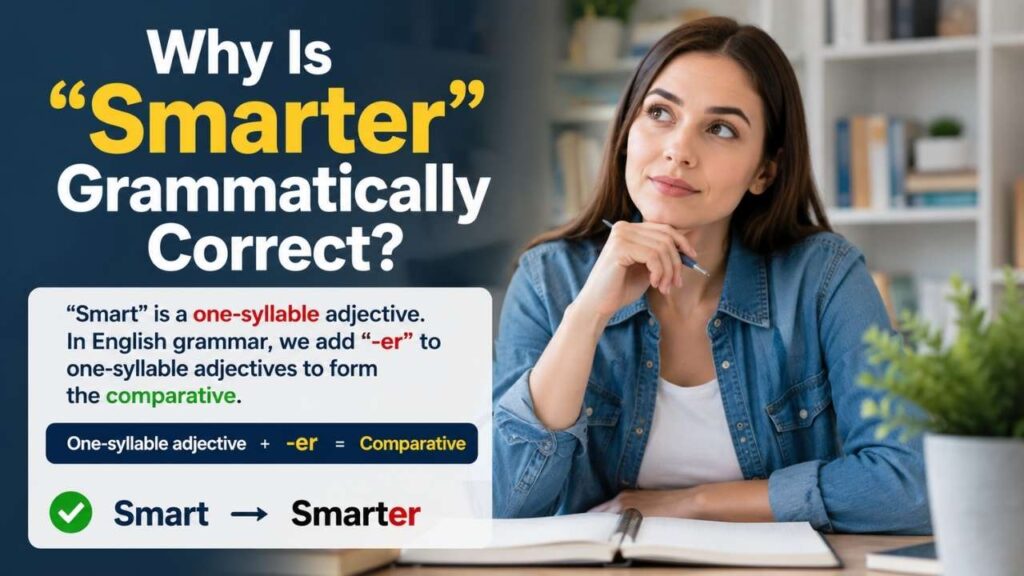
The reason smarter is correct comes from a simple grammar rule for comparative adjectives. In English, most one-syllable adjectives form their comparative by adding -er. Since smart has only one syllable, its correct comparative form becomes smarter, not more smart.
This rule also applies to words like tall, fast, small, and kind, which become taller, faster, smaller, and kinder. Using more before these short adjectives is considered unnatural in standard English.
Understanding this basic rule makes it much easier to choose the correct word in everyday writing and speaking. Once you remember that smart → smarter, you’ll avoid one of the most common grammar mistakes made by English learners.
How Comparative Adjectives Work in English
Comparative adjectives help us compare two people, places, animals, or things. The form you choose depends mainly on the number of syllables in the adjective. Most one-syllable adjectives take -er, while longer adjectives usually use more before the word. Learning these simple patterns will help you avoid common English grammar mistakes and improve your writing.
Although there are a few exceptions, these rules work in most situations. Once you understand how comparatives are formed, choosing between more smart vs. smarter becomes much easier. Instead of memorizing every adjective, focus on the pattern, and you’ll quickly recognize which form sounds natural in everyday English.
| Adjective Type | Comparative Form | Example |
| One syllable | Add -er | Smart → Smarter |
| Two syllables (some) | Add -er or use more | Happy → Happier |
| Three or more syllables | Use more | More intelligent |
| Irregular adjectives | Special forms | Good → Better |
When Do We Use “More” Instead of “-er”?
A common question among English learners is when to use more instead of adding -er. The answer depends on the length of the adjective. Most one-syllable adjectives form the comparative by adding -er, such as smart → smarter or fast → faster.
However, adjectives with three or more syllables usually use more, such as more beautiful, more interesting, and more expensive. Some two-syllable adjectives can use either form, but one option often sounds more natural than the other.
Knowing this simple rule helps you choose the correct comparative adjective without guessing. When comparing two things, always think about the adjective’s length before deciding whether to use more or -er.
| Adjective | Correct Comparative |
| Smart | Smarter |
| Tall | Taller |
| Beautiful | More beautiful |
| Expensive | More expensive |
| Interesting | More interesting |
Common Mistakes with Comparative Adjectives
Many people make small mistakes when using comparative adjectives, especially while learning English. One of the most common errors is saying “more smart” instead of “smarter.” Another mistake is adding both more and -er together, such as “more faster” or “more taller.” These forms are incorrect because only one comparative form should be used.
To improve your grammar, learn the basic comparison rules and practice with everyday examples. If you enjoy learning about commonly confused words, you may also like our guide on Different vs. Differently, which explains another grammar topic that often confuses English learners. Small grammar improvements like these can make your writing much clearer.
| ❌ Incorrect | ✅ Correct |
| More smart | Smarter |
| More tall | Taller |
| More faster | Faster |
| More happier | Happier |
| More kind | Kinder |
Smart vs. Intelligent: What’s the Difference?
Although smart and intelligent are similar, they are not always used in the same way. Smart often describes someone who learns quickly, solves problems, or makes good decisions in everyday life. Intelligent usually refers to a person’s overall ability to think, understand, and learn complex ideas.
When making a comparison, we say smarter because smart is a one-syllable adjective. However, with intelligent, we say more intelligent because it has several syllables. Understanding this difference helps you choose the most natural words in different situations. Both words are correct, but the context decides which one fits better.
| Word | Comparative Form |
| Smart | Smarter |
| Intelligent | More intelligent |
Real-Life Examples of “Smarter” in Sentences
The best way to remember the correct comparative form of smart is to see it in real-life situations. These examples show how smarter is naturally used in everyday English. Notice that each sentence compares two people or things. This follows the basic rule for comparative adjectives and makes the meaning clear.
Reading and practicing examples like these will help you use smarter confidently in conversations and writing. The more you see correct sentence patterns, the easier it becomes to avoid common grammar mistakes.
Examples:
- My sister is smarter than I am at math.
- This laptop is smarter than the older model.
- The new software is much smarter than the previous version.
- He became smarter after learning from his mistakes.
- Our team made a smarter decision this time.
- She found a smarter way to solve the problem.
Frequently Confused Comparative Words
Many English words cause confusion because they look or sound similar. Learning these comparisons helps you improve your vocabulary and avoid common writing mistakes. For example, many people wonder whether Different or Differently is the correct choice in a sentence, while others ask whether Time Off should be written as one word or with a hyphen.
Another common question is whether Preventive and Preventative have different meanings. Exploring these grammar topics alongside more smart vs. smarter gives you a better understanding of how English words are formed and used.
If you’re interested, read our guides on Different vs. Differently, Time Off vs. Time-Off, and Preventive vs. Preventative to strengthen your grammar skills.
FAQs
Is “more smart” grammatically correct?
No. In standard English grammar, smarter is the correct comparative form of smart. More smart sounds unnatural and is rarely used by native speakers.
Why is “smarter” correct?
Because smart is a one-syllable adjective, English grammar forms its comparative by adding -er, creating smarter.
Can you ever say “more smart”?
It may appear in creative writing or for special emphasis, but it is not recommended in normal writing or conversation.
What is the superlative form of smart?
The superlative form is smartest.
Is “smarter” or “more intelligent” better?
Both are correct, but they compare different adjectives. Use smarter with smart and more intelligent with intelligent.
Conclusion
When comparing two people or things, smarter is the correct and natural choice. Since smart is a one-syllable adjective, standard English grammar says you should add -er instead of using more.
Although more smart may occasionally appear for emphasis, it is not the form used in everyday conversation, academic writing, or professional communication. By understanding how comparative adjectives work, you’ll avoid common grammar mistakes and write with greater confidence.
Remember this simple rule: short adjectives usually take “-er,” while longer adjectives usually take “more.” Keep practicing with real examples, and choosing the correct comparative form will soon become second nature.