
Its vs It’s: Simple Grammar Guide with Examples
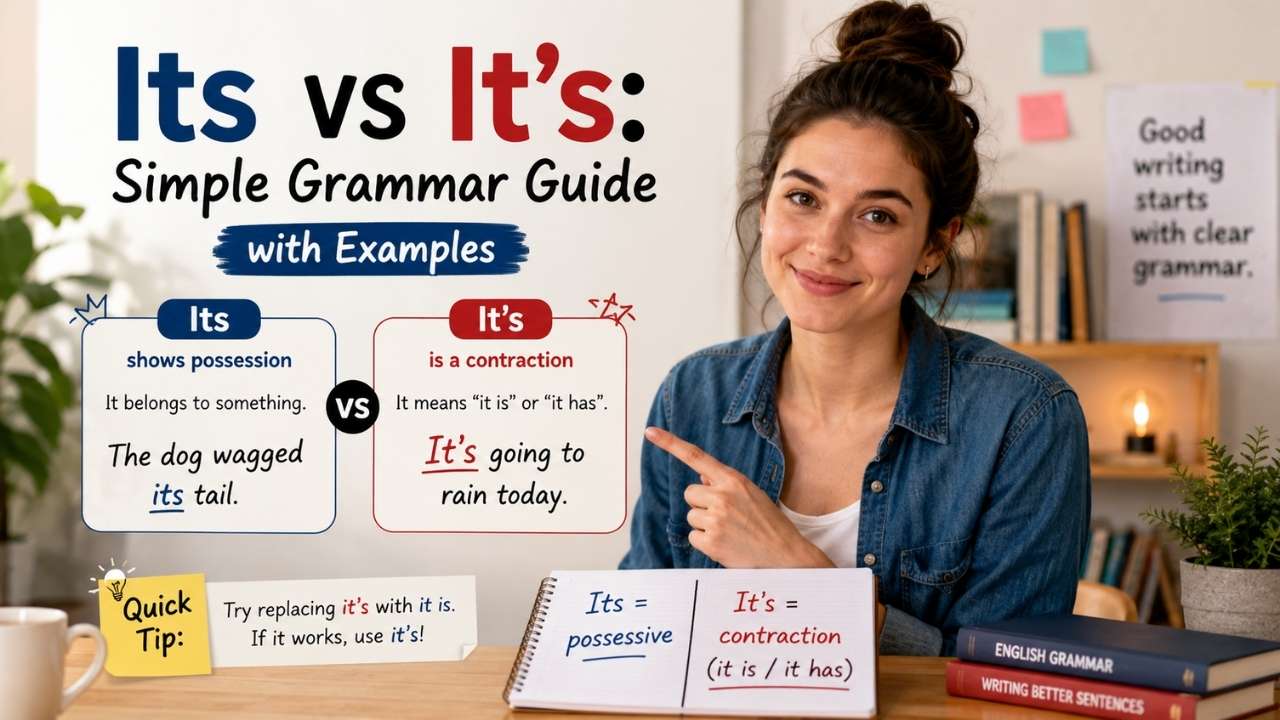
Many English learners mix up its and it’s because they look almost identical. However, these two words have very different meanings in modern English. One shows ownership, while the other is a contraction.
Today, this mistake appears everywhere. People confuse the forms in emails, texts, social media posts, and even professional writing. Because the difference depends on a tiny apostrophe, many writers overlook it during fast typing.
In American English, understanding its vs it’s matters because both forms appear often in daily communication. Once you learn the core rule, the distinction becomes much easier to remember and use naturally.
Quick Answer
Its shows possession, while it’s means it is or it has. In other words, the apostrophe version is always a contraction, not a possessive form.
TL;DR
- Its = possession or ownership
- It’s = short form of it is or it has
- Apostrophes usually show contractions here
- “Its” follows a special possessive rule in English
- American English strongly separates these forms
- The easiest test is replacing it’s with it is
What Its and It’s Mean
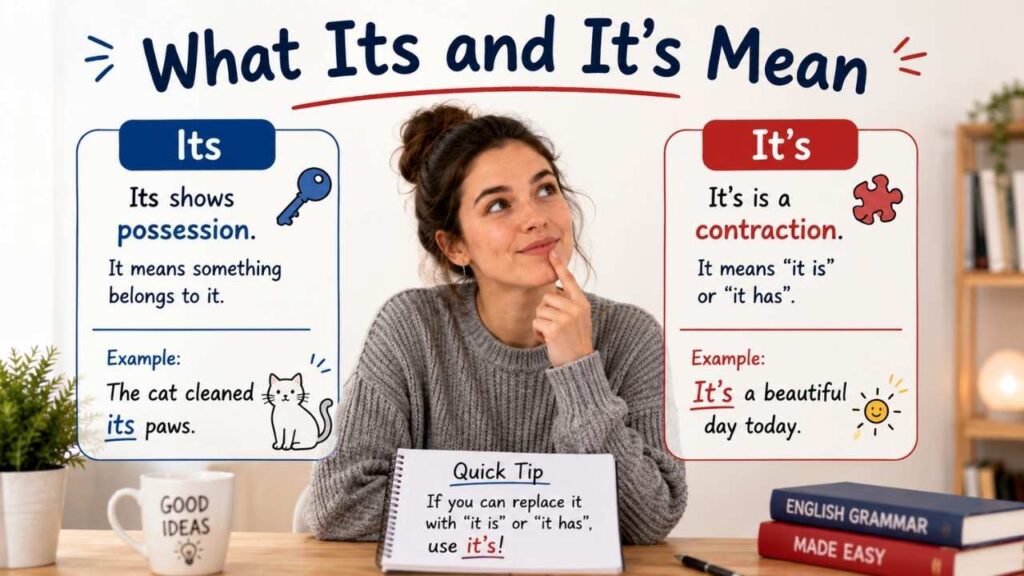
The difference between these words comes from their grammatical roles. Although they sound the same, they function differently inside a sentence.
Understanding “Its”
The word its is a possessive determiner. It shows that something belongs to a thing, animal, place, or idea. For example, “The company changed its logo” means the logo belongs to the company.
Unlike many possessive nouns, its does not use an apostrophe. This surprises many learners because English often adds apostrophes for ownership. However, possessive pronouns follow different rules.
Understanding “It’s”
The form it’s is a contraction. It combines either it is or it has into a shorter form. For example, “It’s raining” means “It is raining.”
In casual American English, contractions appear constantly in speech and informal writing. Because of this, “it’s” is extremely common in conversations, texting, and online communication.
Why People Confuse Its and It’s
This confusion happens because English usually uses apostrophes for possession. For example, “Sarah’s book” clearly shows ownership. Therefore, many writers assume “it’s” should also show possession.
However, pronouns work differently. Words like his, hers, yours, and theirs never use apostrophes for ownership. The word its follows the same pattern.
Additionally, both words sound identical in speech. Since there is no pronunciation difference, writers must rely entirely on grammar and sentence meaning.
The Apostrophe Problem
English apostrophes serve multiple purposes. Sometimes they show possession, and sometimes they create contractions. Because the same punctuation mark has different jobs, confusion naturally develops.
In modern digital writing, people also type quickly. As a result, many mistakes happen from habit rather than misunderstanding.
The Core Grammar Rule
The easiest way to remember the difference is simple: if the word can become it is or it has, use it’s.
If the sentence talks about ownership or belonging, use its instead.
| Context | Correct Usage | Example | Notes |
| Possession | its | The dog wagged its tail. | Tail belongs to dog |
| Contraction | it’s | It’s getting late. | Means “it is” |
| Contraction | it’s | It’s been a long day. | Means “it has” |
| Possession | its | The school changed its policy. | Policy belongs to school |
A Simple Test
Try replacing the word with it is. If the sentence still makes sense, then it’s is correct.
For example, “It’s sunny today” becomes “It is sunny today.” The sentence still works, so the apostrophe form is correct.
However, “The car lost it’s tire” becomes “The car lost it is tire.” That sentence fails, so the correct form is its.
The History Behind Its and It’s
The history of these forms explains why modern English treats them differently. Earlier forms of English used possessive structures less consistently than today.
During the Middle English period, apostrophe rules were not standardized. Writers often used different spelling styles depending on region and printing traditions.
The Rise of Modern Apostrophes
By the seventeenth and eighteenth centuries, English punctuation became more organized. Apostrophes started marking missing letters in contractions more consistently.
At the same time, possessive pronouns developed their own pattern. Words like his, hers, and ours dropped apostrophes completely. Eventually, its followed the same system.
Older English Usage
Interestingly, older English sometimes used it’s as a possessive form. However, that style slowly disappeared as grammar became more standardized.
Today, standard American English accepts only its for possession.
How American English Uses Its and It’s
In the United States, schools strongly teach this distinction from an early age. Even so, it remains one of the most common grammar mistakes in everyday writing.
Modern American English favors contractions heavily in speech and informal writing. Therefore, people often type it’s automatically without checking the sentence structure carefully.
Formal Writing
In professional or academic writing, the distinction matters more because grammar errors can affect credibility. Editors usually correct this mistake immediately.
For example, a business email saying “The company updated it’s website” appears careless to many readers.
Casual Writing
Text messages and social media posts sometimes ignore the difference. However, many readers still notice the mistake, especially in public or professional settings.
Because grammar awareness remains important online, writers increasingly try to avoid this error even in casual communication.
British and American Usage Differences
American and British English mostly agree on the rules for its and it’s. Both varieties treat its as possessive and it’s as a contraction.
However, some differences appear in writing style. British English may use slightly fewer contractions in formal contexts. American English tends to sound more conversational overall.
Even with these stylistic differences, the grammar rule itself stays the same across both varieties.
Historical Influence
Older British texts sometimes show outdated apostrophe styles. Therefore, readers exploring historical literature may occasionally see forms that differ from current standards.
Still, modern publishing standards in both countries now follow the same distinction clearly.
Common Mistakes With Its and It’s
Many errors happen because writers type too quickly. Others happen because people remember incomplete grammar rules about apostrophes.
One frequent mistake involves assuming every possessive word needs an apostrophe. This leads to incorrect sentences like “The cat cleaned it’s paws.”
Confusing Contractions and Possession
Another common problem appears when writers forget contractions hide missing letters. Because “it’s” contains omitted letters from “it is,” the apostrophe signals shortening rather than ownership.
Writers also sometimes avoid contractions completely to escape uncertainty. While that strategy works occasionally, it can make writing sound unnatural or overly formal.
Proofreading Problems
Spellcheck tools do not always catch these errors because both forms are real English words. As a result, grammar mistakes can remain hidden unless writers carefully reread the sentence meaning.
Real-Life Examples in Everyday English
The difference becomes clearer through natural examples from daily communication.
In Conversation
Americans regularly say sentences like “It’s freezing outside” or “It’s been a stressful week.” These contractions make speech flow smoothly and naturally.
Possessive forms also appear constantly. For example, “The phone lost its signal” sounds completely normal in everyday conversation.
In Digital Communication
Online writing often mixes formal and informal styles. Because people type rapidly, apostrophe mistakes appear frequently on social media platforms.
However, professional accounts and business pages usually edit these errors carefully because grammar affects public image.
In School and Work
Teachers and employers often notice confusion between these forms. Therefore, mastering the distinction helps writers appear more polished and confident.
Clear grammar also improves readability. Readers understand sentences faster when punctuation follows standard conventions.
Why Possessive Pronouns Avoid Apostrophes
This rule confuses many learners because it seems inconsistent at first. However, English possessive pronouns follow a broader pattern.
Words like my, your, his, her, our, and their never use apostrophes for possession. Similarly, independent possessive pronouns like yours and theirs also avoid apostrophes.
The Pronoun System
The word its belongs to this possessive pronoun family. Therefore, it naturally follows the same structure.
In contrast, nouns behave differently. For example, “the teacher’s desk” uses an apostrophe because “teacher” is a noun rather than a pronoun.
Understanding this distinction helps the rule feel more logical.
Its and It’s in Modern Digital Writing
Digital communication has changed English writing habits significantly. People now write more often and more quickly than earlier generations.
Because of this shift, small grammar mistakes appear more frequently online. Autocorrect tools sometimes even create errors accidentally by choosing the wrong form automatically.
Social Media Influence
Social platforms encourage fast, conversational writing. As a result, contractions like “it’s” appear constantly.
At the same time, readers increasingly judge writing quality online. Even short posts may attract criticism for visible grammar mistakes.
AI and Grammar Tools
Modern grammar checkers help reduce confusion between these forms. However, automated systems still make mistakes occasionally because sentence meaning matters more than spelling alone.
Human proofreading remains important, especially in professional communication.
Debates and Gray Areas
Unlike some grammar topics, the distinction between its and it’s has little serious debate today. Most style guides agree completely on the rule.
However, discussions sometimes arise about how strictly grammar should matter in casual communication. Some people believe minor apostrophe mistakes should not matter online.
Others argue that consistent grammar improves clarity and professionalism even in relaxed settings.
Language Change Over Time
English constantly evolves. Informal writing now accepts many styles that older grammar books discouraged.
Still, the its versus it’s distinction remains stable because the forms carry different meanings. Therefore, standard English continues teaching the traditional rule strongly.
Easy Memory Tricks for Its and It’s
Simple memory tools can help writers avoid confusion.
One useful trick involves expanding the contraction mentally. If “it is” fits naturally, then it’s works correctly.
Another helpful reminder connects its with other possessive pronouns. Since words like his and hers lack apostrophes, its should too.
Visual Learning
Some writers remember the rule visually. They think of the apostrophe in it’s as marking missing letters rather than ownership.
Repeated reading also helps. Over time, correct forms begin to look natural automatically.
How Teachers Explain Its vs It’s
American schools usually introduce this rule during elementary grammar lessons. Teachers often focus first on contractions because students already recognize phrases like “don’t” and “can’t.”
Later, students learn that pronouns follow separate possessive rules. This stage often creates temporary confusion because the apostrophe pattern changes.
Modern Teaching Methods
Today, many teachers emphasize sentence meaning instead of memorization alone. Students practice replacing “it’s” with “it is” to test correctness.
This practical approach helps learners apply the rule naturally in real writing situations.
FAQs
Is “it’s” ever possessive?
No. In modern standard English, it’s only means it is or it has. The possessive form is always its.
Why doesn’t “its” use an apostrophe?
Possessive pronouns usually avoid apostrophes in English. Words like his, hers, and theirs follow the same rule.
Which form appears more often in conversation?
People often use it’s more frequently in speech because contractions are common in American English conversation.
Do grammar checkers always catch this mistake?
No. Both words are spelled correctly, so software may miss the error unless it understands sentence meaning accurately.
Is the rule different in British English?
No. British and American English both use the same distinction between its and it’s today.
Why do so many native speakers confuse them?
The words sound identical, and English apostrophe rules can feel inconsistent. Fast typing also increases mistakes.
Conclusion
Understanding its vs it’s becomes much easier once you know the core difference. Its shows possession, while it’s works as a contraction for it is or it has.
Although the mistake appears often in modern writing, the rule itself is actually simple. The apostrophe signals missing letters, not ownership. Because possessive pronouns avoid apostrophes, its follows the same pattern as his and theirs.
With practice, the distinction quickly becomes natural. Whenever you feel uncertain, replace it’s with it is and check whether the sentence still works. That small habit can instantly improve your grammar and writing confidence.