
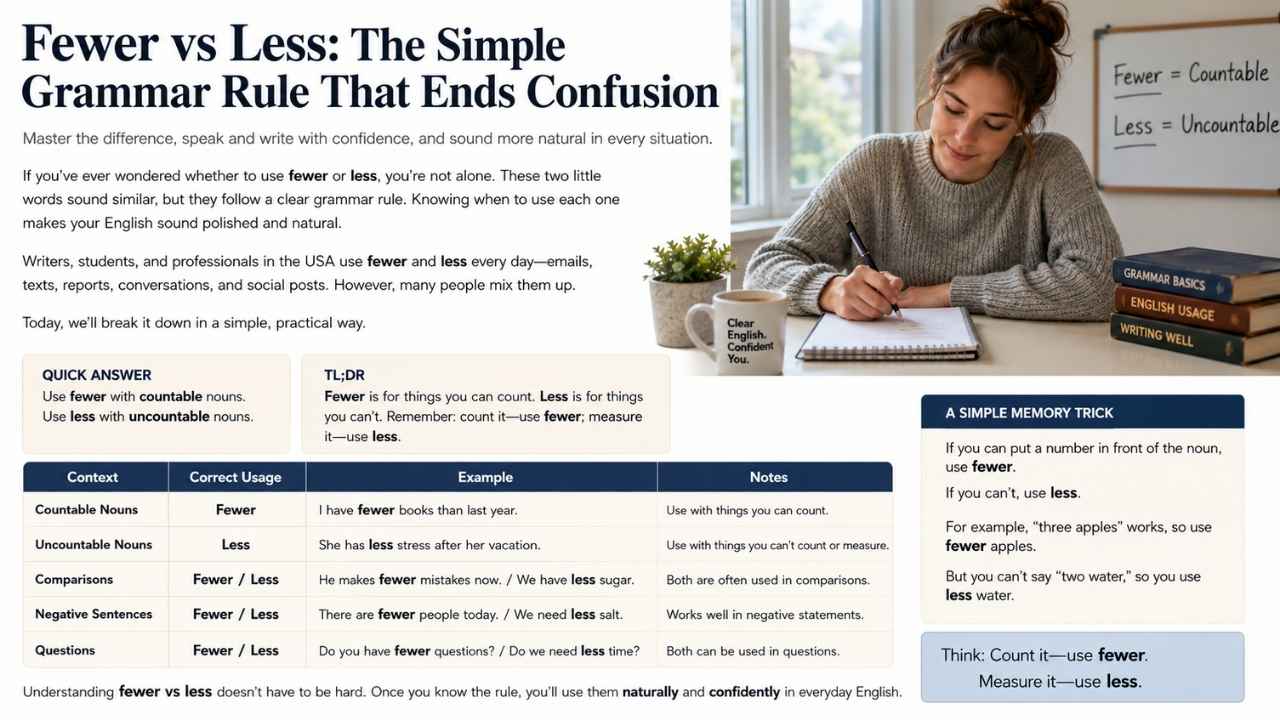
Fewer vs Less: Easy Rules for Clear English
The debate around fewer vs less is one of the most common grammar questions in English. People hear both words daily, yet many still wonder which one is correct. You may notice the issue at grocery stores, in emails, or even on social media.
Today, this grammar topic matters because English changes constantly. Some rules stay strict in formal writing, while others become more flexible in casual speech. Because of that, many speakers feel unsure about when to use each word.
In American English, both words appear often in conversation. However, traditional grammar still separates them by type of noun. Understanding that difference makes writing sound clearer and more natural.
This guide explains the history, rules, modern usage, and confusion around these two words. It also shows how Americans actually use them in daily life.
Quick Answer
The traditional rule for fewer vs less is simple: use fewer with things you can count and less with things you cannot count. For example, say “fewer cars” but “less traffic.”
TL;DR
- Fewer usually goes with countable nouns.
- Less usually goes with uncountable nouns.
- Americans often use less in casual speech.
- Formal writing still prefers the traditional rule.
- Some phrases naturally use less, even with numbers.
- Context matters more than memorizing strict rules.
What Does Fewer Mean?
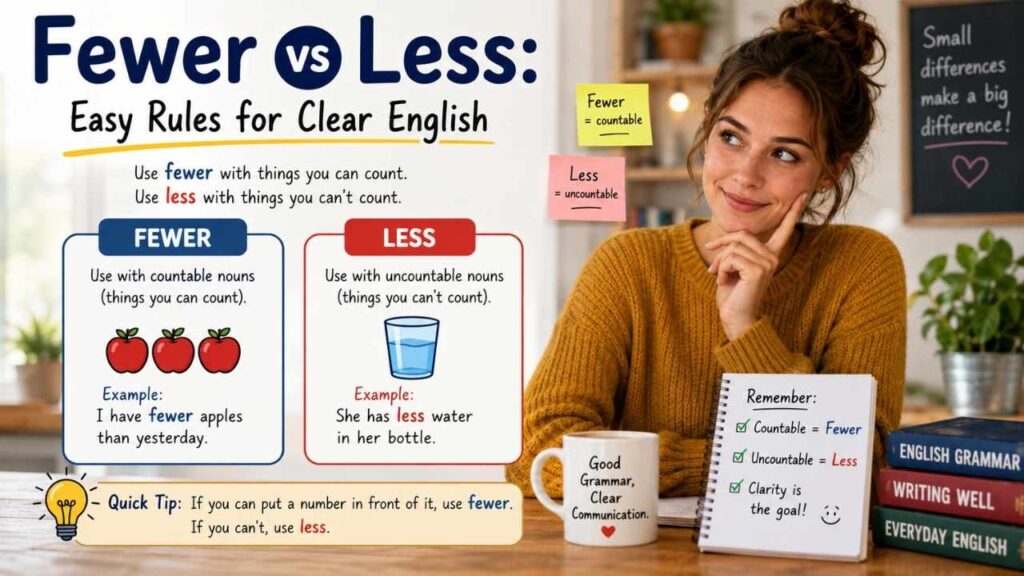
The word fewer refers to a smaller number of individual things. You use it when the items can be counted one by one.
For example, you can count books, students, apples, and chairs. Because these nouns are countable, fewer fits naturally with them.
Using Fewer With Countable Nouns
Countable nouns have singular and plural forms. You can place numbers before them, which makes them easy to count.
For example, these sentences follow the traditional grammar rule:
- “There are fewer cookies left.”
- “We need fewer volunteers this year.”
- “She made fewer mistakes today.”
In each case, the noun can be counted individually.
Why Fewer Sounds More Formal
In American English, fewer often sounds more careful or formal. Teachers, editors, and style guides usually prefer it in professional writing.
However, everyday conversation does not always follow strict grammar patterns. Because of that, many speakers use less instead.
What Does Less Mean?
The word less refers to a smaller amount rather than a smaller number. It usually appears with nouns that cannot be counted individually.
These nouns are often called mass nouns or uncountable nouns.
Using Less With Uncountable Nouns
You cannot easily count things like water, time, air, or sugar one by one. Therefore, English traditionally uses less with them.
Examples include:
- “We have less time now.”
- “She drinks less coffee.”
- “There was less noise outside.”
These nouns describe amounts instead of separate items.
Why Less Appears So Often
The word less feels natural and flexible in conversation. Many Americans use it automatically, especially in fast speech or texting.
Because of this habit, people sometimes use less even when grammar books prefer fewer.
The Core Grammar Rule
The traditional grammar rule separates these words by countability. This distinction became widely accepted in formal English over time.
Countable vs Uncountable Nouns
Countable nouns can be separated into individual units. Uncountable nouns describe things as general amounts or substances.
Here is the basic pattern:
| Context | Correct Usage | Example | Notes |
| Countable nouns | Fewer | Fewer cars on the road | Cars can be counted |
| Uncountable nouns | Less | Less traffic today | Traffic is treated as a mass |
| Time | Less | Less than two hours | Common exception |
| Money | Less | Less than $20 | Amount, not units |
| Distance | Less | Less than five miles | Standard modern usage |
This rule helps writers sound more precise.
Why The Rule Exists
English developed these patterns to separate numbers from amounts. Over time, editors and teachers promoted the distinction in formal writing.
However, spoken English has never followed the rule perfectly.
The History of Fewer and Less
The history behind these words explains why modern English feels inconsistent.
Early English Usage
In older forms of English, writers often used less with both countable and uncountable nouns. Historical texts contain phrases like “less words” and “less people.”
At that time, the rule was much looser.
The Rise of the Modern Rule
During the eighteenth century, grammar experts began promoting stricter standards. One influential writer argued that fewer should describe number while less should describe quantity.
After that, schools and style guides repeated the distinction for generations.
Why The Debate Still Continues
Language changes naturally through daily speech. Because people continued saying “less people” and “less items,” the older pattern never fully disappeared.
As a result, modern English contains both traditional grammar and everyday exceptions.
Fewer vs Less in American English
American English usually follows the traditional rule in formal situations. However, casual speech is much more flexible.
Formal American Usage
Professional writing still prefers careful distinction. Newspapers, academic papers, and business communication often use fewer with countable nouns.
For example, an editor would likely change “less errors” to “fewer errors.”
Informal American Usage
In conversation, many Americans use less naturally with plural nouns. Sentences like “less cars” or “less emails” appear regularly in speech.
Although some listeners notice the difference, many do not.
Social Media and Digital Communication
Texting and online communication favor speed and simplicity. Therefore, people often choose whichever word feels easiest.
Digital language tends to be less strict overall.
Why Grocery Store Signs Say “10 Items or Less”
This example appears in almost every grammar discussion.
The Famous Checkout Sign
Traditional grammar suggests that grocery stores should say “10 items or fewer.” After all, items are countable.
Yet many stores still use “10 items or less.”
Why People Accept It
Short signs often prioritize simplicity and rhythm. The phrase “10 items or less” sounds smoother to many speakers.
Because millions of people hear the phrase regularly, it now feels natural in American culture.
Modern Reactions
Some grammar experts still criticize the phrase. Others argue that language should reflect real usage instead of rigid rules.
Today, both opinions remain common.
Common Mistakes With Fewer and Less
Many learners struggle because English includes exceptions and informal patterns.
Using Less With Countable Nouns
One frequent mistake involves plural countable nouns.
For example:
- Incorrect in formal writing: “Less students attended class.”
- Preferred formal version: “Fewer students attended class.”
This mistake happens because spoken English often ignores the traditional rule.
Overcorrecting Everyday Expressions
Some learners try to replace every use of less with fewer. However, certain phrases traditionally use less, even with numbers.
For example:
- “Less than five minutes”
- “Less than twenty dollars”
- “Less than ten miles”
These expressions sound natural in modern English.
Confusing Quantity and Number
The easiest solution is to ask one question: can you count the thing individually?
If the answer is yes, fewer usually works better.
Exceptions to the Rule
English grammar rarely stays perfectly consistent.
Time, Money, and Distance
Americans usually use less with measurements involving time, money, and distance.
For example:
- “Less than three hours”
- “Less than fifty dollars”
- “Less than ten miles”
Even careful editors generally accept these phrases.
Statistical and Numerical Expressions
Modern English often treats numbers as amounts rather than separate units.
Because of that, phrases like “less than 100 people attended” appear regularly in newspapers and speech.
Fixed Expressions
Some expressions became standard through repeated use. Native speakers learn them naturally without thinking about grammar rules.
That is one reason English feels unpredictable at times.
Fewer vs Less in British English
British English generally follows the same traditional distinction.
Similar Grammar Standards
Schools and publishers in the United Kingdom usually teach the same countable-versus-uncountable rule.
Formal British writing often prefers fewer people instead of less people.
Differences in Everyday Speech
Casual British conversation also bends the rules sometimes. Speakers may choose whichever word sounds smoother in fast speech.
Therefore, the difference between American and British usage is smaller than many people expect.
Real-Life Examples in Daily Communication
Grammar feels easier when connected to real situations.
Workplace Communication
Professional emails often follow traditional grammar more closely.
For example:
- “We had fewer complaints this month.”
- “The project required less funding.”
These choices sound polished and professional.
Texting and Social Media
Online language tends to be shorter and faster.
Someone might text:
- “Need less meetings next week.”
- “Wish there were less ads here.”
Although technically informal, many readers understand the meaning instantly.
Everyday Conversation
Most native speakers focus on communication rather than strict grammar. Because of that, informal speech often sounds more relaxed.
Context usually matters more than perfection.
Why People Feel Strongly About This Rule
Certain grammar topics create emotional reactions.
Grammar as Identity
Some people connect grammar with education or professionalism. Therefore, they may notice mistakes quickly.
Others believe communication matters more than strict rules.
Prescriptive vs Descriptive Grammar
Prescriptive grammar focuses on rules people should follow. Descriptive grammar studies how people actually speak.
The fewer vs less debate often reflects this larger disagreement.
Language Keeps Changing
Modern English changes through technology, culture, and daily habits. Rules that once felt strict may become more flexible over time.
Because of this, grammar discussions rarely disappear completely.
How Usage Has Changed Over Time
English today looks different from English centuries ago.
Older English Was More Flexible
Historical writing used less broadly with many noun types. Therefore, modern complaints about “less people” ignore some earlier English traditions.
The language has always contained variation.
Modern Formal Standards
Schools and publishers later promoted stricter distinctions. As a result, modern formal English often treats the rule as important.
This standard still shapes education today.
Current Trends
Casual communication continues moving toward flexibility. Younger speakers especially use less widely in conversation and online writing.
However, formal writing still favors the traditional distinction.
Tips for Remembering the Difference
Simple memory tricks can help.
Think About Individual Items
If you can count the noun one by one, choose fewer.
For example:
- fewer books
- fewer cars
- fewer mistakes
Think About General Amounts
If the noun feels like a mass or quantity, choose less.
Examples include:
- less water
- less stress
- less traffic
Focus on Clarity
Grammar exists to support communication. Therefore, the best choice is usually the clearest one for the situation.
FAQs
Is “less people” always wrong?
In formal writing, many editors prefer “fewer people.” However, “less people” appears often in casual conversation and everyday speech.
Why do stores say “10 items or less”?
The phrase became common because it sounds smooth and natural to many speakers. Although grammar experts often prefer “10 items or fewer,” both versions are widely understood.
Can I use less with numbers?
Yes. Modern English commonly uses less with time, money, distance, and measurements. For example, “less than twenty dollars” sounds completely natural.
Is fewer more formal than less?
Usually, yes. Formal writing tends to follow the traditional grammar distinction more carefully than casual speech.
Do Americans care about this grammar rule?
Some do, especially teachers, editors, and grammar enthusiasts. However, many Americans use both words freely in conversation.
Which matters more: grammar rules or communication?
Clear communication matters most. Grammar rules simply help make meaning more precise and easier to understand.
Conclusion
Understanding fewer vs less becomes easier once you know the basic distinction between countable and uncountable nouns. In formal writing, fewer usually fits countable items, while less describes amounts or masses.
However, real English is more flexible than strict grammar rules sometimes suggest. Everyday conversation often mixes both forms naturally, especially in American speech and online communication.
The best approach is practical awareness. Use the traditional rule when writing professionally, but also recognize that modern English changes through real usage every day.