
There vs Their vs They’re Explained Clearly
Many English learners and native speakers mix up there, their, and they’re. These words sound the same, but they have very different meanings. Because of that, they are called homophones.
Today, confusion around there vs their vs they’re appears everywhere. People mix them up in emails, text messages, school essays, and social media posts. However, once you understand the role of each word, choosing the correct one becomes much easier.
Quick Answer
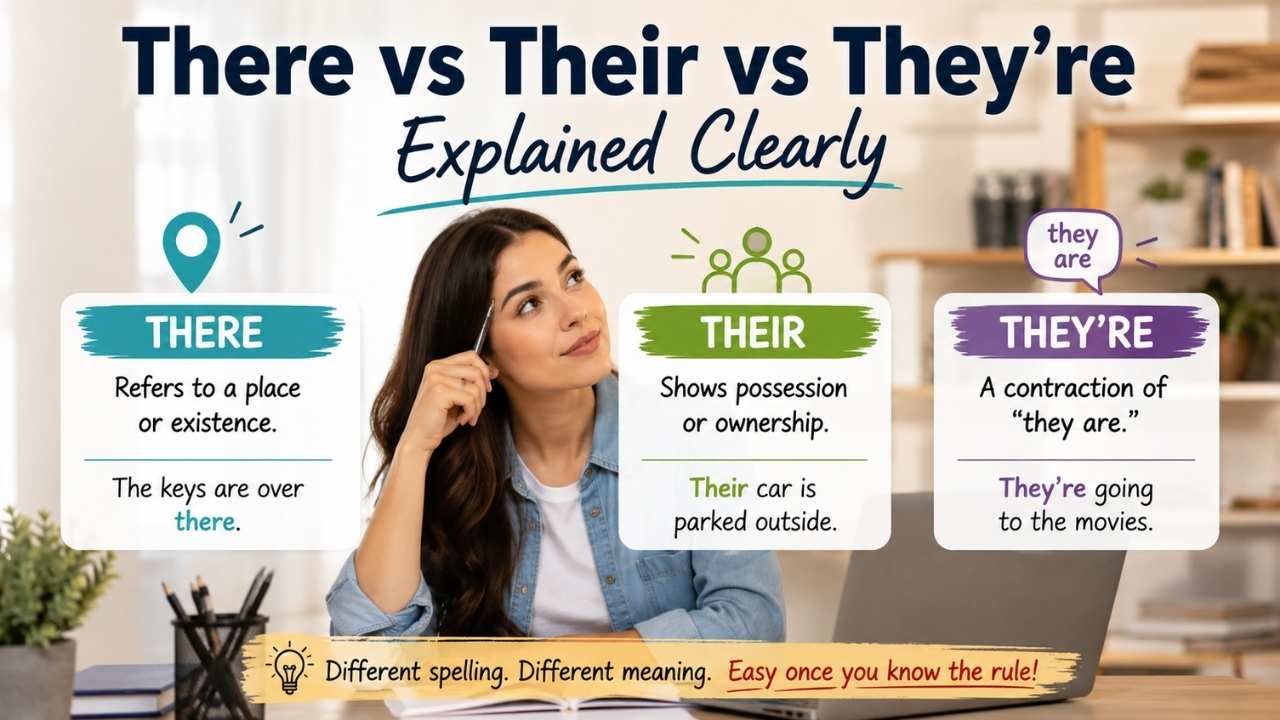
There usually refers to a place or introduces a sentence. Their shows ownership. They’re is a contraction of “they are.” Understanding there vs their vs they’re comes down to knowing each word’s job in a sentence.
TL;DR
- There relates to place or existence.
- Their shows possession or ownership.
- They’re means “they are.”
- These words sound alike but have different meanings.
- Confusing them is common in modern English writing.
- Careful proofreading helps avoid mistakes.
What There, Their, and They’re Mean
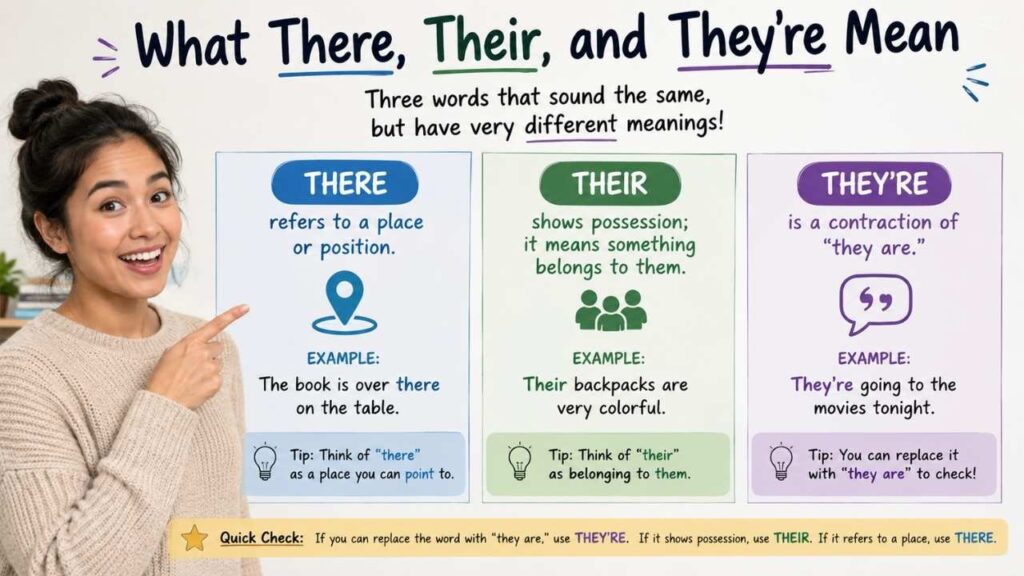
These three words belong to different grammar categories. Even though they sound identical in spoken English, they work differently in sentences.
There often acts as an adverb or pronoun. It usually points to a location or introduces an idea. For example, “The keys are over there” refers to a place. In contrast, “There is a problem” introduces the existence of something.
Their is a possessive determiner. It shows that something belongs to a group of people. For example, “Their car is outside” means the car belongs to them.
They’re is a contraction. It combines the words “they” and “are.” For example, “They’re late again” means “They are late again.”
Because pronunciation does not clearly separate these words, writers often depend on memory and context instead.
Why These Words Cause So Much Confusion
English contains many homophones, but this group causes special problems. One reason is that all three words appear frequently in daily writing.
Another reason involves speed. People type quickly in texts and online comments. As a result, they may choose the wrong spelling without noticing it. Autocorrect also fails sometimes because each spelling is technically a real word.
Children learning English often struggle with these words in school. However, adults confuse them too. Even experienced writers occasionally make mistakes when editing too quickly.
In spoken English, listeners understand meaning from context alone. In writing, though, spelling carries the meaning. That difference creates confusion.
The History Behind There, Their, and They’re
The word there comes from Old English forms related to location and direction. Early Germanic languages used similar words to describe place or position.
Their entered English later through Old Norse influence. During the Viking period, Norse grammar affected many English pronouns and possessive forms. That is partly why “their” differs from older English patterns.
Meanwhile, they’re developed much later. Contractions became more common in everyday English during the Middle English and Early Modern English periods. Over time, informal speech patterns moved into writing.
American English later accepted contractions widely, especially in casual communication. Today, “they’re” appears naturally in conversation, journalism, entertainment writing, and digital communication.
How There Works in Modern English
There as a Place Word
The most common use of there involves location. It answers questions about where something exists.
For example, “Your backpack is over there” points to a place. In this case, the word acts similarly to “here.”
American English uses this structure constantly in conversation. Speakers often use gestures alongside the word when talking face to face.
There as an Introductory Word
Another important use introduces sentences.
For example:
“There are too many people here.”
“There was a loud noise outside.”
In these sentences, there does not describe a location directly. Instead, it introduces the existence of something.
This structure became extremely common in modern English because it sounds natural and conversational.
There in Informal Communication
Online communication often shortens sentences. Still, people continue using introductory “there” regularly.
For example, someone might text:
“There’s food in the fridge.”
The structure remains simple and efficient, which helps explain its popularity.
How Their Shows Ownership
Their as a Possessive Word
Their tells readers that something belongs to people or groups.
For example:
“The students forgot their homework.”
“The neighbors painted their house.”
In each sentence, ownership matters more than location or action.
Singular Their in Modern English
Today, English often uses their with singular subjects. This change has grown significantly in American English during recent decades.
For example:
“Someone left their phone here.”
In the past, some grammar teachers preferred “his or her.” However, singular “their” now appears widely in journalism, academic writing, and everyday speech.
Many style guides accept this usage because it sounds more natural and inclusive.
Their in Everyday American English
Americans use possessive forms constantly in casual speech and writing. Because “their” appears so frequently, spelling mistakes happen often.
For example, someone may accidentally type:
“There dog is cute.”
The brain hears the correct sound but selects the wrong spelling automatically.
Understanding They’re as a Contraction
What Contractions Do
Contractions combine words to create smoother speech and writing. They’re joins “they” and “are.”
For example:
“They’re watching a movie.”
“They’re excited about the trip.”
If “they are” fits the sentence, then “they’re” is correct.
Why They’re Feels Informal
Contractions sound conversational. Because of that, they appear heavily in American English speech.
Formal academic writing once avoided many contractions. However, modern writing standards have relaxed. Today, contractions often appear in newspapers, blogs, advertising, and professional communication.
Still, some legal or highly formal documents prefer the full phrase “they are.”
Common Writing Problems With They’re
Writers sometimes confuse they’re with their because both connect to people.
However, the meanings remain completely different. One shows possession, while the other describes an action or state.
A quick replacement test helps:
If “they are” works, use they’re.
Common Mistakes and How to Avoid Them
Many errors happen because writers rely on sound instead of grammar role. Since all three words sound alike, the brain chooses quickly without checking meaning.
Here is a simple comparison table:
| Context | Correct Usage | Example | Notes |
| Location | There | “The books are there.” | Refers to place |
| Ownership | Their | “Their teacher is absent.” | Shows possession |
| Contraction | They’re | “They’re studying now.” | Means “they are” |
| Existence | There | “There is a problem.” | Introduces existence |
One helpful strategy involves identifying the sentence purpose first. Ask whether the sentence discusses place, ownership, or “they are.”
Reading sentences aloud also helps. Because “they’re” expands naturally into “they are,” mistakes become easier to catch.
There vs Their vs They’re in American English
American English strongly favors contractions in casual communication. Because of that, they’re appears frequently in texting and online writing.
At the same time, American schools place heavy emphasis on spelling distinctions between these homophones. Students practice them early because confusion affects clarity.
In business communication across the USA, mistakes involving these words may appear careless. Although readers usually understand the meaning, repeated errors can weaken credibility.
Digital communication has also increased spelling mistakes overall. Fast typing encourages shortcuts and accidental substitutions.
British vs American Usage Differences
The meanings of these words remain mostly identical in British and American English. However, small differences exist in style preferences.
British English traditionally used fewer contractions in formal writing. American English accepted contractions more openly and earlier.
Today, though, both varieties use they’re regularly in casual writing.
Another difference involves punctuation and style traditions rather than grammar meaning. The actual functions of there, their, and they’re remain stable across regions.
Real-Life Examples in Daily Communication
In Text Messages
People often type quickly on phones. Because of that, mistakes happen constantly.
Someone might write:
“They’re coming over later.”
Another person may accidentally type:
“Their coming over later.”
Even native speakers make this mistake when typing fast.
In School Writing
Teachers usually correct these words because the confusion affects grammar accuracy.
For example:
“Their are many reasons.”
This sentence contains the wrong possessive form. The correct version uses “there.”
In Social Media Posts
Social media encourages speed more than careful editing. As a result, homophone mistakes spread easily online.
However, audiences still notice repeated grammar errors, especially in professional or public posts.
Memory Tricks That Actually Help
Simple memory devices often improve accuracy.
The word their contains “heir,” which relates to ownership or inheritance. That can remind writers about possession.
Meanwhile, they’re includes an apostrophe because letters were removed from “they are.”
For there, think about location. The word contains “here,” which also relates to place.
These tricks may seem basic, but they work surprisingly well for many learners.
Misunderstandings and Grammar Debates
Some grammar debates involve singular “their.” Traditional grammar once discouraged it in formal writing.
However, English speakers used singular “their” for centuries in real conversation and literature. Modern language experts now recognize it as natural standard English.
Another misunderstanding involves the idea that grammar mistakes always show poor intelligence. In reality, homophone confusion often comes from typing speed and automatic brain processing.
Because these words sound identical, mistakes happen even among skilled writers.
How Usage Has Changed Over Time
English grammar constantly evolves. Earlier English writing followed stricter formal standards, especially in published work.
During the twentieth and twenty-first centuries, conversational writing became more accepted. Contractions like they’re appeared more often in newspapers, magazines, and online communication.
Technology also changed writing habits. Phones, messaging apps, and social media increased informal writing dramatically. As a result, spelling confusion became more visible in public communication.
At the same time, grammar education shifted toward clarity and practical use instead of rigid memorization alone.
How to Proofread These Words Correctly
Proofreading works best when done slowly. Instead of checking spelling only, check meaning.
Ask these questions:
Does the sentence describe a place?
Does it show ownership?
Can “they are” replace the word?
Reading backward sentence by sentence also helps. That method forces the brain to focus on grammar instead of overall meaning.
Professional editors often use this technique because the brain naturally skips familiar errors.
FAQs
Is “there” ever possessive?
No. There does not show ownership. It usually refers to place or introduces the existence of something.
Why do people confuse these words so often?
They sound exactly alike in speech. Because of that, writers sometimes choose the wrong spelling automatically.
Is singular “their” correct today?
Yes. Modern American English widely accepts singular their in both casual and many formal situations.
Can “they’re” appear in formal writing?
Yes, sometimes. Many modern style guides allow contractions in professional and academic writing when the tone is not extremely formal.
What is the easiest way to test “they’re”?
Replace it with “they are.” If the sentence still works, then “they’re” is correct.
Do native English speakers make these mistakes?
Yes. Even fluent speakers confuse these words occasionally, especially while typing quickly.
Conclusion
Understanding there vs their vs they’re becomes much easier once you focus on each word’s purpose. There relates to place or existence, their shows ownership, and they’re means “they are.”
Although these homophones confuse many writers, the differences are actually simple. Careful proofreading and regular practice help build confidence quickly.
Over time, these choices become automatic. Once you connect meaning with spelling, you’ll use the correct form naturally in everyday English.