

This or These Information: Understanding the Correct Usage
Many English learners often wonder whether they should say “this information” or “these information” in a sentence. The confusion happens because information usually includes multiple facts, details, or ideas, so it may feel like a plural word.
However, in standard English, information is an uncountable noun, which means it does not take a plural form. The correct phrase is “this information,” while “these information” is grammatically incorrect. Understanding this small grammar rule can help you avoid common English mistakes in writing and conversation.
In this guide, you will learn the difference between this or these information, why this information is correct, why these information does not work, and how to use alternatives like “these pieces of information” correctly. These rules are especially useful for clear everyday and professional English communication.
Quick Answer
“This information” is correct, while “these information” is incorrect in standard English. The reason is that information is an uncountable noun, so it does not usually have a plural form. If you want to talk about multiple separate items, use “these pieces of information” instead. For example, say “This information is useful” or “These pieces of information are helpful.”
Why Is “This Information” Correct?
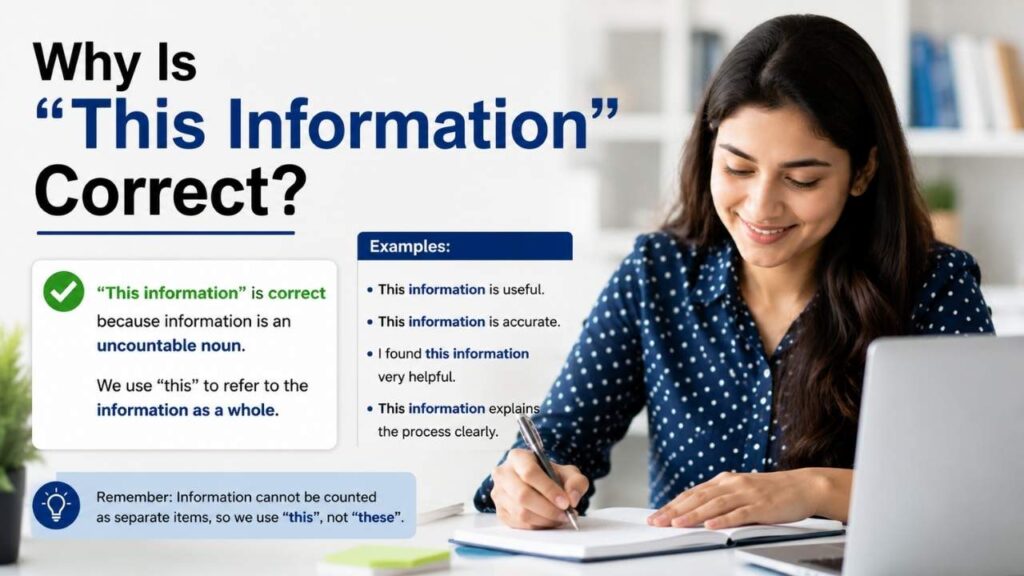
The phrase “this information” is correct because information is an uncountable noun in English. Uncountable nouns describe things that we cannot count as separate individual units. Instead of treating information as separate objects, English speakers view it as a collection of knowledge, facts, or details. That is why we use the singular demonstrative “this” with information.
For example:
- This information is useful for our project.
- This information explains the process clearly.
- I found this information online.
In each sentence, “this” refers to the complete idea or collection of knowledge being discussed. Many people confuse this rule because information may contain multiple facts, but the noun itself remains uncountable. Understanding this grammar rule helps you use correct English phrases in conversations, emails, and professional writing. When you need to refer to specific individual facts, you can use alternatives like “these pieces of information” or “these details.”
Why Is “These Information” Incorrect?
The phrase “these information” is incorrect because the word “these” requires a plural countable noun, while information does not work that way. The demonstrative “these” points to multiple separate items that we can count, such as documents, reports, facts, or ideas. However, we do not normally count information directly in English.
For example:
❌ These information is helpful.
❌ These information are important.
Both sentences sound incorrect because information is not a plural noun. Instead, use:
✅ This information is helpful.
✅ These pieces of information are helpful.
The mistake usually happens because people think of information as many separate facts. While information can contain many facts, English grammar treats it as one uncountable concept. Avoiding this common mistake will make your writing sound more natural and professional, especially in formal communication.
Is Information Singular or Plural?
Many learners ask, “Is information singular or plural?” The answer is that information is an uncountable noun, not a regular singular or plural noun. It does not change form, and it does not become “informations” in standard English. Instead, English uses quantity words and phrases that work with uncountable nouns.
Correct examples:
- I need some information about the program.
- She provided useful information.
- We received more information yesterday.
Incorrect examples:
- ❌ I need some informations.
- ❌ She gave me many information.
When you want to count separate pieces, add a counting word before information:
- A piece of information
- Two pieces of information
- Several pieces of information
Understanding that information is an uncountable noun helps you avoid mistakes with phrases like “these information,” “many information,” and “informations.” This rule applies widely in American English and everyday professional writing.
This Information vs These Pieces of Information
The difference between “this information” and “these pieces of information” depends on whether you are talking about information as a whole or separate items.
| Phrase | Correct? | Explanation |
| This information | ✅ Correct | Refers to information as a complete idea or amount |
| These information | ❌ Incorrect | “These” cannot be used with uncountable nouns |
| These pieces of information | ✅ Correct | Refers to multiple separate information items |
Use “this information” when you are discussing a report, message, data, or knowledge as one group.
Example:
- This information will help us make a decision.
Use “these pieces of information” when you want to highlight individual facts.
Example:
- These pieces of information helped the researchers complete the study.
Choosing the right phrase depends on whether you see information as a general collection or as separate pieces.
Common Mistakes With the Word “Information”
The word information creates several common grammar mistakes because many learners try to treat it like a countable noun. Understanding these errors can help you write more naturally.
Mistake 1: Using “These Information”
❌ These information are correct.
✅ This information is correct.
The word these needs a plural countable noun.
Mistake 2: Adding “S” to Information
❌ I collected many informations.
✅ I collected a lot of information.
In standard English, information does not have a plural form.
Mistake 3: Using “Many Information”
❌ She gave me many information.
✅ She gave me a lot of information.
Use much information or a lot of information because information is uncountable.
Mistake 4: Saying “An Information”
❌ I received an information.
✅ I received a piece of information.
When you need to count information, use piece of information.
Avoiding these mistakes will improve your grammar accuracy in emails, academic writing, and daily conversations.
Examples of “This Information” in Everyday English
The phrase “this information” appears frequently in everyday conversations, workplaces, and formal writing. Since information is uncountable, this phrase works naturally when referring to a specific set of knowledge, details, or facts.
Workplace Examples:
- This information will help our team complete the report.
- Please review this information before the meeting.
- We used this information to improve our strategy.
Academic Examples:
- This information supports the main argument of the research.
- Students can use this information for their assignments.
Daily Conversation Examples:
- I found this information on the internet.
- This information answers my question.
These examples show how native English speakers use “this information” naturally. Whether you are writing a business email, preparing a report, or having a conversation, this phrase remains the correct choice.
When Should You Use “These” Instead?
The word “these” is correct when it describes plural countable nouns. Unlike information, these nouns represent separate items that we can count individually. Understanding this difference helps you choose between “this” and “these” correctly.
Use these with words like:
- These documents are important.
- These facts are accurate.
- These details explain the issue.
- These reports contain useful data.
Compare:
❌ These information are useful.
✅ These details are useful.
The reason is simple: details, facts, and documents are countable, but information is not. If you want to talk about multiple parts of information, use “these pieces of information” instead.
Learning this difference between this vs these will make your English sound clearer and more natural.
This Information vs This Data vs These Details
Although information, data, and details are related words, they have different uses in English. Choosing the right word can make your writing more precise.
| Word | Meaning | Example |
| Information | General knowledge or facts | This information is helpful. |
| Data | Collected facts, numbers, or measurements | This data shows a trend. |
| Details | Specific individual points | These details explain the problem. |
Use information when you talk about knowledge as a whole. Use data when discussing research, statistics, or measurements. Use details when you want to mention separate pieces of information.
For example:
- This information explains the situation.
- This data supports the conclusion.
- These details answer the questions.
Understanding these differences helps you avoid confusing similar words and improves your overall English accuracy.
FAQs
Is “these information” grammatically correct?
No, “these information” is not grammatically correct in standard English. Use “this information” because information is an uncountable noun.
Why can’t we say “these informations”?
Because information does not normally have a plural form. The correct alternative is “these pieces of information.”
What is the plural form of information?
Information usually has no plural form. Instead of “informations,” use pieces of information.
Is information countable or uncountable?
Information is an uncountable noun, which means we cannot count it directly.
Should I say this information or these details?
Use this information for general knowledge and these details for separate points.
Can I say “many information”?
No. Use much information or a lot of information instead.
What is another way to say multiple information?
Use phrases like several pieces of information, different details, or various facts.
Is “this information is” or “these information are” correct?
The correct phrase is “this information is” because information takes a singular verb form.
Conclusion
The correct phrase is “this information,” while “these information” is incorrect in standard English. The main reason is that information is an uncountable noun, so it does not take a plural form. Even though information may include many facts or details, English treats it as one general concept.
When you need to describe separate items, use “these pieces of information” instead. Remember:
✅ This information is useful.
❌ These information are useful.
✅ These pieces of information are useful.
By understanding the difference between this and these, you can avoid common grammar mistakes and write clearer English in everyday conversations, academic work, and professional communication.