
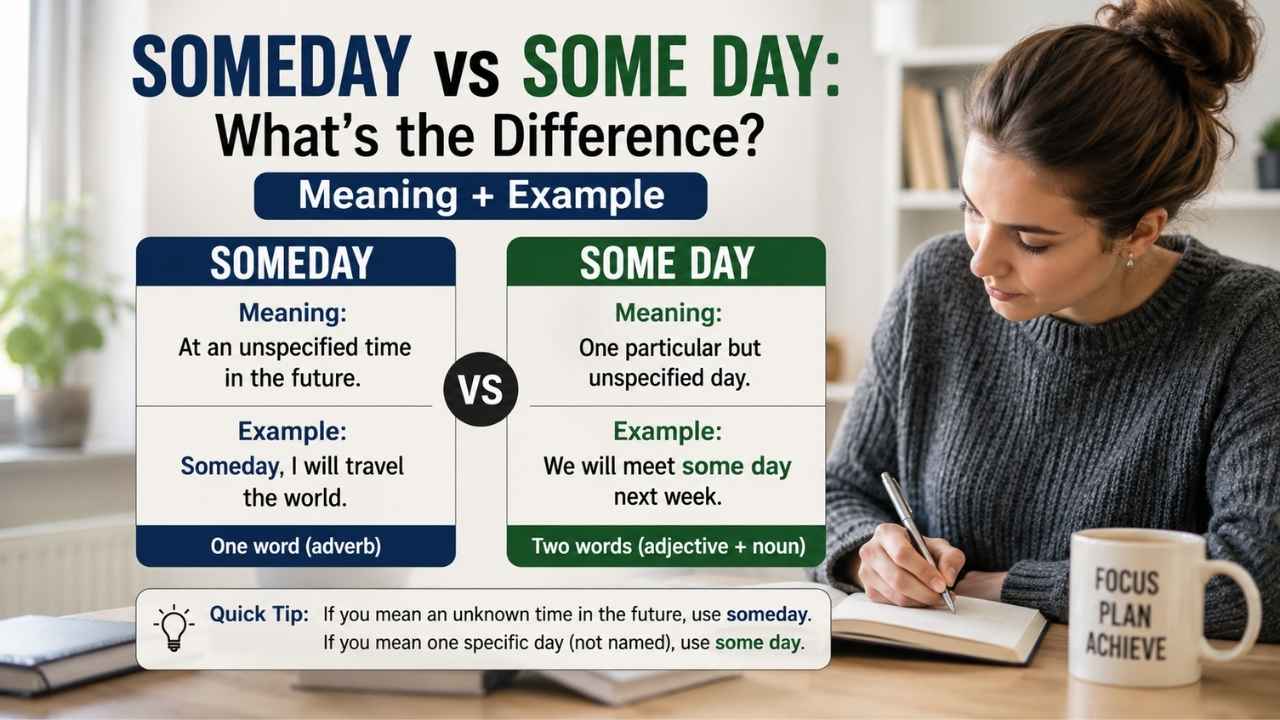
Someday vs Some Day: What’s the Difference? Meaning, Example
Have you ever wondered whether you should write “someday” or “some day”? Although they look almost identical, they have different meanings and are used in different situations. Knowing the difference between someday vs some day can help you avoid common grammar mistakes and make your writing clearer.
In English grammar, someday is an adverb that refers to an unspecified time in the future, while some day is a two-word phrase that means one particular but unspecified day.
In this guide, you’ll learn the grammar rule, correct usage, simple definitions, and plenty of sentence examples to help you choose the right form every time. Whether you’re a student, writer, professional, or English learner, this easy usage guide will help you write with confidence.
Quick Answer
The difference between someday and some day is simple. Someday is an adverb that means at an unspecified time in the future, while some day is a two-word phrase meaning one particular but unspecified day. Both are grammatically correct, but they are not interchangeable. Choosing the right form depends on the meaning you want to express.
Someday vs Some Day: The Main Difference at a Glance

Many people think someday and some day mean the same thing because the only difference is a space. However, they have different meanings in English grammar. Someday is an adverb that means at an unspecified time in the future.
Some day, on the other hand, is a two-word phrase that means one particular but unspecified day. Both forms are grammatically correct, but they are not interchangeable. Understanding the difference between someday and some day helps you make better word choices and avoid common writing mistakes.
If you enjoy learning about confusing English words, you may also like our guides on Hear vs Here, Orientated vs Oriented, and Is It Correct to Say Most Recent.
What Does “Someday” Mean?
Someday is a single word that works as an adverb of time. It refers to an unspecified time in the future without mentioning an exact date or day. You use someday when talking about hopes, dreams, plans, or events that may happen later. It answers the question “When?” but leaves the timing open.
This is why someday is common in both everyday conversations and writing. If you’re wondering when to use someday, remember that it always points to the future rather than a specific day. Here are a few examples: “Someday I’ll visit New York.” “She hopes to become a doctor someday.” In each sentence, the future time is unknown but expected.
What Does “Some Day” Mean?
Some day is a two-word phrase made up of the adjective some and the noun day. Together, they refer to one particular but unspecified day. Unlike someday, this phrase focuses on a specific day, even though the exact date is not given.
Learning how to use some day correctly will make your writing clearer and more accurate. For example, “Let’s meet some day next month.” Here, the speaker is talking about one day within next month, not just any future time.
Another example is “Some day you’ll understand why I made this decision.” In this sentence, some day points to one future day when understanding will happen. Knowing this grammar rule helps avoid confusion.
Why Does One Space Change the Meaning?
It may seem surprising, but a single space can completely change the meaning of a phrase. The reason is that someday and some day have different grammatical functions. Someday is one word and acts as an adverb, describing when something happens.
Some day is a phrase where some describes the noun day, making it an adjective + noun combination. This small spacing difference changes how the words work in a sentence. That is why spacing changes meaning in English.
Understanding this simple grammar point makes it easier to choose the correct form and improves your English writing, whether you’re writing emails, school assignments, or everyday messages.
Grammar Rule Explained: When to Use Someday vs Some Day
The easiest grammar rule to remember is this: use someday when you mean at an unspecified time in the future. Use some day when you mean one particular but unspecified day. A simple test can help.
If you can replace the word with “one day” without changing the meaning, some day is usually the correct choice. If you’re talking about a general future time instead of a specific day, use someday.
This rule makes it much easier to decide which is correct: someday or some day. Although both forms are grammatically correct, they have different meanings, so choosing the right one helps your writing sound natural and clear.
Side-by-Side Comparison Table
| Feature | Someday | Some Day |
| Meaning | At an unspecified time in the future | One particular but unspecified day |
| Part of Speech | Adverb | Adjective + Noun |
| Usage | Talks about a general future time | Refers to a specific day that isn’t named |
| Can it be replaced with “one day”? | No | Usually yes |
| Example | Someday I’ll write a book. | Let’s meet some day next week. |
This simple comparison shows the difference between someday and some day at a glance. If you’re unsure when to use someday or when to use some day, check the meaning first instead of looking only at the spelling. The correct choice depends on the message you want to express.
Real-Life Examples of “Someday” and “Some Day”
Seeing both forms in real situations makes the grammar rule easier to understand. Here are a few examples.
Conversation: Someday we’ll travel across Europe together.
Workplace: I hope to become a team leader someday.
Email: Let’s schedule the meeting some day next week.
School: Some day our class will visit the science museum.
Family: Someday I’ll teach my children how to fish.
Planning: We should choose some day this month for the family picnic.
These sentence examples show that someday expresses a general future hope or plan, while some day refers to one particular day, even if that day hasn’t been chosen yet. Using them correctly makes your writing smoother and more professional.
Common Mistakes and How to Fix Them
One of the most common grammar mistakes is using someday and some day as if they have the same meaning. They don’t. Here are a few examples.
❌ Let’s meet someday next Tuesday.
✔ Let’s meet some day next Tuesday.
❌ Someday next week I’ll finish the report.
✔ Some day next week I’ll finish the report.
❌ Some day I’ll own my dream house.
✔ Someday I’ll own my dream house.
A helpful tip is to think about whether you’re talking about a general future time or one specific day. If it’s a dream, goal, or hope, use someday. If you’re referring to a particular day that isn’t named, use some day. This simple habit will help you avoid common writing errors.
One Day vs. Someday vs. Some Day
Many writers also confuse one day, someday, and some day because they all talk about future time. However, their meanings are slightly different. Someday refers to an unknown time in the future, usually connected with hopes, dreams, or goals.
For example, “I want to visit Japan someday.” One day can have a similar meaning, but it can also refer to a specific day in the past or future. For example, “One day, I received an unexpected letter.”
Some day focuses on one particular but unnamed day. For example, “We should meet some day this summer.” Understanding these small differences helps you use these time expressions in English correctly and improves your overall writing clarity.
Easy Memory Trick to Remember the Difference
Remembering someday vs some day does not have to be difficult. Use this simple memory trick: one word means one general future time, while two words mean one specific day. When you talk about a dream, wish, or future possibility, choose someday.
For example, “I hope to learn another language someday.” When you talk about a day that could be identified but is not named, choose some day. For example, “We will visit the museum some day this month.”
Another helpful tip is to replace some day with one day. If the sentence still makes sense, some day may be the right choice. This easy rule makes choosing the correct form much faster.
Practice Quiz: Can You Choose the Correct Form?
Now that you understand the difference between someday and some day, test your knowledge. Choose the correct option in each sentence.
- I hope to start my own business ______.
- (Someday / Some day)
- Let’s meet ______ after the holidays.
- (Someday / Some day)
- She believes she will achieve her goals ______.
- (Someday / Some day)
- We should plan a trip ______ next month.
- (Someday / Some day)
Answers:
- Someday — It refers to an unknown future time.
- Some day — It refers to one specific but unnamed day.
- Someday — It expresses a future hope or dream.
- Some day — It points to a particular day within a period.
Practice like this helps you remember the grammar rule and use both forms naturally in everyday writing.
FAQs
Is someday one word?
Yes. Someday is written as one word when it means at an unknown time in the future.
Is some day grammatically correct?
Yes. Some day is also correct when you mean one particular but unspecified day.
Are someday and some day interchangeable?
No. Although they look similar, they have different meanings and are not always interchangeable.
When should I use someday?
Use someday when talking about future hopes, dreams, or plans without a specific date.
When should I use some day?
Use some day when referring to one specific day that has not been named.
Is someday formal or informal?
Someday is common in both casual and formal writing when used correctly.
How can I remember the difference?
Think: someday = someday in the future, while some day = one day.
Conclusion
The difference between someday and some day comes down to meaning, not spelling alone. Someday is an adverb used for an unknown time in the future, while some day is an adjective + noun phrase that refers to one particular but unnamed day.
Both forms are correct, but using the wrong one can change the meaning of your sentence. A simple rule can help: use someday for dreams, goals, and future possibilities; use some day for a specific day that has not been identified.
By understanding this English grammar rule and practicing with examples, you can avoid confusion and write more clearly. Good word choice makes your writing sound natural, confident, and professional.