
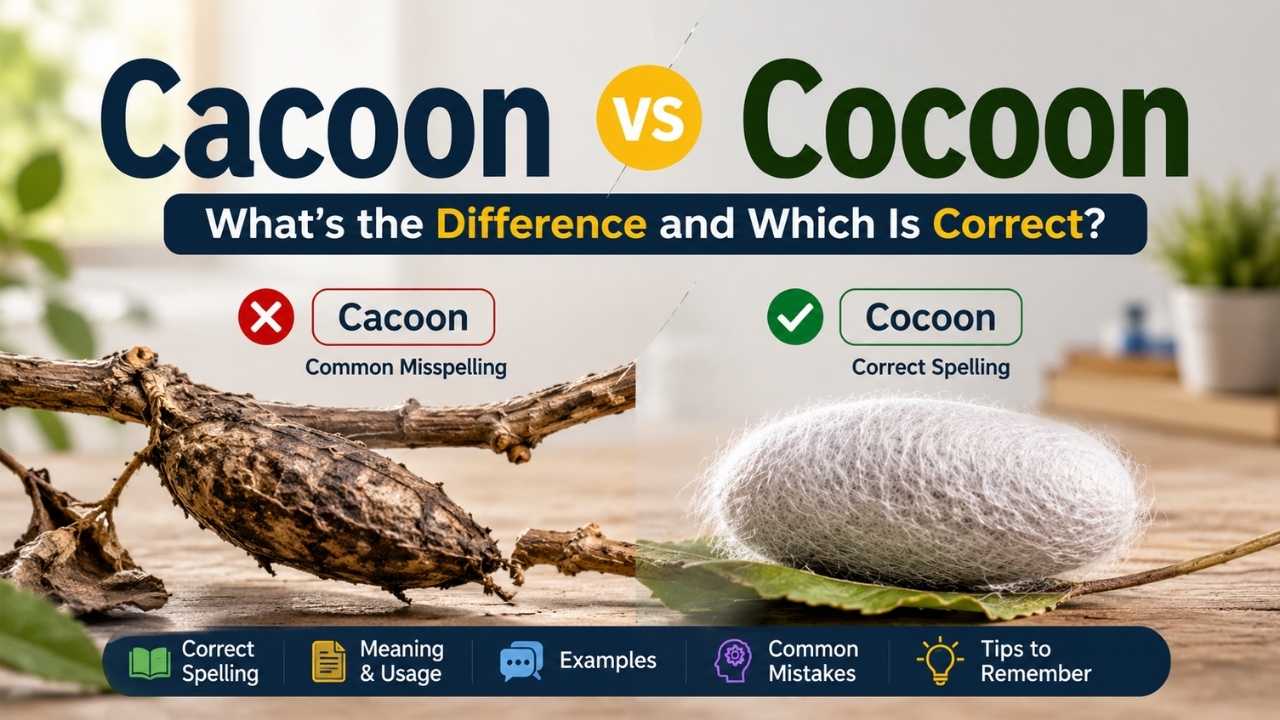
Cacoon vs Cocoon: What’s the Difference and Which Is Correct?
Have you ever typed “cacoon” and wondered whether it was the correct spelling? You are not alone. Many people search for “Cacoon vs Cocoon”, “Cacoon or Cocoon,” or ask, “Is cacoon a word?” because the two spellings look very similar. However, they do not mean the same thing in standard English.
The correct spelling is “cocoon.” A cocoon is a protective silk casing made by certain insects, such as moths, during metamorphosis. In contrast, “cacoon” is usually a common spelling mistake, although it has a rare botanical meaning that most English learners never need to use.
In this guide, you’ll learn the difference between cacoon and cocoon, discover the correct spelling of cocoon, understand its meaning, explore real-life examples, avoid common mistakes, and learn an easy trick to remember the correct word every time.
Quick Answer
If you’re wondering “Cacoon vs Cocoon” or asking “Which spelling is correct?”, the answer is simple: “Cocoon” is the correct spelling in standard English. A cocoon is a protective silk casing that certain insects, such as moths, spin around themselves during metamorphosis. Many people accidentally write “cacoon”, but in most situations, it is only a misspelling.
Although cacoon has a rare botanical meaning, it does not refer to the silk covering made by insects. If you are writing about butterflies, moths, insects, or biology, always use “cocoon.” Learning the correct spelling of cocoon will improve your writing, help you avoid common spelling mistakes, and make your communication clearer.
Cacoon vs Cocoon at a Glance
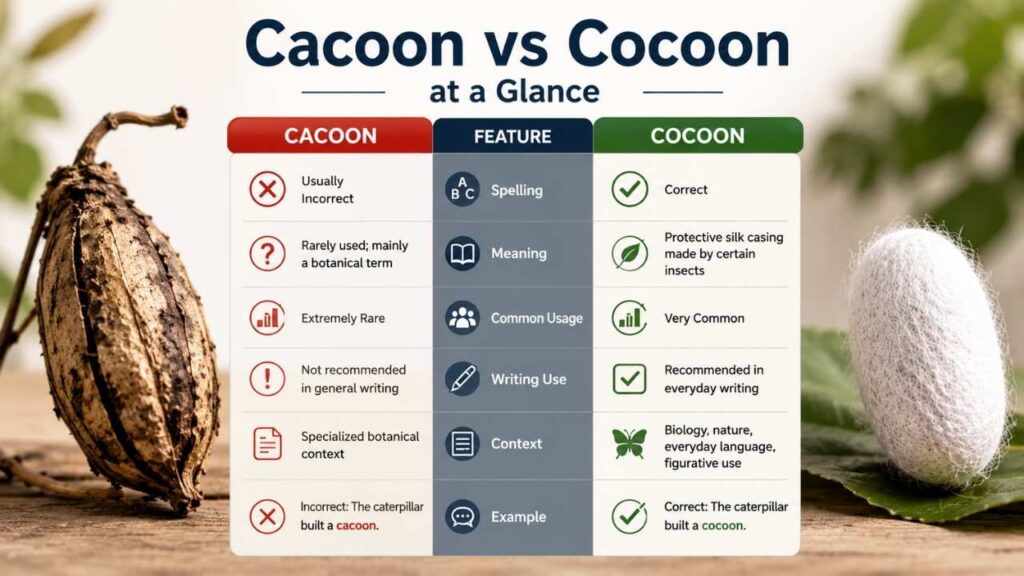
The easiest way to understand Cacoon vs Cocoon is by comparing them side by side.
| Feature | Cocoon | Cacoon |
| Spelling | ✅ Correct | ❌ Usually Incorrect |
| Meaning | A silk casing made by certain insects | Usually a misspelling; rarely a botanical term |
| Usage | Standard English | Rarely used |
| Common Context | Biology, nature, figurative writing | Specialized botanical references |
| Example | The caterpillar built a cocoon. | Incorrect: The caterpillar built a cacoon. |
Whenever you ask, “Cacoon or Cocoon?”, remember that cocoon is almost always the right choice. Unless you are discussing the rare botanical meaning, cacoon should be avoided in everyday writing.
What Does “Cocoon” Mean?
The word “cocoon” refers to a protective silk covering created by the larvae of certain insects, especially moths, before they become adults. During metamorphosis, the insect stays safely inside the cocoon while its body changes. This biological meaning is the most common and the one most people search for when they look up the cocoon meaning or cocoon definition.
People also use cocoon in a figurative sense. For example, someone may cocoon themselves at home to enjoy peace, privacy, and comfort. In this context, the word suggests feeling safe and protected from the outside world. Whether you use it in science or everyday conversation, cocoon always carries the idea of protection, growth, and transformation.
Biological Meaning
In biology, a cocoon is a silk casing spun by the larvae of insects such as moths. Inside this covering, the insect develops until it is ready to emerge as an adult. The cocoon protects the insect from weather, predators, and other dangers during this important stage of its life cycle.
Figurative Meaning
Outside biology, people often use cocoon to describe a place or feeling of comfort and safety. Someone might say they want to cocoon themselves during a rainy weekend by staying home with a blanket and a good book. This figurative meaning has become common in everyday English.
Cocoon as a Verb
The word cocoon also works as a verb. It means to wrap, surround, or protect someone or something. For example, parents may cocoon a child with love and care, or travelers may cocoon themselves in warm clothing during winter.
Is “Cacoon” a Real Word?
Many people ask, “Is cacoon a word?” The answer depends on the context. In everyday English, cacoon is not the correct spelling when referring to the silk covering made by insects. Most dictionaries and grammar experts treat it as a common misspelling of cocoon.
However, cacoon has a rare botanical meaning. It can refer to a tropical plant or its seed in specialized botanical discussions. This usage is uncommon and appears mainly in scientific or historical references. Because most readers are looking for the correct spelling of cocoon, you should use “cocoon” in almost every situation. Unless your topic is botany, writing cacoon instead of cocoon may confuse readers and weaken your writing.
Cacoon vs Cocoon: Key Differences
Although cacoon and cocoon look alike, their usage is very different. The biggest difference is that cocoon is the accepted English spelling, while cacoon is usually a spelling error.
| Feature | Cocoon | Cacoon |
| Correct Spelling | ✅ Yes | ❌ Usually No |
| English Usage | Common | Extremely Rare |
| Dictionary Recognition | Standard | Rare botanical usage |
| Everyday Writing | Recommended | Not Recommended |
| Biology | Yes | No |
When writing essays, articles, emails, or social media posts, choose cocoon. If someone searches for “What is the difference between cacoon and cocoon?”, the simplest answer is that cocoon is the standard English word, while cacoon is generally a misspelling with a rare specialized meaning.
Why Do People Misspell “Cocoon”?
Many English learners and even native speakers accidentally write “cacoon” instead of “cocoon.” This happens because the two words sound similar when spoken quickly. People often rely on pronunciation rather than remembering the exact spelling.
Another reason is the double “o” in the middle of cocoon. Double vowels can confuse writers, especially when typing fast. Autocorrect may also fail to catch the mistake if the word appears in a specialized dictionary. Some people simply guess the spelling because they have heard the word more often than they have seen it written.
The easiest way to avoid this common spelling mistake is to remember that cocoon contains two “o” letters, just like the rounded shape of the protective covering itself.
Pronunciation Guide
Knowing the correct cocoon pronunciation can help you avoid spelling mistakes. The word cocoon is pronounced /kəˈkuːn/, which sounds like “kuh-KOON.” The stress falls on the second syllable. Since both syllables contain an “oo” sound, some people mistakenly write “cacoon” instead.
If you’re wondering how do you spell cocoon correctly, say the word slowly: kuh-KOON. Then remember that both long vowel sounds use the letter “o,” not “a.” Reading the word aloud while writing it is another simple way to remember the correct spelling.
Practicing the correct pronunciation and spelling together will improve your vocabulary and help you avoid common writing errors.
Examples in Sentences
Reading cocoon examples in context makes it easier to remember the correct spelling and usage.
Correct Examples
- The caterpillar spun a cocoon before becoming a moth.
- After a long week, I wanted to cocoon myself at home with a good book.
- The scientist carefully studied the insect inside its cocoon.
- The child learned that a cocoon protects the insect during metamorphosis.
Incorrect Examples
- ❌ The caterpillar built a cacoon.
- ❌ I found a beautiful cacoon on the tree.
Everyday Examples
- She created a cozy cocoon of blankets during the winter.
- The hotel room felt like a peaceful cocoon away from the busy city.
Using these examples will help you remember that cocoon is the standard spelling in everyday English.
Cocoon vs Chrysalis
Many people confuse a cocoon with a chrysalis, but they are not the same thing. A cocoon is a silk covering spun by the larvae of many moths. The insect stays inside this protective case while it develops into an adult.
A chrysalis, however, is the hard outer stage of a butterfly’s pupa. Butterflies do not spin silk cocoons. Instead, their bodies naturally harden into a chrysalis during metamorphosis.
Understanding this difference helps you use the correct scientific term. If someone asks, “Do butterflies make cocoons?”, the answer is usually no. Most butterflies develop inside a chrysalis, while many moths develop inside a cocoon.
Common Mistakes to Avoid
When learning Cacoon vs Cocoon, writers often make the same mistakes. Avoiding these errors will improve your grammar and spelling.
- Writing “cacoon” instead of “cocoon.” In most cases, cocoon is the only correct spelling.
- Confusing a cocoon with a chrysalis. They are different stages in the life cycles of different insects.
- Ignoring figurative usage. Remember that cocoon can also describe a feeling of comfort, safety, or privacy.
- Relying only on pronunciation. Always check the spelling before publishing your work.
By paying attention to these common mistakes, you can write with more confidence and answer questions like “Which spelling is correct, cacoon or cocoon?” without hesitation.
Memory Trick to Remember the Correct Spelling
A simple memory trick can help you remember the correct spelling of cocoon forever.
Think about the word “moon.” Both moon and cocoon contain the double “oo” sound. Since a cocoon is round and protective, imagine its shape matching the two round “o” letters in the middle of the word.
Another easy trick is this:
Two “O”s protect the insect inside the cocoon.
Whenever you feel unsure and ask yourself “Is cacoon the correct spelling?”, picture the two “o” letters wrapping around the insect like its protective covering. This simple visual reminder makes the correct spelling much easier to remember.
Related Words
Learning related words helps expand your vocabulary and improves your understanding of cocoon.
- Cocooned – Protected or surrounded.
- Cocooning – Staying comfortably at home or avoiding outside activity.
- Cocoon-like – Similar to a cocoon in appearance or feeling.
- Pupa – The life stage during which many insects develop into adults.
- Metamorphosis – The process of changing from one life stage to another.
- Chrysalis – The protective stage of a butterfly during development.
These related words appear in books, science lessons, and everyday English. Learning them together with cocoon helps you understand the topic more completely.
FAQs
Is cacoon a correct spelling?
No. Cocoon is the correct spelling in standard English. Cacoon is usually a misspelling, although it has a rare botanical meaning.
Is cacoon a real English word?
Yes, but only in a rare botanical context. In everyday writing, you should use cocoon instead.
What does cocoon mean?
A cocoon is a protective silk covering made by certain insects during metamorphosis. It can also describe a place or feeling of safety and comfort.
Can cocoon be used as a verb?
Yes. Cocoon can mean to wrap, protect, or surround someone or something.
Do butterflies make cocoons?
No. Most butterflies form a chrysalis, while many moths spin a cocoon.
How do you spell cocoon correctly?
The correct spelling is C-O-C-O-O-N.
Why do people spell cocoon as cacoon?
People often confuse the spelling because of pronunciation, typing habits, and the double “o” letters.
Conclusion
When comparing Cacoon vs Cocoon, the answer is clear. Cocoon is the correct spelling in standard English and the word you should use when referring to the protective silk casing made by certain insects. While cacoon exists as a rare botanical term, it is not the correct choice for everyday writing, biology, or grammar discussions.
If you ever wonder “Cacoon or Cocoon?”, remember this simple rule: Choose “cocoon” almost every time. It is the spelling recognized in dictionaries, schools, and professional writing.
By understanding its meaning, pronunciation, usage, and common mistakes, you can write with confidence and avoid one of the most common spelling errors in English.