
Dateline vs Deadline: What’s the Difference and Which Is Correct?
Many people confuse dateline vs deadline because the two words look alike and both relate to dates and written communication. However, they have completely different meanings and belong in different situations. Understanding the difference between dateline and deadline helps you choose the correct word whether you’re reading a news article, writing a press release, completing a school assignment, or meeting a work schedule.
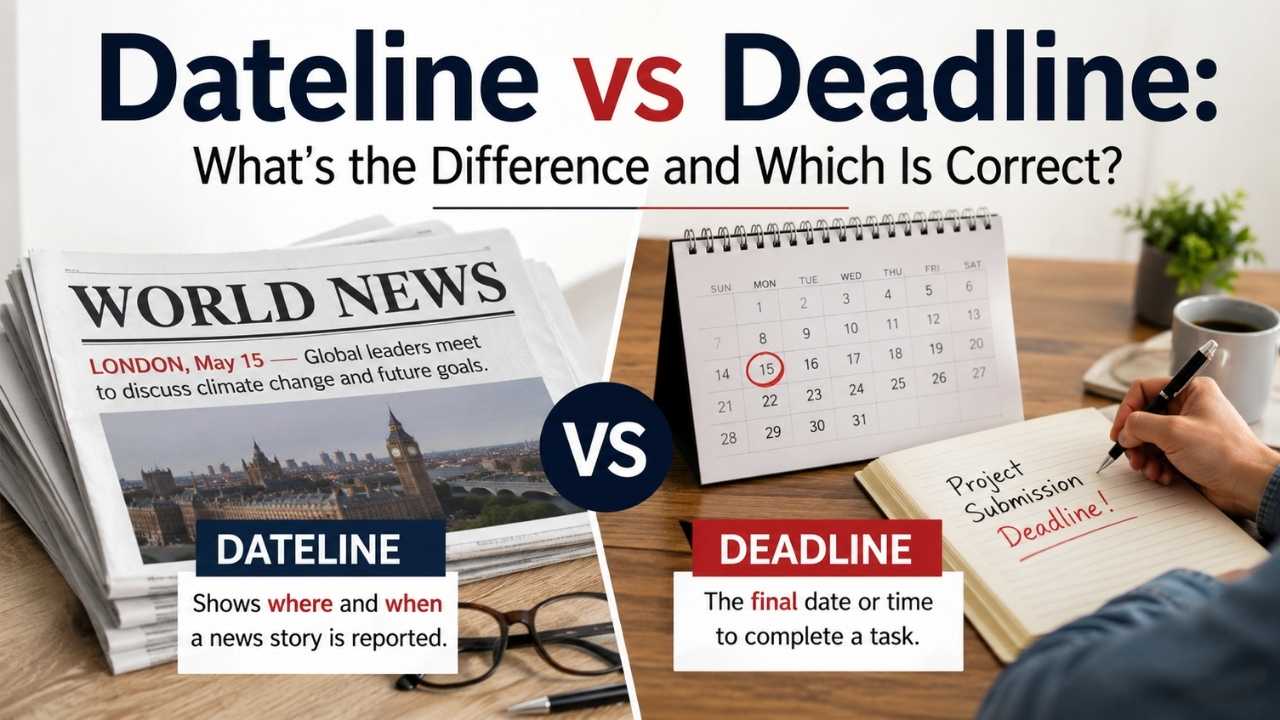
A dateline tells readers where and when a news story was reported, while a deadline is the final date or time by which a task must be completed. Since these words are not interchangeable, using the wrong one can confuse your readers.
In this guide, you’ll learn the dateline meaning, deadline meaning, their key differences, when to use dateline or deadline, practical examples, common mistakes, and a simple trick to remember the correct word every time.
Quick Answer
The difference between dateline and deadline is simple once you know what each word means. A dateline appears at the beginning of a news article or press release. It tells readers where and sometimes when the story was reported. In contrast, a deadline is the final date or time by which someone must finish a task.
You may see a deadline for a school assignment, job application, project, or tax filing. Although both words contain “date,” they have different purposes and should not be used interchangeably. If you are writing about journalism, use dateline.
If you are talking about a due date, submission deadline, or completion date, use deadline. Choosing the correct word makes your writing clearer and more accurate.
Dateline vs Deadline at a Glance
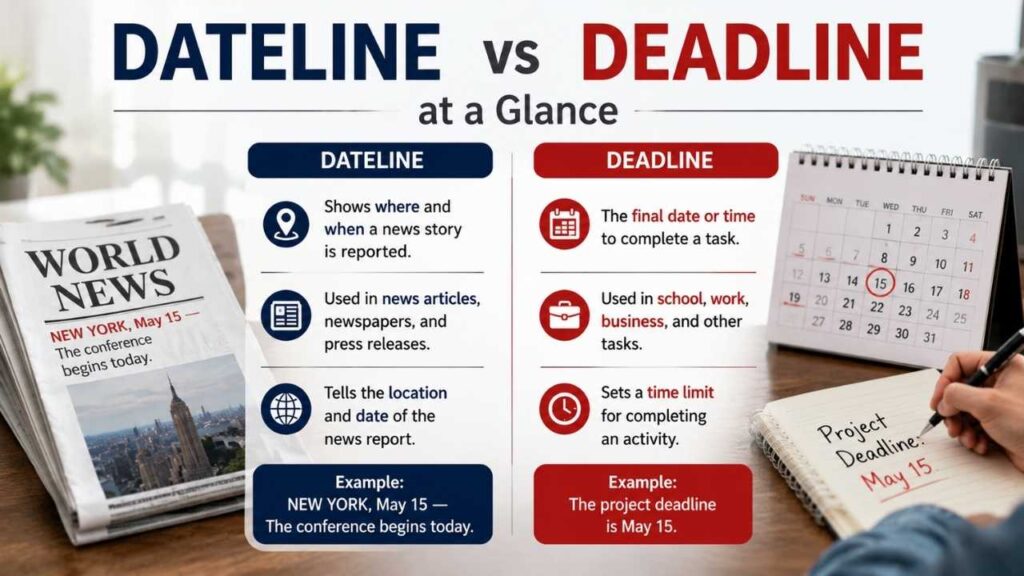
The table below gives a quick comparison of dateline vs deadline. It shows their meaning, purpose, where they are used, and examples. If you only need a fast answer, this comparison will help you understand the key differences without reading the full guide. Remember that a dateline belongs to news reporting and provides information about the place and date of a story.
A deadline, however, sets a time limit for completing work. Students, writers, businesses, and professionals often work with deadlines, while reporters and editors use datelines. Even though these words sound similar, they have different roles in English grammar and should never replace one another in writing.
| Feature | Dateline | Deadline |
| Meaning | Shows where and when a news story was reported | The final date or time to complete a task |
| Purpose | Gives context to a news report | Sets a time limit |
| Common Use | Journalism, newspapers, press releases | School, work, business, legal documents |
| Example | LONDON, July 20 | Submit the report by July 20. |
| Interchangeable? | ❌ No | ❌ No |
What Does “Dateline” Mean?
A dateline is a line at the beginning of a news article or press release that tells readers where and sometimes when the story was reported. It is a common feature in journalism because it gives important background information before the article begins. A dateline usually includes the city and the date, helping readers identify the source of the news.
Unlike a deadline, it does not set a time limit or due date. Instead, it provides context for the story. If you are learning the dateline meaning, remember that it belongs to news reporting and helps readers understand where the information came from. Knowing when to use a dateline will help you avoid confusing it with a deadline.
Where Datelines Are Used
You will usually find datelines in newspapers, news websites, and press releases. Reporters use them to show where the story was reported before the main text begins.
Parts of a Dateline
A dateline usually includes the city and the date. Some publications may also include the state or country, depending on the location and style guide.
Dateline Examples
- NEW YORK, July 12 — The mayor announced new housing plans.
- LONDON, March 5 — Scientists shared the results of a new study.
What Does “Deadline” Mean?
A deadline is the final date or time by which you must complete a task. People use deadlines in schools, businesses, government offices, and many other settings. For example, you may have a submission deadline, assignment deadline, or project deadline. Missing a deadline can delay work or cause you to miss an important opportunity.
Unlike a dateline, which gives the location of a news story, a deadline tells you when something must be finished. Understanding the deadline meaning makes it easier to use the correct word in everyday writing. Whenever you see the word deadline, think of a due date or time limit, not a news article or journalism.
Common Uses
Deadlines are common in school assignments, job applications, business projects, tax filings, and legal documents. They help people complete work on time.
Deadline Examples
- The application deadline is June 30.
- We met the project deadline ahead of schedule.
- Please submit your report before the submission deadline.
Dateline vs Deadline: Key Differences
Although dateline and deadline look similar, they have very different meanings. A dateline belongs to journalism and tells readers where and when a news story was reported. A deadline, on the other hand, is the final date or time to complete a task.
You may see a dateline in a newspaper, news article, or press release, while deadlines appear in schools, businesses, and government offices.
These words are not interchangeable, so using the wrong one can confuse your readers. If you remember that a dateline gives information about a story and a deadline gives a time limit, choosing the correct word becomes much easier. The comparison below highlights the key differences between dateline vs deadline.
| Feature | Dateline | Deadline |
| Meaning | Shows where and when a news story was reported | The final date or time to complete a task |
| Purpose | Gives context to a news report | Sets a time limit |
| Common Use | Newspapers, journalism, press releases | School, work, business, legal documents |
| Example | PARIS, June 10 — | The application deadline is June 10. |
| Interchangeable? | No | No |
When to Use “Dateline”
Use a dateline whenever you write or read a news article, press release, or other form of news reporting. Its purpose is to tell readers where the story was reported and sometimes when it was written. Journalists, editors, and news organizations use datelines to provide clear context before the main article begins.
You should not use a dateline when writing emails, essays, reports, or school assignments because those types of writing usually do not require one. If you are unsure when to use dateline, ask yourself whether you are writing a news story. If the answer is yes, a dateline is probably appropriate. Otherwise, another format is usually the better choice.
Use a Dateline When:
- Writing a news article
- Creating a press release
- Reporting an event from a specific location
- Publishing news for newspapers or news websites
When to Use “Deadline”
Use a deadline whenever you need to describe the final date or time for completing a task. Deadlines are common in everyday life because they help people finish work on time. You may have a submission deadline for a report, an assignment deadline at school, or an application deadline for a job or scholarship.
Businesses also use deadlines to manage projects and keep work on schedule. Unlike a dateline, a deadline does not describe a location or a news report. Instead, it reminds people that something must be completed before a specific time.
Understanding when to use deadline will help you communicate clearly and avoid one of the most common English grammar mistakes.
Use a Deadline When:
- Submitting homework or projects
- Applying for jobs or scholarships
- Completing business tasks
- Filing taxes or legal documents
- Meeting a due date
Can Dateline and Deadline Be Used Interchangeably?
No. Dateline and deadline have different meanings, so you should never use them interchangeably. A dateline belongs to journalism and gives readers information about the location and date of a news story. A deadline tells people the final time to finish a task. Replacing one word with the other changes the meaning of your sentence and may confuse your audience.
For example, saying “The project dateline is Friday” is incorrect because projects have deadlines, not datelines. Likewise, a newspaper article begins with a dateline, not a deadline. Learning this simple difference helps you avoid common writing mistakes and choose the correct word with confidence.
Incorrect: The report’s dateline is Friday.
Correct: The report’s deadline is Friday.
Incorrect: The newspaper published a deadline from London.
Correct: The newspaper published a dateline from London.
Why People Confuse Dateline and Deadline
Many people confuse dateline and deadline because the words look and sound alike. Both contain the word “date,” and both often appear in written communication. However, they serve completely different purposes.
A dateline gives information about a news story, while a deadline sets a time limit for completing work. People who are new to English vocabulary or journalism often mix them up because they assume both words relate to due dates.
The easiest way to avoid this mistake is to remember their main functions. Think of a dateline as the beginning of a news report and a deadline as the finish line for a task. This simple trick makes the difference much easier to remember.
Dateline vs Deadline in Real-Life Scenarios
Knowing the difference between dateline and deadline becomes much easier when you see how each word works in real life. A dateline appears in journalism, where it tells readers the location and date of a news report. A deadline, however, appears in everyday situations where someone must complete a task before a specific time.
Students, employees, business owners, and government offices all use deadlines to manage work and stay organized. Understanding these real-life examples will help you use the correct word with confidence. Whenever you read a news article, think about the dateline. Whenever you need to finish an assignment, submit an application, or complete a project, think about the deadline.
Journalism
A reporter writes a story about a sports event. The article begins with “LOS ANGELES, July 15 —” to show where the news was reported. This line is the dateline.
Business
A company asks employees to submit their monthly reports by Friday. Friday is the deadline because it is the final day to complete the task.
Academic Writing
A teacher gives students one week to submit their essays. The last day to hand in the assignment is the submission deadline.
Press Releases
A company starts its announcement with “NEW YORK, April 20 —” before sharing important news. This opening line is the dateline.
Common Mistakes to Avoid
Many writers use dateline and deadline incorrectly because the words look similar. The easiest way to avoid mistakes is to remember that a dateline belongs to a news article, while a deadline belongs to a task with a due date. Before using either word, think about the purpose of your sentence.
Are you talking about the source of a news story or the final time to complete something? If you answer that question first, you will choose the correct word every time. Learning these common mistakes also improves your English grammar, builds a stronger vocabulary, and helps you write with greater confidence in school, work, and everyday communication.
| ❌ Incorrect | ✅ Correct |
| The project dateline is Friday. | The project deadline is Friday. |
| We missed the dateline for the scholarship. | We missed the deadline for the scholarship. |
| The article begins with a deadline. | The article begins with a dateline. |
| Please read the deadline at the top of the news story. | Please read the dateline at the top of the news story. |
Memory Trick to Remember the Difference
A simple memory trick can help you remember dateline vs deadline without confusion. Think of the word dateline as “date + location.” It appears at the beginning of a news article and tells readers where the story comes from. Now think of deadline as the line you should not cross because your work must be finished before that time.
This image makes the meaning easy to remember. Whenever you see a press release or newspaper article, look for the dateline. Whenever you receive homework, a work project, or a job application, check the deadline. This quick reminder works well for students, writers, and anyone learning English vocabulary.
Easy Tip:
- Dateline = Date + Location + News
- Deadline = Due Date + Finish Your Work
Related Terms You Shouldn’t Confuse
Some words are closely related to dateline and deadline, but they have different meanings. Learning these terms will help you avoid more common English errors and improve your writing. Two of the most confusing comparisons are dateline vs byline and deadline vs due date. Although these words appear in similar situations, each one has its own purpose. Understanding the differences makes your writing clearer and more professional.
Dateline vs Byline
A dateline tells readers where and when a news story was reported. A byline tells readers who wrote the article. One identifies the location, while the other identifies the author.
Deadline vs Due Date
A due date is the day something should be submitted. A deadline is the final limit for completing a task. In many everyday situations, people use these terms in a similar way, but deadline often suggests that late submissions are not accepted.
Frequently Used Collocations
Learning common collocations helps you sound more natural in English. These word combinations appear often in books, newspapers, workplaces, and daily conversations. If you know these phrases, you will use dateline and deadline more confidently and avoid awkward wording.
Common Collocations with Dateline
- news dateline
- newspaper dateline
- press release dateline
- foreign dateline
- article dateline
Common Collocations with Deadline
- meet a deadline
- miss a deadline
- tight deadline
- hard deadline
- submission deadline
- application deadline
- project deadline
- assignment deadline
FAQs
What is the difference between dateline and deadline?
A dateline shows where and when a news story was reported. A deadline is the final date or time to complete a task.
Is a dateline the same as a deadline?
No. A dateline belongs to journalism, while a deadline refers to a due date or time limit.
What is a dateline in journalism?
A dateline is a line at the beginning of a news article that shows the reporting location and often the date.
What is a deadline?
A deadline is the last date or time to submit or finish work, such as an assignment, project, or application.
Can dateline and deadline be used interchangeably?
No. They have different meanings and should never replace one another.
Where is a dateline used?
A dateline is used in newspapers, news websites, and press releases.
Where is a deadline used?
A deadline is used in schools, businesses, government offices, and other situations where tasks have a due date.
Is a deadline the same as a due date?
They are similar, but a deadline usually means the final limit, while a due date can sometimes be more flexible.
What comes first, a byline or a dateline?
A dateline shows the location and date of the story, while a byline identifies the author. Their placement depends on the publication’s style.
How can I remember the difference between dateline and deadline?
Remember this simple trick: Dateline = News + Location, Deadline = Due Date + Finish Your Work.
Conclusion
Understanding the difference between dateline and deadline is easier once you know the purpose of each word. A dateline belongs to journalism and tells readers where and when a news story was reported.
A deadline is the final date or time for completing a task, such as an assignment, project, or application. Although these words look alike, they have different meanings and should never be used interchangeably. Remember this simple rule: dateline = news, deadline = due date.
Keeping this distinction in mind will help you avoid common grammar mistakes, improve your English vocabulary, and communicate more clearly. Whether you’re reading a newspaper, writing a press release, or meeting a project deadline, you’ll know exactly which word to use.