
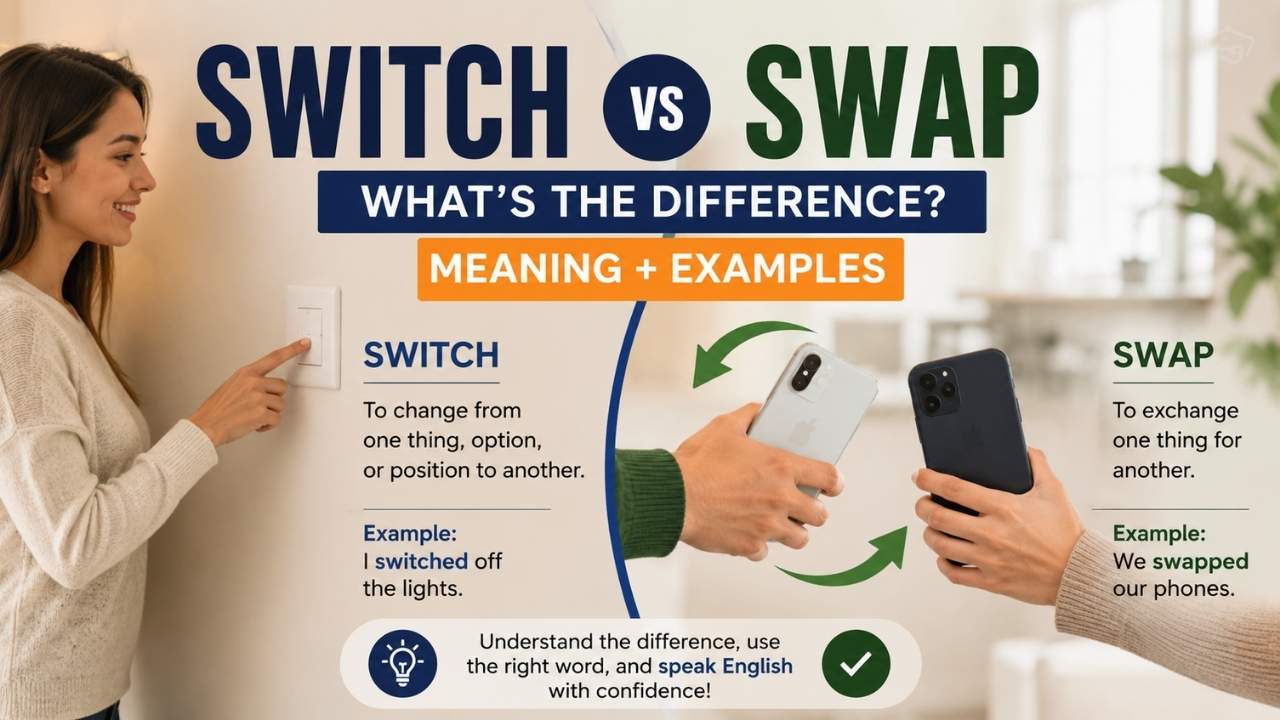
Switch vs Swap: What’s the Difference? Meaning + Examples
If you’ve ever wondered whether switch vs swap mean the same thing, you’re not alone. Many English learners and even native speakers get confused when deciding which word fits a sentence best.
While both words describe a change, they are not always interchangeable. Understanding the difference between switch and swap can help you speak and write more naturally. In simple terms, switch usually means changing from one thing, option, or position to another, while swap often means exchanging one thing for another with someone else.
In this guide, you’ll learn the meaning, usage, and key differences between switch vs. swap, discover when to use each word, and explore plenty of real-life examples. By the end, you’ll know exactly when to use switch and when to use swap with confidence.
Quick Answer
The main difference between switch and swap is that switch means to change from one thing, option, or position to another, while swap means to exchange one thing for another, usually between two people or two objects. In simple terms, use switch when you’re making a change, and use swap when something is traded or exchanged.
For example, you switch your phone to silent mode, but you swap seats with a friend. Although the two words can sometimes be used interchangeably in casual situations, they often have different meanings depending on the context.
Switch vs. Swap at a Glance
People often ask, “What is the difference between switch and swap?” Although these words are similar, they are not exactly the same. Switch usually means changing from one option, place, or condition to another.
Swap, however, means exchanging one thing for another, often between two people or objects. In many situations, they seem alike, but their meaning changes depending on the context. If you’re learning switch vs. swap in English, remembering this simple rule can help you choose the right word.
Just as understanding word differences matters in grammar, learning the difference between switch and swap improves your writing and speaking. If you enjoy grammar guides like More Smart vs. Smarter, you’ll appreciate how small word choices can make a big difference.
| Switch | Swap |
| Change from one thing to another | Exchange one thing for another |
| May involve only one person or thing | Usually involves two people or two things |
| Focuses on changing | Focuses on exchanging |
| Example: She switched jobs. | Example: They swapped seats. |
What Does “Switch” Mean?
The meaning of switch is to change from one thing, option, place, or state to another. Unlike swap, a switch does not always require an exchange. For example, you can switch phones, switch jobs, or switch from coffee to tea without giving something to another person.
This is why switch usage is common in everyday English. You’ll also hear phrases like switch on, switch off, switch to, and switch between, which are called common collocations.
Learning how to use switch correctly helps you sound more natural in conversations and writing. If you’re interested in other commonly confused words, you may also enjoy Different vs. Differently, which explains another useful grammar difference.
What Does “Swap” Mean?
The meaning of swap is to exchange one thing for another. Unlike switch, a swap usually involves two people, two objects, or two positions. For example, you can swap seats with a friend, swap phones, or swap gifts during a celebration. In each case, one thing is exchanged for another.
This is why swap usage often includes phrases like swap with, swap for, and swap out. If you’re learning switch vs. swap grammar, remembering that swap usually means an exchange will make your word choice much easier. Understanding how to use swap correctly also helps you avoid common mistakes in both speaking and writing.
Switch vs Swap: What’s the Main Difference?
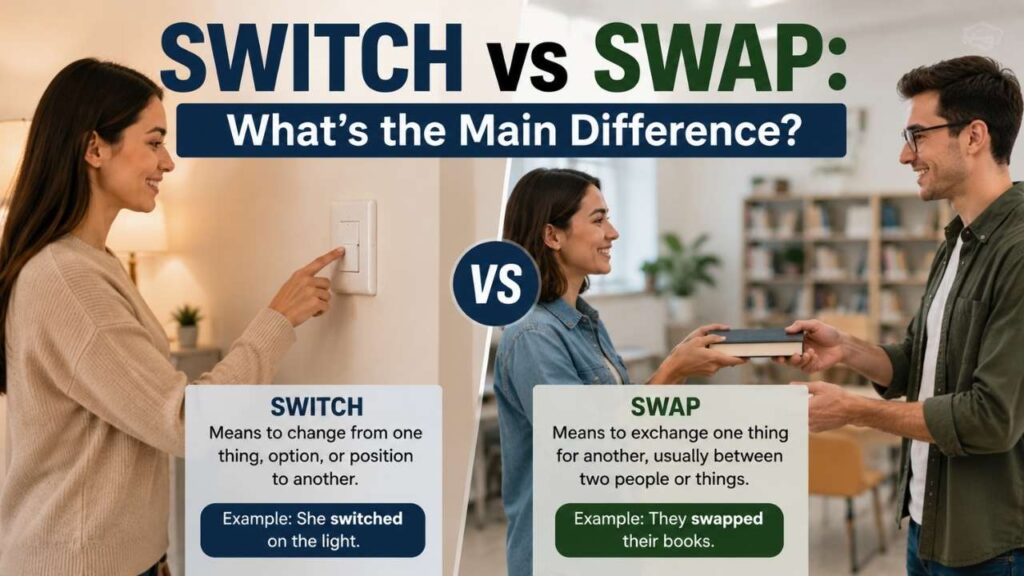
The main difference between switch and swap is simple. Switch means changing from one thing to another, while swap means exchanging one thing for another. In other words, every swap is a type of change, but not every switch is an exchange. For example, if you switch jobs, you move from one job to another.
However, if two coworkers swap shifts, they exchange their work schedules. This small difference in switch vs. swap meaning is important because using the wrong word can change the meaning of your sentence. Once you understand this rule, you’ll know when to use switch instead of swap and when to use swap instead of switch with confidence.
When Should You Use “Switch”?
You should use switch when you are talking about changing something rather than exchanging it. This could be changing a device, a setting, a plan, or even a habit. For example, you might switch accounts, switch teams, switch languages, or switch from working at home to the office.
These actions involve moving from one option to another, not trading with someone else. Common expressions include switch on the lights, switch off the TV, and switch to a different browser.
If you’re wondering when should I use switch, remember this simple rule: use switch whenever the focus is on changing direction, choice, or condition, rather than making an exchange.
When Should You Use “Swap”?
Use swap when two people or two things exchange places or items. This word is common in everyday conversations because people often swap clothes, swap books, swap cards, swap ideas, or swap seats. You can also swap shifts with a coworker or swap SIM cards between phones. In each example, one thing is exchanged for another.
If there is no exchange, swap is usually not the best choice. Many English learners ask, “When should I use swap?” A simple trick is to think about trading. If both sides give and receive something, swap is almost always the correct word. This makes swap meaning with examples much easier to remember.
Can “Switch” and “Swap” Be Used Interchangeably?
Many people ask, “Can switch and swap be used interchangeably?” The answer is sometimes, but not always. In casual conversations, you might hear someone say “Let’s switch seats” or “Let’s swap seats,” and both sound natural because two people are exchanging places.
However, some situations only allow one word. For example, you can switch on the lights, but you cannot swap on the lights. Likewise, you can swap gifts with a friend, but switch gifts sounds less natural in most situations.
If you’re unsure, remember this rule: switch focuses on changing, while swap focuses on exchanging. This simple difference helps you choose the correct word every time.
Common Collocations with Switch and Swap
Learning common collocations helps you use switch and swap like a native speaker. A collocation is a pair or group of words that naturally go together. With switch, you will often hear switch on, switch off, switch to, switch from, switch between, and switch gears. These phrases usually describe changing a state, direction, or option.
With swap, common expressions include swap with, swap for, swap out, swap places, swap positions, swap stories, and swap ideas. Knowing these natural word combinations improves your English vocabulary and helps you understand the difference between switch and swap in everyday conversations.
Common Mistakes to Avoid
Many learners make mistakes because switch and swap have similar meanings. The most common error is using swap when there is no exchange. For example, “I swapped to a new phone” is incorrect because you are changing phones, not exchanging them with someone. Instead, say “I switched to a new phone.”
Another mistake is saying “switch gifts” when two people trade presents. In that case, swap gifts is the better choice. Remember that switch is about changing, while swap is about exchanging. Paying attention to the context will help you avoid these common English mistakes and improve your confidence in both speaking and writing.
Switch vs. Swap in Everyday Situations
The difference between switch and swap becomes much clearer in real-life situations. You can switch jobs, switch devices, switch accounts, or switch from one app to another because you are changing from one option to the next.
On the other hand, you can swap phones with a friend, swap clothes, swap batteries, swap partners, or swap seats because each person or object exchanges places.
Understanding these everyday examples makes switch vs. swap in English much easier to remember. Whenever you are unsure, ask yourself one question: Am I changing something, or am I exchanging it? The answer usually tells you which word is correct.
Similar Words and How They Compare
Besides switch and swap, English has other words with related meanings, such as change, exchange, replace, substitute, and trade. Although these words are connected, they are not always interchangeable. Exchange is very close to swap because it usually involves giving one thing and receiving another.
Replace means putting one thing in the place of another, often without getting the original item back. Substitute means using one thing instead of another, while trade usually refers to exchanging goods or services. Learning the difference between switch, swap, exchange, and replace helps you choose the most accurate word in every situation.
Example Sentences
Reading switch vs. swap examples is one of the easiest ways to remember the difference.
- I switched from tea to coffee last month.
- She switched her phone to silent mode.
- We switched classrooms after lunch.
- They swapped seats so everyone could see the stage.
- My brother and I swapped bikes for the weekend.
- Let’s swap ideas before we start the project.
- He switched careers after finishing college.
- The players swapped jerseys after the match.
- You can switch between different languages in the app.
- We swapped books after finishing them.
These examples show that switch usually means changing, while swap usually means exchanging.
Quick Tips to Remember the Difference
Here are a few simple tips to help you remember switch vs. swap. Think of switch as changing from one option, place, or condition to another. Think of swap as trading or exchanging one thing for another. If only one person or object changes, switch is usually the right word.
If two people or two things exchange something, swap is normally the better choice. A quick memory trick is: Switch = Change, Swap = Exchange. This easy rule works in most situations and helps you decide which is correct: switch or swap without overthinking. With regular practice, choosing the right word will become natural.
FAQs
Is switch the same as swap?
No. Switch means changing from one thing to another, while swap means exchanging one thing for another. They are similar but not always interchangeable.
Can switch replace swap?
Sometimes. Both words work when two people exchange places, such as switch seats or swap seats. However, many situations require only one of the two words.
When should I use switch instead of swap?
Use switch when you are changing an option, setting, place, or condition without exchanging something with another person or object.
When should I use swap instead of switch?
Use swap when two people or two things exchange items, positions, or roles.
Conclusion
Although switch and swap both describe a change, they are used in different ways. Switch focuses on changing from one option, place, or condition to another, while swap focuses on exchanging one thing for another.
Understanding this simple difference will help you use both words correctly in everyday conversations, school assignments, and professional writing.
Whenever you’re unsure, remember this rule: if there is a change, use switch; if there is an exchange, use swap. By learning their meaning, usage, common collocations, and real-life examples, you’ll feel more confident choosing the right word every time.