

Your vs You’re Difference: Easy Explanation With Examples
Many English learners struggle with the your vs you’re difference because the two words sound exactly alike. However, they have completely different meanings and grammar roles. Even native speakers mix them up in texting, emails, and social media posts.
Today, this confusion appears everywhere online. A simple spelling mistake can change the meaning of a sentence or make writing seem careless. Because of that, understanding the difference matters in both casual and professional communication.
The good news is that the rule is actually simple. Once you understand how each word works in a sentence, choosing the correct form becomes much easier.
Quick Answer
The your vs you’re difference is simple: your shows possession, while you’re is a contraction of “you are.” If you can replace the word with “you are,” then you’re is correct.
TL;DR
- Your shows ownership or connection.
- You’re means “you are.”
- Both words sound the same in speech.
- Confusion happens because English has many homophones.
- The mistake is common in texting and social media.
- Testing with “you are” helps you choose correctly.
What Your and You’re Mean
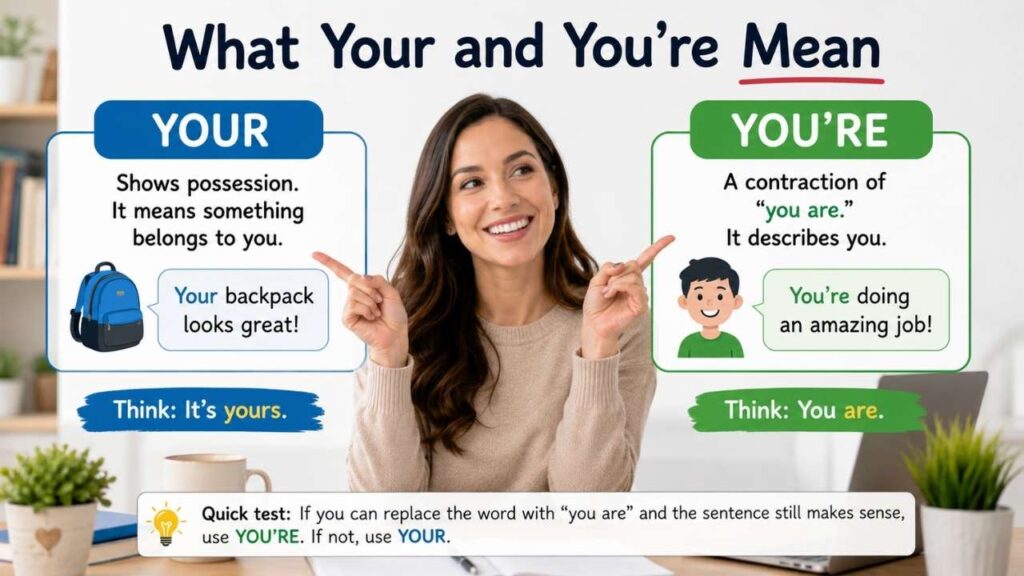
The words your and you’re belong to different grammar categories. Although they sound identical, they perform separate jobs inside a sentence.
The word your is a possessive determiner. It shows that something belongs to “you.” For example, in the sentence “Your phone is ringing,” the phone belongs to the person being addressed.
In contrast, you’re is a contraction. It combines the words “you” and “are.” For example, “You’re late again” really means “You are late again.”
How Your Functions in a Sentence
The word your usually appears before a noun. It helps describe ownership, connection, or association. In American English, this structure appears constantly in both speech and writing.
For example, “your jacket,” “your idea,” and “your family” all show possession. The word acts like other possessive words such as “my,” “his,” and “their.”
How You’re Functions in a Sentence
The contraction you’re replaces “you are.” Because English speakers often shorten phrases in conversation, contractions became common in everyday language.
For instance, “You’re funny” means “You are funny.” Similarly, “You’re working late” means “You are working late.” If the expanded version sounds correct, then the contraction is also correct.
Why People Confuse Your and You’re
The confusion mainly comes from pronunciation. Both words are pronounced the same way in standard American English. Linguists call these words homophones.
Because spoken English gives no spelling clues, writers must rely on grammar knowledge instead. Fast typing also increases mistakes, especially on phones and social platforms.
In addition, English spelling does not always match pronunciation clearly. Many native speakers learn grammar rules naturally through reading, but online communication often encourages speed over accuracy.
The Role of Autocorrect and Digital Writing
Modern technology sometimes makes the problem worse. Autocorrect tools occasionally replace one form with the other. As a result, people may send incorrect sentences without noticing.
Social media also encourages short and rapid messages. Therefore, grammar checking often becomes less careful in casual communication.
The History Behind Your and You’re
The history of these words reaches back hundreds of years. The word your developed from older forms in Middle English. Earlier English used related forms connected to the pronoun “you.”
Meanwhile, contractions like you’re became increasingly common after the Early Modern English period. Writers and speakers gradually shortened phrases to create faster, smoother communication.
How English Changed Over Time
Old English had a more complex grammar system. Pronouns changed form depending on number and social relationship. Over time, English simplified many of these forms.
As English evolved, contractions became accepted in everyday writing. Today, Americans regularly use contractions in speech, texting, advertising, and informal documents.
Formal Acceptance of Contractions
At one time, some teachers considered contractions too informal for serious writing. However, modern American English accepts contractions in many professional situations.
Still, highly formal writing sometimes avoids contractions. Academic papers, legal writing, and technical documents may prefer “you are” instead of “you’re.”
Your vs You’re in American English
In the United States, both forms appear constantly in daily communication. Americans use contractions heavily in speech because they sound natural and conversational.
However, possession remains equally important. Because of this, writers must quickly recognize whether a sentence needs ownership or the phrase “you are.”
Everyday American Examples
Americans commonly say:
“Your coffee is ready.”
“You’re going to love this movie.”
These patterns appear in schools, workplaces, entertainment, advertising, and online communication. The distinction remains important because incorrect usage can confuse readers.
Formal and Informal Usage
In informal American English, contractions are extremely common. Text messages, emails, and social posts often use you’re naturally.
In formal settings, writers may still use contractions, but some situations favor the full form “you are.” Meanwhile, your remains unchanged in all contexts because it is not a contraction.
Simple Rules to Remember
Many grammar experts teach a replacement test. This method works because you’re always expands to “you are.”
If replacing the word with “you are” makes sense, then you’re is correct. If the sentence sounds strange after replacement, then you probably need your instead.
| Context | Correct Usage | Example | Notes |
| Showing possession | Your | Your shoes are outside | Indicates ownership |
| Meaning “you are” | You’re | You’re very kind | Contraction |
| Before a noun | Your | Your dog is barking | Possessive determiner |
| Before an adjective | You’re | You’re helpful today | Short for “you are” |
The “You Are” Test
Consider this sentence: “You’re my best friend.” Replacing the contraction gives “You are my best friend.” The sentence still works, so you’re is correct.
Now look at this sentence: “Your my best friend.” Replacing “your” with “you are” creates “You are my best friend,” which changes the sentence structure completely. Therefore, “your” is incorrect there.
Common Mistakes People Make
One common mistake happens when writers type quickly. They may choose the shorter spelling automatically without checking grammar carefully.
Another problem appears when people memorize rules but forget sentence structure. Because both words sound identical, writers sometimes rely only on instinct.
Mistakes in Social Media Posts
Social media often contains sentences like “Your amazing” or “I love you’re style.” These mistakes happen because typing speed matters more than editing.
Even so, many readers still notice the error. In professional settings, repeated mistakes may affect credibility.
Mistakes in Professional Writing
Grammar mistakes can create negative impressions in resumes, work emails, and business documents. Although everyone makes occasional errors, repeated confusion may appear careless.
Because of this, proofreading remains important in professional American English.
Real-Life Examples of Correct Usage
Learning through examples helps many readers understand grammar naturally. Real sentences show how meaning changes depending on word choice.
For example, “Your presentation was impressive” focuses on ownership. The presentation belongs to the listener.
Meanwhile, “You’re impressive during presentations” describes the person directly. The sentence means “You are impressive during presentations.”
Examples in Text Messages
People often write:
“You’re coming tonight, right?”
“I like your new profile picture.”
These examples reflect everyday American communication. One expresses an action or state, while the other shows possession.
Examples in Workplace Communication
Professional messages may include:
“You’re scheduled for tomorrow’s meeting.”
“Your report needs one final revision.”
Again, the grammar role changes completely depending on meaning.
British and American Usage Differences
There is almost no major difference between British and American English regarding your and you’re. Both varieties follow the same grammar rules.
However, punctuation style and contraction frequency may vary slightly between regions and writing traditions.
Contractions Across English Varieties
American English often sounds more conversational in business writing. Because of this, contractions like you’re appear frequently in workplace communication.
British English also uses contractions regularly, although some formal contexts may avoid them more often.
Why Grammar Experts Still Discuss This Topic
Although the rule itself is simple, language experts still study errors involving homophones. These mistakes reveal interesting patterns about how people process spoken and written English.
Researchers have found that native speakers often rely on sound rather than structure while typing quickly. Therefore, even educated writers occasionally confuse homophones.
The Influence of Fast Communication
Digital communication changed writing habits dramatically. Many people now write more messages daily than previous generations.
Because speed matters online, proofreading sometimes disappears. As a result, homophone mistakes became more visible in public communication.
Your and You’re in Schools and Education
Teachers in the United States often introduce this grammar point early in elementary school. Students practice distinguishing possession from contractions through worksheets and sentence exercises.
However, confusion can continue into adulthood. Since both words sound identical, repeated exposure and reading practice help strengthen understanding.
Why Reading Helps
People who read often usually recognize correct grammar patterns faster. Exposure to correct sentences trains the brain to notice structure naturally.
Because of this, reading books, articles, and edited writing can improve grammar awareness over time.
How Usage Has Changed in Modern English
The core grammar rule has not changed much over time. However, attitudes toward grammar errors have shifted in digital culture.
Today, many people accept small mistakes in casual communication. Texting and social media encourage speed and personality more than strict grammar accuracy.
Informal Writing Today
Modern Americans often ignore capitalization, punctuation, and spelling in casual messages. Even so, many readers still expect correct grammar in important situations.
Therefore, understanding the distinction remains useful in school, work, and public writing.
Memory Tricks That Actually Help
Simple memory devices can make grammar easier. One common trick connects the apostrophe in you’re to the missing letter in “are.”
Another helpful strategy focuses on the noun after your. Since possessive words usually describe nouns, this pattern often signals the correct choice.
Pattern Recognition
For example, “your car,” “your shoes,” and “your opinion” all place a noun after your.
Meanwhile, “you’re tired,” “you’re welcome,” and “you’re leaving” describe actions, states, or conditions.
Why This Difference Matters
Some people argue that grammar mistakes do not matter online. However, word choice still shapes communication and clarity.
Correct grammar helps readers understand meaning instantly. It also creates a stronger impression in professional and academic settings.
Communication and Credibility
A small spelling difference can influence how readers judge a message. Although one mistake rarely causes serious problems, repeated errors may reduce trust.
Because of this, mastering common grammar pairs remains valuable in modern English.
FAQs
Is “your welcome” correct?
No, the correct form is usually “you’re welcome.” The phrase means “you are welcome,” so the contraction is necessary.
Why do people mix up your and you’re?
People confuse them because they sound identical in speech. Fast typing and autocorrect also contribute to the mistake.
Is the mistake common among native speakers?
Yes, even native English speakers make this error sometimes. Homophones can confuse writers when typing quickly.
Can I use “you are” instead of “you’re”?
Yes, both forms are grammatically correct. However, “you’re” sounds more natural in casual writing and speech.
Is “your” ever a contraction?
No, “your” is never a contraction. It is always a possessive determiner showing ownership or connection.
Do schools still teach this rule?
Yes, American schools continue teaching the distinction early in grammar education. It remains an important writing skill.
Conclusion
Understanding the your vs you’re difference becomes much easier once you know the basic rule. Your shows possession, while you’re means “you are.” Although the words sound the same, their grammar roles are completely different.
Today, this confusion appears often in digital communication. However, a quick replacement test usually solves the problem immediately. If “you are” fits the sentence, then you’re is correct.
With practice, correct usage becomes automatic. Reading carefully, proofreading messages, and noticing sentence structure can help you use both forms naturally and confidently.