
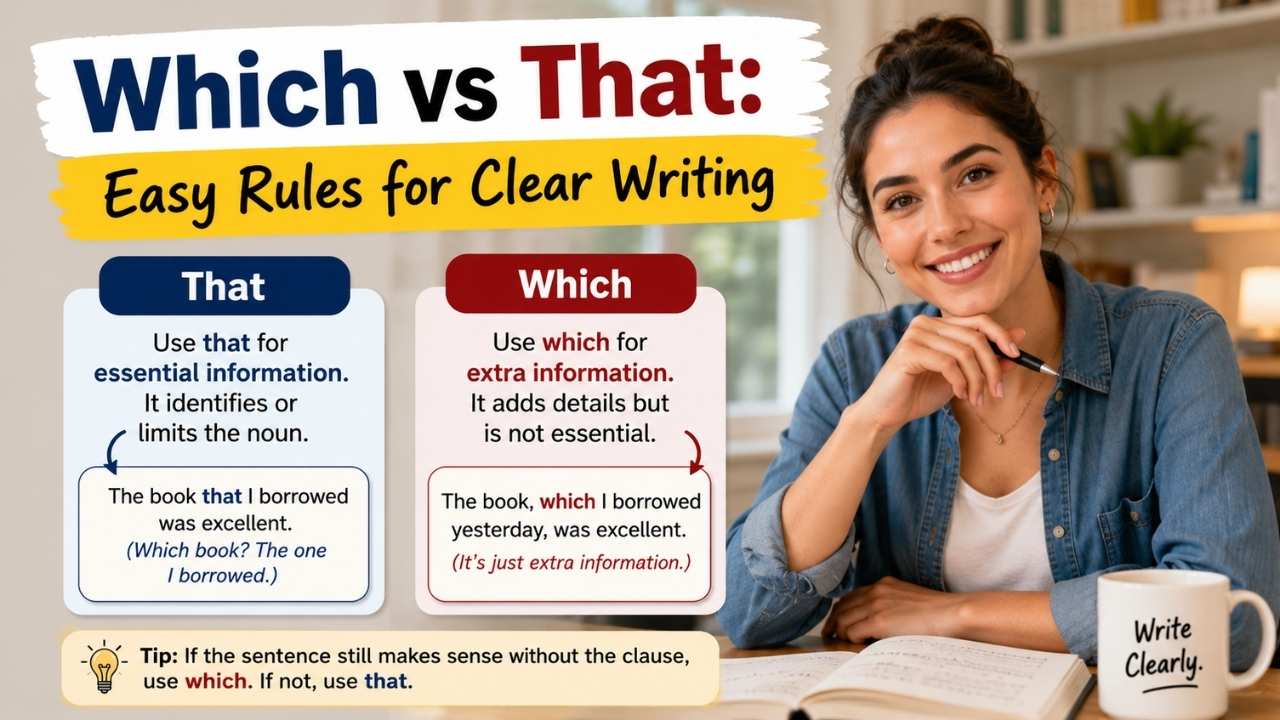
Which vs That: Easy Rules for Clear Writing
Many English learners struggle with which vs that because both words introduce extra information in a sentence. At first, they seem interchangeable. However, American English usually treats them differently in formal writing.
Today, this grammar point matters more than ever. People use it in emails, school papers, business writing, blogs, and social media posts. Clear sentence structure helps readers understand ideas faster.
The confusion also comes from changing language habits. In casual speech, many Americans mix which and that naturally. Still, style guides and editors often prefer a specific rule in formal writing.
Quick Answer
In American English, “that” usually introduces essential information, while “which” introduces nonessential information. In most formal writing, the rule for which vs that depends on whether the information changes the meaning of the sentence.
TL;DR
- “That” introduces essential clauses.
- “Which” introduces extra, nonessential details.
- Nonessential clauses usually use commas.
- Essential clauses usually do not use commas.
- Casual speech often mixes both forms.
- Formal American writing follows the distinction more strictly.
What Which and That Mean
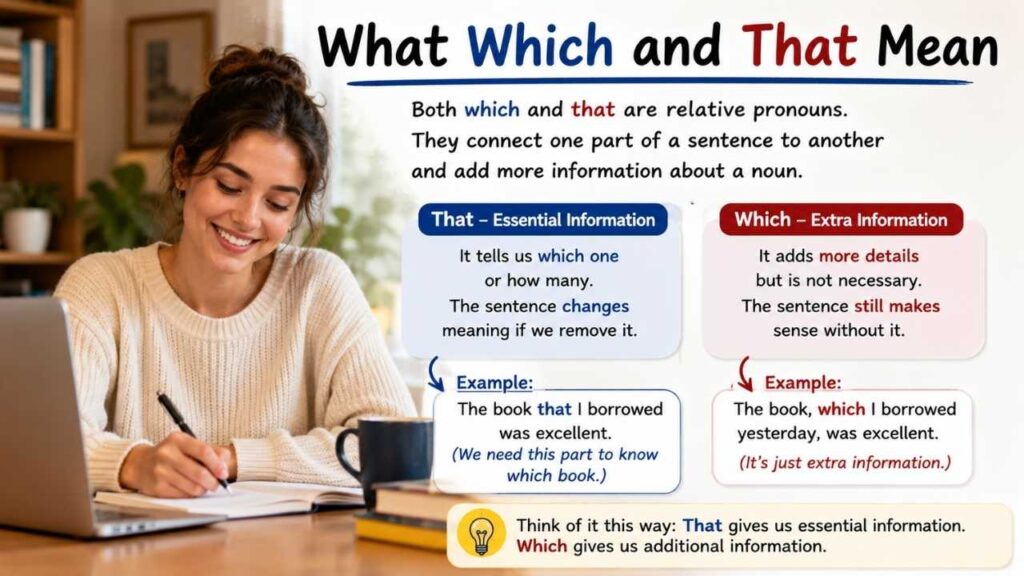
Both which and that are relative pronouns. They connect one part of a sentence to another. In simple terms, they introduce extra information about a noun.
The key difference involves importance. Some information is necessary to identify the noun clearly. Other information simply adds detail. American English often separates these two jobs between that and which.
For example, consider the sentence: “The book that I borrowed was excellent.” Here, the clause identifies a specific book. Without it, the meaning changes.
Now compare it with: “The book, which I borrowed yesterday, was excellent.” The borrowing detail adds information, but the sentence still identifies the book without it.
Essential vs Nonessential Clauses
An essential clause changes the sentence meaning if removed. Because it limits or identifies something specific, American English usually prefers that.
A nonessential clause adds extra detail only. Since the sentence still works without it, writers usually use which with commas.
This distinction became especially important in formal American writing during the twentieth century. However, spoken English remains more flexible.
The Core Rule Behind Which vs That
The modern American rule is fairly simple once you see the pattern. Essential information takes that. Extra information takes which.
Look at these examples:
| Context | Correct Usage | Example | Notes |
| Essential information | That | The phone that has a cracked screen is mine. | Identifies the phone |
| Nonessential information | Which | My phone, which has a cracked screen, still works. | Adds extra detail |
| Formal writing | That preferred | The report that arrived today is important. | Common in US style guides |
| Informal speech | Either sometimes heard | The movie which we watched was funny. | Common in conversation |
Why Commas Matter
Commas signal nonessential information. Therefore, which usually appears after a comma in American English.
Without commas, readers assume the information is essential. Because of this, that normally appears without commas.
For example:
“The students that studied passed the test.”
This sentence means only some students studied.
Now compare:
“The students, which studied hard, passed the test.”
This version sounds awkward in American English because which usually follows nonessential information more naturally.
Modern Exceptions
Real-life English is less strict than grammar books suggest. Many native speakers use which in essential clauses, especially in speech.
British English also accepts restrictive which more often than American English. Because of this, readers sometimes see both styles online.
The History of Which and That in English
The difference between which and that did not always exist so clearly. Earlier forms of English used relative pronouns much more freely.
Old English had several systems for connecting clauses. During Middle English, writers used that, which, who, and other forms interchangeably in many contexts.
By the eighteenth and nineteenth centuries, grammar experts started encouraging more consistency. American editors especially pushed the essential-versus-nonessential distinction.
The Influence of Style Guides
Modern American style guides strengthened the rule. Publications, universities, and newspapers often preferred the distinction because it improved clarity.
Writers such as Fowler discussed the issue heavily in the early twentieth century. Later, American editing traditions made the rule even more standard.
Still, linguists note that the distinction is partly stylistic rather than purely grammatical. Native speakers often understand sentences correctly even when the rule is ignored.
How Americans Use Which and That Today
Modern American English generally follows the distinction in professional writing. Students learn it in schools, and editors often correct it automatically.
However, everyday speech tells a different story. Many Americans naturally say “the car which I bought” even though formal writing often prefers that.
Digital communication has also relaxed grammar rules. Text messages, comments, and casual posts frequently mix both forms without confusion.
Formal Writing in the USA
Formal American writing usually prefers precision. Because of this, newspapers, academic papers, and business documents often use that for restrictive clauses.
Editors believe the distinction improves readability. Readers can quickly recognize whether information is essential or optional.
For example:
“The employees that work remotely attend online meetings.”
This sentence identifies a specific group of employees.
Casual American Speech
Conversation is less strict. People often choose whichever form sounds natural at the moment.
Because spoken English moves quickly, clarity usually comes from context and tone rather than punctuation.
As a result, many Americans do not consciously think about the rule while speaking.
British vs American Usage
British English treats restrictive which more naturally than American English does. Therefore, British publications sometimes use which where Americans prefer that.
For example, British writers may comfortably write:
“The house which stands on the corner is very old.”
In American English, many editors would change which to that.
Why the Difference Exists
The American distinction became strongly connected to editorial style. British English remained more flexible historically.
Neither system is truly incorrect. Instead, each reflects different conventions and preferences.
Today, global internet writing blends these styles regularly. Readers may encounter both forms across websites and publications.
Common Mistakes People Make
One major mistake involves commas. Writers often use which without commas even when the clause is nonessential.
Another common issue comes from overcorrecting. Some people avoid which completely because they fear making errors.
However, which remains necessary and useful in many sentences.
Mixing Essential and Nonessential Information
Consider this sentence:
“My laptop which I bought last year still works.”
In formal American English, readers may expect commas around the clause if the laptop is already identified.
A clearer version might be:
“My laptop, which I bought last year, still works.”
Using Which for People
Writers sometimes use which for people accidentally. Standard English usually prefers who for humans.
Incorrect:
“The teacher which helped me was kind.”
Correct:
“The teacher who helped me was kind.”
Which vs That in Everyday Writing
This grammar point appears constantly in daily communication. Emails, texts, essays, and online posts all use relative clauses.
In professional settings, the distinction can affect tone. Careful grammar often sounds more polished and precise.
However, casual writing values speed and natural rhythm more than strict rules.
In Emails and Work Communication
Business writing usually benefits from clarity. Therefore, many professionals follow the traditional American distinction.
For example:
“The document that you requested is attached.”
This sentence feels direct and efficient.
In Social Media and Texting
Online communication tends to ignore strict punctuation. Many people skip commas entirely, making which and that harder to distinguish.
Still, readers usually understand the meaning from context.
Because internet language evolves quickly, flexibility has become more accepted in casual spaces.
Why the Rule Still Matters
Some grammar rules fade over time. Yet this distinction survives because it helps readers process information efficiently.
When readers see commas with which, they immediately recognize added detail rather than essential meaning.
This structure reduces ambiguity in longer sentences.
Clarity in Complex Sentences
Long sentences benefit most from the distinction. Without clear structure, readers may misunderstand what information matters most.
For example:
“The employees that completed training received certificates.”
This sentence limits the group.
Now compare:
“The employees, which completed training, received certificates.”
This version sounds confusing because the commas suggest all employees completed training.
Gray Areas and Grammar Debates
Not all grammar experts fully agree on the rule’s importance. Some linguists argue that native speakers naturally understand meaning without strict separation.
Others believe the distinction creates useful precision, especially in formal writing.
Because language changes constantly, both views continue to exist.
Descriptive vs Prescriptive Grammar
Descriptive grammar studies how people actually speak. Prescriptive grammar teaches preferred rules for standard writing.
From a descriptive viewpoint, many speakers use which and that interchangeably.
From a prescriptive viewpoint, maintaining the distinction improves clarity and consistency.
Is Restrictive Which Wrong?
Most modern linguists would say no. Restrictive which appears throughout English literature and speech history.
However, many American editors still avoid it in formal contexts.
Therefore, understanding audience expectations remains important.
How Punctuation Changes Meaning
Punctuation strongly affects the which-versus-that distinction. Commas signal whether information is essential or optional.
Readers often rely on punctuation more than the pronoun itself.
Sentence Pair Comparisons
Consider these examples:
“The cars that are electric save fuel.”
Only electric cars save fuel.
“The cars, which are electric, save fuel.”
All the cars are electric.
This small punctuation shift changes the entire meaning.
Why Readers Notice Commas
Commas create pauses and separate extra information. Because readers process written language visually, punctuation guides interpretation quickly.
That is why formal writing often follows stricter punctuation rules.
Which vs That in Academic Writing
Academic writing in the United States strongly favors the traditional distinction. Universities often teach it as part of standard composition style.
Research papers value clarity and precision. Therefore, editors usually correct restrictive which automatically.
Style Manuals and Academic Standards
Major American style manuals often recommend:
- That for restrictive clauses
- Which for nonrestrictive clauses
Although not every professor enforces the rule equally, students commonly encounter it in editing feedback.
Why Students Struggle
Many students learn grammar through speech rather than formal analysis. Since spoken English mixes the forms naturally, written distinctions feel artificial at first.
Practice usually improves recognition over time.
Changes in Modern English Usage
English grammar constantly evolves. Digital communication, global media, and informal writing styles have softened many traditional rules.
The distinction between which and that still exists, but enforcement varies more today.
Internet Influence
Online writing encourages speed and conversational tone. Because of this, many people care less about formal clause distinctions.
Autocorrect tools also influence grammar habits. Some editing software still flags restrictive which, while others accept both forms.
What Experts Expect in 2025–2026
Current American usage still prefers the traditional distinction in edited writing. However, modern linguists increasingly recognize natural variation.
As a result, readers should understand both the formal rule and real-world flexibility.
Which vs That in Spoken English
Spoken English follows rhythm and comfort more than strict grammar rules. Native speakers often choose whichever word sounds smoother.
Listeners rarely become confused because speech includes tone, pauses, and context.
Natural Speech Patterns
Many Americans naturally say:
“The movie which we watched was great.”
Even though formal writing may prefer that, conversation accepts this easily.
Speech tends to prioritize flow over strict editing standards.
Why Spoken and Written English Differ
Writing depends entirely on visual structure. Speech includes voice signals that help listeners interpret meaning naturally.
Because of this, written English often uses stricter punctuation and grammar conventions.
FAQs
Is it always wrong to use which instead of that?
No. Many native speakers use which in restrictive clauses, especially in speech and British English. However, formal American writing usually prefers that for essential information.
Do commas always go with which?
In formal American English, which usually introduces nonessential clauses and therefore takes commas. Still, casual writing sometimes ignores this pattern.
Why do grammar checkers correct which to that?
Many grammar tools follow American editorial style rules. They aim for formal clarity and consistency in writing.
Can I use that for nonessential clauses?
Usually no in formal writing. Nonessential clauses normally use which and commas instead.
Which sounds more formal: which or that?
Neither is automatically more formal. The difference depends on sentence structure and whether the information is essential.
Do British writers follow the same rule?
Not always. British English accepts restrictive which more comfortably than American English does.
Conclusion
Understanding which vs that becomes easier once you recognize the difference between essential and extra information. In formal American English, that usually identifies necessary details, while which adds optional information with commas.
However, real English remains flexible. Casual speech, online communication, and British usage often mix both forms naturally. Because language changes over time, context matters as much as strict rules.
The best approach is simple: use the traditional distinction in formal writing, but recognize that everyday English is often more relaxed. With practice, the choice will start to feel natural and clear.