
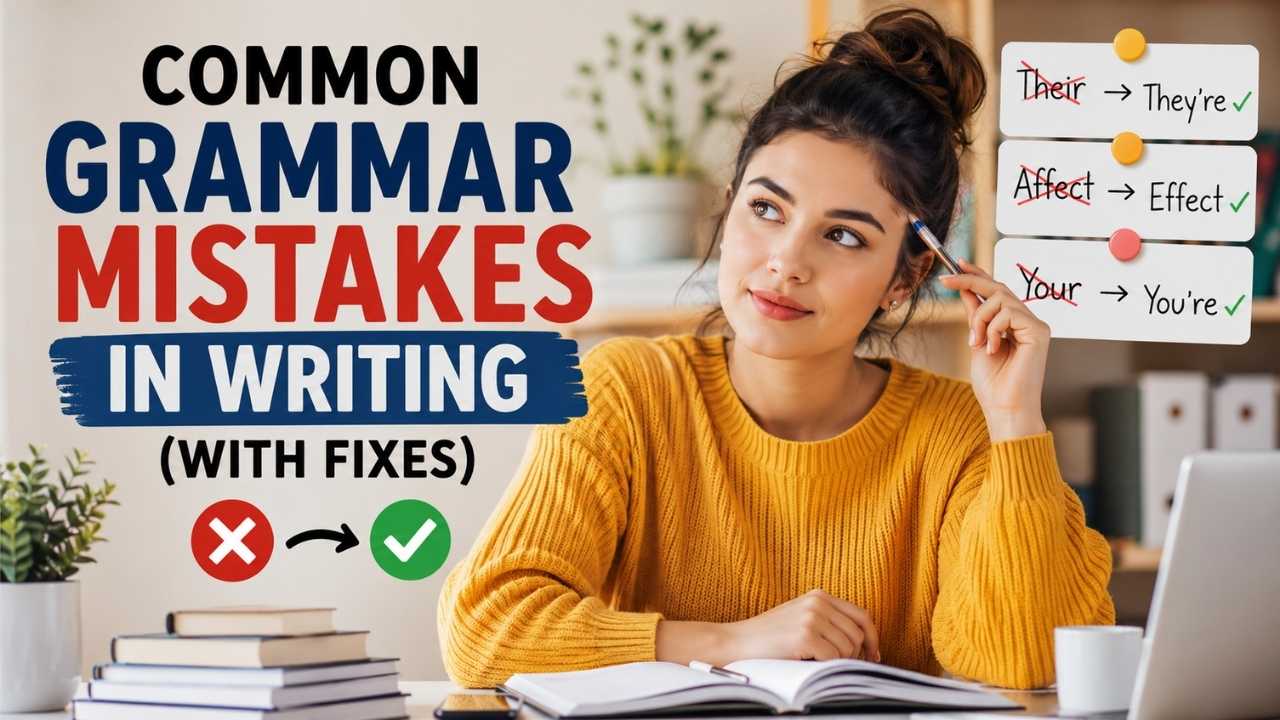
Common Grammar Mistakes in Writing (With Fixes)
Writing clearly matters in school, work, and daily life. However, many people still make small grammar errors that weaken their message. Some mistakes confuse readers, while others simply make writing feel awkward or unclear.
Today, common grammar mistakes in writing appear everywhere. They show up in emails, text messages, social media posts, essays, and even business reports. Because English has many exceptions and changing rules, even native speakers struggle with grammar sometimes.
The good news is that most grammar mistakes are easy to recognize once you understand how English structure works. In many cases, the issue is not intelligence. Instead, it comes from fast typing, informal habits, or confusing rules that developed over centuries.
Quick Answer
Common grammar mistakes in writing usually involve sentence structure, punctuation, verb agreement, word confusion, and unclear wording. Most errors happen because spoken English often sounds different from formal written English.
TL;DR
- Grammar mistakes often come from rushed writing habits.
- Many errors involve punctuation and sentence structure.
- American English rules sometimes differ from British English.
- Informal digital writing changes how people use grammar today.
- Clear grammar improves communication and reader trust.
- Most grammar mistakes can be fixed with careful editing.
What Common Grammar Mistakes Really Mean
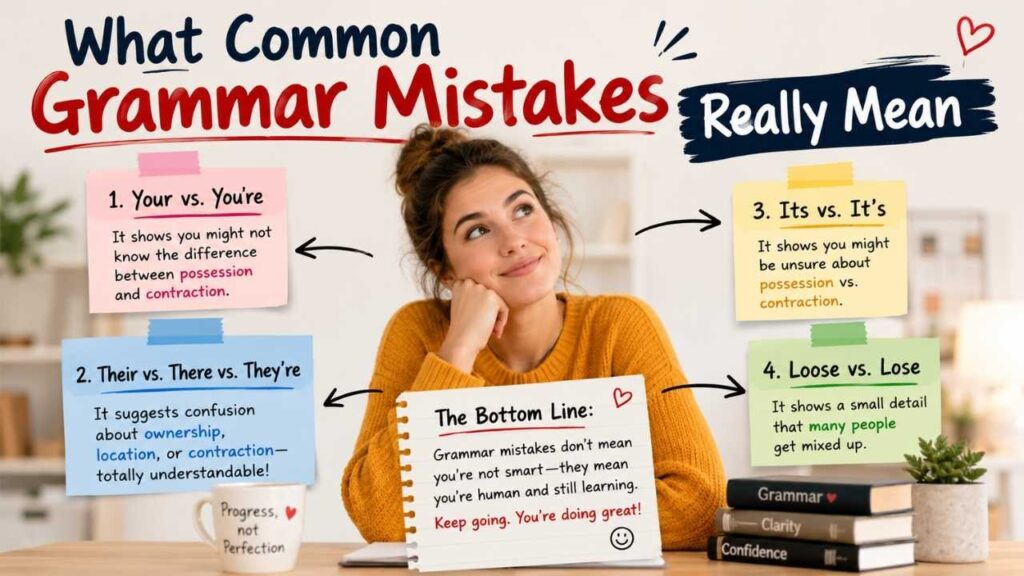
Grammar mistakes happen when words, punctuation, or sentence patterns break accepted language rules. These mistakes can make writing unclear or harder to understand. Sometimes the meaning changes completely because of one small error.
In English, grammar controls how words work together. It shapes sentence order, verb tense, punctuation, and agreement between subjects and verbs. Because English evolved from several language families, its rules are not always consistent.
Why Grammar Errors Matter
Good grammar helps readers understand ideas quickly. Clear writing also creates confidence and credibility. For example, a job application with grammar errors may seem careless, even if the applicant is skilled.
However, not every grammar mistake causes confusion. Some errors are minor and common in casual conversation. Modern American English often accepts relaxed grammar in texts and online communication.
How Written English Differs From Spoken English
People speak more casually than they write. Spoken English includes pauses, repeated words, and unfinished thoughts. Writing usually requires clearer structure and punctuation.
Because of this difference, many people write exactly how they speak. That habit often creates grammar problems, especially with commas, sentence fragments, and run-on sentences.
The History Behind English Grammar Rules
English grammar developed over many centuries. Old English used complex endings similar to German. Later, Norman French and Latin influenced vocabulary and sentence structure.
By the eighteenth century, scholars began creating formal grammar rules. Many writers wanted English to appear more orderly and refined. As a result, some grammar rules copied Latin patterns, even when natural English usage differed.
Prescriptive and Descriptive Grammar
Prescriptive grammar focuses on strict rules. It explains how people “should” write according to formal standards. Schools traditionally taught this approach.
Descriptive grammar studies how people actually use language. Modern linguists often follow this method instead. Today, many grammar debates come from tension between these two views.
Grammar Changes Over Time
English grammar constantly changes. For example, singular “they” once faced criticism in formal writing. Today, it appears widely in academic, professional, and everyday English.
Similarly, split infinitives were once strongly discouraged. Modern style guides now accept them in many situations because they often sound more natural.
Sentence Fragments and Why They Confuse Readers
A sentence fragment is an incomplete sentence. It lacks a full thought, a subject, a verb, or both. Fragments appear often in casual writing because people write quickly or imitate speech patterns.
For example, “Because I was late” is incomplete. The reader expects more information after the word “because.”
Why Fragments Happen
Fragments often appear when dependent clauses stand alone. Writers sometimes mistake long phrases for complete sentences. Social media writing also encourages shorter sentence patterns.
However, fragments are not always wrong. Skilled writers sometimes use them for emphasis in creative writing or advertising. In formal writing, though, too many fragments reduce clarity.
Fragment Examples in Daily Writing
| Context | Correct Usage | Example | Notes |
| Complete sentence | “I missed the meeting because traffic was heavy.” | Full thought included | |
| Text message | Informal fragment | “Running late again.” | Common in casual texting |
| Academic writing | Avoid fragments | “The experiment failed because the temperature changed.” | Formal clarity matters |
| Social media | Stylized fragment | “Best day ever.” | Accepted informally |
Run-On Sentences and Comma Splices
Run-on sentences happen when two independent clauses join incorrectly. A comma splice is a specific type of run-on that uses only a comma between full sentences.
For example, “I finished my homework, I watched television” is a comma splice. Both parts could stand alone as separate sentences.
Why Run-Ons Are Common
People naturally connect ideas while speaking. In writing, however, readers need punctuation signals to follow thoughts clearly. Without those signals, sentences become confusing.
Digital communication also encourages long, unedited sentences. Many people type quickly without reviewing punctuation carefully.
How to Fix Run-Ons Naturally
Writers can fix run-ons by adding a period, semicolon, or conjunction. For example, “I finished my homework, and I watched television” works correctly because the conjunction connects the clauses properly.
Today, American English prefers shorter sentences in business and online writing. Because of that shift, many editors encourage concise sentence structure.
Subject-Verb Agreement Problems
Subject-verb agreement means the verb must match the subject in number. Singular subjects take singular verbs, while plural subjects take plural verbs.
Errors often happen when extra words separate the subject from the verb. For example, “The list of items are on the table” sounds natural to some speakers, but “list” is singular.
Why Agreement Errors Happen
English sometimes places long phrases between subjects and verbs. Writers may accidentally match the verb with the nearest noun instead of the true subject.
Collective nouns also create confusion. In American English, words like “team” or “family” usually take singular verbs. British English often treats them as plural.
American vs British Usage
American English commonly says, “The team is winning.” British English often says, “The team are winning.” Both versions follow regional grammar traditions.
These differences show how grammar depends partly on style and language history.
Confusing Words People Mix Up Constantly
Many grammar mistakes involve similar-looking or similar-sounding words. These errors are especially common because English spelling developed irregularly over time.
Words like “their,” “there,” and “they’re” remain among the most frequent mistakes in modern writing.
Why Homophone Errors Persist
Homophones sound alike but have different meanings. Because people learn spoken language before written language, they often confuse these words while typing quickly.
Autocorrect also creates new problems. Sometimes software replaces correct words automatically without the writer noticing.
Frequently Confused Words
Common examples include “your” versus “you’re,” “affect” versus “effect,” and “then” versus “than.” These mistakes appear often in emails, advertisements, and online discussions.
Although readers usually understand the intended meaning, repeated word confusion may reduce professionalism in formal writing.
Apostrophe Mistakes in Modern Writing
Apostrophes confuse many writers because they serve multiple purposes. They show possession and contraction, but they do not create ordinary plurals.
For example, “The dog’s leash” shows possession. Meanwhile, “don’t” combines two words into a contraction.
The Apostrophe Plural Problem
Many signs incorrectly use apostrophes for plural nouns. Examples like “Apple’s for sale” appear frequently in stores and advertisements.
This mistake became more visible during the twentieth century because printed advertising expanded rapidly across the United States.
Informal Digital Writing
Today, many people skip apostrophes entirely in text messages and social media posts. Informal online communication often values speed over grammatical precision.
However, formal writing still expects correct apostrophe use in most professional settings.
Misplaced Modifiers and Unclear Meaning
Modifiers describe words or ideas. A misplaced modifier appears too far from the word it describes, creating confusion or unintended humor.
For example, “She almost drove her kids to school every day” suggests she nearly drove them but never actually did.
Why Modifier Problems Matter
Word placement changes meaning significantly in English. Because English relies heavily on word order, misplaced phrases easily confuse readers.
Professional editing often focuses closely on modifier placement because unclear wording weakens communication.
Dangling Modifiers
Dangling modifiers occur when the sentence lacks a clear subject for the modifying phrase. For example, “Walking through the park, the flowers looked beautiful” suggests the flowers were walking.
These mistakes appear often in rushed writing and first drafts.
Punctuation Mistakes That Change Meaning
Punctuation guides readers through written language. Even one missing comma can change meaning dramatically.
For example, “Let’s eat Grandma” and “Let’s eat, Grandma” communicate entirely different ideas.
Comma Confusion
Comma rules remain one of the hardest grammar areas for many writers. Some people overuse commas, while others avoid them almost completely.
American English typically follows style-guide conventions for commas. However, punctuation preferences still vary between publishers and organizations.
The Oxford Comma Debate
The Oxford comma appears before the final item in a list. Some style guides require it, while others treat it as optional.
For example, “red, white, and blue” includes the Oxford comma. Although debate continues, many American publishers prefer it because it improves clarity.
Formal Grammar Versus Casual Communication
Grammar changes depending on context. Professional reports usually follow stricter standards than text messages or social media posts.
Today, casual digital communication influences everyday grammar heavily. Shortened phrases, missing punctuation, and abbreviations appear constantly online.
Informal Grammar in American English
Modern American English accepts relaxed grammar more often than previous generations did. For example, sentence fragments commonly appear in advertising and online writing.
However, formal settings still value standard grammar strongly. College essays, legal documents, and workplace communication usually require greater precision.
Code-Switching Between Styles
Many people naturally shift grammar styles depending on audience and setting. Linguists call this code-switching.
Someone may text casually with friends but write formally at work. This flexibility reflects communication skills rather than poor grammar.
Grammar Mistakes in Social Media and Texting
Social media changed writing habits significantly during the twenty-first century. Fast communication encourages shorter sentences, abbreviations, and simplified punctuation.
As a result, grammar rules became more flexible in digital spaces.
Why Online Writing Looks Different
People often write online the same way they speak. They prioritize speed, tone, and emotion over formal correctness.
Capitalization, punctuation, and spelling frequently become stylistic choices instead of strict rules.
Are Digital Grammar Changes Permanent?
Some online habits eventually influence mainstream grammar. For example, internet communication helped normalize lowercase writing styles and shortened expressions.
However, formal American English still maintains many traditional grammar standards in education and professional settings.
Grammar Myths People Still Believe
Many grammar “rules” are actually style preferences or historical opinions. Over time, schools repeated these ideas so often that people accepted them as absolute truths.
Modern linguistics questions several traditional grammar warnings.
Ending Sentences With Prepositions
Teachers once strongly discouraged ending sentences with prepositions. Yet native English speakers naturally say phrases like “Who are you talking to?”
Today, most American style guides accept ending sentences with prepositions when the wording sounds natural.
Split Infinitives
A split infinitive separates “to” from the verb, as in “to boldly go.” Earlier grammar teachers objected because Latin grammar avoided this structure.
Modern English experts usually accept split infinitives when they improve clarity or rhythm.
How Grammar Learning Has Changed
Grammar teaching methods changed greatly across American education history. Earlier classrooms emphasized memorization and diagramming sentences.
Today, many teachers focus more on communication and readability.
The Shift Toward Practical Usage
Modern grammar instruction often emphasizes context instead of strict memorization. Students learn how grammar affects meaning and audience understanding.
This approach reflects real-world communication needs more closely.
Technology and Grammar Checking
Grammar software now helps millions of writers daily. These tools catch spelling errors, punctuation problems, and awkward phrasing quickly.
However, grammar programs still make mistakes. Human judgment remains important because language depends heavily on context and tone.
Why Even Native Speakers Make Grammar Mistakes
Grammar mistakes are normal, even among educated native speakers. English contains many irregular rules and exceptions.
Also, most people learn grammar naturally through speech before studying formal writing.
Fast Communication Increases Errors
Modern communication happens quickly. People send emails, texts, and posts constantly throughout the day.
Because speed matters, editing often becomes less careful. As a result, grammar mistakes appear more frequently.
Stress and Attention
Grammar accuracy also depends on focus and mental energy. Tired or distracted writers make more errors, even when they know the correct rules.
That reality explains why proofreading remains important for professional communication.
FAQs
Why do people make grammar mistakes so often?
English contains many irregular rules and exceptions. Also, spoken English differs from formal written English, which creates confusion for many writers.
Are grammar mistakes always a serious problem?
Not always. Minor mistakes in casual conversation or texting usually do not matter much. However, formal writing often requires clearer grammar.
Is American grammar different from British grammar?
Yes, some differences exist. American English and British English vary in punctuation, spelling, and certain grammar preferences.
Do grammar rules change over time?
Yes, grammar evolves constantly. Many rules considered strict in earlier centuries became more flexible in modern English.
Can grammar checkers replace proofreading?
No completely. Grammar tools help identify problems, but they sometimes miss context, tone, or intended meaning.
Is informal internet grammar ruining English?
Most linguists do not believe so. Instead, digital communication simply created additional writing styles for different situations.
Conclusion
Understanding common grammar mistakes in writing helps people communicate more clearly and confidently. Most grammar problems involve sentence structure, punctuation, agreement, or confusing word choices. Fortunately, these errors become easier to spot with practice and careful reading.
English grammar continues evolving, especially in digital communication. However, strong grammar still matters in professional, academic, and public writing. Clear sentences help readers trust and understand your message.
The best approach is balance. Learn standard grammar rules, understand when they matter most, and practice writing with clarity in mind. Over time, correct grammar becomes a natural part of everyday communication.