
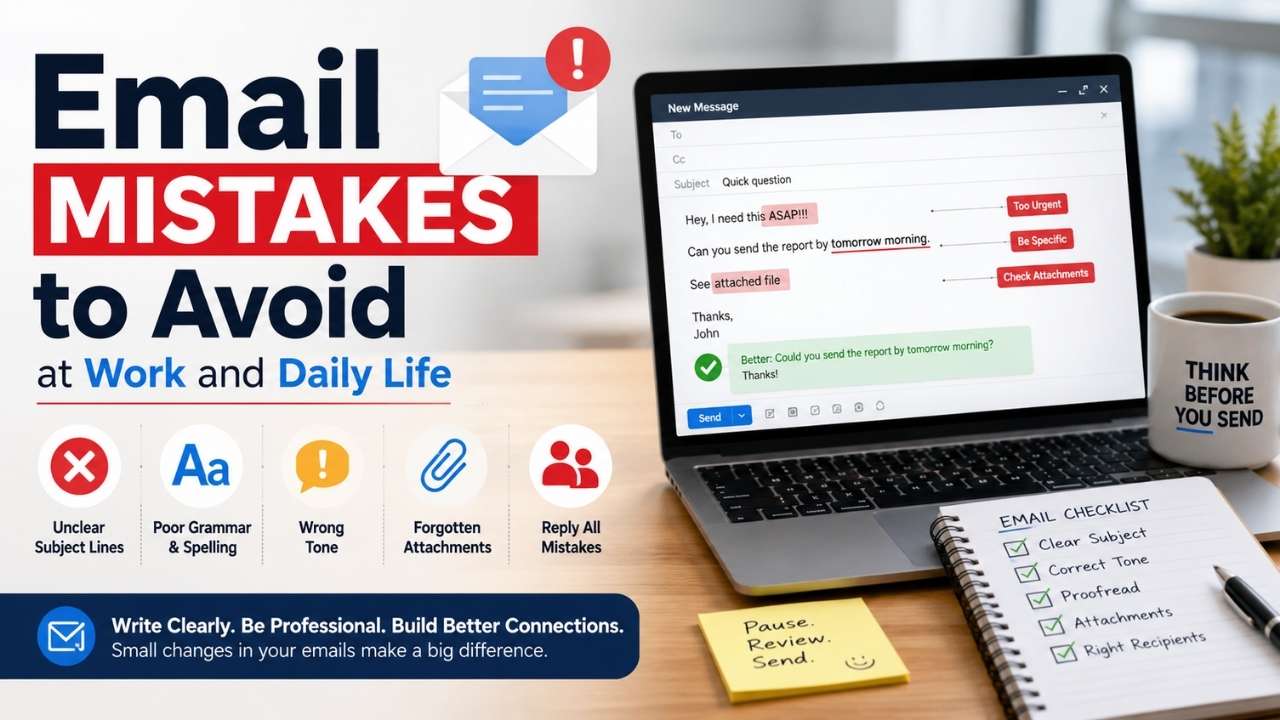
Email Mistakes to Avoid at Work and Daily Life
Email remains one of the most important communication tools in modern life. People use it for work, school, customer service, networking, and personal conversations. However, even experienced writers still make common email mistakes to avoid in daily communication.
Many email problems come from small grammar choices, unclear wording, or poor tone. A missing subject line, an overly casual greeting, or confusing punctuation can change how a message sounds. Because of this, understanding email writing habits matters more today than ever before.
Modern American English email style has also changed quickly. Shorter sentences, mobile-friendly formatting, and conversational language are now common. Still, professional standards continue to matter in business and formal settings.
Quick Answer
The most important email mistakes to avoid include unclear subject lines, poor grammar, weak tone, missing context, overusing punctuation, and forgetting proofreading. Clear, polite, and direct writing usually creates the best email communication.
TL;DR
- Clear subject lines help readers understand the message quickly.
- Short paragraphs improve readability on phones and laptops.
- Grammar and punctuation mistakes can affect professionalism.
- Tone matters more in email because readers cannot hear your voice.
- Proofreading helps prevent confusing or embarrassing errors.
- Modern American email style is more conversational than older business writing.
Understanding Email Communication
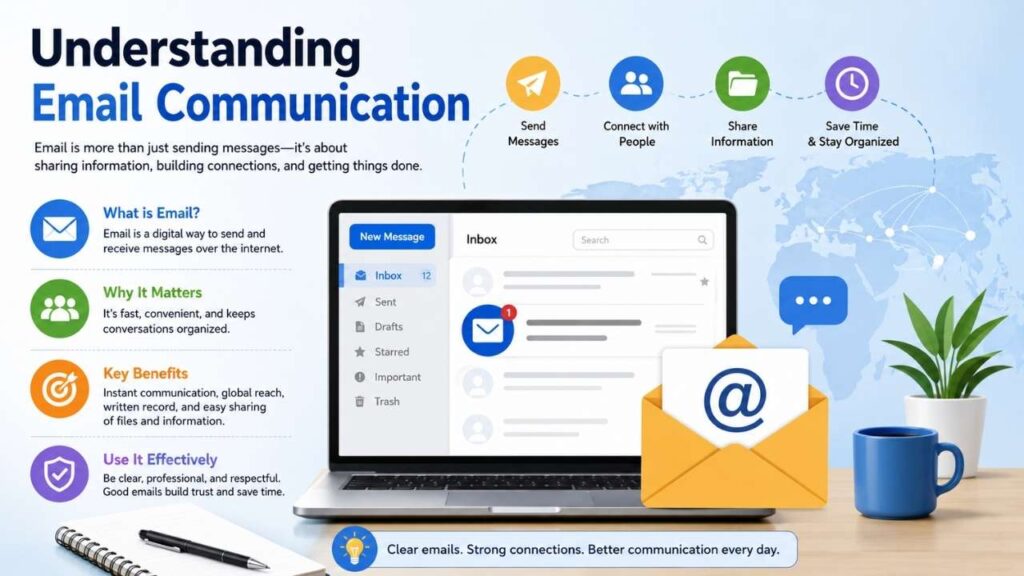
Email is a written form of communication that combines elements of letters, conversation, and digital messaging. Unlike texting, email usually carries more structure and formality. At the same time, it is often less formal than traditional printed business letters.
In American English, email writing focuses heavily on clarity and efficiency. Readers expect direct communication that respects their time. Because of this, most professional emails today are shorter than emails from the early 2000s.
Why Email Writing Matters
Email often creates a first impression. A poorly written message may seem careless, rushed, or disrespectful. In contrast, a clear and organized email can build trust and professionalism.
Today, many workplaces rely on email for decisions, scheduling, collaboration, and documentation. As a result, small language mistakes sometimes create larger misunderstandings.
How Digital Writing Changed English
Email influenced modern English in major ways. Short greetings, sentence fragments, and conversational phrases became more accepted after digital communication expanded during the late 1990s and early 2000s.
However, professional American English still values grammar, punctuation, and respectful tone. Informal style does not mean careless writing.
The Historical Background of Email Style
The first electronic mail systems appeared in the 1970s. Early emails were mostly technical and used by universities, researchers, and government workers. Messages were brief because systems had limited storage and slower technology.
By the 1990s, email became common in homes and offices across the United States. During this period, email style borrowed heavily from formal business letters. Writers often used long greetings, detailed closings, and very formal wording.
The Shift Toward Conversational English
During the 2000s and 2010s, email language became more relaxed. Companies started encouraging friendlier communication styles. Expressions like “Hi,” “Thanks,” and “Just checking in” became normal in workplaces.
Today, modern American email writing balances professionalism with conversational tone. Extremely formal phrases may now sound distant or outdated in many industries.
Unclear Subject Lines
A weak subject line is one of the most common email problems. Subject lines help readers organize and prioritize messages. Without a clear subject, emails may be ignored or misunderstood.
For example, a subject line like “Question” gives little information. Instead, readers respond better to specific wording such as “Question About Friday’s Meeting Schedule.”
Why Specificity Matters
Specific subject lines reduce confusion and save time. They also improve communication in busy workplaces where employees receive dozens of emails daily.
In American business culture, efficiency is highly valued. Therefore, concise and descriptive subject lines are considered professional and respectful.
Poor Grammar and Punctuation
Grammar mistakes remain one of the easiest ways to weaken an email. Errors can distract readers and make the message appear rushed. Common issues include incorrect verb tense, missing commas, and sentence fragments.
For example, confusing “your” and “you’re” still appears frequently in workplace emails. Similarly, overusing exclamation points can create an unprofessional tone.
| Context | Correct Usage | Example | Notes |
| Professional request | Use complete sentences | “Could you send the report by noon?” | Clear and polite |
| Follow-up email | Avoid excessive punctuation | “Thanks for the update.” | One period is enough |
| Scheduling | Use precise wording | “The meeting starts at 2 p.m.” | Prevents confusion |
| Team communication | Keep grammar consistent | “We are reviewing the proposal.” | Sounds professional |
The Rise of Informal Grammar
Digital communication changed grammar expectations somewhat. Sentence fragments and short replies are now more accepted in quick workplace conversations.
However, important emails still benefit from traditional grammar rules. Readers usually expect polished writing in applications, formal requests, and client communication.
Using the Wrong Tone
Tone is one of the hardest parts of email writing because readers cannot hear facial expressions or vocal emotion. A sentence intended as neutral may sound cold, impatient, or sarcastic.
For example, writing “Send this today” may sound demanding. In contrast, “Could you send this today?” sounds more cooperative and polite.
Formal vs Informal Tone
American workplaces often prefer friendly professionalism. Emails that sound too formal may appear stiff. Meanwhile, overly casual writing may appear disrespectful.
Today, phrases like “Hi everyone” or “Thanks so much” are widely accepted in professional American English. However, slang and internet abbreviations may still seem inappropriate in formal settings.
Forgetting Proofreading
Proofreading is one of the simplest ways to improve email quality. Even strong writers make mistakes when typing quickly. Missing words, spelling errors, and accidental attachments happen often.
Autocorrect also creates new problems. Sometimes software changes correct words into unintended ones. Because of this, careful review still matters.
Why Fast Writing Causes Errors
Modern workplaces value speed. Employees often answer emails quickly between meetings or tasks. As a result, many messages contain avoidable mistakes.
Reading an email one final time before sending can prevent confusion and embarrassment. This small habit greatly improves communication quality.
Writing Emails That Are Too Long
Long emails often overwhelm readers. Many people skim messages instead of reading every sentence carefully. Therefore, concise writing improves understanding.
Short paragraphs are especially important today because many people read emails on phones. Dense blocks of text feel difficult to follow on smaller screens.
Modern American Preference for Brevity
American business communication generally favors directness. Writers often place the main point near the beginning of the email rather than at the end.
This style became more common as workplace communication sped up during the smartphone era.
Missing Context or Key Details
Some emails confuse readers because they assume too much shared knowledge. Writers may forget dates, names, deadlines, or background information.
For example, saying “Let’s move it to next week” may create confusion if several projects are being discussed. Clear details reduce unnecessary follow-up emails.
Context Improves Clarity
Strong email writing gives readers enough information to respond easily. Context includes dates, times, project names, and action steps.
Because email lacks face-to-face interaction, written clarity becomes especially important.
Reply-All and Forwarding Mistakes
Digital communication introduced new social rules into English usage. One major example involves “Reply All” behavior. Sending unnecessary replies to large groups can frustrate coworkers.
Forwarding messages without context also creates confusion. Readers may not understand why they received the email or what action is expected.
Email Etiquette in Modern Workplaces
Workplace etiquette evolved alongside email technology. Today, concise replies and thoughtful forwarding are considered signs of professionalism.
American office culture often values efficiency and respect for others’ attention.
Overusing Capital Letters and Punctuation
Capital letters traditionally emphasize importance. However, online writing culture often interprets full capitalization as shouting.
Similarly, excessive punctuation can make emails seem emotional or aggressive. Multiple exclamation marks may appear unprofessional in formal communication.
How Internet Culture Changed Interpretation
Digital communication created new emotional meanings for punctuation and formatting. For example, all caps now commonly suggest anger or urgency.
Because tone can easily be misunderstood online, moderation usually works best.
Weak Openings and Closings
The beginning and ending of an email strongly shape reader perception. Weak openings may feel abrupt, while missing closings may seem careless.
Professional American emails usually begin with a greeting and end with appreciation or a clear next step.
Changing Greeting Styles
Older business letters often used greetings like “Dear Sir or Madam.” Today, many workplaces prefer more natural openings such as “Hi James” or “Hello team.”
This change reflects broader shifts toward conversational business English.
Attachment and Link Errors
Forgetting attachments remains one of the oldest email mistakes. Writers often mention a document but fail to include it before sending.
Broken links also create frustration. Therefore, checking files and links before sending is considered good digital communication practice.
Why These Errors Continue
People often focus heavily on writing and forget technical details. Multitasking increases the likelihood of these mistakes.
Simple review habits help prevent avoidable follow-up emails.
Common Email Mistakes in Personal Communication
Email mistakes do not happen only at work. Personal emails also suffer from unclear tone, missing information, and rushed writing.
For example, vague family emails may create scheduling confusion. Similarly, emotional wording may cause misunderstandings between friends.
Informal English Still Needs Clarity
Personal emails allow more flexibility than professional communication. However, clear wording still improves understanding.
Even relaxed emails benefit from organized thoughts and respectful tone.
British vs American Email Style
British and American email writing share many similarities. However, subtle differences still exist in spelling, punctuation, and tone.
American English often favors shorter sentences and direct wording. British English sometimes sounds slightly more formal in professional settings.
Examples of Regional Differences
American writers commonly use “Hi” in workplace emails. British professionals may use “Hello” more frequently in certain industries.
Spelling differences also remain important. American English uses “organize,” while British English often uses “organise.”
How Email Language Continues to Change
Email style continues evolving because communication technology changes rapidly. Messaging apps, remote work, and mobile devices all influence modern writing habits.
Today, many workplace emails sound closer to conversation than traditional business letters. At the same time, professionalism still matters in important situations.
The Influence of Younger Generations
Younger professionals often prefer concise and friendly communication. Shorter greetings and simpler phrasing are increasingly common.
However, expectations still vary between industries, age groups, and workplace cultures.
Real-Life Examples of Better Email Writing
Effective email writing combines clarity, tone, grammar, and structure. Strong emails help readers understand the message quickly without confusion.
For example, compare these two versions:
“Need this now!!!”
“Could you send the updated file this afternoon? Thanks.”
The second example sounds clearer, calmer, and more professional.
Everyday Communication Benefits
Good email habits improve workplace relationships and reduce misunderstandings. They also help people appear organized and respectful.
Because email remains a permanent written record, thoughtful writing continues to matter in modern communication.
FAQs
What is the most common email mistake?
One of the most common mistakes is unclear communication. Missing details, poor grammar, or weak tone often confuse readers.
Are short emails considered rude?
Not necessarily. In modern American English, short emails are often preferred. However, they should still sound polite and complete.
Should professional emails use emojis?
Most formal business emails avoid emojis. However, some casual workplaces accept limited emoji use in friendly communication.
Why does tone matter so much in email?
Readers cannot hear your voice or see facial expressions. Because of this, wording strongly affects emotional interpretation.
Is email grammar still important today?
Yes. Modern emails may sound conversational, but grammar still affects professionalism and clarity.
How can I make my emails clearer?
Use short paragraphs, direct wording, and specific details. Also, proofread before sending.
Conclusion
Understanding email mistakes to avoid helps people communicate more clearly and professionally. Small grammar choices, tone decisions, and formatting habits can strongly affect how readers interpret a message.
Today, email writing in American English balances professionalism with conversational style. While communication has become faster and more informal, clarity and respect still matter deeply.
The best emails are usually simple, direct, and thoughtful. When writers focus on clear language and careful tone, communication becomes easier for everyone.