
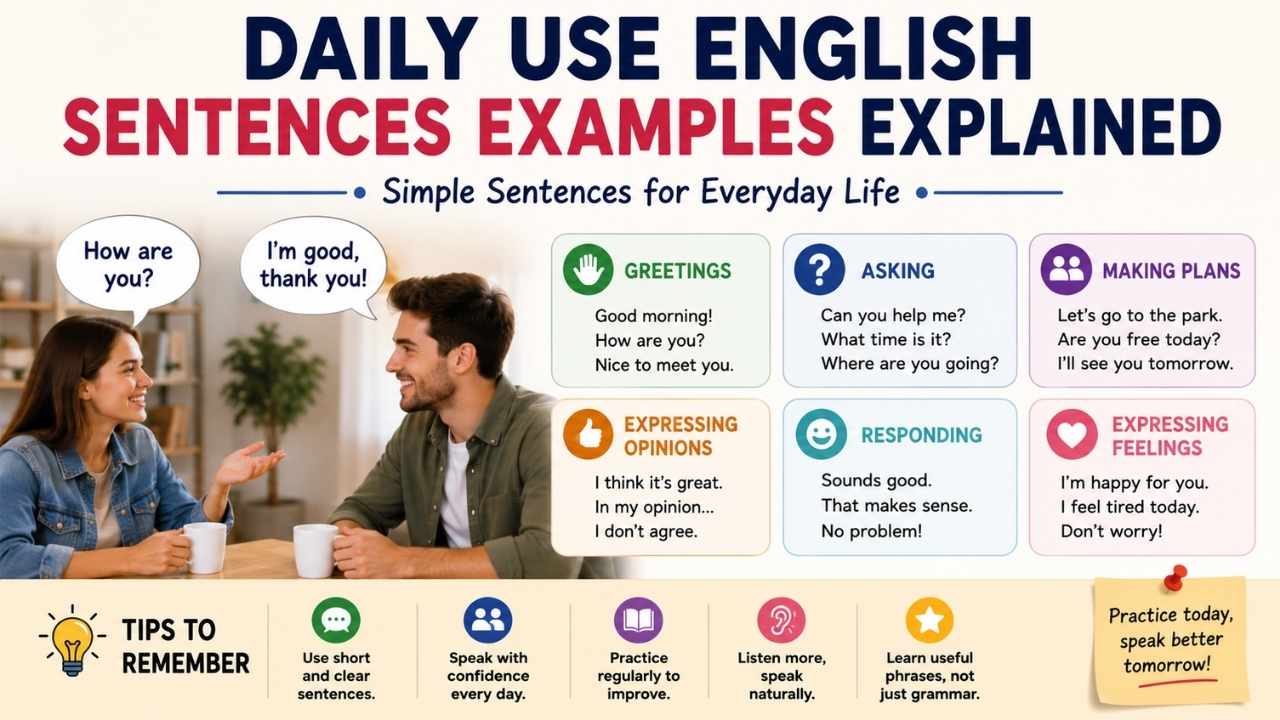
Daily Use English Sentences Examples Explained
Daily use English sentences examples help people speak and write more naturally in everyday life. These sentences appear in conversations, emails, texts, workplaces, schools, and social media. Because they are simple and practical, learners often use them to build confidence in English.
Today, many people want English that sounds natural instead of overly formal. Short everyday sentences make communication faster and clearer. They also help speakers understand tone, context, and common American expressions.
In modern American English, daily expressions change with culture and technology. Some phrases stay formal, while others become casual over time. As a result, understanding how these sentences work helps people communicate smoothly in real situations.
Quick Answer
Daily use English sentences examples are common phrases people use in everyday communication. They follow standard English grammar rules but often become shorter, more natural, and more conversational in American English.
TL;DR
- Everyday English uses short and clear sentence patterns.
- American English often sounds more direct and casual.
- Context changes how a sentence feels.
- Informal speech sometimes breaks older grammar traditions.
- Common expressions evolve over time through texting and online communication.
- Learning sentence patterns improves confidence and fluency.
What Daily Use English Sentences Mean
Daily use English sentences are practical expressions people use every day. They usually focus on greetings, requests, opinions, feelings, and simple actions. These sentences are often easy to understand because they follow familiar patterns.
For example, people say, “How are you?” or “I’ll call you later” without thinking about grammar rules. However, these expressions still follow English sentence structure. Most use a subject, a verb, and sometimes an object.
Common Structure in Everyday English
Many daily sentences use simple present tense because people talk about routines and current situations. For example, “I work from home” and “She likes coffee” are common sentence forms.
In contrast, spoken English often removes unnecessary words. Someone might say, “Sounds good” instead of “That sounds good.” Although shorter, the meaning stays clear in conversation.
Why Everyday Sentences Matter
Everyday expressions help people connect quickly. They reduce confusion and create smoother conversations. Because of this, language learners often study these sentences before advanced grammar.
Daily expressions also show social tone. A sentence can sound polite, friendly, serious, or casual depending on wording and context.
The Historical Development of Everyday English
English daily speech has changed for centuries. Old English sounded very different from modern speech today. Over time, English became simpler in structure and more flexible in conversation.
After the Norman Conquest in 1066, English borrowed many French words. Later, trade, printing, and education spread more standard forms of English across Britain and eventually America.
How American English Changed Everyday Speech
American English developed its own style during the 1700s and 1800s. Speakers preferred direct and practical language. Because of this, many American expressions became shorter and more conversational.
For example, Americans often say “Got it” or “No problem.” These phrases sound natural and efficient. In formal British English of earlier centuries, longer wording was more common.
Technology and Modern Language
Texting and social media strongly shaped daily communication during the 2000s and 2010s. Short replies like “Sounds great,” “I’m good,” and “See you soon” became even more popular.
Today, digital communication continues changing everyday English. However, standard grammar still matters in professional situations.
Common Daily Use English Sentences Examples
People use certain sentence patterns repeatedly in daily life. These patterns appear in homes, offices, schools, and online conversations.
| Context | Correct Usage | Example | Notes |
| Greeting | Friendly opening | “Good morning!” | Common in formal and casual settings |
| Asking for help | Polite request | “Can you help me?” | Uses modal verb for politeness |
| Making plans | Future intention | “I’ll see you tomorrow.” | Very common in speech |
| Giving opinions | Personal view | “I think it’s great.” | Softens statements |
| Everyday response | Casual reply | “Sounds good.” | Common informal American English |
| Checking understanding | Clarification | “What do you mean?” | Used in conversation often |
Sentences Used at Home
At home, people use relaxed and familiar language. Parents may say, “Dinner is ready,” while children often ask, “Can I go outside?”
These expressions usually sound informal because family communication is comfortable and personal.
Sentences Used at Work
Workplace English tends to sound more polite and organized. For example, people say, “Could you send me the file?” instead of “Send me the file.”
American workplaces often balance friendliness with professionalism. Therefore, tone matters as much as grammar.
Grammar Rules Behind Everyday Sentences
Daily English still follows grammar rules, even when sentences sound casual. Most sentences use standard word order: subject, verb, and object.
For example, “I need coffee” follows a simple structure. The subject is “I,” the verb is “need,” and the object is “coffee.”
Sentence Fragments in Conversation
Spoken English sometimes uses fragments instead of full sentences. A person may simply say, “Maybe later” or “Not today.”
Although fragments are technically incomplete, they are accepted in conversation because context explains the meaning.
Contractions in Daily English
Contractions appear constantly in modern American English. People usually say “I’m,” “don’t,” and “can’t” instead of full forms.
Contractions make speech sound smoother and more natural. However, formal writing may avoid too many contractions in serious situations.
Daily Sentences in American English
American English often values clarity and speed. Because of this, speakers prefer direct sentence patterns.
For example, Americans frequently say:
“Let’s go.”
“I’m running late.”
“I’ll text you.”
These sentences sound natural because they are short and efficient.
Informal Tone in the USA
Casual speech is common in American culture. Even workplaces sometimes allow relaxed conversation styles. However, tone still changes depending on the situation.
For example, a manager may write, “Please review this document,” while a friend texts, “Check this out.”
Everyday Politeness
American English often uses polite helper words like “please,” “could,” and “would.” These soften requests and make communication friendlier.
Instead of saying, “Give me the report,” many speakers say, “Could you send me the report?”
British and American Differences
British and American English share most grammar rules. However, everyday wording sometimes differs.
Americans may say, “I’m good,” while British speakers sometimes prefer, “I’m fine.” Both are correct, but usage depends on region and culture.
Vocabulary Variations
Daily expressions also change across countries. Americans say “apartment,” while British English commonly uses “flat.”
Similarly, Americans often say “vacation,” while British speakers use “holiday.”
Tone Differences
American English usually sounds more direct. British English can sound slightly more indirect or formal in some situations.
However, modern online communication has reduced many differences between the two styles.
Formal and Informal Everyday Sentences
English changes depending on context. A sentence that works with friends may sound rude in a business meeting.
For example:
“Send it now” sounds direct.
“Could you send it when you have time?” sounds polite.
Informal Speech Patterns
Informal English often removes words and uses slang. People say:
“No worries.”
“See ya.”
“Gotta go.”
These forms appear often in texting and casual speech.
Formal Communication
Formal English keeps more complete grammar structures. It avoids slang and unclear shortcuts.
Professional writing often uses full sentences and careful wording. Because of this, tone becomes more respectful and organized.
Common Mistakes With Everyday English
Many learners understand grammar rules but struggle with natural usage. They may create sentences that are technically correct but sound unusual.
For example, “I am going to my home now” sounds less natural than “I’m going home now.”
Translating Directly From Another Language
Direct translation causes many mistakes. Sentence structure differs across languages, so English may require different wording.
Instead of translating word by word, learners should focus on common English patterns.
Overusing Formal Language
Some learners use extremely formal English in casual settings. Saying “I would be delighted” during a simple text conversation may sound unnatural.
Modern American English often prefers simpler wording in daily communication.
Daily English in Texting and Social Media
Technology changed sentence style dramatically. People now write shorter and faster messages than before.
Texting commonly removes punctuation or shortens expressions. For example:
“On my way”
“See u later”
“Sounds good”
Informal Grammar Online
Online communication sometimes ignores capitalization and punctuation. However, professional messages still require clearer grammar.
A work email usually needs more structure than a text message to a friend.
Emojis and Tone
Digital communication lacks facial expressions and voice tone. Because of this, people often use emojis or extra wording to avoid misunderstandings.
Still, strong writing skills remain important even in online spaces.
Real-Life Conversation Patterns
Real conversation rarely sounds like textbook English. People interrupt themselves, repeat words, and shorten sentences naturally.
For example, someone might say:
“I was gonna call you, but I got busy.”
This sentence uses relaxed pronunciation and conversational rhythm.
Fillers in Spoken English
Speakers often use fillers like “well,” “you know,” and “like.” These words help conversations flow naturally.
However, too many fillers can weaken clear communication.
Listening and Natural Rhythm
Understanding daily English also means understanding rhythm and stress. Native speakers often connect words together during speech.
For example, “What are you doing?” may sound like “Whaddaya doing?” in fast conversation.
Misunderstandings and Gray Areas
Some grammar rules remain debated in modern English. Everyday speech often accepts forms once considered incorrect.
For example, many people now begin sentences with “And” or “But.” Older grammar teaching sometimes discouraged this practice.
Singular “They”
Modern English increasingly uses singular “they” for unknown or nonbinary individuals. Many style guides now accept this usage.
For example:
“Someone left their bag.”
This structure sounds natural to most American speakers today.
Ending Sentences With Prepositions
People commonly say:
“Who are you talking to?”
“What are you looking at?”
Although older rules discouraged ending with prepositions, modern English widely accepts it.
How Daily English Keeps Changing
Language constantly evolves because society changes. New technology, media, and cultural trends introduce new expressions every year.
Words like “text,” “DM,” and “stream” gained new meanings during recent decades.
Younger Generations and Language
Young speakers often create new phrases quickly. Some disappear after a few years, while others become mainstream English.
Social media speeds up language change more than earlier communication methods did.
What Counts as Standard English Today
Modern English accepts more conversational styles than older grammar systems. However, formal grammar still matters in schools, business, and publishing.
Good communication means choosing the right style for the situation.
Learning Daily English Naturally
People learn everyday English best through regular exposure and practice. Reading conversations, watching videos, and listening to native speakers help learners understand natural patterns.
Memorizing grammar alone is usually not enough. Context and repetition matter equally.
Building Confidence With Common Sentences
Repeating useful sentence patterns improves fluency. Short expressions become automatic over time.
For example:
“I’m not sure.”
“That makes sense.”
“I’ll think about it.”
These phrases appear frequently in real conversations.
Balancing Correctness and Naturalness
Good English balances grammar accuracy with natural expression. Perfect grammar may still sound awkward if wording feels unnatural.
Instead, strong communication focuses on clarity, tone, and context together.
FAQs
What are daily use English sentences?
These are common English expressions people use in everyday situations. They help speakers communicate naturally in conversations, texts, and workplaces.
Why do some daily sentences sound grammatically incomplete?
Conversation often uses fragments because context fills in missing information. Short replies like “Maybe later” still make sense during communication.
Is informal English incorrect?
Not necessarily. Informal English follows different social rules than formal writing. However, professional situations usually require more standard grammar.
Why does American English sound more direct?
American English often values efficiency and clarity. Because of this, speakers commonly use shorter and simpler sentence patterns.
Should learners memorize daily sentences?
Memorizing useful patterns can improve fluency and confidence. However, understanding context and grammar is also important.
Are texting shortcuts acceptable in professional writing?
Usually not. Professional communication normally requires complete words and clearer grammar structures.
Conclusion
Daily use English sentences examples show how grammar works in real communication. These expressions help people speak naturally, understand tone, and connect with others in daily life.
Modern American English mixes traditional grammar with conversational flexibility. Because of this, people often shorten sentences, use contractions, and prefer direct wording. Still, understanding grammar structure remains important for clear communication.
The best way to improve everyday English is through regular practice and exposure. When learners understand both the rules and the real-life usage behind common expressions, they communicate with greater confidence and clarity.