

How to Improve English Speaking at Home
Learning English at home is easier today than ever before. However, many learners still struggle with speaking naturally and confidently. They may understand grammar rules and vocabulary, yet freeze during conversations.
The good news is that spoken English improves through daily use, not perfection. Small habits often matter more than expensive courses or advanced textbooks. Because of this, many learners now focus on building speaking confidence inside their normal routines.
If you want to know how to improve English speaking at home, the key is consistent practice with real communication patterns. Modern American English also values clarity and natural expression more than perfect grammar in every sentence.
Quick Answer
If you want to learn how to improve English speaking at home, practice speaking every day in realistic situations. Listen to natural American English, repeat phrases aloud, think in English, and speak even when nobody is around. Confidence grows through repeated use, not silent studying.
TL;DR
- Speaking improves faster through daily use than memorization.
- Listening and speaking should develop together.
- American English often uses relaxed, conversational patterns.
- Mistakes are normal and help build fluency.
- Thinking in English reduces translation problems.
- Short speaking sessions work better than rare long sessions.
What Improving English Speaking Really Means
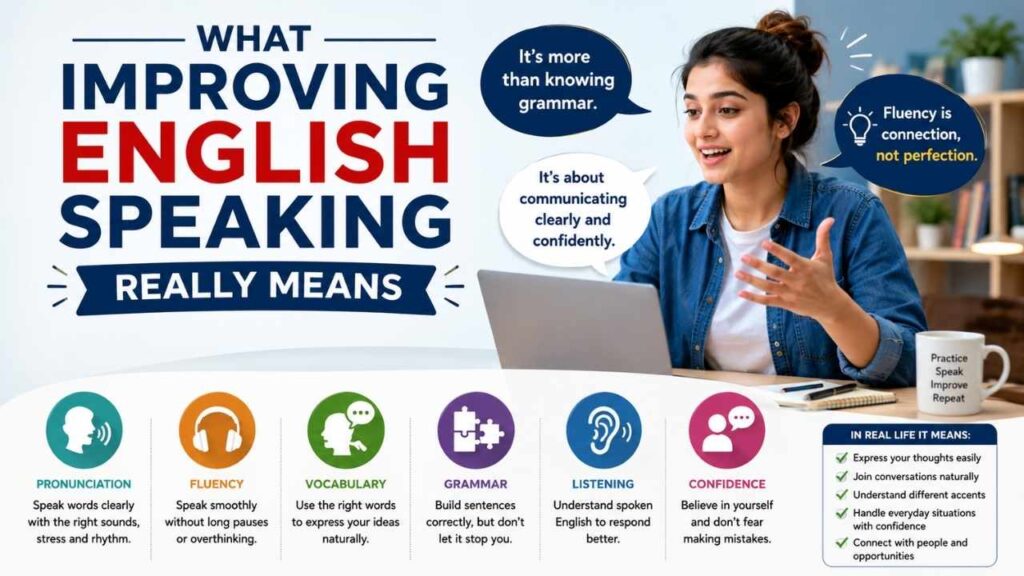
Speaking English is more than knowing grammar rules. It also includes pronunciation, rhythm, listening speed, confidence, and sentence building in real time. Many learners know English on paper but struggle during live conversations.
In modern American English, fluency often means communicating clearly and naturally. Native speakers frequently use contractions, shortened phrases, and informal wording. Because of this, textbook English may sound overly formal in casual conversation.
Understanding Active English
Passive English includes words you recognize while reading or listening. Active English includes words you can actually use while speaking. Many learners have large passive vocabularies but limited active speaking ability.
For example, someone may understand the phrase “I’m looking forward to it” but never use it naturally in conversation. Speaking practice turns passive knowledge into active communication.
Why Speaking Feels Difficult
Speaking happens quickly. Unlike writing, there is little time to stop and think. Therefore, learners often feel pressure to respond immediately.
Fear of mistakes also plays a major role. However, research in language learning during 2025–2026 continues to show that frequent speaking improves fluency faster than silent grammar study alone.
The History of Spoken English Learning
For centuries, English teaching focused mainly on reading and grammar translation. Students memorized rules but rarely practiced speaking aloud. This approach was common in schools throughout Europe and parts of Asia.
During the twentieth century, language education slowly changed. Teachers began emphasizing communication instead of memorization alone. Audio recordings, television, and later the internet made spoken English more accessible.
The Rise of Conversational English
American media strongly influenced global English learning after World War II. Movies, radio, and television spread conversational American English worldwide. As a result, learners became more interested in natural speech patterns.
Today, social media and video platforms expose learners to real spoken English every day. Modern learners can hear authentic conversations without leaving home.
Why Daily Speaking Practice Matters
Language skills grow through repetition. Short daily speaking sessions usually work better than occasional long study periods. This happens because the brain strengthens language patterns through regular exposure.
Speaking every day also reduces anxiety. The more often learners use English aloud, the more natural it feels.
Building Automatic Responses
Fluent speakers do not translate every sentence mentally. Instead, common phrases become automatic over time. For example, expressions like “That makes sense” or “I’ll check on that” eventually come naturally.
Daily speaking trains the brain to respond faster. Even five to ten minutes of consistent practice can create improvement over several months.
Creating Real-Life Habits
Speaking practice works best when connected to normal routines. Some learners describe their day aloud while cooking or cleaning. Others repeat phrases during walks or while driving.
Because these habits feel natural, they are easier to maintain long term.
How Listening Improves Speaking
Listening and speaking are closely connected. Learners who hear natural English regularly usually develop better pronunciation and rhythm.
American English especially relies on connected speech. Words often blend together during fast conversation. Therefore, listening practice helps learners understand real speech patterns.
Learning Rhythm and Stress
English is a stress-timed language. Certain words receive stronger emphasis, while others become softer and shorter. This rhythm helps speech sound natural.
For example, native speakers may say:
“I wanna go.”
instead of:
“I want to go.”
Although both forms are understandable, the first sounds more conversational in everyday American English.
Shadowing as a Speaking Technique
Shadowing means listening to English and repeating it immediately. This method helps learners copy pronunciation, timing, and intonation.
Many learners use podcasts, interviews, or television clips for shadowing practice. Over time, this improves speaking smoothness and confidence.
Thinking in English Instead of Translating
Many speaking problems come from mental translation. Learners first create sentences in their native language and then convert them into English. This slows conversations dramatically.
Thinking directly in English helps speech become faster and more natural.
Starting with Simple Thoughts
At first, learners should think in short English phrases. Examples include:
“I’m tired.”
“I need coffee.”
“It’s raining today.”
These simple mental habits gradually reduce dependence on translation.
Why Translation Causes Delays
Languages organize ideas differently. Direct translation sometimes creates unnatural wording or grammar mistakes. Because of this, fluent speakers usually think directly in the target language.
This shift takes time, but regular exposure helps the brain adapt naturally.
How American English Is Used in Everyday Speech
American English often sounds more informal than textbook examples. Native speakers regularly shorten words, combine phrases, and use casual expressions.
Understanding these patterns helps learners sound more natural during conversations.
| Context | Correct Usage | Example | Notes |
| Casual greeting | Informal conversational English | “What’s up?” | Very common in the USA |
| Making plans | Relaxed future expression | “I’m gonna call later.” | “Going to” becomes “gonna” |
| Agreement | Conversational response | “Sounds good.” | Common in texting and speech |
| Polite conversation | Softened wording | “Could you help me?” | Sounds more natural than commands |
Formal and Informal Differences
Formal English appears in business writing, academic work, and official communication. Informal English appears in conversations, texting, and social media.
However, modern American workplaces often mix formal and conversational language. For example, business emails today are usually friendlier and shorter than older styles.
Common Mistakes When Practicing Speaking
Many learners focus too heavily on grammar perfection. While grammar matters, constant self-correction can interrupt fluency and confidence.
Another common mistake is practicing only silently. Speaking requires physical mouth movement and vocal repetition.
Memorizing Without Using
Some learners memorize vocabulary lists without speaking the words aloud. Unfortunately, recognition alone does not create conversational ability.
Words become useful only after repeated active use in realistic situations.
Avoiding Mistakes Completely
Fear of embarrassment often slows progress. Yet mistakes help learners notice gaps in knowledge. Native speakers also make speaking errors occasionally.
Confidence grows when learners continue speaking despite imperfections.
How Pronunciation Has Changed Over Time
English pronunciation has changed constantly throughout history. Even native accents differ widely across regions in the United States.
Because English spelling developed over centuries, pronunciation and spelling do not always match perfectly.
Modern American Pronunciation Trends
American English today often uses reduced sounds in fast conversation. For example, “want to” frequently becomes “wanna,” while “did you” may sound like “didja.”
These patterns are normal in informal speech. However, learners should first understand standard forms before relying heavily on casual pronunciation.
Accent Versus Clarity
Many learners worry about sounding completely American. In reality, clear pronunciation matters more than losing an accent entirely.
Most communication problems come from unclear stress or rhythm, not from having a foreign accent.
Best Home Activities for Speaking Practice
Home speaking practice works best when it feels realistic and enjoyable. Learners improve faster when English becomes part of everyday life instead of a separate school subject.
Talking to Yourself
Self-talk may feel unusual at first, but it is highly effective. Learners can describe actions, explain opinions, or retell daily events aloud.
This builds fluency because the brain practices organizing ideas quickly.
Reading Aloud
Reading aloud improves pronunciation and speaking rhythm. It also helps learners notice punctuation, sentence flow, and stress patterns.
Many learners use short news articles or dialogue-heavy stories for this exercise.
Recording Your Voice
Voice recordings help learners hear pronunciation issues more clearly. Over time, recordings also reveal improvement that may otherwise go unnoticed.
Listening back can feel uncomfortable initially. However, it often becomes one of the fastest ways to improve speaking clarity.
Using Technology to Practice Spoken English
Technology has transformed home language learning. Learners now have access to podcasts, video calls, speech tools, and conversation platforms from almost anywhere.
However, passive watching alone usually does not improve speaking significantly. Active participation matters most.
Speaking with AI and Apps
Many learners now practice English conversations using language apps and AI tools. These systems allow repeated speaking without fear of judgment.
Because practice is available anytime, learners often feel more comfortable experimenting with new vocabulary.
Social Media and Spoken English
Short-form videos expose learners to modern conversational English. Slang, pronunciation trends, and informal expressions spread quickly online.
Still, learners should balance casual online English with standard grammar and pronunciation.
British and American Speaking Differences
British and American English share the same foundation but differ in pronunciation, vocabulary, and conversational style.
American English often sounds more direct and relaxed. British English sometimes preserves more formal phrasing in certain situations.
Vocabulary Differences
Americans say “apartment,” while British speakers often say “flat.” Americans use “elevator,” while British English commonly uses “lift.”
These differences rarely block understanding, but learners should recognize common variations.
Pronunciation Variations
American English often pronounces the “r” sound strongly. In contrast, many British accents soften or drop it after vowels.
Today, global media exposure means learners frequently hear mixed English varieties online.
Why Confidence Matters in Spoken English
Confidence strongly affects speaking ability. Some learners know enough English but hesitate too much during conversations.
Confidence grows through repeated success, even small successes.
Speaking Before Feeling Ready
Many learners wait until their grammar feels perfect. However, fluency develops through active speaking, not endless preparation.
Native conversations are often imperfect, interrupted, and informal. Real communication values understanding more than perfection.
Reducing Fear of Judgment
Most people appreciate communication effort. Minor grammar mistakes rarely matter if the message is clear.
Therefore, learners should focus on communication first and gradual refinement later.
How Spoken English Continues to Change
English constantly evolves through technology, culture, and media. Text messaging and online communication have influenced modern spoken language heavily.
Shortened expressions now appear commonly in speech as well as writing.
Digital Communication Effects
Phrases like “DM me,” “I’m online,” and “That went viral” entered spoken English through internet culture. Younger speakers especially adopt new expressions quickly.
However, formal English standards still remain important in professional and academic settings.
The Future of Conversational English
Global communication continues shaping English worldwide. Today’s learners hear accents and styles from many countries, not only the United States or Britain.
Because of this, international clarity has become increasingly important in spoken English.
FAQs
How long does it take to improve English speaking at home?
Improvement speed varies by practice quality and consistency. Many learners notice progress within a few months of daily speaking practice. Small habits often create strong long-term results.
Is speaking alone really helpful?
Yes, speaking alone builds fluency and confidence. It trains the brain to organize thoughts quickly in English. Many advanced learners still use self-talk practice regularly.
Should I focus on grammar or fluency first?
Both matter, but fluency usually needs more active practice. Constant grammar correction can interrupt natural speech. Clear communication should remain the main goal.
Can movies improve spoken English?
Movies help learners hear natural pronunciation and conversational rhythm. However, improvement happens faster when learners repeat lines and practice aloud afterward.
Do I need an American accent to speak well?
No, clear communication matters more than accent imitation. Many fluent English speakers keep their original accents while speaking naturally and confidently.
What is the best daily habit for spoken English?
Daily speaking aloud is one of the strongest habits. Even short conversations, shadowing exercises, or self-talk sessions help build fluency over time.
Conclusion
Learning spoken English at home is completely possible with steady daily practice. Fluency develops through repetition, listening, confidence, and real communication habits. Small speaking exercises often produce bigger results than long periods of silent study.
If you want to master how to improve English speaking at home, focus on using English actively every day. Speak aloud, listen carefully, and accept mistakes as part of the learning process. Over time, English will begin to feel less like a subject and more like a natural way to communicate.