
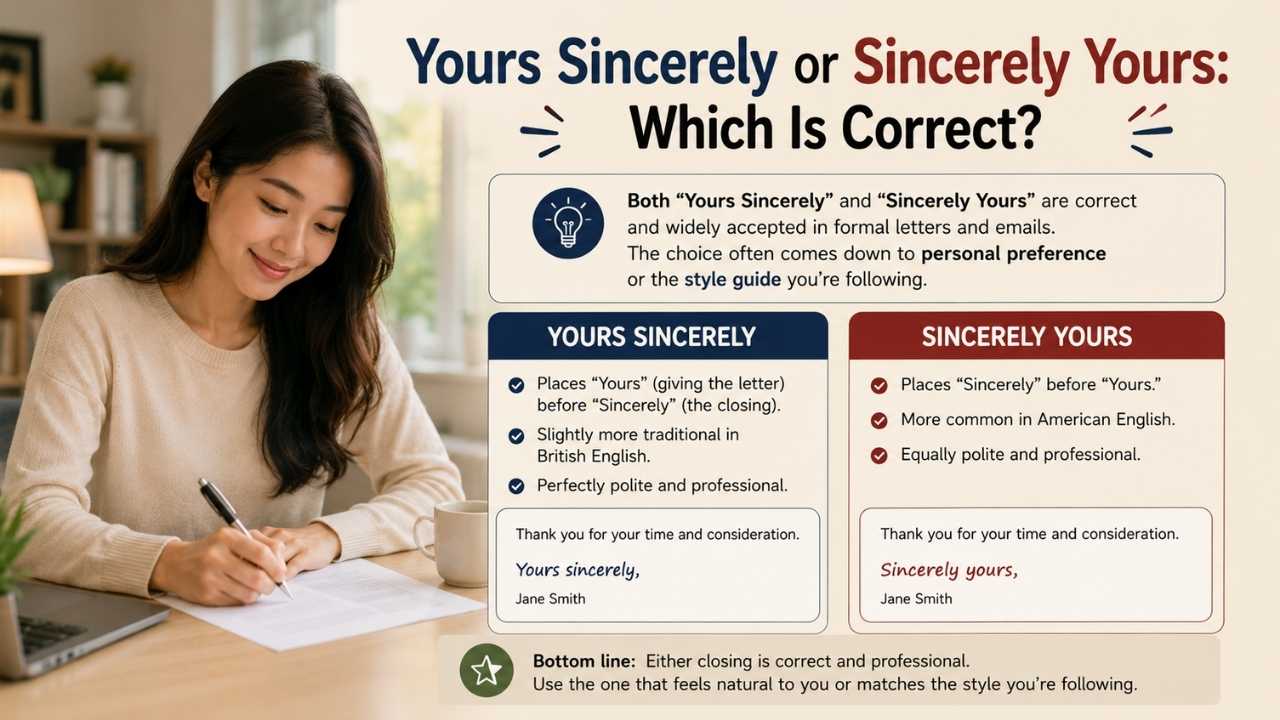
Yours Sincerely or Sincerely Yours: Which Is Correct?
If you have ever written a formal letter, business letter, or professional email, you may have wondered whether to use Yours sincerely or Sincerely yours. This question confuses many writers because both phrases appear in professional correspondence, job applications, cover letters, and official documents.
The good news is that both expressions are correct. However, their usage depends mainly on regional preferences rather than grammar rules. In the United Kingdom, Yours sincerely remains the standard choice for formal correspondence. In the United States, writers traditionally prefer Sincerely yours, although many modern professionals shorten it to Sincerely.
Understanding the difference between yours sincerely vs sincerely yours helps you choose the right email sign-off, avoid common mistakes, and create a professional impression. In this guide, you’ll learn the meaning of both phrases, their differences, regional usage, examples, common errors, and the best alternatives for modern business communication.
Quick Answer
Yours sincerely and Sincerely yours are both correct formal letter closings, but they follow different regional writing conventions. In British English, people typically use Yours sincerely when they know the recipient’s name. In American English, Sincerely yours is more common, although many professionals now simply use Sincerely. Neither phrase is more correct than the other. The best choice depends on your audience, location, and the style of English you use.
Yours Sincerely vs Sincerely Yours at a Glance

Although Yours sincerely and Sincerely yours serve the same purpose, they follow different writing traditions.
| Feature | Yours Sincerely | Sincerely Yours |
| Common Region | British English | American English |
| Formality | Formal | Formal |
| Used in Business Letters | Yes | Yes |
| Used in Professional Emails | Yes | Yes |
| Professional Tone | Strong | Strong |
| Modern Alternative | Sincerely | Sincerely |
When comparing yours sincerely vs sincerely yours, the key difference is location rather than meaning. Both phrases show respect and professionalism. They act as a complimentary close, which is the polite phrase placed before a signature in a formal letter or email.
If your audience is in the UK, Yours sincerely often sounds more natural. If your readers are in the United States, Sincerely yours may feel more familiar. Understanding these conventions helps you select the most appropriate professional sign-off.
What Does “Yours Sincerely” Mean?
The phrase Yours sincerely is a traditional formal letter sign-off used to end professional and official correspondence. It expresses respect, honesty, and genuine regard for the recipient.
In British English, writers commonly use Yours sincerely when they know the recipient’s name. For example, if a letter begins with “Dear Mr. Brown” or “Dear Ms. Smith,” the standard closing is often Yours sincerely.
The yours sincerely meaning is straightforward. It indicates that the sender genuinely means what they have written and wishes to end the communication respectfully. This closing has remained popular in business writing because it sounds professional without appearing overly emotional.
Today, many professionals still use Yours sincerely in cover letters, formal requests, complaint letters, recommendation letters, and academic correspondence. Although shorter alternatives exist, this phrase remains a trusted option for serious and professional communication.
What Does “Sincerely Yours” Mean?
Sincerely yours carries almost the same meaning as Yours sincerely. It expresses respect, professionalism, and goodwill toward the recipient.
The sincerely yours meaning centers on honesty and sincerity. The phrase assures the reader that the message comes from a genuine place and that the sender values the relationship.
In American English, Sincerely yours has long been a standard closing in business letters, legal correspondence, professional requests, and corporate communication. Although many organizations now prefer shorter endings such as Sincerely, the traditional version remains acceptable in formal situations.
When writing to an American audience, Sincerely yours often feels more natural than Yours sincerely. However, readers generally understand both phrases regardless of location. Choosing the appropriate closing simply helps your communication match local writing conventions and appear more polished.
Yours Sincerely vs Sincerely Yours: The Main Difference
Many people search for the difference between Yours sincerely and Sincerely yours because both expressions seem identical. In practice, they share the same purpose and nearly the same meaning.
The primary difference is word order and regional preference.
In British English, the traditional format places Yours before sincerely, creating Yours sincerely. In American English, writers typically reverse the order to create Sincerely yours.
Neither phrase sounds more professional than the other. Both are accepted in business correspondence, professional communication, and formal writing.
The choice comes down to audience expectations. If your readers are based in the UK, Yours sincerely may feel more familiar. If your readers are in the US, Sincerely yours may seem more natural.
Therefore, if you are wondering whether to use yours sincerely or sincerely yours, focus on your audience rather than searching for a universally correct answer.
Which Is Correct—Yours Sincerely or Sincerely Yours?
One of the most common questions writers ask is, “Which is correct—Yours sincerely or Sincerely yours?”
The answer is simple: both are correct.
Neither expression violates grammar rules. Both function as accepted formal email closings and business letter sign-offs. The difference lies in regional writing conventions rather than correctness.
British organizations often prefer Yours sincerely, while American organizations frequently use Sincerely yours or simply Sincerely.
Modern communication has also become more flexible. Many professionals use shorter sign-offs in emails because they are quick and efficient. However, traditional closings still carry value in job applications, legal correspondence, official requests, and academic communication.
Instead of asking which phrase is more correct, consider which one fits your audience. Matching local conventions can make your writing appear more natural and professional.
When Should You Use Yours Sincerely?
You should use Yours sincerely when writing formal correspondence that follows British English conventions.
This closing works particularly well when:
- You know the recipient’s name.
- You are submitting a job application.
- You are writing a cover letter.
- You are contacting a university.
- You are sending a professional request.
- You are communicating with a government office.
For example:
Dear Mr. Wilson,
Thank you for considering my application.
Yours sincerely,
James Carter
This structure remains common throughout the UK and many countries influenced by British writing standards.
Even in modern email communication, Yours sincerely maintains a professional tone. It demonstrates respect while keeping the message formal and polished.
If your audience expects traditional business writing, Yours sincerely remains one of the safest and most effective choices.
When Should You Use Sincerely Yours?
Sincerely yours works best when following traditional American English writing conventions.
You may use this sign-off when writing:
- Business correspondence
- Corporate communication
- Professional inquiries
- Recommendation letters
- Legal documents
- Formal requests
For example:
Dear Ms. Johnson,
I appreciate your time and consideration.
Sincerely yours,
Michael Adams
Many professionals still use this format because it sounds respectful and professional. However, modern business communication often shortens the phrase to Sincerely.
If your audience primarily uses American English, Sincerely yours may feel more familiar than Yours sincerely. Although the difference is subtle, matching local expectations can strengthen the professionalism of your communication.
Is “Your Sincerely” Correct?
No, Your sincerely is not correct.
This mistake appears frequently because people confuse your and yours. However, they serve different grammatical functions.
Correct:
✔ Yours sincerely
Incorrect:
✘ Your sincerely
The word yours functions as a possessive pronoun, which makes it suitable for a standalone closing phrase. The word your functions as a possessive determiner and must modify a noun.
Because no noun follows the word in the closing phrase, Yours sincerely is the only correct option.
If you often search for your sincerely or yours sincerely, remember this simple rule: formal sign-offs require yours, not your.
British English vs American English Letter Closings
The debate surrounding yours sincerely or sincerely yours largely comes from the differences between British English and American English.
In British English:
- Dear Mr. Brown → Yours sincerely
- Dear Sir/Madam → Yours faithfully
In American English:
- Dear Mr. Brown → Sincerely yours
- Dear Sir/Madam → Sincerely yours
- Modern alternative → Sincerely
Today, globalization has made these distinctions less important. Most readers understand both forms regardless of location.
However, following regional conventions still demonstrates attention to detail and professionalism. If you communicate with international clients, employers, or institutions, using the expected sign-off can create a stronger impression.
Can You Simply Use “Sincerely”?
Yes. In modern professional communication, many writers simply use Sincerely.
This shorter version feels clean, professional, and efficient. It works well in:
- Business emails
- Job applications
- Professional correspondence
- Academic communication
Many organizations now prefer concise communication. As a result, Sincerely has become one of the most common email closings in the United States.
However, if you are writing a highly formal document, Yours sincerely or Sincerely yours may still feel more traditional and appropriate.
Common Mistakes to Avoid
When using formal letter closings, avoid these common mistakes:
❌ Your sincerely
❌ Sincerely your
❌ yours Sincerely
❌ sincerely Yours
Correct forms include:
✔ Yours sincerely
✔ Sincerely yours
✔ Sincerely
Also pay attention to punctuation and capitalization. Consistency matters in professional writing. A small mistake in your sign-off can distract readers and reduce the overall polish of your correspondence.
Yours Sincerely vs Yours Faithfully
Many writers also confuse Yours sincerely and Yours faithfully.
In traditional British letter writing:
- Use Yours sincerely when you know the recipient’s name.
- Use Yours faithfully when you do not know the recipient’s name.
Example:
Dear Mr. Smith → Yours sincerely
Dear Sir/Madam → Yours faithfully
This distinction remains common in British business correspondence and formal communication.
Alternatives to Yours Sincerely and Sincerely Yours
Modern communication offers several alternatives:
- Best regards
- Kind regards
- Warm regards
- Respectfully
- Sincerely
- Best wishes
These options work well in professional emails and business correspondence. However, for highly formal situations, traditional sign-offs often remain the safest choice.
Frequently Asked Questions
Is it Yours sincerely or Sincerely yours?
Both Yours sincerely and Sincerely yours are correct. The difference comes from regional writing conventions. Yours sincerely is more common in British English, while Sincerely yours is traditionally used in American English. Neither option is grammatically incorrect.
Which is more professional: Yours sincerely or Sincerely yours?
Both phrases sound professional and work well in formal correspondence, business letters, and professional emails. The best choice depends on your audience and whether you are following British or American writing standards.
When should I use Yours sincerely?
Use Yours sincerely when writing a formal letter or email to someone whose name you know. It is the preferred formal letter closing in British English and commonly appears in job applications, cover letters, and official correspondence.
When should I use Sincerely yours?
Use Sincerely yours in traditional American business writing, legal correspondence, and professional communication. It remains a respected and professional way to end a formal message.
Is “Your sincerely” correct?
No. Your sincerely is incorrect. The correct form is Yours sincerely because yours is the appropriate possessive pronoun used in formal sign-offs.
Can I use simply “Sincerely” instead?
Yes. Many professionals now use Sincerely as a shorter alternative to Sincerely yours. It works well in business emails, cover letters, and professional correspondence while maintaining a formal tone.
What is the difference between Yours sincerely and Yours faithfully?
In traditional British letter writing, use Yours sincerely when you know the recipient’s name and Yours faithfully when you do not. For example, a letter beginning with “Dear Mr. Brown” typically ends with Yours sincerely, while a letter beginning with “Dear Sir/Madam” usually ends with Yours faithfully.
Is Sincerely yours outdated?
Not at all. Although many professionals now prefer shorter closings such as Sincerely, Sincerely yours remains an accepted and professional sign-off in formal American correspondence.
Can I use Yours sincerely in an email?
Yes. Yours sincerely works perfectly in formal emails, especially when communicating with employers, clients, universities, or government organizations. It creates a respectful and professional impression.
What are the best alternatives to Yours sincerely and Sincerely yours?
Some popular alternatives include:
- Sincerely
- Best regards
- Kind regards
- Warm regards
- Respectfully
- Best wishes
The best option depends on the level of formality and your relationship with the recipient.
Should I capitalize Yours sincerely or Sincerely yours?
In most formal letters, only the first word is capitalized.
✔ Yours sincerely
✔ Sincerely yours
Avoid capitalizing every word unless a specific style guide requires it.
Do I need a comma after Yours sincerely or Sincerely yours?
Punctuation rules vary by region and style guide. In modern British English, writers often omit the comma. In American business writing, a comma may follow the closing. Always follow your organization’s preferred formatting style.
Conclusion
If you are trying to decide between Yours sincerely and Sincerely yours, remember that both are correct. The main difference lies in regional writing conventions rather than grammar.
Choose Yours sincerely for traditional British English communication and Sincerely yours for traditional American English correspondence. If you prefer a modern option, Sincerely works well in most professional situations.
Ultimately, the best formal letter closing is the one that matches your audience, maintains professionalism, and fits the tone of your message. By understanding these conventions, you can end every letter or email with confidence and clarity.