

Wreckless or Reckless: Which Spelling Is Correct?
Have you ever wondered whether wreckless or reckless is the correct spelling? Many writers, students, and English learners ask this question because the two words look very similar. At first glance, wreckless seems logical because it contains the word wreck, which often relates to accidents and damage. However, English spelling does not always follow what looks logical.
The correct spelling is reckless. This word describes someone who acts without thinking about the possible consequences of their actions. People often use it to describe reckless behavior, reckless driving, or other forms of risky and irresponsible behavior. On the other hand, wreckless is generally considered a spelling mistake in standard English.
In this guide, you’ll learn the difference between wreckless and reckless, discover the reckless meaning, explore real examples, and understand why so many people confuse these commonly confused words. By the end, you’ll know exactly how to spell reckless correctly and use it with confidence in your writing.
Quick Answer
Reckless is the correct spelling. It means careless, irresponsible, or showing no concern for the possible consequences of an action. Wreckless is generally considered a misspelling and is not accepted in standard English usage. If you are wondering which is correct, wreckless or reckless, always choose reckless in formal writing, academic work, and everyday communication. The confusion often occurs because people mistakenly connect the word to wreck.
Wreckless vs Reckless at a Glance
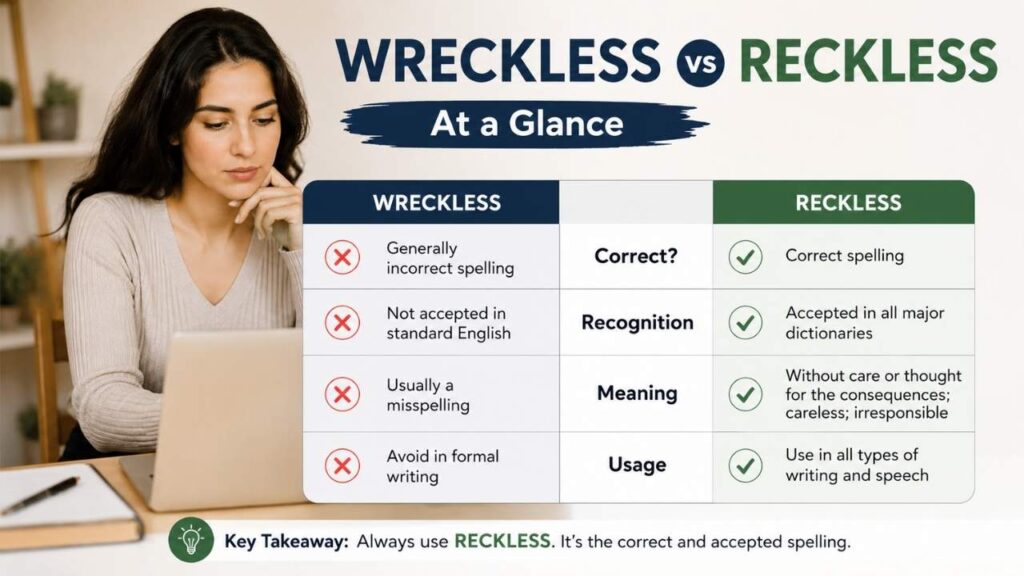
If you are trying to decide between wreckless or reckless, the answer is simple: reckless is the correct spelling. Many people make this spelling mistake because the word wreck is familiar and seems to fit the meaning. However, standard dictionaries recognize only reckless when describing someone who acts without care or concern for consequences.
| Word | Correct? | Meaning |
| Reckless | Yes | Careless, irresponsible, or dangerous |
| Wreckless | No (in standard English) | Usually a misspelling of reckless |
The difference between wreckless and reckless is not about meaning but about correct usage. If you write an essay, email, report, or social media post, you should always use reckless. Understanding this simple distinction can help you avoid one of the most common English spelling mistakes and improve your writing confidence.
What Does Reckless Mean?
The reckless meaning is simple. A person is reckless when they act without thinking carefully about the results of their actions. They often ignore risks, warnings, or possible consequences. Because of this, the word usually carries a negative meaning.
You might hear people talk about reckless driving, reckless behavior, or reckless decisions. For example, a driver who speeds through a busy street without paying attention is acting recklessly. A person who spends all their money without a plan may also make reckless choices.
Some common synonyms for reckless include careless, irresponsible, rash, and thoughtless. Common antonyms include careful, cautious, and responsible. Knowing these related words helps you understand the reckless definition more clearly and use it correctly in everyday conversations and writing.
Is Wreckless a Real Word?
Many people ask, “Is wreckless a real word?” In standard English, the answer is generally no. Most major dictionaries recognize reckless as the correct spelling and treat wreckless as a misspelling. That is why teachers, editors, and grammar experts recommend avoiding it in formal writing.
The confusion happens because the word wreck relates to accidents and destruction. As a result, some people assume that wreckless means “without a wreck” or connect it to dangerous actions. While this idea may seem reasonable, it does not match the historical development of the word.
You may occasionally see Wreckless used in brand names, usernames, song titles, or creative projects. In those cases, it is often a deliberate choice rather than standard language usage. For everyday writing, reckless remains the correct and accepted spelling.
Why Do People Confuse Wreckless and Reckless?
The confusion between wreckless and reckless happens for a very understandable reason. Many English speakers recognize the word wreck and naturally connect it to accidents, damage, and risky behavior. Since reckless actions can often lead to a wreck, people assume that wreckless must be the correct spelling.
Another reason is that English spelling can be tricky. Many words follow patterns that seem logical, but their history tells a different story. Because people hear the word more often than they see it written, they sometimes guess the spelling based on sound alone.
The mistake becomes even more common online, where informal writing spreads quickly. Fortunately, remembering that reckless is the accepted spelling can help you avoid this error. Once you learn the difference between wreckless and reckless, it becomes much easier to spot and correct the mistake in your own writing.
The Origin and History of Reckless
Understanding the history of the word can make the spelling easier to remember. The word reckless comes from the old English word reck, which means “to care,” “to pay attention,” or “to take notice.” Over time, people added the ending -less, which means “without.”
As a result, reckless originally meant “without care” or “without concern.” This meaning remains very close to how we use the word today. A reckless person often ignores warnings, risks, or possible consequences.
Many people believe that reckless comes from the word wreck, but that is not true. Although the two words look similar, they developed from different origins. Learning this simple fact helps explain why wreckless is usually considered incorrect. The history of the word provides a useful memory trick and helps you understand the true origin of reckless.
Examples of Reckless in Sentences
Looking at examples is one of the best ways to understand how to use reckless correctly. The word often describes actions that involve unnecessary risk or poor judgment.
- The driver received a ticket for reckless driving.
- His reckless behavior put everyone in danger.
- She made a reckless decision without thinking about the consequences.
- The company faced criticism for its reckless spending habits.
- Jumping into the river during a storm was a reckless choice.
- The athlete took a reckless risk during the competition.
- His reckless comments created problems at work.
- The teenager showed reckless disregard for safety rules.
In each example, the person acts without enough care or caution. These examples show the reckless meaning in real-life situations. When you use the word this way, your writing becomes clearer and more accurate.
Common Phrases That Use Reckless
The word reckless appears in several common expressions. Learning these phrases can improve your vocabulary and help you use the word naturally.
One of the most common phrases is reckless driving, which refers to operating a vehicle in a dangerous or irresponsible way. Another popular expression is reckless abandon, which describes acting freely without worrying about consequences. You may also hear reckless disregard, a phrase often used when someone ignores rules, safety, or the well-being of others.
Other examples include reckless behavior, reckless spending, and reckless risk-taking. These phrases all share the same core idea: acting without enough thought or caution.
Because these expressions appear frequently in news reports, books, and everyday conversations, understanding them can help you recognize and use the word reckless more confidently in different situations.
Reckless vs Careless: What’s the Difference?
People often use reckless and careless interchangeably, but they are not exactly the same. Both words describe a lack of caution, yet reckless usually suggests a greater level of risk.
A careless person may make a mistake because they were distracted or did not pay enough attention. A reckless person, however, often knows there is danger but chooses to act anyway. This difference makes reckless behavior seem more serious.
For example, forgetting your keys might be careless. Driving at high speed through a crowded area would be reckless. One action involves a simple mistake, while the other involves a significant risk.
Understanding the difference between these words improves your vocabulary and helps you communicate more precisely. When serious danger or disregard for consequences is involved, reckless is usually the better choice.
How to Remember the Correct Spelling
If you often mix up wreckless and reckless, a simple memory trick can help. Remember that reckless comes from the old word reck, not from wreck. The word has always been connected to the idea of care and attention, not accidents or destruction.
Another helpful trick is to focus on the meaning. A reckless person acts without care, and the word reckless already contains the part that relates to care. Once you connect the spelling with its history, it becomes easier to remember.
You can also practice by writing common phrases such as reckless driving, reckless behavior, and reckless disregard. Repeating these examples helps build familiarity with the correct spelling.
With a little practice, you will quickly remember that reckless is correct and wreckless is usually a spelling mistake.
FAQs
Is Wreckless a Real Word?
Wreckless is not generally accepted as a standard English word. Most dictionaries recognize reckless as the correct spelling. While you may see wreckless used in creative names, usernames, or informal contexts, it is usually considered a spelling mistake in normal writing. If you are writing an article, email, assignment, or professional document, always use reckless.
What Does Reckless Mean?
The word reckless means acting without enough care, caution, or thought about possible results. A person who makes reckless decisions often ignores risks or dangers. For example, speeding on a crowded road is an example of reckless driving because the person does not consider the safety of others.
How Do You Spell Reckless Correctly?
The correct spelling is r-e-c-k-l-e-s-s: reckless. A common mistake is adding a w and writing wreckless because people connect the word with wreck. However, the correct word comes from reck, meaning care or concern, not from wreck.
Is Reckless Always a Negative Word?
In most cases, reckless has a negative meaning because it describes actions that involve unnecessary risk or poor judgment. It is usually linked with words like dangerous, careless, and irresponsible. However, in creative writing, people may sometimes use it to describe extreme energy or freedom in a dramatic way.
What Is the Opposite of Reckless?
The opposite of reckless includes words such as careful, cautious, responsible, and thoughtful. A careful person thinks about possible outcomes before acting, while a reckless person may act quickly without considering the consequences.
Is Reckless a Formal Word?
Yes, reckless is a common and formal English word. You can use it in professional writing, academic work, news articles, and everyday conversations. It is a standard adjective used to describe unsafe, careless, or irresponsible actions.
Conclusion
When comparing wreckless or reckless, the correct choice is always reckless in standard English. The word means careless, irresponsible, or showing little concern for consequences. Although many people write wreckless, dictionaries and grammar experts generally consider it a misspelling.
The confusion often comes from the word wreck, which makes the incorrect spelling seem logical. However, the true origin of reckless comes from the old word reck, meaning “to care” or “pay attention.” This history explains why the accepted spelling does not include the word wreck.
To avoid mistakes, remember that reckless appears in common expressions such as reckless driving, reckless behavior, and reckless disregard. Once you understand the meaning, spelling, and history of the word, you can use it confidently and accurately in any type of writing.