
Is It Correct to Say Most Recent? Meaning, Grammar, & Examples
If you’ve ever wondered, “Is it correct to say most recent?”, you’re not alone. This common English phrase appears in business writing, academic writing, job applications, emails, and everyday conversations.
Many learners ask whether most recent is grammatically correct, whether it sounds redundant, or if words like latest, last, or newest are better choices. The good news is that most recent is a standard and widely accepted expression in English grammar. However, choosing the right word depends on the context and the message you want to communicate.
In this guide, you’ll learn the meaning of most recent, the grammar rule behind it, how to use it correctly, how it compares with similar expressions, and see plenty of example sentences to help you use the phrase naturally and confidently in both formal and everyday English.
Quick Answer
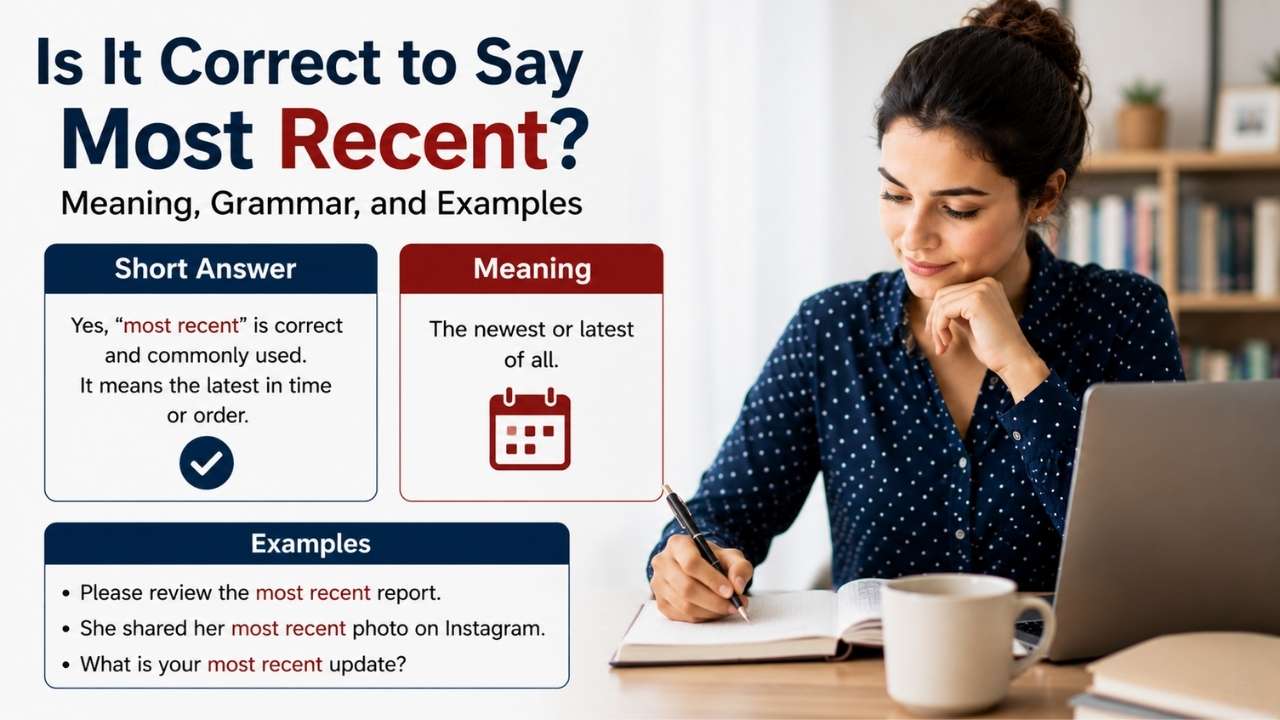
Yes, “most recent” is grammatically correct and commonly used in both formal and informal English. It is the superlative form of recent and refers to the latest item, event, or version in a series. You’ll often see most recent in business writing, academic writing, reports, resumes, and everyday conversations when identifying the newest or latest occurrence.
What Does “Most Recent” Mean?
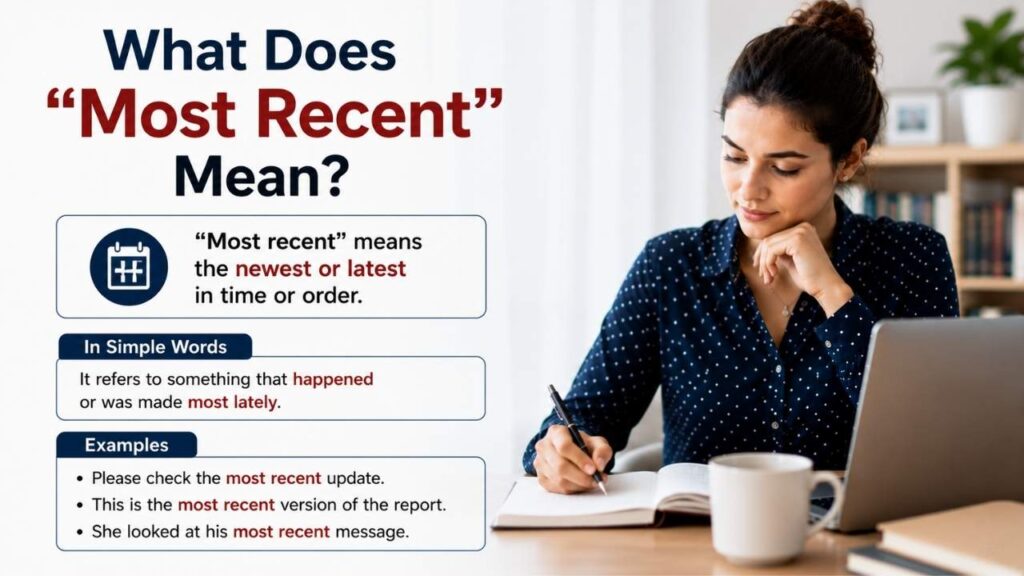
The phrase most recent means the latest, newest, or last item, event, or version in a sequence. It describes something that happened closest to the present time. For example, your most recent job is the one you had last, while your most recent update is the newest version available.
This expression is common in business writing, academic writing, reports, resumes, and everyday conversations because it clearly identifies the newest information.
Understanding the meaning of most recent helps you communicate with accuracy and avoid confusion. If you enjoy learning about commonly confused English words, you may also like our guide on Shined vs Shone, which explains another pair of words that often causes uncertainty.
Why Is “Most Recent” Correct? (The Grammar Rule)
Yes, most recent is grammatically correct because recent is an adjective, and adjectives can have comparative and superlative forms. Since recent is a longer adjective, English forms its superlative by adding most instead of -est. That’s why we say most recent, not recentest.
This follows the same grammar pattern as most important or most useful. You’ll often see most recent in formal English, professional writing, research papers, and official documents.
Knowing this grammar rule makes it easier to understand why the phrase is accepted by native speakers. If you’re interested in similar grammar differences, read our article on Orientated vs Oriented to learn which form is preferred in different varieties of English.
How “Recent” Changes: Recent, More Recent, and Most Recent
The word recent has three forms that compare time. Recent is the basic form and simply means something happened not long ago. More recent compares two things and shows that one happened later than the other. Most recent is the superlative adjective, meaning it refers to the latest item among three or more choices.
For example, “This report is more recent than last year’s,” while “This is our most recent report” points to the newest one available. Understanding these forms improves your English grammar and helps you write with confidence. Learning grammar also builds vocabulary, just as understanding Paucity Meaning Explained helps you use less common English words correctly.
When Should You Use “Most Recent”?
You should use most recent whenever you want to identify the latest person, event, document, or version in a group. It works well in both formal and informal English, making it suitable for everyday conversations and professional communication. For example, you can write most recent update, most recent study, most recent report, most recent employer, or most recent project.
These phrases are common in resumes, job applications, emails, research papers, and business documents. Using most recent helps readers understand exactly which item you mean without creating confusion. If there is only one newest choice, this phrase is usually the clearest and most natural option for both spoken and written English.
Most Recent vs Latest: What’s the Difference?
Both most recent and latest refer to something new, but they are not always used in the same way. Latest often emphasizes the newest version, product, or news, while most recent focuses on the item that happened closest to the present time. For example, “the latest smartphone” highlights the newest model, while “my most recent job” refers to the last position you held.
In many situations, the two expressions can be used interchangeably, but most recent usually sounds more precise in academic writing, reports, resumes, and official documents. Choosing the right phrase depends on the context and the message you want to communicate clearly.
Most Recent vs Last vs Newest vs Current
Although these words are related, they do not always mean the same thing. Most recent refers to the item that happened closest to the present time. Last usually means the final item in a sequence, but it can also mean the one before the current one.
Newest highlights something that was created or introduced most recently, while current describes something that exists or is being used now.
For example, your most recent employer is the last company you worked for, but your current employer is where you work today. Choosing the right word makes your writing clearer and helps readers understand your exact meaning.
Most Recent vs Most Recently
Many English learners confuse most recent with most recently, but they have different jobs in a sentence. Most recent is an adjective phrase that describes a noun, such as most recent report, most recent version, or most recent study. Most recently, on the other hand, is an adverb phrase that describes an action.
For example, “She most recently worked in New York” explains when she worked there. Knowing this difference improves your English grammar and helps you avoid common mistakes. If you remember that adjectives describe nouns and adverbs describe verbs, choosing the correct form becomes much easier.
20 Example Sentences Using “Most Recent”
Seeing most recent in real sentences is one of the best ways to learn how to use it naturally. Here are a few examples: My most recent project was completed ahead of schedule. The most recent update fixed several software issues. Please attach your most recent resume to the application. Scientists published their most recent study this year.
We reviewed the most recent report before making a decision. Can you share your most recent address? The doctor checked my most recent medical records during the visit. These examples show that most recent is widely used in business writing, academic writing, healthcare, technology, and everyday conversations to identify the latest information.
Common Mistakes When Using “Most Recent”
One common mistake is using recentest, which is not a standard English word. The correct superlative form is always most recent. Another mistake is confusing most recent with latest, last, or current without considering the context. Some writers also use most recently when they actually need the adjective most recent before a noun.
In addition, avoid using most recent if there is only one item and the time reference is already obvious, as it may sound unnecessary. Learning these small differences helps you write more naturally and improves the clarity of your formal English and everyday communication.
Better Alternatives to “Most Recent”
While most recent is often the best choice, there are times when another word fits better. You can use latest when talking about products, software, news, or technology. Current works well when referring to something happening now, such as your current job or current address.
Newest emphasizes something that has just been created or introduced. In some situations, last is also a natural alternative, especially in casual conversations.
Choosing the right expression depends on your audience and context. Understanding these alternatives helps improve your word choice, making your writing sound more natural, precise, and easy to understand.
Quick Comparison Table
| Phrase | Meaning | Best Used For |
| Most Recent | The latest item in time | Reports, resumes, studies, updates, formal writing |
| Latest | The newest version or development | News, technology, products |
| Last | Final or previous item | Everyday conversations, simple references |
| Newest | Most recently created | Products, inventions, designs |
| Current | Existing or happening now | Jobs, addresses, situations, positions |
This comparison makes it easier to choose the right word. In many situations, most recent is the clearest option because it specifically refers to the item closest to the present time.
FAQs
Is “most recent” grammatically correct?
Yes. Most recent is the correct superlative form of recent and is widely used in both formal and informal English.
Is “most recent” redundant?
No. It is not redundant. It clearly identifies the latest item, event, or version in a sequence.
Can I use “most recent” in business writing?
Yes. It is common in business writing, academic writing, resumes, research papers, reports, and professional emails.
What is the difference between “most recent” and “latest”?
Most recent focuses on time, while latest often highlights the newest version, product, or development.
Is “recentest” a word?
No. Standard English uses most recent, not recentest.
Conclusion
Yes, you should confidently use most recent because it is grammatically correct, clear, and widely accepted in modern English. It is the proper superlative form of recent and appears regularly in business writing, academic writing, resumes, research papers, legal documents, and everyday conversations.
Whether you are referring to your most recent employer, most recent report, most recent study, or most recent update, the phrase communicates your meaning accurately and professionally.
Remember to choose alternatives like latest, current, last, or newest only when they better match your context. By understanding these differences, you can write with greater confidence, improve your English grammar, and communicate more naturally in every situation.