
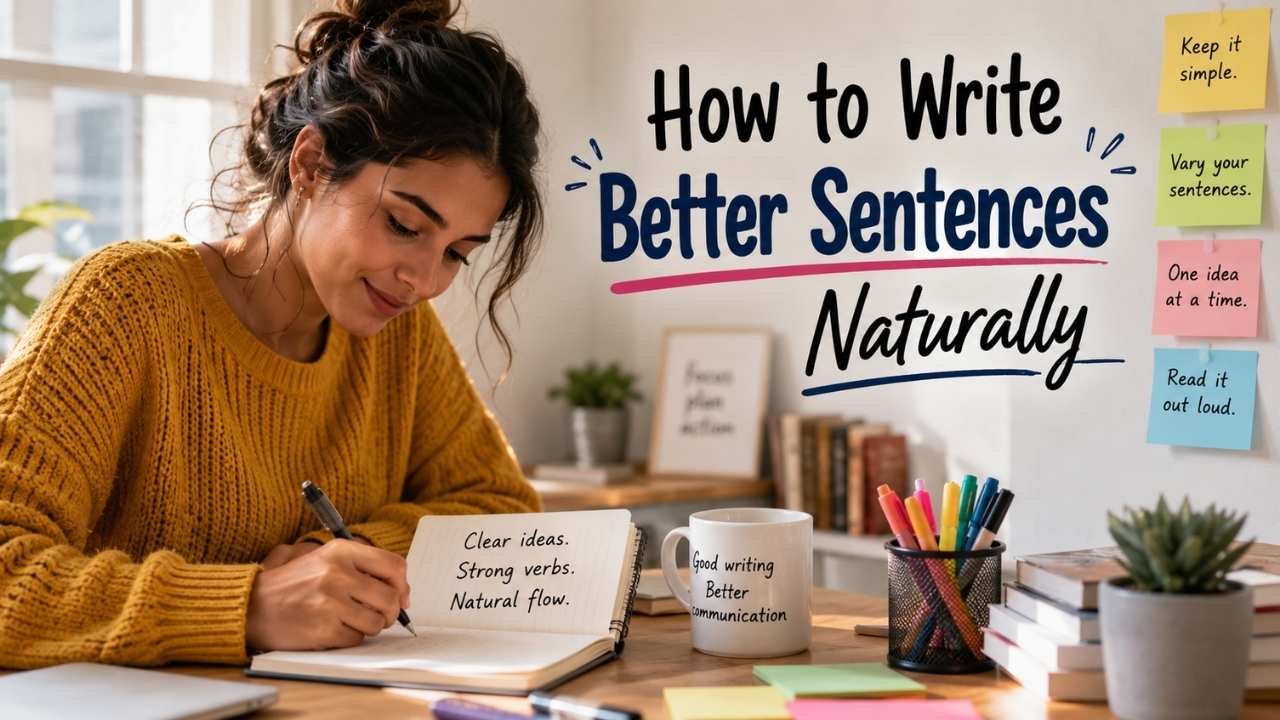
How to Write Better Sentences Naturally
Writing strong sentences is one of the most useful skills in English. Good sentences make ideas easier to understand, more enjoyable to read, and more persuasive in daily communication. Whether you’re writing emails, essays, texts, or social posts, sentence quality shapes how people respond to your message.
Today, many people want to know how to write better sentences because modern communication moves quickly. Readers often skim instead of reading every word. As a result, clear sentence structure matters more than ever in American English.
Strong sentences are not always long or advanced. In fact, many effective sentences are short and direct. However, they still sound natural, varied, and engaging. That balance is what skilled writers learn over time.
Quick Answer
If you want to learn how to write better sentences, focus on clarity, rhythm, and structure. Good sentences usually express one main idea clearly, use natural word order, and vary length for better flow.
TL;DR
- Clear sentences are easier to read and understand.
- Strong verbs improve sentence energy and movement.
- Sentence variety keeps writing from sounding repetitive.
- Modern American English favors direct and natural phrasing.
- Overwriting often weakens communication instead of improving it.
What Better Sentences Really Mean

Writing better sentences does not mean using difficult vocabulary. Instead, it means expressing ideas clearly and naturally. A strong sentence guides readers smoothly from one thought to another.
In English grammar, a sentence normally includes a subject and a verb. However, strong writing also depends on tone, pacing, emphasis, and word choice. That’s why two grammatically correct sentences can feel very different.
Clear Structure Matters Most
Readers process information quickly. Because of this, clear structure helps them understand ideas without confusion. Most effective English sentences follow a familiar order: subject, verb, and object.
For example, “The teacher explained the lesson clearly” feels natural because the action is easy to follow. In contrast, overly complicated structure slows readers down.
Better Writing Sounds Human
Modern American English values conversational rhythm. As a result, natural writing often sounds closer to speech than older formal styles. Writers today usually avoid stiff wording unless the context requires it.
That shift became stronger during the late twentieth century. Business writing, journalism, and digital communication all encouraged shorter and more direct sentences.
The History of Sentence Style in English
English sentence structure has changed greatly over time. Early English writing often copied Latin patterns, especially in academic and legal texts. Those sentences were long, dense, and filled with clauses.
During the eighteenth and nineteenth centuries, formal writing still favored complexity. Educated writers often believed longer sentences sounded more intelligent.
American English Became More Direct
In the United States, writing style gradually became simpler and more practical. Newspapers helped drive this change because readers needed information quickly.
Later, television, advertising, and internet culture strengthened concise writing habits. Today, many American readers expect writing to be efficient and easy to scan.
Digital Communication Changed Expectations
Texting and online messaging also influenced sentence style. People now use shorter sentences more often in casual communication. However, clarity still matters even in informal settings.
Because of this shift, modern writers usually avoid unnecessary filler words and overly formal phrases.
How Sentence Structure Shapes Meaning
Sentence structure controls how readers experience information. Even small changes in order can change emphasis and tone.
For example, “I only asked for help yesterday” has a different focus from “Yesterday, I only asked for help.” Both are grammatical, but the meaning feels slightly different.
Simple Sentences Create Clarity
Simple sentences contain one independent idea. They work well when writers want direct communication.
For example, “The meeting ended early” is simple but complete. Short sentences like this often create strong impact.
Compound and Complex Sentences Add Depth
Compound sentences join related ideas together. Complex sentences show relationships between thoughts, such as cause, contrast, or timing.
These structures help writing feel smoother and more connected. However, using too many long sentences can overwhelm readers.
Why Strong Verbs Improve Sentences
Verbs carry energy in English sentences. Weak verbs often make writing feel dull or indirect. Strong verbs create movement and clarity.
For example, “She ran to the store” feels more vivid than “She went quickly to the store.” The stronger verb removes extra wording.
Weak Verbs Often Add Unnecessary Words
Many weak sentences rely heavily on forms of “to be,” such as “is,” “was,” or “were.” These verbs are not wrong, but overusing them can flatten writing.
Instead of “The speech was inspiring,” writers sometimes use “The speech inspired the audience.” The second version feels more active.
Action Improves Reader Attention
Readers usually stay engaged when sentences contain clear action. That’s why strong verbs appear frequently in journalism, fiction, and advertising.
Modern American writing often prefers active voice because it feels more immediate and direct.
Sentence Length and Rhythm
Good writing uses variety. If every sentence has the same length, the writing becomes predictable. Readers may lose interest even when grammar is correct.
Sentence rhythm works much like music. Some sentences move quickly. Others slow readers down for emphasis.
| Context | Correct Usage | Example | Notes |
| Formal essay | Balanced sentence variety | “The results were surprising. However, researchers continued testing.” | Mixes short and medium sentences |
| Business email | Direct wording | “Please send the file by noon.” | Clear and efficient |
| Storytelling | Longer rhythm for detail | “The rain continued through the evening while the city lights reflected across wet streets.” | Creates atmosphere |
| Social media | Short conversational style | “That movie was amazing.” | Natural informal tone |
Short Sentences Create Emphasis
Short sentences often feel powerful. They help important ideas stand out clearly.
For example, “Nobody expected the result” creates strong emphasis because the structure is simple and direct.
Longer Sentences Add Flow
Longer sentences can sound elegant when written carefully. However, they should still remain easy to follow.
Good writers often combine sentence lengths to create natural rhythm and pacing.
Common Mistakes That Weaken Sentences
Many sentence problems come from trying too hard to sound advanced. Writers sometimes believe complicated wording sounds smarter. In reality, it often creates confusion.
Clear writing usually feels stronger than overly formal writing.
Wordiness Hurts Clarity
Wordy sentences contain unnecessary phrases. For example, “Due to the fact that” is usually weaker than “because.”
Similarly, phrases like “in order to” often become simply “to.” Small changes make sentences smoother and easier to read.
Run-On Sentences Create Confusion
Run-on sentences join ideas incorrectly. They often lack proper punctuation or conjunctions.
For example, “I finished the report I sent it yesterday” needs separation. Correct punctuation helps readers process information clearly.
Fragments Sometimes Cause Problems
Sentence fragments lack a complete thought. However, modern writing occasionally uses fragments intentionally for style.
For example, “No chance.” is technically incomplete but common in conversation and creative writing.
How Better Sentences Work in Everyday American English
American English strongly favors readability. In daily communication, people often choose direct and natural wording over formal complexity.
This trend appears in workplaces, schools, media, and online communication.
Emails Favor Clear Structure
Professional emails today are usually shorter than older business letters. Writers often begin with the main point instead of lengthy introductions.
For example, “Can we meet Thursday afternoon?” sounds more natural than overly formal alternatives.
Social Media Changed Writing Habits
Online platforms encourage fast communication. Because of this, sentence structure often becomes more conversational.
However, strong grammar still matters. Clear sentences help messages avoid confusion and misunderstanding online.
Formal vs Informal Sentence Style
Sentence style changes depending on context. Formal writing usually uses more complete structure and careful transitions. Informal writing sounds more relaxed and conversational.
Neither style is automatically better. Good writers adjust based on audience and purpose.
Formal Writing Uses Greater Precision
Academic and professional writing often avoids slang and overly casual phrasing. Sentences may include more detail and explanation.
However, modern formal writing still values clarity. Extremely dense writing is less common today than in earlier centuries.
Informal Writing Sounds More Natural
Text messages, blogs, and social media often use contractions and shorter phrasing. Writers may also break traditional grammar rules for tone.
Still, effective informal writing remains understandable and organized.
American and British Sentence Differences
American and British English share most grammar rules. However, sentence style sometimes differs slightly.
American writing usually favors concise structure and direct phrasing. British writing may sound more formal in certain contexts.
Punctuation Style Can Differ
Americans commonly place periods and commas inside quotation marks. British English sometimes handles punctuation differently.
Sentence rhythm may also vary because of vocabulary preferences and tone.
Tone Differences Still Exist
American business writing often sounds more direct. British communication may include softer phrasing in requests or criticism.
These differences are usually stylistic rather than grammatical.
How Reading Improves Sentence Writing
Strong writers are usually strong readers. Reading exposes people to rhythm, structure, and natural phrasing patterns.
Because of this, regular reading helps sentence skills improve over time.
Different Genres Teach Different Skills
Novels teach pacing and rhythm. Journalism teaches clarity and efficiency. Essays teach structure and logical flow.
Reading many styles helps writers build flexibility in their own sentences.
Imitation Has Always Helped Writers
Throughout English history, writers learned partly through imitation. Students copied sentence patterns from respected authors for centuries.
Today, writers still improve by studying how effective sentences work.
Why Overediting Can Hurt Sentences
Editing improves clarity, but too much editing can remove personality. Some writers revise sentences repeatedly until they sound stiff or unnatural.
Good writing balances polish with natural flow.
Simplicity Often Sounds Better
Many effective sentences are surprisingly simple. Writers sometimes add unnecessary complexity because they fear sounding basic.
However, readers usually prefer clarity over decoration.
Natural Voice Matters
A strong writing voice sounds human and confident. Readers connect more easily with sentences that feel authentic.
That’s why modern American writing often avoids excessive formality unless required.
Sentence Rules That Continue to Evolve
English grammar changes constantly. Some rules once treated as absolute are now more flexible.
Language experts today often focus more on clarity and audience expectations than rigid tradition.
Ending Sentences With Prepositions
Older grammar teaching discouraged sentences ending with prepositions. However, modern English accepts this structure naturally.
For example, “Who are you talking to?” sounds normal in everyday American speech.
Starting Sentences With Conjunctions
Beginning sentences with “and” or “but” was once discouraged in schools. Today, professional writers regularly use these openings for rhythm and emphasis.
Modern grammar guides generally accept this practice when used carefully.
Real-Life Examples of Better Sentence Writing
Strong sentences appear everywhere in daily life. Clear writing helps people communicate effectively at work, school, and home.
Even small sentence improvements can make communication feel more confident and professional.
Workplace Communication
Managers often prefer concise sentences because they reduce confusion. Clear instructions save time and improve teamwork.
For example, “Please review the draft today” feels more effective than indirect wording.
Personal Communication
In personal messages, sentence clarity prevents misunderstandings. Tone also becomes easier to interpret when wording is direct and natural.
This matters especially in texting and online conversations where facial expressions are missing.
FAQs
What makes a sentence better?
A better sentence is clear, natural, and easy to follow. It expresses one main idea without unnecessary confusion or extra wording.
Should sentences always be short?
No. Good writing uses both short and long sentences. Variety creates rhythm and keeps readers interested.
Is formal writing always better?
Not always. The best style depends on the situation, audience, and purpose. Modern American English often prefers clear and conversational wording.
Can sentence fragments ever be correct?
Yes. Fragments appear often in creative writing, advertising, and conversation. However, they should be used carefully in formal writing.
Why do strong verbs matter?
Strong verbs make sentences more vivid and direct. They often remove unnecessary words and improve sentence energy.
Do grammar rules change over time?
Yes. English grammar evolves constantly. Some older rules are now treated more flexibly in modern usage.
Conclusion
Learning how to write better sentences takes practice, but the core ideas are simple. Strong sentences focus on clarity, structure, rhythm, and natural wording. They help readers understand ideas quickly and comfortably.
Today’s American English favors communication that feels direct and human. Because of this, effective writing often sounds simpler than many people expect. Good sentences do not try to impress readers with complexity. Instead, they guide readers smoothly from one idea to the next.
The best way to improve sentence writing is to read carefully, write regularly, and revise with clarity in mind. Over time, strong sentence habits become natural parts of everyday communication.