
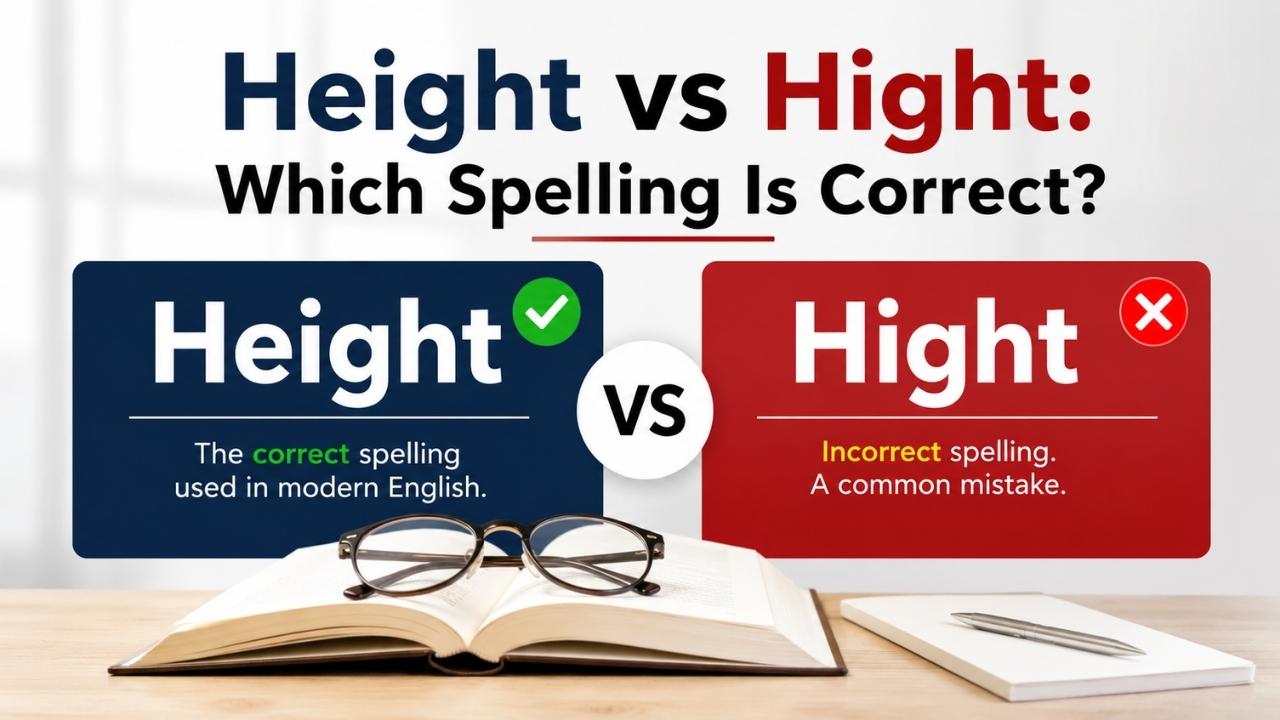
Height vs Hight: Which Spelling Is Correct?
Many people wonder whether height vs hight is the correct spelling. This confusion is common because both words look similar, and many English learners assume that hight follows the same pattern as the word high. However, in modern English, height is the correct spelling when referring to the measurement of how tall a person, building, object, or mountain is.
If you have ever asked, “Is hight a word?” or “What is the difference between height and hight?”, you are not alone. This spelling mistake appears frequently in everyday writing, school assignments, and online searches. While height is widely accepted in dictionaries and professional writing, hight has a different history and is rarely used today.
In this guide, you’ll learn the meaning of height, the meaning of hight, their correct usage, examples, pronunciation, and simple tips to avoid this common spelling mistake.
Quick Answer
Height is the correct spelling in modern English. It refers to the measurement of how tall a person, building, object, or place is. Hight is usually a misspelling of height, although it exists as an old English word that is rarely used today. For everyday, academic, and professional writing, always use height.
Which Spelling Is Correct?
When comparing height vs hight, only height is considered correct in modern English. You should use this spelling whenever you describe the vertical measurement of a person, structure, mountain, or object. For example, “The height of the building is 50 meters” is correct.
Many English learners ask, “How do you spell height?” The correct spelling is h-e-i-g-h-t. Although the word looks unusual, it has been the accepted form for centuries.
Writers sometimes use hight by mistake because it appears similar to words such as high, higher, and highest. However, dictionaries and grammar experts do not recognize hight as the standard spelling for measurement.
If your goal is clear and professional communication, always choose height. Using the correct spelling improves your writing and helps you avoid one of the most common spelling mistakes in English.
Why Most People Search for This Difference
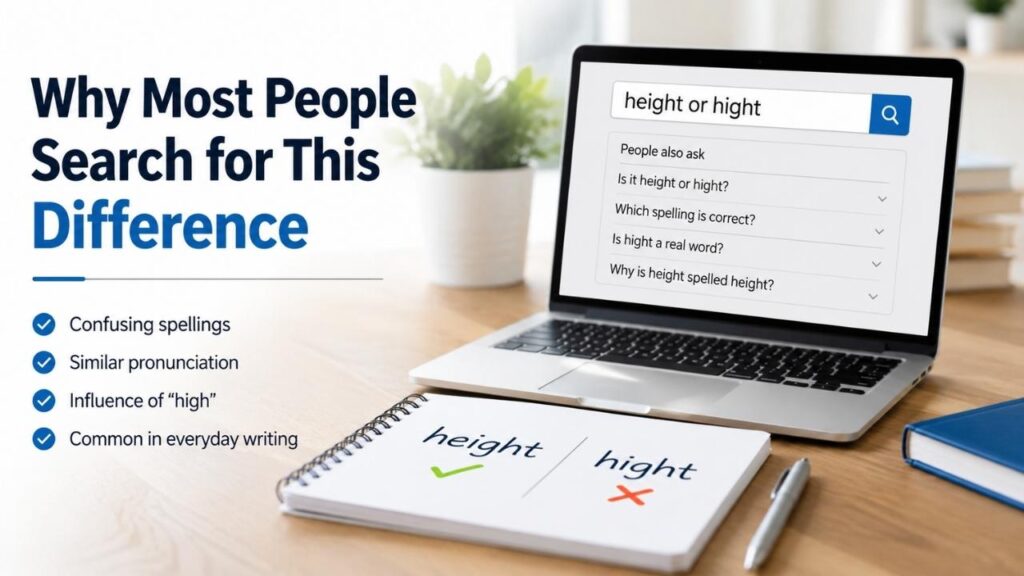
Many people search for “height vs hight” because the two words look very similar. The confusion often starts with the word high. Since words like higher and highest keep the same basic spelling, many writers assume that hight should also be correct.
Another reason for the confusion is pronunciation. When people hear the word height, they may not immediately know how it is spelled. As a result, they often type hight when searching online or writing quickly.
English contains many words with unusual spelling patterns, so this mistake is understandable. However, knowing the difference between height and hight can help you write more accurately.
Today, most searches for height or hight come from students, language learners, writers, and professionals who want to confirm the correct spelling before using it in formal or everyday communication.
Height vs Hight Comparison Table
A comparison table makes it easier to understand the difference between height and hight. Although the two words look similar, they do not serve the same purpose in modern English. Height is the accepted spelling used in dictionaries, schools, workplaces, and everyday communication. It describes the vertical measurement of a person, object, building, or place. In contrast, hight is not the standard spelling and rarely appears in modern writing.
| Feature | Height | Hight |
| Modern English Usage | ✔ Yes | ✘ No |
| Correct Spelling | ✔ Yes | ✘ Usually No |
| Dictionary Recognition | ✔ Common | Limited |
| Everyday Writing | ✔ Used Frequently | ✘ Rare |
| Professional Writing | ✔ Accepted | ✘ Not Recommended |
When choosing between height or hight, always use height unless you are discussing historical or archaic language.
What Does Height Mean?
The word height is a noun that refers to how tall a person, object, building, tree, or mountain is. It measures the distance from the bottom to the top of something. People often use height in everyday conversations, academic writing, science, construction, and geography.
For example, you might talk about the height of a building, the height of a basketball player, or the height of a mountain above sea level. In each case, the word describes a vertical measurement.
The meaning of height extends beyond physical measurements. Writers sometimes use it to describe the highest level of something, such as success, power, or popularity. For example, someone may say a company reached the height of its success.
Because height is the standard spelling in modern English, it is the correct choice in both formal and informal writing.
Height Pronunciation
Many people know the meaning of height but still wonder how to pronounce it correctly. The word is pronounced as “hite”, which rhymes with words such as light, night, and right. Even though the spelling contains several letters, the pronunciation remains simple.
Some learners become confused because the spelling of height does not look exactly like its pronunciation. This difference often causes spelling mistakes such as hight. However, the correct pronunciation has remained the same for many years.
To remember it, try saying the sentence: “The height of the tower is impressive.” Listening to native speakers can also help improve pronunciation and spelling.
Learning both the correct spelling and pronunciation makes communication clearer. Whether you are speaking or writing, using height correctly helps you avoid common grammar and vocabulary mistakes.
What Does Hight Mean?
Many people assume that hight is another spelling of height, but that is not true. In modern English, hight is not the standard word for describing how tall something is. Instead, it is an old or archaic word that appeared in earlier forms of English.
Historically, hight meant “named” or “called.” Writers sometimes used it in old poems, stories, and historical texts. For example, a sentence might describe a character as “a knight hight Arthur,” meaning “a knight named Arthur.”
Today, most English speakers never use hight in regular conversation or writing. That is why dictionaries often label it as archaic or obsolete. If your goal is clear communication, you should choose height when discussing measurement and avoid using hight unless you are referring to historical language.
Why Do People Misspell Height as Hight?
The most common reason people write hight instead of height is that English spelling can be confusing. Many writers notice the word high and assume its noun form should naturally become hight. This assumption seems logical, but English spelling does not always follow simple patterns.
Another reason is pronunciation. Since people hear the word before they learn its spelling, they often guess how it should look in writing. As a result, many type hight during online searches or while writing quickly.
Autocorrect and typing habits can also contribute to the mistake. Once someone becomes familiar with the incorrect spelling, they may continue using it without realizing the error.
Understanding the difference between height and hight helps you avoid this common spelling mistake and improve your writing accuracy.
The Relationship Between High and Height
The words high and height belong to the same word family, but they serve different grammatical roles. High is an adjective that describes something tall or far above the ground. Height, on the other hand, is a noun that refers to the measurement of that vertical distance.
For example, you can say, “The mountain is high.” Here, high describes the mountain. You can also say, “The height of the mountain is 2,000 meters.” In this sentence, height names the measurement.
Many people become confused because words like higher and highest keep the same spelling pattern as high. However, English developed the noun height differently over time.
Learning the difference between high vs height helps improve grammar skills and makes writing more precise and professional.
Why Is Height Spelled with “EI” Instead of “IGH”?
The spelling of height comes from the long history of the English language. In old English, the word developed from forms that did not follow today’s simple spelling rules. Over time, English changed, but the spelling of height stayed the same. That is why it uses “ei” instead of “igh” like the word high.
The word high describes something tall, while height became the noun form to show measurement. Even though they are related, their spelling evolved differently. English spelling often keeps older forms, which is why we still write height today.
So, when people ask, “why is height not spelled hight?”, the answer is history. The modern spelling was fixed through dictionaries and common use, making height the standard form in writing today.
How to Pronounce Height Correctly
The word height is pronounced as /haɪt/, which sounds like “hite.” It rhymes with words like light, night, and right. Even though the spelling looks complex, the pronunciation is very simple in everyday English.
A common mistake learners make is trying to pronounce all the letters in the word. This often leads to confusion, but in reality, English does not pronounce “gh” in height.
In both American and British English, the pronunciation is the same: hite. There is no major difference between accents.
Many learners also mix up height vs hight when speaking, but only height is correct. To improve pronunciation, listen to native speakers and repeat simple sentences like “The height of the tree is tall.” This helps build confidence and accuracy in both speaking and writing.
Examples of Height in Sentences
Here are some simple examples of how to use height correctly in everyday English.
In daily life, you can say: “The height of this building is amazing.” or “What is your height in centimeters?” These sentences show normal use in conversation.
In academic writing, you may write: “The height of the mountain affects the climate.” or “Scientists measured the height of the structure.” These examples are more formal.
In professional settings, you might say: “The project reached the height of success.” or “We recorded the height of each object carefully.”
These examples clearly show that height is used in many contexts, including daily speech, education, and professional communication. It is always the correct spelling when talking about measurement or level.
Examples of Hight in Historical Context
The word hight is not commonly used in modern English, but it appears in old or historical texts. In older English, hight meant “called” or “named.” For example, a sentence might read, “A knight hight William,” meaning a knight named William.
This usage comes from Middle English, where spelling and grammar were very different from today. Writers often used hight in poetry and literature to describe characters or names.
However, in modern English, this meaning has almost disappeared. You will rarely see hight in books, articles, or conversations today.
When comparing height vs hight, it is important to remember that hight is only used in historical or literary contexts, while height is used in modern writing to describe measurement and size.
Common Mistakes Related to Height
Many English learners make spelling mistakes when writing height. The most common error is writing hight instead of height. This happens because people think it follows the pattern of high.
Other frequent mistakes include heigth, hieght, and hightt. These errors appear in quick typing, school assignments, and online searches.
Another confusion is between high vs height. While high describes something tall, height is the noun that measures it. For example, “The mountain is high” is correct, but “The height of the mountain is 3,000 meters” is also correct.
Understanding these common mistakes helps improve writing accuracy. If you remember the correct spelling height, you can easily avoid confusion and write more professionally in both academic and everyday English.
Memory Trick to Remember the Correct Spelling
A simple way to remember the spelling of height is to think of the word high. Since height is related to high, many learners try to match them. But instead of adding “t” at the end of “high,” remember that height keeps the “ei” pattern.
A helpful mnemonic is: “H = High + E + I + G + H + T”, where “ei” reminds you that the spelling is not “hight.”
You can also use a visual trick. Imagine a tall building reaching the height of the sky, and associate the word with something high and large.
Practicing this small trick helps you avoid confusion between height vs hight. Over time, your brain will automatically choose the correct spelling, especially in writing tasks, exams, and professional communication.
FAQs
Many learners have questions about height vs hight, so here are clear answers.
Is hight correct?
No, hight is not correct in modern English. It is mostly an old word and should not be used in everyday writing.
Is hight in the dictionary?
Yes, but only in historical or archaic meaning, where it means “named” or “called.”
Why is height not spelled hight?
The spelling comes from historical English development, not modern spelling rules.
What part of speech is height?
Height is a noun that shows measurement or level.
Can hight ever be used today?
Only in old literature or historical context, not in modern communication.
Conclusion
The final conclusion is simple: height is the correct and standard spelling in modern English. It is used in schools, exams, business writing, and everyday communication. The word describes how tall a person, object, or place is.
On the other hand, hight is mostly an old or archaic word that is rarely used today. It does not fit modern spelling rules and is considered incorrect in most writing situations.
So, when you compare height vs hight, always choose height for clear and professional communication. Remembering this small rule helps you avoid one of the most common spelling mistakes in English and improves your overall writing accuracy.