
Much Needed or Much-Needed: Which Is Correct?
Many writers feel unsure about much needed and much-needed because both forms appear in everyday writing. This confusion often leads people to ask, “Much Needed or Much-Needed: which is correct?” The truth is that both forms are grammatically correct, but they follow different grammar rules and serve different purposes in a sentence.
Understanding the difference between much needed vs much-needed can improve your writing clarity, strengthen your sentence structure, and help you avoid common hyphenation mistakes. The key lies in knowing when the phrase acts as a compound adjective and when it functions differently within a sentence.
In this guide, you’ll learn the much-needed grammar rule, discover when to use much-needed or much needed, explore clear examples, and understand how proper English grammar and punctuation rules affect their usage.
Quick Answer: Much Needed vs Much-Needed
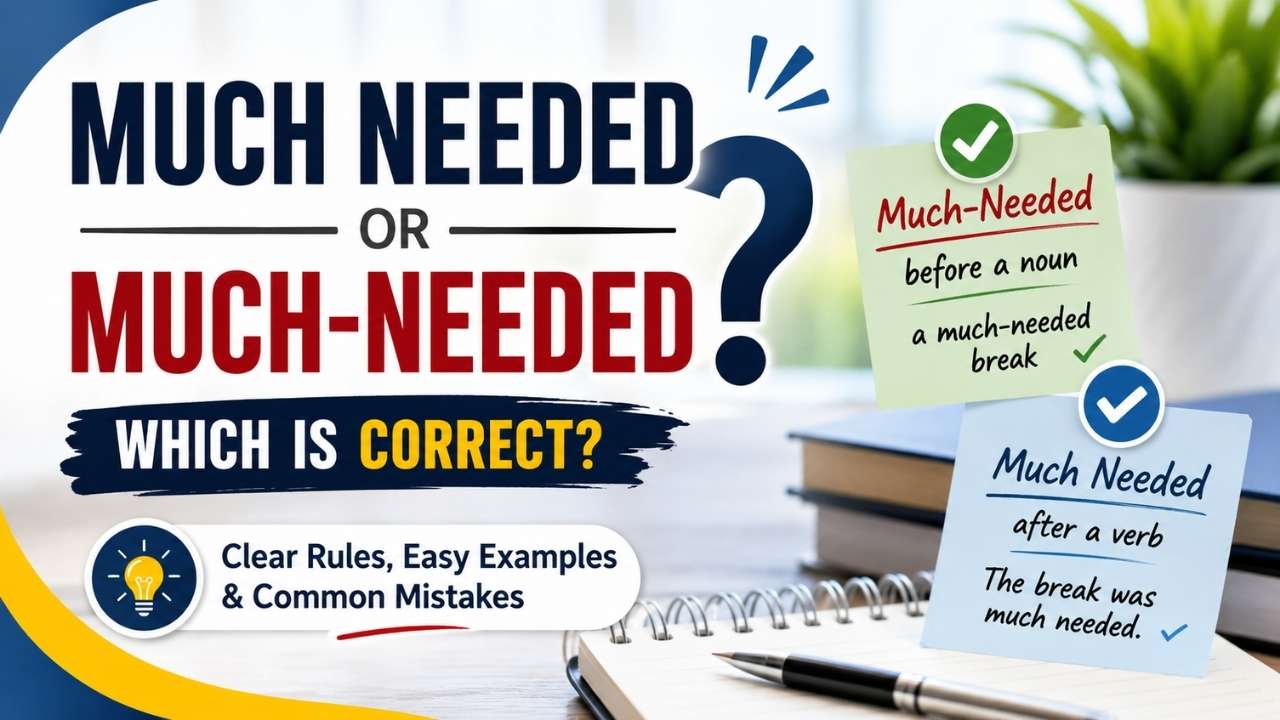
Both much needed and much-needed are correct. Use much-needed when the phrase comes before a noun and acts as a compound adjective, such as a much-needed break. Use much needed after a verb, such as The break was much needed. This simple hyphenation rule helps improve writing clarity and ensures correct English grammar in both formal and everyday writing.
What Does “Much-Needed” Mean?

The phrase much-needed describes something that people strongly need or greatly appreciate. It often refers to something that brings relief, improvement, support, or positive change. You will commonly see it before a noun as a compound adjective.
Examples:
- We finally took a much-needed vacation.
- The company received much-needed funding.
- She enjoyed a much-needed break after the project ended.
In each example, the hyphen joins the words to create a single modifier that describes the noun.
Why Is There a Hyphen Sometimes?
The hyphen appears because much-needed acts as a compound modifier before a noun. The hyphen helps readers understand that both words work together to describe the noun.
Compare these examples:
- We enjoyed a much-needed rest.
- The rest was much needed.
The meaning stays the same, but the hyphenation rule changes based on the phrase’s position in the sentence. This rule improves writing clarity and prevents confusion.
When to Use Much-Needed
Use much-needed before a noun.
Examples:
- We took a much-needed break.
- The city welcomed a much-needed change.
- The team received a much-needed boost.
- Students enjoyed a much-needed holiday.
- The organization secured much-needed support.
This form functions as a hyphenated adjective that directly modifies a noun.
Workplace Examples
- Employees appreciated a much-needed update.
- The department received much-needed assistance.
Academic Examples
- Researchers obtained much-needed funding.
- Students welcomed a much-needed revision period.
Everyday Examples
- She enjoyed a much-needed vacation.
- We got some much-needed rain.
When to Use Much Needed
Use much needed after a verb, especially a linking verb such as was, is, are, seems, or became.
Examples:
- The vacation was much needed.
- The support is much needed.
- The break was much needed after a busy week.
- The funding became much needed during the crisis.
In these cases, the phrase does not appear before a noun, so the hyphen is unnecessary.
Formal Writing Examples
- The reforms were much needed.
- The improvements are much needed in the industry.
Much Needed vs Much-Needed Comparison Table
| Feature | Much-Needed | Much Needed |
| Function | Compound adjective | Adjective phrase |
| Position | Before a noun | After a verb |
| Hyphen | Required | Not required |
| Example | A much-needed break | The break was much needed |
| Grammar Rule | Modifies a noun directly | Describes the subject |
A Simple Trick to Remember the Difference
Use this easy memory rule:
Before a Noun?
Use much-needed.
Example:
- a much-needed vacation
- a much-needed solution
After a Verb?
Use much needed.
Example:
- The vacation was much needed.
- The solution was much needed.
If a noun follows immediately, add the hyphen.
Common Mistakes Writers Make
Using a Hyphen Everywhere
Incorrect:
- The break was much-needed.
Correct:
- The break was much needed.
Forgetting the Hyphen Before a Noun
Incorrect:
- We took a much needed break.
Correct:
- We took a much-needed break.
Misunderstanding Compound Adjectives
Many writers forget that a compound adjective usually needs a hyphen when it appears before a noun.
Real Examples From Professional Writing
Professional writers often follow this pattern:
Business Writing
- The company announced a much-needed improvement.
Journalism
- The region received much-needed relief after the storm.
Academic Writing
- Researchers gained much-needed support for the project.
Everyday Communication
- I needed a much-needed rest after work.
These examples show how common and useful the phrase is across different types of writing.
Does AP Style Require Much-Needed?
Most editorial style guides support the standard compound modifier rule.
AP Style
AP Style generally uses hyphens when two or more words work together before a noun.
Example:
- a much-needed reform
Chicago Manual of Style
The Chicago Manual of Style follows a similar approach and recommends hyphenating many compound modifiers before nouns.
Because much-needed functions as a single modifier, editors typically prefer the hyphenated form before a noun.
Similar Hyphenated Expressions
The same grammar pattern applies to many common expressions.
Examples:
- well-known author
- long-term plan
- high-quality product
- full-time employee
- best-selling book
Like much-needed, these expressions use hyphens when they appear before nouns.
Much-Needed as a Compound Adjective Explained
A compound adjective forms when two or more words work together to describe a noun.
Example:
- a much-needed change
Here, both words create one descriptive unit.
Attributive Adjective
An adjective before a noun is called an attributive adjective.
Example:
- a much-needed break
Predicate Adjective
An adjective after a linking verb is called a predicate adjective.
Example:
- The break was much needed.
This distinction explains why the hyphen appears in one case but not the other.
FAQs
Is much-needed grammatically correct?
Yes. Use much-needed before a noun.
Is much needed grammatically correct?
Yes. Use much needed after a verb.
Why is much-needed hyphenated?
The hyphen joins the words into a compound modifier that describes a noun.
Can I use much needed before a noun?
Standard grammar and style guides usually prefer much-needed before a noun.
Is much-needed a compound adjective?
Yes. It acts as a compound adjective when it modifies a noun.
Do style guides support this rule?
Yes. Most major style guides follow this hyphenation pattern.
Conclusion
Both much needed and much-needed are correct, but they serve different grammatical purposes. Use much-needed before a noun, such as a much-needed break, and use much needed after a verb, such as The break was much needed.
Once you understand this simple hyphenation rule, you can write with greater confidence, improve sentence clarity, and avoid common grammar mistakes in both formal and everyday writing.