
Alternative Of or Alternative For or Alternative To: Which Is Correct?
Many English learners wonder whether they should use alternative of, alternative for, or alternative to. Because these expressions look similar, people often use them interchangeably. However, modern English grammar treats them differently. Choosing the correct preposition after alternative helps your writing sound more natural and professional.
The short answer is that alternative to is the standard and most common expression. Alternative for can work in certain contexts, while alternative of is uncommon and usually sounds unnatural. Understanding these differences will improve your word usage, help you avoid common grammar mistakes, and make your sentences clearer.
In this guide, you will learn the meaning of each expression, when to use it, common errors to avoid, and real examples that show the correct usage.
Quick Answer
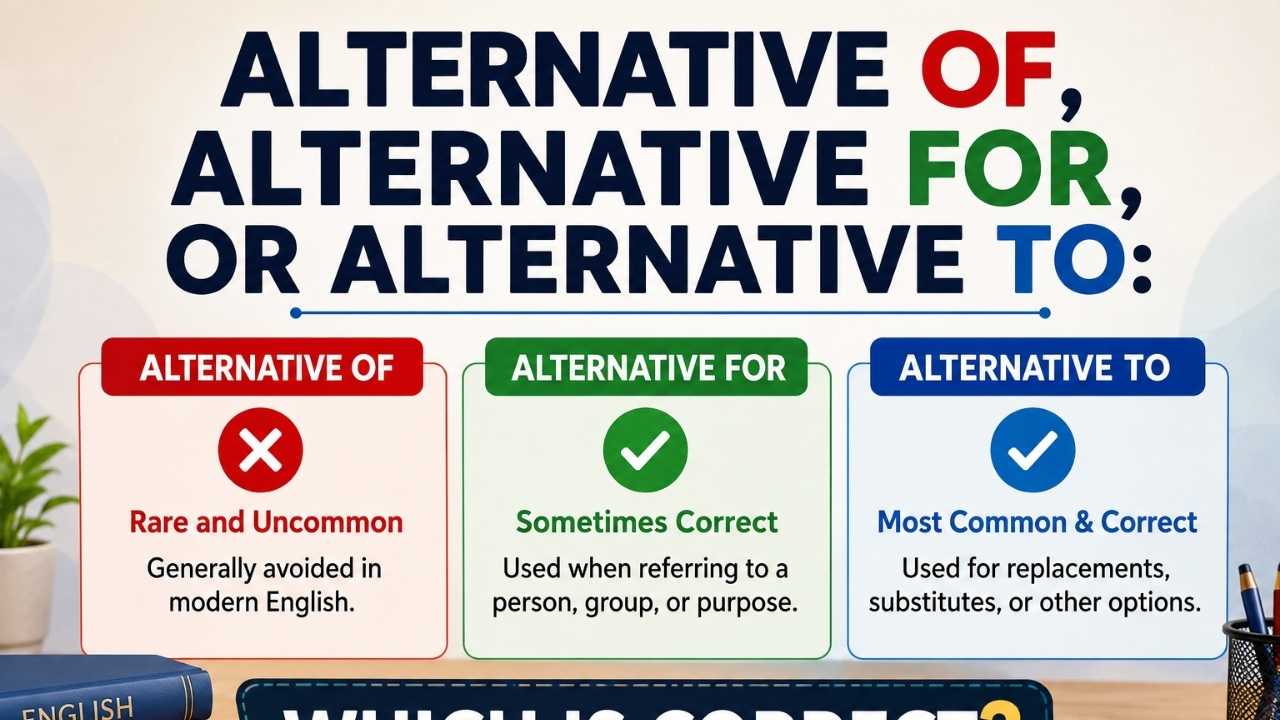
If you want a simple rule, use alternative to in most situations.
- Alternative to = the standard and preferred form.
- Alternative for = sometimes correct when referring to a person, group, or purpose.
- Alternative of = rarely used and generally avoided in modern English.
Examples
✅ Cycling is an alternative to driving.
✅ This medication is an alternative for patients who cannot take antibiotics.
❌ Cycling is an alternative of driving.
What Does “Alternative” Mean?
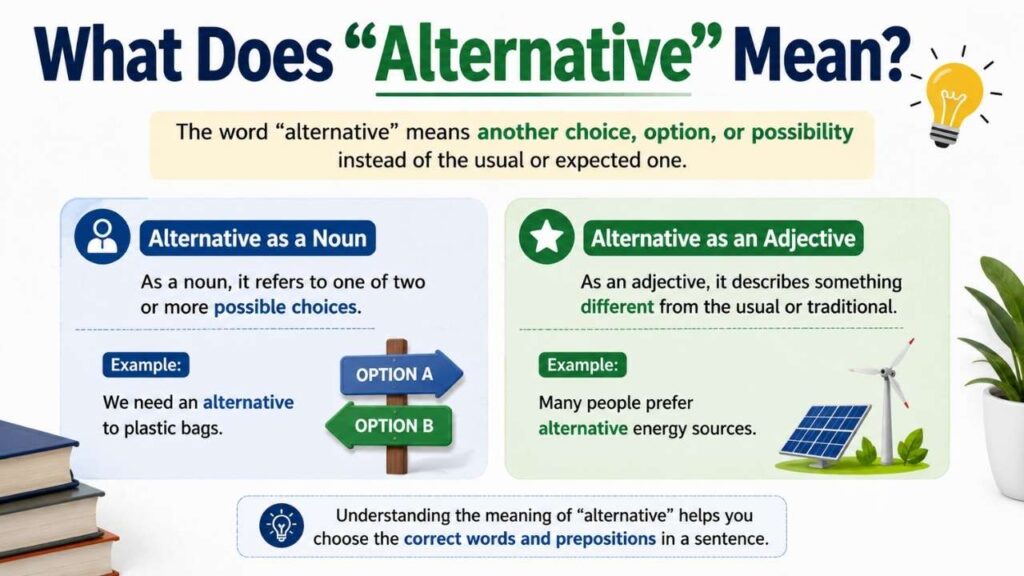
The word alternative refers to another option, choice, solution, or possibility.
Alternative as a Noun
As a noun, it means another choice.
Example:
We need an alternative to plastic bags.
Alternative as an Adjective
As an adjective, it describes something different from the usual option.
Example:
Many people prefer alternative energy sources.
Understanding this meaning helps explain why alternative to is usually the preferred expression.
When to Use Alternative To
Alternative To for Replacements
Use alternative to when one thing replaces another.
Examples:
- Walking is an alternative to driving.
- Tea is an alternative to coffee.
- Online classes provide an alternative to traditional classrooms.
Alternative To for Different Choices
You can also use it when discussing another option.
Examples:
- We need an alternative to this plan.
- She found an alternative to expensive software.
Common Contexts
You will often see alternative to in:
- Business writing
- Academic writing
- Technology articles
- Everyday conversations
Because it is the most common grammatical construction, native speakers naturally prefer it.
When to Use Alternative For
Alternative For a Person
Use alternative for when referring to a specific person or group.
Examples:
- This treatment is an alternative for patients with allergies.
- The course provides an alternative for beginners.
Alternative For a Purpose
Sometimes alternative for describes something suitable for a particular purpose.
Examples:
- This tool serves as an alternative for small businesses.
- The product is an alternative for people on a budget.
Why It Is Less Common
Although correct in some situations, alternative for appears less frequently than alternative to. Most people use alternative to when discussing replacement or substitution.
Is Alternative Of Correct?
Why Native Speakers Rarely Use It
In modern English, alternative of sounds unusual.
Native speakers almost always choose alternative to instead.
Historical Usage
Older texts may contain alternative of, but modern style guides rarely recommend it.
Better Alternatives
Instead of:
❌ An alternative of driving
Use:
✅ An alternative to driving
This change follows accepted English preposition usage and sounds more natural.
Alternative To vs Alternative For
Core Difference
The main difference involves meaning.
- Alternative to focuses on replacement.
- Alternative for focuses on a person, audience, or purpose.
Comparison Table
| Expression | Main Meaning | Example |
| Alternative to | Replacement or substitute | Walking is an alternative to driving. |
| Alternative for | Suitable for someone or something | This treatment is an alternative for patients. |
| Alternative of | Rare and uncommon | Generally avoided |
Side-by-Side Examples
✅ This app is an alternative to the original software.
✅ This app is an alternative for users who need a cheaper option.
Alternative Of vs Alternative To
When comparing alternative of vs alternative to, the answer is simple.
Alternative to is the accepted and natural choice.
Alternative of rarely appears in modern English and often sounds incorrect.
Examples
❌ An alternative of public transport
✅ An alternative to public transport
❌ An alternative of this method
✅ An alternative to this method
Alternative To vs Substitute For
People often confuse alternative and substitute.
Similarities
Both suggest another option.
Differences
A substitute usually replaces something directly.
An alternative offers another possibility or choice.
Examples
- Soy milk is a substitute for milk.
- Soy milk is an alternative to milk.
Both sentences are correct, but the meaning is slightly different.
Common Mistakes With Alternative
Using Alternative Of
Many learners write:
❌ Alternative of driving
Correct version:
✅ Alternative to driving
Choosing the Wrong Preposition
Use alternative to when discussing a replacement.
Overusing Alternative For
Do not automatically replace alternative to with alternative for. They are not always interchangeable.
Real Sentence Examples
Business Examples
- Remote work is an alternative to traditional office work.
- The platform offers an alternative for startups with limited budgets.
Academic Examples
- Online courses provide an alternative to classroom learning.
- The program serves as an alternative for international students.
Everyday Examples
- Water is a healthy alternative to soda.
- This recipe is an alternative for people with food allergies.
Professional Writing Examples
- The company adopted renewable energy as an alternative to fossil fuels.
- The solution provides an alternative for small organizations.
British English vs American English Usage
Both British English and American English strongly prefer alternative to.
You may occasionally find alternative for in both varieties, especially when referring to a person or purpose.
However, neither variety commonly uses alternative of.
As a result, alternative to remains the safest and most widely accepted choice.
Quick Rule to Remember
If one thing replaces another, use alternative to.
If something suits a specific person, group, or purpose, alternative for may work.
Avoid alternative of in most situations.
Easy Memory Trick
Think:
To = Replacement
For = Purpose
Of = Usually Avoid
FAQs
Is Alternative To Correct?
Yes. It is the standard and most common form.
Is Alternative For Correct?
Yes, but only in certain contexts involving a person or purpose.
Is Alternative Of Correct?
Usually no. Modern English rarely uses it.
Which Form Is Most Common?
Alternative to is by far the most common expression.
Can Alternative Be Followed by For?
Yes, but only when referring to suitability for a person, audience, or purpose.
Conclusion
Understanding the difference between alternative to, alternative for, and alternative of can help you improve your English grammar and make better word choices. In most situations, alternative to is the standard and most widely accepted expression because it refers to a replacement, substitute, or another option.
Alternative for can be correct when you are talking about something suitable for a specific person, group, or purpose. However, alternative of is uncommon in modern English and often sounds unnatural to native speakers.If you are unsure which form to use, choose alternative to. It is the safest option and works in most contexts.
By following these simple grammar rules and reviewing real examples, you can avoid common mistakes and use alternative correctly and confidently in both writing and conversation.