
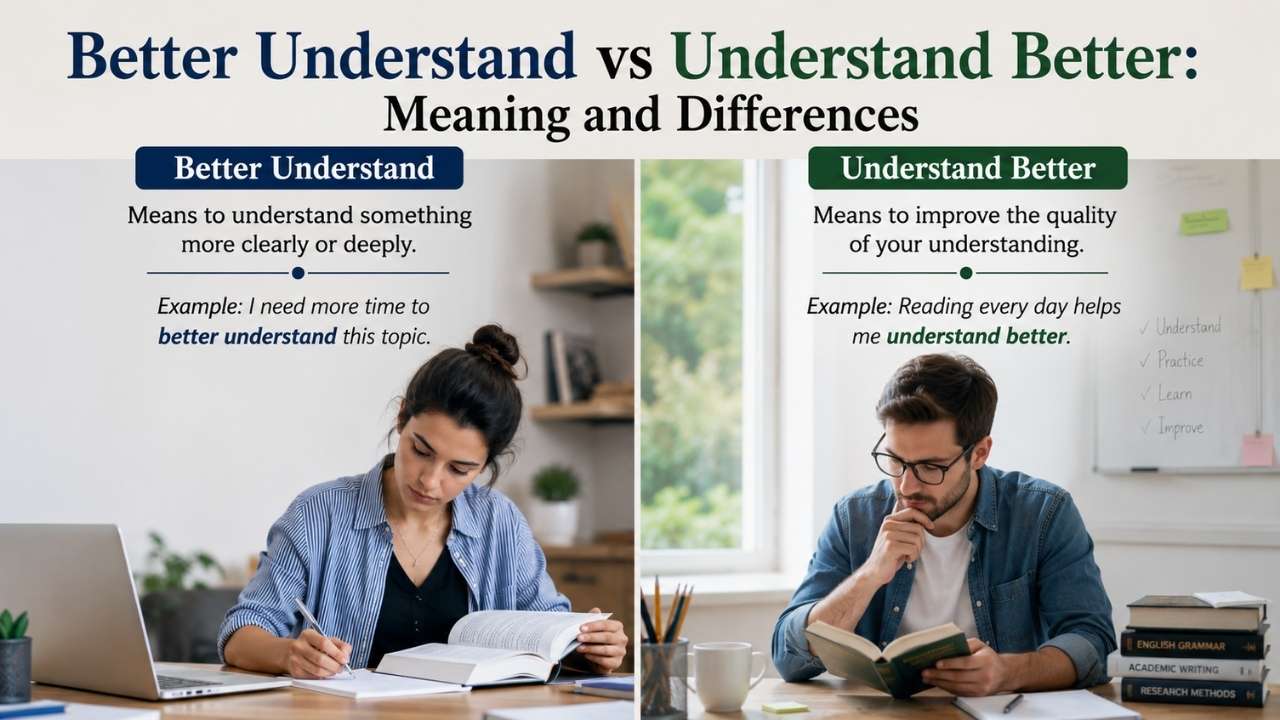
Better Understand vs Understand Better: Meaning and Differences
Many English learners ask, “Is it better understand vs understand better?” This question appears often because both phrases look similar, sound natural, and seem to follow the same sentence structure. As a result, many people become unsure about which expression they should use in speaking or writing.
The good news is that both phrases are accepted in modern English usage. Neither expression breaks any important grammar rules, and native speakers regularly use both forms. However, subtle differences in adverb placement, tone, and emphasis can make one option sound more suitable than the other in certain situations.
Understanding these small differences can help you write with greater confidence and improve your overall communication skills. Whether you are writing an email, preparing an academic paper, participating in business communication, or simply having a conversation, choosing the right phrase can make your message sound more natural.
In this guide, you will learn the difference between better understand and understand better, discover when each phrase works best, see real-life examples, and find out which option native speakers often prefer. By the end, you will better understand how these expressions work and use them more effectively in both spoken and written English.
Quick Answer
Both “better understand” and “understand better” are grammatically correct in English grammar. In most situations, they express the same idea: gaining a clearer or deeper understanding of something. However, the difference lies in word order, sentence emphasis, and sometimes the overall tone of the sentence.
“Better understand” often appears in formal English, professional writing, and academic contexts. In contrast, “understand better” sounds more natural in everyday conversations and informal communication.
For example:
- I want to better understand customer behavior.
- I want to understand better how customers make decisions.
Both sentences are correct and carry nearly the same meaning. The choice usually depends on writing style, sentence flow, and personal preference rather than a strict grammar rule.
If you are wondering which phrase is correct, the answer is simple: both are correct. The key is knowing when to use better understand and when to use understand better for the most natural and effective communication.
Are “Better Understand” and “Understand Better” Both Correct?
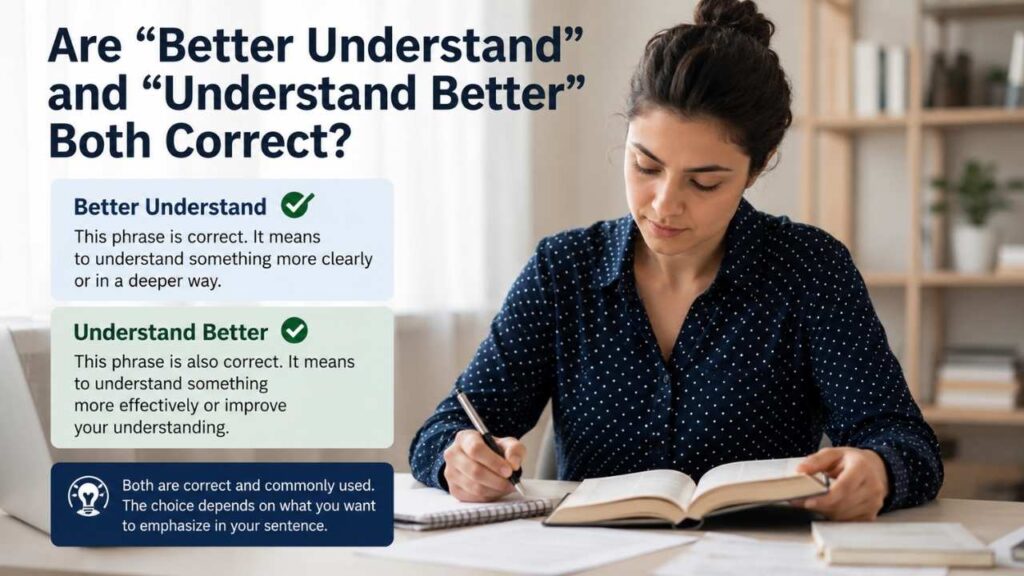
Yes, both “better understand” and “understand better” are correct in modern English grammar. Many people think one phrase is wrong because of old grammar advice, but native speakers use both forms regularly. The difference is not about correctness. Instead, it is mainly about word placement, sentence flow, and emphasis.
When you say “better understand,” the word “better” comes before the verb. When you say “understand better,” the word “better” comes after the verb. This small change does not usually affect the meaning. In most cases, both phrases help express the idea of improving your understanding of something.
For example, “I want to better understand this topic” and “I want to understand this topic better” mean almost the same thing. That is why many writers and speakers use them interchangeably. If you are wondering which phrase is grammatically correct, the answer is simple: both are acceptable and widely used in everyday English.
What Does “Better Understand” Mean?
The phrase “better understand” means to gain a deeper, clearer, or more complete understanding of something. People often use it when they want to learn more about a topic, situation, person, or idea. This phrase is common in formal English, professional communication, and academic writing.
Many writers choose “better understand” because it sounds smooth and direct. It often appears in reports, research papers, presentations, and business discussions. The phrase focuses on the process of improving understanding rather than the final result.
Examples:
- We need to better understand customer needs.
- Scientists continue to better understand climate change.
- Teachers help students better understand difficult concepts.
Although the phrase sounds slightly more formal, it still feels natural and easy to understand. If you write professional documents or academic content, better understand often fits well because it creates a polished and confident tone.
What Does “Understand Better” Mean?
The phrase “understand better” also means improving your understanding of something. However, many native speakers use it more often in everyday conversation and casual writing. It sounds natural, friendly, and easy to follow.
Unlike “better understand,” this phrase places the focus on the result rather than the action itself. The meaning remains almost the same, but the sentence may feel more conversational. Because of this, people often use “understand better” when speaking with friends, family members, coworkers, or classmates.
Examples:
- After reading the guide, I understand better how the system works.
- Talking to her helped me understand better what happened.
- Practice will help you understand better over time.
In modern English usage, there is nothing wrong with this phrase. In fact, many people feel that understand better sounds more natural in spoken English. If your goal is clear and simple communication, this phrase works very well.
Better Understand vs Understand Better: What’s the Difference?
When comparing better understand vs understand better, the biggest difference is emphasis, not meaning. Both phrases express the same basic idea, but they place attention on different parts of the sentence.
Better understand focuses more on the action of improving understanding. This is one reason why it appears often in business writing, research papers, and formal communication. On the other hand, understand better highlights the improved understanding itself and often sounds more natural in everyday speech.
| Better Understand | Understand Better |
| Slightly more formal | More conversational |
| Focuses on the action | Focuses on the result |
| Common in writing | Common in speech |
| Professional tone | Casual tone |
In most situations, you can use either phrase without changing the meaning. The choice usually depends on your audience, writing style, and the tone you want to create.
When to Use “Better Understand”
Use “better understand” when you want your writing to sound more professional, structured, or formal. This phrase appears frequently in business communication, academic writing, reports, and educational materials. Many organizations use it because it sounds clear and polished.
For example, a company might say, “We conducted surveys to better understand customer expectations.” A researcher may write, “The study aims to better understand human behavior.” In both cases, the phrase fits the formal setting naturally.
You should also consider using better understand when writing emails, presentations, proposals, or articles. It helps create a confident tone without sounding overly complicated.
Although this phrase works well in formal situations, you can still use it in everyday conversations. Native speakers often switch between both phrases depending on the sentence structure and the overall flow of their message.
When to Use “Understand Better”
Use “understand better” when speaking casually or writing in a relaxed and conversational style. This phrase feels natural in everyday English and appears often in conversations, social media posts, personal emails, and informal articles.
For example, you might say, “Can you explain it again so I can understand better?” or “After watching the video, I understand better how the process works.” These sentences sound friendly and easy to follow.
Many native speakers prefer understand better because it matches the way people naturally speak. It places the focus on the improved understanding rather than the action of gaining knowledge.
If your audience includes students, beginners, or general readers, this phrase can make your writing feel more approachable. While it is slightly less formal than better understand, it remains grammatically correct and works perfectly in most daily situations.
Which Phrase Sounds More Natural to Native Speakers?
Many English learners ask, “Which sounds more natural: better understand or understand better?” The answer depends on the situation. In everyday conversation, many native speakers prefer “understand better” because it feels more relaxed and conversational. It follows a sentence pattern that people commonly use in spoken English.
For example, someone might say, “Now I understand better why this happened.” This wording sounds natural and easy to follow. However, native speakers also use “better understand” regularly, especially in professional, academic, and business settings.
You will often see sentences like, “The research helps us better understand consumer behavior.” This structure sounds polished and formal.
In reality, neither phrase sounds strange to native speakers. Both are common in modern English. Your choice should depend on your audience, purpose, and preferred writing style rather than a strict grammar rule.
Is “Better Understand” a Split Infinitive?
Some people connect “better understand” with the grammar topic known as a split infinitive. A split infinitive happens when a word comes between “to” and a verb, such as in the phrase “to better understand.” Traditional grammar rules often discouraged this structure.
However, modern English has changed. Most grammar experts now accept split infinitives when they make a sentence clearer or more natural. Because of this, phrases like “to better understand” appear frequently in books, articles, business reports, and academic writing.
For example:
- We conducted surveys to better understand customer needs.
- Scientists continue to study the issue to better understand its effects.
Today, many writers no longer worry about split infinitives. Instead, they focus on clarity and readability. If “to better understand” sounds natural and communicates your message effectively, it is perfectly acceptable to use.
Common Mistakes to Avoid
Although both phrases are correct, writers sometimes make mistakes when choosing between them. One common mistake is believing that only one phrase is grammatically correct. In reality, both “better understand” and “understand better” follow accepted English usage.
Another mistake involves forcing one phrase into every sentence. Some writers overuse “better understand” because they think it sounds more professional. Others always choose “understand better” because it feels more natural. Instead, consider the context and select the phrase that fits the tone.
Some learners also spend too much time worrying about split infinitives. Modern grammar guides generally accept them, so clarity should remain your priority.
Finally, avoid creating awkward sentence structures simply to follow an old grammar rule. Natural communication matters more than strict traditions. Focus on writing clear sentences that readers can easily understand.
Better Understand vs Understand Better Examples
Looking at examples can help you better understand the difference between these phrases. Although the meaning stays similar, the sentence may feel slightly different depending on word placement.
Workplace Examples
- Managers want to better understand employee concerns.
- The meeting helped us understand better what customers expect.
Academic Examples
- Researchers hope to better understand climate patterns.
- This study helps students understand better how ecosystems work.
Daily Conversation Examples
- I want to better understand your point of view.
- After your explanation, I understand better what you mean.
- Reading the guide helped me understand better the process.
These examples show that both phrases work naturally. The choice often depends on sentence flow and personal preference. In most situations, readers and listeners will understand your meaning regardless of which version you choose.
Similar Grammar Patterns
The comparison between better understand and understand better is not unique. English contains many similar phrase pairs where word placement changes the emphasis but not the overall meaning.
Consider these examples:
- Better explain vs explain better
- Better appreciate vs appreciate better
- Better remember vs remember better
- Better communicate vs communicate better
In each pair, both expressions are usually correct. The first version often sounds slightly more formal, while the second version feels more conversational. However, the difference is often very small.
Understanding these patterns can improve your overall English grammar and help you make better choices in both writing and speaking. Once you recognize how adverb placement works, you can apply the same idea to many other phrases and expressions used in everyday English.
Which Phrase Should You Use?
If you still wonder which phrase is correct, remember that both are correct. The better choice depends on your audience and purpose.
Use “better understand” when writing formal documents, business reports, academic papers, or professional emails. This phrase often sounds more polished and structured in formal settings.
Use “understand better” when speaking casually, writing conversational content, or communicating with friends and family. Many native speakers find this version more natural in everyday situations.
If you are unsure which phrase to choose, focus on readability. Read the sentence aloud and select the version that sounds smoother. Since both expressions are grammatically correct, you do not need to worry about making a mistake.
The goal is clear communication. Whether you choose better understand or understand better, your readers will easily understand your message when you use the phrase naturally.
FAQs
Is it better understand or understand better?
Both are correct. Better understand sounds more formal, while understand better sounds more conversational.
Which phrase is grammatically correct?
Both phrases are grammatically correct in modern English.
Are better understand and understand better interchangeable?
Yes, in most situations, you can use them interchangeably without changing the meaning.
Is better understand more formal?
Yes. Better understand often appears in academic, business, and professional writing.
Is understand better more natural?
Yes. Many native speakers prefer understand better in everyday conversation.
Why do native speakers use both phrases?
Both are correct, so speakers choose the one that sounds best in a particular sentence.
Does the meaning change?
Not usually. The difference is mainly in emphasis and sentence flow.
Is “to better understand” a split infinitive?
Yes, but modern grammar generally accepts split infinitives.
Which phrase should I use in formal writing?
Use better understand if you want a slightly more formal tone.
Which phrase do native speakers prefer?
Many prefer understand better in speech, but both are common and natural.
Conclusion
The debate over better understand vs understand better is much simpler than many people think. Both phrases are grammatically correct, widely used, and accepted in modern English. The difference does not involve meaning as much as it involves tone, emphasis, and sentence structure.
Better understand often appears in formal writing, academic work, and professional communication. It places more attention on the action of gaining understanding. Understand better, on the other hand, sounds more conversational and often appears in everyday speech. It focuses slightly more on the result of improved understanding.
In most situations, you can use either phrase without changing your message. Native speakers regularly switch between the two depending on context and personal preference.
The simplest rule is this: choose the phrase that sounds most natural in your sentence. If your writing is clear and easy to read, either option will work perfectly.