

Business Email Phrases Examples for Clear Communication
Business communication depends heavily on email. Today, many workplace conversations happen through short digital messages instead of face-to-face meetings. Because of this shift, people often search for business email phrases examples to sound more professional, polite, and clear.
Good email phrases help readers understand tone quickly. They also reduce confusion and improve workplace relationships. In American English, email language has become more conversational over time, but professionalism still matters.
Modern business emails balance clarity with friendliness. A message can sound professional without feeling cold or robotic. That balance is especially important in workplaces across the United States, where communication often values directness, efficiency, and approachability.
Quick Answer
Business email phrases examples are common professional expressions used in workplace emails. They help writers greet people, make requests, explain information, follow up, apologize, and close messages politely in modern American English.
TL;DR
- Business email phrases create clear and professional communication.
- American workplace emails are usually polite but direct.
- Formal phrases are still common in professional settings.
- Modern emails often sound more conversational than older business letters.
- Tone changes depending on the audience and situation.
- Short, clear wording usually works best in workplace communication.
What Business Email Phrases Mean
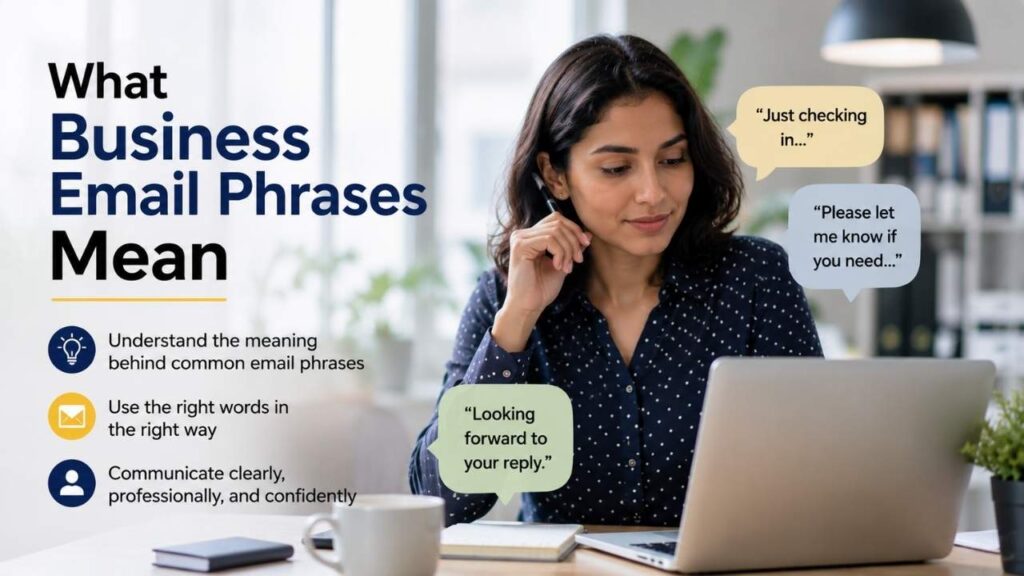
Business email phrases are standard expressions people use in workplace emails. These phrases appear in greetings, requests, explanations, responses, and closings. They help emails sound organized and professional.
In English grammar, these phrases often use polite modal verbs, indirect requests, and formal sentence patterns. For example, phrases like “Could you please” or “I wanted to follow up” soften the tone while keeping the message clear.
These expressions also create consistency in communication. Because many professionals recognize them immediately, readers understand the writer’s purpose faster. That makes workplace communication smoother and more efficient.
Common Structures in Business Emails
Many business phrases follow predictable grammar patterns. Requests often begin with modal verbs such as “could,” “would,” or “may.” Updates commonly use present tense forms like “I’m writing to inform you.”
Professional emails also rely heavily on transition phrases. Expressions such as “In addition,” “However,” and “Please note” help connect ideas clearly.
Why These Phrases Matter
Business phrases do more than sound professional. They help writers manage tone carefully. For example, a direct sentence like “Send the report today” may sound harsh. However, “Could you send the report by today?” sounds more respectful.
Because tone is harder to read in digital communication, email phrasing plays a major role in avoiding misunderstandings.
The Historical Background of Business Email Language
Business writing existed long before email. In the nineteenth and early twentieth centuries, companies mainly used formal business letters. These letters followed strict formats and highly formal wording.
Older business English often sounded distant and ceremonial. Writers commonly used phrases like “Please be advised” or “Enclosed herewith.” Over time, workplace communication became more conversational.
The rise of email during the 1990s changed business writing dramatically. Messages became shorter and faster. Because employees communicated more frequently, overly formal language started to feel unnatural in many workplaces.
Today, American business emails usually combine professionalism with a conversational tone. However, highly formal industries still prefer traditional wording in some situations.
The Influence of Digital Communication
Text messaging and workplace chat apps also affected email style. Many professionals now prefer concise writing instead of long paragraphs.
Even so, business emails still follow certain expectations. Clear greetings, respectful requests, and polite closings remain important in professional American English.
Business Email Greetings Examples
Greetings set the tone for the entire email. In American workplaces, greetings are usually polite, short, and friendly.
Formal greetings are common when writing to clients, supervisors, or new contacts. Examples include “Dear Mr. Carter” or “Good morning, Sarah.”
Less formal greetings appear more often between coworkers. Phrases like “Hi James” or “Hello team” are now standard in many offices.
Formal vs Informal Greetings
The level of formality depends on the relationship. A lawyer writing to a client may choose more formal wording. In contrast, coworkers in a startup company may use relaxed greetings.
American English generally favors first names in workplace communication. British English sometimes keeps titles longer in formal business settings.
Greeting Examples in Context
| Context | Correct Usage | Example | Notes |
| First contact | Formal greeting | Dear Ms. Taylor, | Common in professional introductions |
| Internal email | Friendly greeting | Hi Marcus, | Standard in many US offices |
| Group message | Team greeting | Hello everyone, | Neutral and professional |
| Client email | Polite opening | Good afternoon, Mr. Lee, | Slightly more formal |
| Quick follow-up | Casual greeting | Hi again, | Common in ongoing conversations |
Professional Request Phrases in Emails
Requests are one of the most common parts of business emails. American English usually avoids commands in professional writing. Instead, writers soften requests with polite phrasing.
Expressions like “Could you please,” “Would you mind,” and “When you have a moment” make requests sound respectful.
These patterns often use modal verbs because they reduce pressure on the reader. This style is especially common in customer service, management, and corporate communication.
Indirect Requests in American English
Indirect requests sound less aggressive than direct commands. For example, “Could you review the document?” feels more professional than “Review the document.”
Indirect phrasing also helps preserve workplace relationships. It allows communication to stay polite even during stressful situations.
Modern Workplace Tone
Modern American workplaces often prefer concise requests. Very long or overly polite wording can sound outdated. For example, “I would greatly appreciate it if you could possibly” may feel excessive today.
Instead, shorter phrases usually sound more natural and professional.
Phrases for Follow-Up Emails
Follow-up emails help maintain communication after meetings, applications, or unanswered messages. These emails are common in modern workplaces because professionals handle large numbers of messages daily.
Polite follow-up phrases avoid sounding impatient. Writers often use expressions like “I wanted to follow up regarding” or “Just checking in about.”
These phrases soften the reminder while keeping the purpose clear.
Why Follow-Up Language Matters
A follow-up email can easily sound demanding if written poorly. However, polite wording keeps the tone professional.
American business culture usually accepts follow-up emails as normal workplace practice. Still, timing matters. Sending repeated reminders too quickly may appear pushy.
Common Grammar Patterns
Many follow-up phrases use progressive verb forms such as “I’m following up” or past-tense softeners like “I wanted to check.”
These structures make the request feel less abrupt.
Business Email Closing Phrases Examples
Closing phrases leave the final impression. Professional closings in American English are usually short and polite.
Common examples include “Best regards,” “Thank you,” and “Sincerely.” Less formal closings like “Best” or “Thanks” are now widely accepted in workplace emails.
The relationship between writer and reader often determines the best choice.
Formal Closings
Traditional business settings still use formal closings. Legal firms, financial institutions, and government offices may prefer “Sincerely” or “Respectfully.”
These closings reflect older business writing traditions.
Informal Professional Closings
Many modern companies use warmer closings. Expressions like “Thanks again” or “Looking forward to hearing from you” create a friendlier tone.
American English increasingly favors approachable business communication instead of rigid formality.
Polite Email Phrases for Difficult Situations
Professional emails sometimes involve mistakes, delays, or disagreements. In these cases, careful wording becomes extremely important.
Polite apology phrases help reduce tension. Common examples include “I apologize for the delay” or “Thank you for your patience.”
These phrases acknowledge the issue without sounding defensive.
Softening Negative Information
Business English often softens bad news using indirect phrasing. For example, “We may need additional time” sounds gentler than “The project is delayed.”
This style helps maintain professionalism during uncomfortable conversations.
Tone and Emotional Impact
Digital communication lacks facial expressions and voice tone. Because of this, wording strongly affects how readers interpret messages.
Even small changes in phrasing can make emails sound respectful, impatient, supportive, or rude.
Formal vs Informal Business Email Language
Business emails today range from highly formal to conversational. The appropriate style depends on industry culture, company expectations, and audience.
Formal emails usually contain complete sentences, careful punctuation, and professional vocabulary. Informal emails often sound shorter and more relaxed.
American English generally accepts conversational business writing more than earlier generations did.
Changes in Workplace Expectations
Younger workplaces often prefer direct and friendly communication. Long formal introductions may feel unnecessary in fast-moving environments.
However, formal writing still matters in client communication, legal matters, and executive correspondence.
Balancing Professionalism and Friendliness
The best professional emails usually sound respectful without appearing stiff. Writers often aim for a natural tone that still shows professionalism.
That balance is one reason many people search for practical phrase examples instead of strict grammar rules alone.
Common Mistakes in Business Email Writing
Many email mistakes involve tone rather than grammar alone. Writers sometimes sound too direct, too vague, or overly formal.
For example, using all capital letters can appear aggressive. Extremely short replies may also seem unfriendly.
Grammar issues can create problems as well. Missing punctuation or unclear wording sometimes changes meaning entirely.
Overusing Formal Language
Some learners believe professional English must sound extremely formal. However, phrases like “Kindly do the needful” often sound outdated in American business English.
Modern workplace communication usually values clarity and natural phrasing instead.
Confusing Friendly and Unprofessional Tone
On the other hand, overly casual language can hurt professionalism. Excessive slang, emojis, or abbreviations may appear inappropriate in formal situations.
Business emails should sound human without becoming careless.
Real-Life Business Email Usage Today
Business email phrases appear everywhere in modern life. Employees use them in remote work, customer service, project management, and job applications.
Email communication also shapes workplace reputation. Clear writing often creates stronger professional impressions.
Today, many professionals send emails from phones instead of desktop computers. Because of this change, shorter paragraphs and concise wording have become more common.
Workplace Communication Trends
Remote work increased email communication across many industries. Teams now rely heavily on digital writing for collaboration.
As a result, business English continues evolving toward faster and clearer communication styles.
Email and Professional Identity
People often judge professionalism through written communication. Even simple phrase choices can influence how coworkers and clients view someone’s competence.
Because of this, strong email writing skills remain valuable across industries.
British vs American Business Email Differences
British and American business English share many similarities. However, tone and wording sometimes differ slightly.
British emails may sound somewhat more formal in certain professional settings. American emails often use a friendlier tone earlier in the relationship.
Vocabulary also varies. Americans commonly use “Hi” in workplace emails, while some British professionals may prefer “Dear” in formal situations.
Spelling Differences
Spelling variations also appear in international communication. American English uses forms like “organize” and “color,” while British English uses “organise” and “colour.”
Most international companies accept either version if used consistently.
Global Communication Changes
Global workplaces increasingly mix communication styles. Because of this, business email language continues becoming more flexible and internationally understandable.
How Business Email Language Has Changed Over Time
Professional writing constantly evolves. Older business communication emphasized hierarchy and distance. Modern communication values efficiency and clarity more heavily.
Phrases once considered professional may now sound outdated. For example, expressions like “To whom it may concern” appear less often in everyday business emails today.
At the same time, some traditional phrases remain useful in formal contexts.
The Rise of Conversational Professional English
Modern American business English increasingly sounds conversational. Writers often use contractions, shorter sentences, and friendlier greetings.
However, professionalism still matters. The goal is usually clear communication with respectful tone.
Future Changes in Business Communication
Artificial intelligence, remote work, and messaging apps continue influencing professional English. Email language will likely keep becoming shorter and more direct.
Even so, politeness and clarity will probably remain central parts of workplace communication.
Choosing the Right Phrase for the Situation
The best business phrase depends on context. A manager speaking to a close team member may use different wording than a salesperson contacting a new client.
Audience awareness matters more than memorizing fixed rules. Strong writers adjust tone naturally depending on the situation.
Professional communication also depends on industry culture. Technology companies often prefer relaxed wording, while law firms may expect more formality.
Reading Tone Carefully
Before sending an email, many professionals reread messages to check tone. This practice helps prevent misunderstandings.
Small wording adjustments can make emails sound more collaborative and respectful.
Building Confidence Through Practice
People improve email writing by reading and using professional phrases regularly. Over time, these patterns become natural parts of communication.
Because workplace English changes gradually, flexibility is also important.
FAQs
What are business email phrases?
Business email phrases are common professional expressions used in workplace emails. They help writers communicate politely and clearly in professional settings.
Why are polite phrases important in business emails?
Polite wording reduces misunderstandings and improves professional relationships. It also helps messages sound respectful instead of demanding.
Are formal email phrases still used today?
Yes, formal phrases still appear in many industries. However, modern American workplaces often prefer a more conversational style.
What is the difference between formal and informal business emails?
Formal emails usually use more careful wording and structure. Informal emails sound friendlier and are common between coworkers.
Do American and British business emails differ?
The differences are usually small. American emails often sound slightly more direct and conversational.
How can I improve my business email writing?
Reading professional emails and practicing common phrases can help. Clear, concise writing usually works best.
Conclusion
Professional email communication continues evolving, but its main purpose remains the same. People use business emails to share information clearly, maintain workplace relationships, and communicate respectfully in professional settings.
Understanding business email phrases examples helps writers sound more confident and natural. These phrases are not simply grammar rules. Instead, they reflect how modern American English works in real workplace communication.
The most effective business emails balance clarity, politeness, and efficiency. When writers understand tone and context, professional communication becomes much easier and more effective.