
Whos vs Whose: What’s the Difference? With Examples
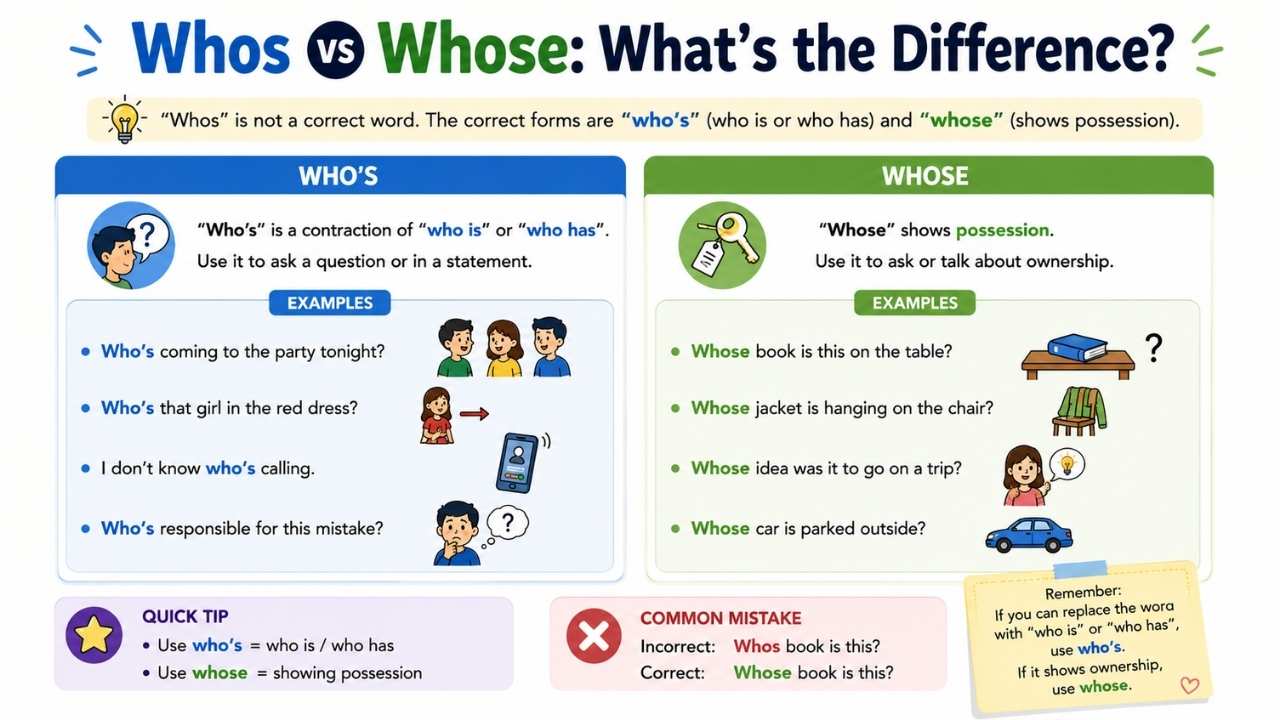
Many English learners confuse whos vs whose because the words sound the same. However, they serve very different grammar roles. One relates to possession, while the other is a contraction.
This confusion appears often in texting, emails, social media posts, and even workplace writing. Because both forms sound identical in spoken English, writers usually make mistakes when typing quickly.
Today, understanding the difference matters more than ever. Digital communication moves fast, and small grammar errors can affect clarity. Fortunately, this rule is actually simple once you break it down.
Quick Answer
The difference between whos vs whose is straightforward. Who’s is a contraction of who is or who has, while whose shows possession or ownership.
TL;DR
- Who’s means who is or who has
- Whose shows possession
- Who’s jacket is this? is incorrect
- Whose jacket is this? is correct
- If you can replace the word with who is, use who’s
What Whose Means in English
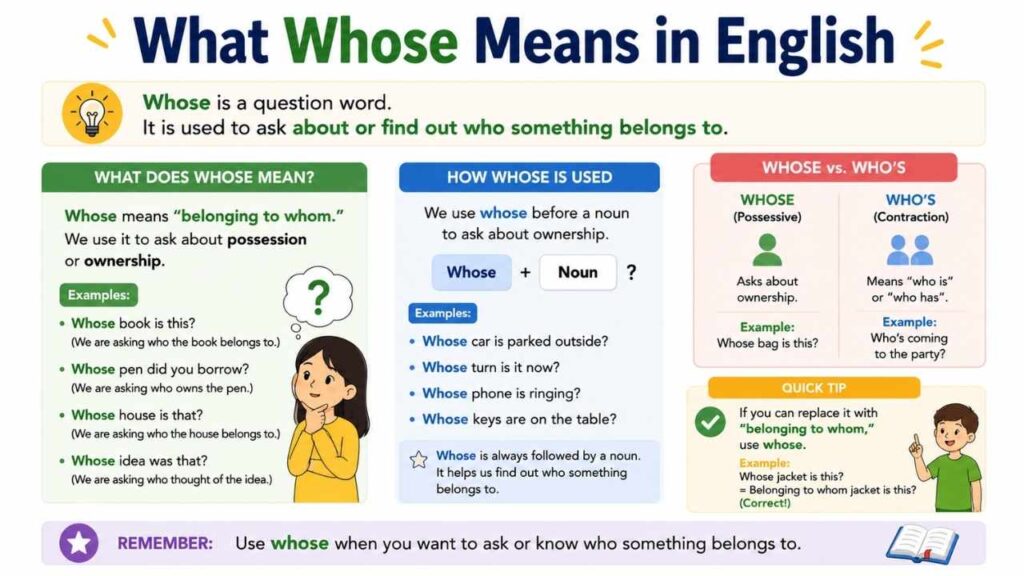
The word whose is a possessive pronoun and determiner. It asks or shows ownership, connection, or relationship between a person and something else.
For example, in the sentence “Whose phone is ringing?” the speaker wants to know who owns the phone. The word connects the object to its owner.
How Whose Functions Grammatically
Whose often appears before a noun. In that position, it acts like other possessive words such as my, your, or their.
For example:
| Context | Correct Usage | Example | Notes |
| Asking about ownership | Whose | Whose keys are these? | Shows possession |
| Relative clause | Whose | The student whose laptop broke left early. | Connects ownership |
| Formal writing | Whose | The company whose policy changed announced updates. | Common in business English |
Because whose already signals possession, it never needs an apostrophe.
Whose in Relative Clauses
American English frequently uses whose in relative clauses. These clauses add information about a person or thing.
For example, “The teacher whose class I joined was helpful” identifies a specific teacher. Here, whose connects the teacher to the class.
Interestingly, modern English also uses whose for objects and organizations. Older grammar traditions sometimes discouraged this use. However, it is now standard in both formal and informal writing.
What Who’s Means in English
The word who’s is a contraction. It combines who is or who has into a shorter form.
For example, “Who’s coming tonight?” really means “Who is coming tonight?” Likewise, “Who’s finished the report?” can mean “Who has finished the report?”
Why the Apostrophe Matters
The apostrophe in who’s replaces missing letters. This follows a common English contraction pattern.
For example:
- it’s = it is
- she’s = she is
- who’s = who is
Because apostrophes often appear in possessive nouns, many writers mistakenly think who’s is possessive. In reality, it is never possessive.
Testing Whether Who’s Is Correct
A quick test helps many writers avoid mistakes. Replace who’s with who is in the sentence.
If the sentence still makes sense, who’s is correct.
For example:
- “Who’s ready for lunch?” → “Who is ready for lunch?” ✔
- “Who’s backpack is on the floor?” → “Who is backpack is on the floor?” ✘
Since the second sentence fails the test, whose is correct instead.
The Historical Background of Whose and Who’s
The history of these words reaches back to Old English. Early forms of English already had pronouns showing possession and identity.
The word whose developed from ancient Germanic roots tied to possession and questioning. It has existed in English for hundreds of years.
How Contractions Developed
Contractions like who’s became more common later. Spoken English naturally shortened phrases over time. Writers eventually reflected those spoken forms in print.
By the eighteenth and nineteenth centuries, contractions appeared regularly in dialogue and informal writing. Today, they are accepted across most forms of American English, although highly formal writing sometimes avoids them.
Why the Confusion Increased
Modern confusion partly comes from pronunciation. Both words sound exactly alike in nearly all American accents.
As texting and online messaging expanded during the 2000s and 2010s, spelling mistakes involving apostrophes became more visible. Even native speakers now mix up these forms regularly.
Whos vs Whose in American English
In the United States, both forms appear constantly in daily communication. However, American English strongly favors contractions in casual speech and informal writing.
As a result, many people type who’s automatically, even when they actually need whose.
Everyday American Usage
Americans commonly use whose in questions:
- “Whose turn is it?”
- “Whose car blocked the driveway?”
Meanwhile, who’s appears naturally in conversation:
- “Who’s calling me?”
- “Who’s already eaten?”
Because spoken pronunciation does not distinguish them, context becomes essential.
Workplace and Academic Writing
Professional and academic writing in the USA usually expects correct apostrophe usage. Errors involving who’s and whose may appear careless.
For example, a sentence like “Who’s responsible for this project?” is correct because it means “Who is responsible.” However, “Whose responsible for this project?” is incorrect because possession is not involved.
Why Native Speakers Still Mix Them Up
Even fluent English speakers confuse these words. The mistake is extremely common online.
One reason is that English apostrophe rules are inconsistent. Possessive nouns usually take apostrophes, such as:
- the teacher’s desk
- the company’s office
However, possessive pronouns do not use apostrophes:
- hers
- yours
- theirs
- whose
This inconsistency creates confusion.
Speed and Informal Writing
Digital communication also encourages fast typing. People often rely on sound rather than grammar structure.
Autocorrect sometimes worsens the problem. Some devices incorrectly replace one form with the other based on prediction patterns instead of grammar.
Common Mistakes With Whose and Who’s
The most common mistake is using who’s for possession.
For example:
- Incorrect: “Who’s shoes are by the door?”
- Correct: “Whose shoes are by the door?”
Another common mistake is dropping the apostrophe from who’s.
For example:
- Incorrect: “Whos coming with us?”
- Correct: “Who’s coming with us?”
Why These Errors Happen
Many writers learned that apostrophes show possession. Therefore, they assume who’s must be possessive.
However, English pronouns often behave differently from nouns. Possessive pronouns rarely use apostrophes.
This explains why we write:
- his
- hers
- yours
- whose
instead of forms with apostrophes.
Real-Life Examples in Daily Communication
These words appear constantly in modern communication. Understanding them improves clarity in emails, texts, and social media posts.
For example, someone might text:
“Who’s picking up dinner?”
Here, the writer means “Who is picking up dinner?”
In contrast, a parent might ask:
“Whose water bottle is this?”
That question asks about ownership.
Social Media and Informal Language
Social media often contains grammar shortcuts. Some writers intentionally ignore apostrophes altogether.
For example:
- “Whos ready for vacation?”
- “Whose excited for the concert?”
Although readers usually understand the meaning, these forms are technically incorrect. Standard written English still distinguishes them clearly.
Formal vs Informal Usage
In formal writing, correct distinction matters more. Business emails, essays, and reports generally follow standard grammar expectations.
For example:
“The manager whose proposal was approved joined the meeting.”
This sentence sounds polished and professional.
Casual Conversation
In spoken conversation, listeners cannot hear the spelling difference. Therefore, context does all the work.
Because speech naturally hides the distinction, many writers transfer spoken habits into written English.
Still, careful writing benefits from proper usage, especially in professional settings.
British vs American English Differences
There is very little difference between British and American English regarding whose and who’s. Both varieties follow the same grammar rules.
However, punctuation preferences may vary slightly in surrounding sentence styles. British English sometimes treats contractions a bit more cautiously in formal contexts.
Even so, both forms function identically across major English dialects.
Shared Modern Standards
Modern dictionaries in both the USA and the UK define:
- whose as possessive
- who’s as a contraction
Because these meanings remain stable, learners can apply the same rule almost everywhere English is spoken.
Grammar Debates and Gray Areas
Some grammar debates involve the use of whose for objects instead of people.
Older style traditions occasionally preferred phrases like:
“the house of which the roof collapsed”
instead of:
“the house whose roof collapsed.”
Modern Usage Trends
Today, most modern grammar experts accept whose for both people and things. American English especially favors the smoother, more natural structure.
As a result, sentences using whose for organizations, places, or objects now appear widely in newspapers, books, and academic writing.
How Usage Has Changed Over Time
English grammar changes gradually. Contractions became more accepted over centuries, especially in conversational writing.
Today, American English uses contractions heavily in digital communication. This makes who’s extremely common in everyday text.
The Rise of Informal English
Online communication has blurred the line between spoken and written English. Many people now write almost exactly as they speak.
Because of this shift, apostrophe errors appear more often than in older printed writing. Still, schools, publishers, and workplaces continue teaching the traditional distinction.
Easy Memory Tricks for Whose and Who’s
Simple memory tricks help many learners remember the difference.
The best method is expansion testing. Replace who’s with who is or who has.
If the sentence still works, use who’s.
If ownership appears, use whose instead.
Comparing Similar Pairs
English contains several confusing pairs like this:
- it’s vs its
- they’re vs their
- you’re vs your
Learning one pair often helps with the others because the grammar pattern repeats.
FAQs
Is “whos” ever correct without an apostrophe?
No. Standard English does not accept “whos” as a correct spelling. You usually need either who’s or whose.
What is the easiest way to remember who’s vs whose?
Try replacing who’s with who is. If the sentence still works, the contraction is correct.
Is whose only used for people?
No. Modern English also uses whose for things, organizations, and places. This use is widely accepted today.
Why do native speakers confuse these words?
Both words sound identical in speech. Also, English apostrophe rules can feel inconsistent.
Is it wrong to skip apostrophes in texting?
Many people skip apostrophes informally online. However, standard writing still considers that incorrect.
Can who’s mean who has?
Yes. For example, “Who’s finished the assignment?” can mean “Who has finished the assignment?”
Conclusion
Understanding whos vs whose becomes much easier once you separate possession from contraction. Whose shows ownership, while who’s stands for who is or who has.
Although the words sound identical, their grammar roles differ completely. Because modern communication moves quickly, mistakes happen often. Still, one simple test can prevent most errors.
If you can replace the word with who is, use who’s. If the sentence involves ownership, use whose instead. With practice, the difference soon feels natural in everyday English writing and speech.