Basic English Sentences for Beginners Explained
Learning basic English sentences for beginners is one of the fastest ways to build confidence in English. Simple sentences help people speak clearly, understand others, and communicate in daily life. They also create the foundation for better grammar later.
Today, beginners use English in many places. They use it in school, at work, online, and during travel. Because of this, understanding simple sentence structure matters more than ever.
English sentences may look easy at first. However, they follow clear patterns and rules. Once learners understand those patterns, speaking and writing become much easier.
In American English, short and direct sentences are common. People often prefer clear communication instead of long and formal wording. That makes beginner sentences especially useful in everyday life.
Quick Answer
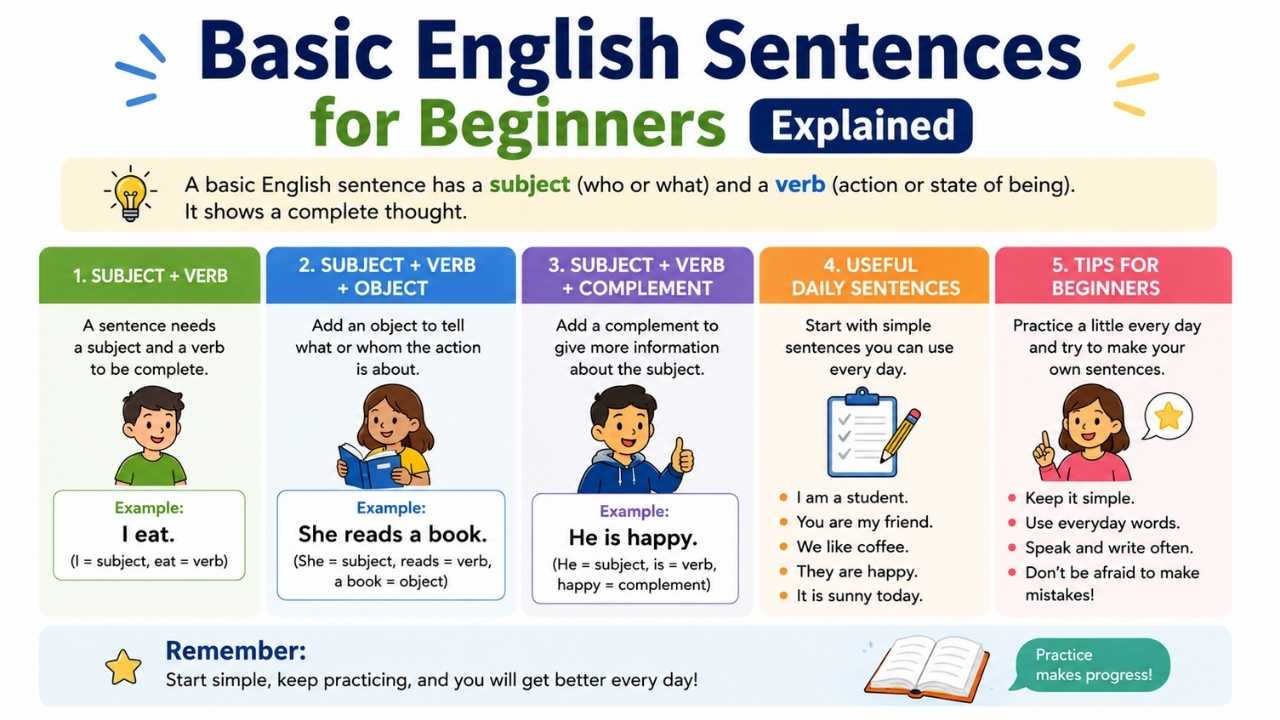
Basic English sentences for beginners are short and simple statements that follow common English grammar patterns. Most use a subject, a verb, and sometimes an object, such as “I like coffee” or “She is happy.”
TL;DR
- Basic English sentences usually follow a simple word order.
- Most sentences begin with a subject and verb.
- American English often prefers short and direct sentences.
- Beginners commonly learn greetings, questions, and daily expressions first.
- Small grammar mistakes are normal during early learning.
- Practice with real conversations improves sentence building quickly.
What Basic English Sentences Mean
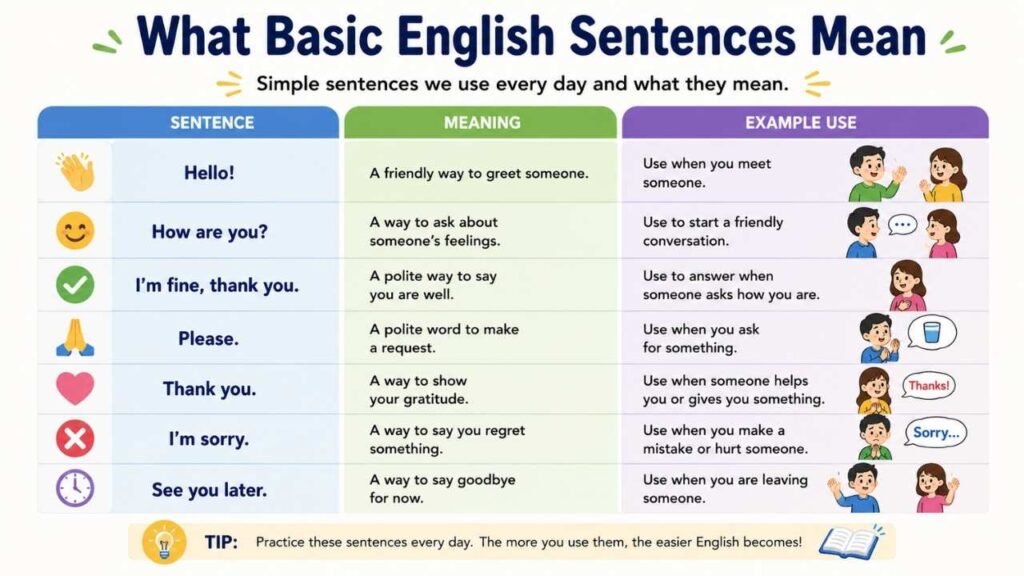
Basic English sentences are simple groups of words that express a complete idea. They help beginners communicate basic thoughts, feelings, actions, and questions.
Most beginner sentences follow a clear structure. English normally uses subject + verb + object order. For example, “I eat breakfast” follows this pattern. The subject is “I,” the verb is “eat,” and the object is “breakfast.”
Simple Sentence Structure
English sentence structure became more fixed over time. Older forms of English allowed more flexible word order. However, modern English depends heavily on word order to show meaning clearly.
Today, American English strongly prefers predictable sentence patterns. Because of this, beginners usually learn sentence order early in the learning process.
Why Simple Sentences Matter
Simple sentences help learners understand grammar naturally. Instead of memorizing difficult rules first, beginners learn by using practical examples.
Short sentences also reduce confusion. For example, “I am tired” is easier to understand than a long sentence with many clauses.
The History of English Sentence Structure
English grammar changed greatly across centuries. Old English, spoken before the Norman period, had complex endings that showed grammatical meaning.
After the Norman influence, English slowly became simpler. Word order became more important because many old endings disappeared. As a result, modern English relies on sentence position more than older forms did.
How American English Simplified Usage
American English later developed its own style. In many situations, Americans preferred shorter and more direct communication. This influenced sentence patterns in schools, business writing, and daily conversation.
Today, beginner textbooks often teach American-style sentence simplicity first. This approach helps learners communicate faster in real situations.
Modern Changes in Communication
Digital communication also shaped sentence use. Texting, social media, and messaging apps encouraged shorter expressions. Many people now use simple sentence patterns even in casual professional settings.
However, standard grammar rules still matter in formal writing. Beginners should understand both casual and formal sentence styles.
Common Types of Basic English Sentences
English beginners usually learn four main sentence types first. These types appear constantly in daily communication.
Statements
Statements share information or opinions. Examples include “I live in Texas” and “She likes music.” These are often the first sentences learners practice.
Statements normally end with a period. In speech, the voice usually falls slightly at the end.
Questions
Questions ask for information. English often changes word order in questions. For example, “You are ready” becomes “Are you ready?”
Beginners sometimes forget this change. However, repeated listening and speaking practice helps learners remember the correct pattern.
Commands
Commands give instructions or requests. Examples include “Open the door” and “Please sit down.”
In commands, the subject is often hidden. The listener understands that the speaker means “you.”
Exclamations
Exclamations show strong emotion. Examples include “What a great day!” and “That’s amazing!”
These sentences appear often in spoken American English because they create natural and expressive communication.
Basic English Sentences Used in Daily Life
Daily English relies heavily on simple sentences. Many conversations use short patterns instead of long grammar structures.
People often begin with greetings and common expressions. Sentences like “How are you?” and “I’m fine” remain essential in American communication.
Conversations at Home
Family conversations usually use direct language. Parents and children often speak with simple sentence structures because they are fast and natural.
For example, people commonly say:
“I’m hungry.”
“The food is ready.”
“Can you help me?”
These short sentences carry clear meaning without extra complexity.
Sentences at School and Work
Schools and workplaces also depend on clear communication. Even professionals often use simple sentences during meetings or emails.
American workplaces especially value clarity. Therefore, short and organized sentences are usually preferred over overly formal wording.
Basic English Sentences for Greetings and Introductions
Greetings are often the first sentences beginners learn. They create social connection and help conversations start naturally.
Saying Hello
American English includes both formal and informal greetings. “Hello” works in almost every situation. Meanwhile, “Hi” sounds more casual and friendly.
Younger speakers also use expressions like “What’s up?” or “How’s it going?” in informal situations.
Introducing Yourself
Simple introductions usually follow a basic pattern. A beginner may say, “My name is Anna” or “I’m David.”
These structures are important because introductions happen constantly in real life. They also help learners practice subjects and verbs naturally.
Asking Basic Questions
Questions such as “Where are you from?” and “What do you do?” appear often in everyday conversations.
American English sometimes shortens these questions in casual speech. For example, “What are you doing?” may sound like “Whatcha doing?” in fast conversation. However, beginners should first learn the standard form.
Understanding Subject and Verb Agreement
One important grammar rule involves matching subjects and verbs correctly. This is called subject-verb agreement.
Singular subjects usually take singular verbs. Plural subjects take plural verbs. For example, “She runs” is correct, while “She run” is incorrect.
Why Beginners Struggle With Agreement
Many languages use different agreement systems. Because of this, English learners sometimes forget the extra “s” in present tense verbs.
American English also includes irregular verbs, which creates additional confusion. For example, “I am” changes to “they are.”
Learning Agreement Naturally
Listening practice helps learners understand agreement patterns more naturally. Repeating common sentence forms also improves accuracy over time.
Mistakes are common during early learning stages. However, regular exposure usually fixes these problems gradually.
Common Beginner Sentence Patterns
Some sentence patterns appear more often than others. Learning these structures helps beginners communicate faster.
| Context | Correct Usage | Example | Notes |
| Introducing yourself | Subject + be verb | I am Lisa. | Very common for beginners |
| Talking about likes | Subject + like + object | I like pizza. | Useful in conversations |
| Asking questions | Be verb + subject | Are you ready? | Common in spoken English |
| Describing feelings | Subject + be + adjective | She is tired. | Often used daily |
| Talking about actions | Subject + verb + object | They watch TV. | Basic sentence pattern |
Patterns Beginners Use Most
The verb “to be” appears constantly in beginner English. Sentences like “I am happy” and “He is tall” are foundational structures.
Action verbs also become important quickly. Examples include “eat,” “go,” “play,” and “study.”
Building Longer Sentences
Once beginners understand short patterns, they can connect ideas. For example, “I like coffee” can become “I like coffee because it helps me wake up.”
This gradual growth helps learners avoid feeling overwhelmed.
Common Mistakes Beginners Make
Mistakes are a natural part of language learning. Many beginner errors happen because English grammar differs from other languages.
Missing Verbs
Some learners forget the verb completely. For example, they may say “She happy” instead of “She is happy.”
English usually requires a verb in every complete sentence. Because of this, beginners must practice sentence completeness carefully.
Incorrect Word Order
English word order is stricter than many languages. Beginners sometimes place words incorrectly, especially in questions.
For example, “Where you are going?” should become “Where are you going?”
Overusing Literal Translation
Learners often translate directly from their native language. However, English expressions do not always translate word for word.
Natural practice and listening help reduce this problem over time.
Formal and Informal Sentence Usage
English changes depending on the situation. Formal English appears in academic writing and professional communication. Informal English appears in casual conversations and texting.
Formal Beginner Sentences
Formal sentences avoid slang and shortened expressions. For example, “I cannot attend today” sounds more formal than “I can’t come today.”
Schools often teach formal grammar first because it follows clearer rules.
Informal American English
American English uses contractions frequently. People regularly say “I’m,” “don’t,” and “we’re” in speech and writing.
Informal communication also includes shorter sentences. For example, many text messages use very direct wording.
Balancing Both Styles
Beginners should understand both forms. Formal grammar helps with writing, while informal grammar improves real conversations.
Knowing when to switch styles is an important communication skill.
British and American Differences in Simple Sentences
British and American English share most grammar rules. However, some sentence patterns and vocabulary differ slightly.
Differences in Everyday Usage
Americans often prefer shorter and more direct expressions. British English may sound slightly more formal in some situations.
For example, Americans commonly say “Can I get a coffee?” while British speakers may say “May I have a coffee?”
Vocabulary Changes
Certain beginner words differ between regions. Americans say “apartment,” while British speakers say “flat.”
These differences rarely stop communication. However, learners may notice them in movies, books, and online content.
Pronunciation and Rhythm
American English also tends to reduce sounds more in casual speech. Beginners sometimes struggle with fast spoken American conversations because words blend together.
Listening practice is especially important for understanding these speech patterns.
Basic English Sentences in Digital Communication
Technology changed how people write English. Text messages, social media posts, and chats often use simpler sentence structures.
Shorter Sentences Online
People usually write quickly online. Because of this, short sentences dominate digital communication.
Examples include:
“I’m here.”
“See you later.”
“That sounds good.”
These patterns help conversations move faster.
Informal Grammar Online
Online communication sometimes ignores standard grammar rules. People may skip punctuation or capitalization in casual settings.
However, professional communication still expects proper grammar. Beginners should understand the difference between casual texting and formal writing.
Emojis and Meaning
Modern communication also includes emojis and abbreviations. Still, strong sentence structure remains important because words carry the main meaning.
Simple and clear writing usually creates the best communication online.
How Beginner Sentences Build Confidence
Simple sentences help learners feel successful early. This confidence encourages more speaking and writing practice.
Speaking Without Fear
Many beginners worry about making mistakes. However, native speakers usually understand short and clear sentences easily.
For example, “I need help” communicates meaning effectively even if pronunciation is imperfect.
Repetition Creates Fluency
Repeated sentence patterns train the brain naturally. Over time, learners stop translating mentally and begin responding automatically.
This process explains why daily speaking practice matters so much.
Real-Life Progress
Beginners often notice improvement quickly. Small victories, like ordering food or introducing themselves, create motivation for continued learning.
Because of this, practical sentence practice is more useful than memorizing isolated grammar rules alone.
How English Sentence Usage Continues to Change
English constantly evolves. New technology, global communication, and cultural changes affect sentence patterns every year.
Simpler Communication Trends
Modern English increasingly values speed and clarity. Many businesses and schools encourage concise writing instead of overly formal language.
As a result, beginner-style sentence simplicity sometimes appears even in professional communication.
Influence of Global English
English is now spoken worldwide. Different accents and sentence styles influence each other through movies, music, and online platforms.
American English especially spreads quickly through entertainment and social media.
Standard Grammar Still Matters
Although language changes, core grammar rules remain important. Clear sentence structure helps people communicate accurately across cultures and regions.
Therefore, beginners should first master standard patterns before experimenting with informal styles.
FAQs
What is the easiest English sentence structure for beginners?
The easiest structure is usually subject + verb + object. Examples include “I like music” and “She drinks water.” This pattern appears constantly in everyday English.
Why do English sentences need a subject?
English grammar normally requires a subject to show who performs the action. Even short sentences usually include one. Commands are a common exception.
Are contractions acceptable in beginner English?
Yes, contractions are very common in American English. Native speakers regularly say “I’m,” “can’t,” and “they’re” in daily conversation.
How many words should a beginner sentence have?
Most beginner sentences contain three to eight words. Short sentences help learners focus on grammar and meaning clearly.
Is American English easier than British English for beginners?
Many learners find American English easier because it often uses direct and simplified speech patterns. However, both versions follow mostly the same grammar rules.
Can beginners use slang?
Beginners can learn basic slang gradually. However, understanding standard English first usually creates stronger communication skills.
Conclusion
Learning basic English sentences for beginners gives learners a strong foundation for speaking and writing confidently. Simple sentence patterns make communication clearer, faster, and easier to understand.
English grammar may seem difficult at first. However, most daily communication depends on short and predictable sentence structures. Once learners master those patterns, they can expand naturally into more advanced English.
Today, American English especially values clear and direct communication. Because of this, simple sentences remain extremely useful in conversations, emails, texting, and social interaction.
The best way to improve is through consistent practice. Reading, listening, writing, and speaking simple sentences every day gradually builds fluency and confidence over time.