
Benefited or Benefitted? Which Spelling Is Correct?
Many English learners and native speakers pause when writing benefited or benefitted. Both forms appear online, in books, and even in professional writing. Because of that, people often wonder which spelling is actually correct.
Today, this spelling difference mostly comes down to regional English rules and style preferences. In American English, benefited is usually the standard form. However, benefitted still appears in some British and international writing.
The confusion also connects to a larger grammar pattern in English. Some verbs double the final consonant before adding endings like -ed or -ing, while others do not. Understanding that pattern makes this word much easier to use naturally.
Quick Answer
Benefited is the preferred spelling in modern American English, while benefitted appears more often in British English and some international usage. Both forms are accepted, but American style guides strongly favor benefited.
TL;DR
- Benefited is standard in the United States.
- Benefitted is less common but still considered correct in some regions.
- The difference relates to consonant-doubling spelling rules.
- American English usually avoids doubling the final “t” in this word.
- British English sometimes prefers benefitted and benefitting.
- Both forms mean “received an advantage or gain.”
What Benefited and Benefitted Mean
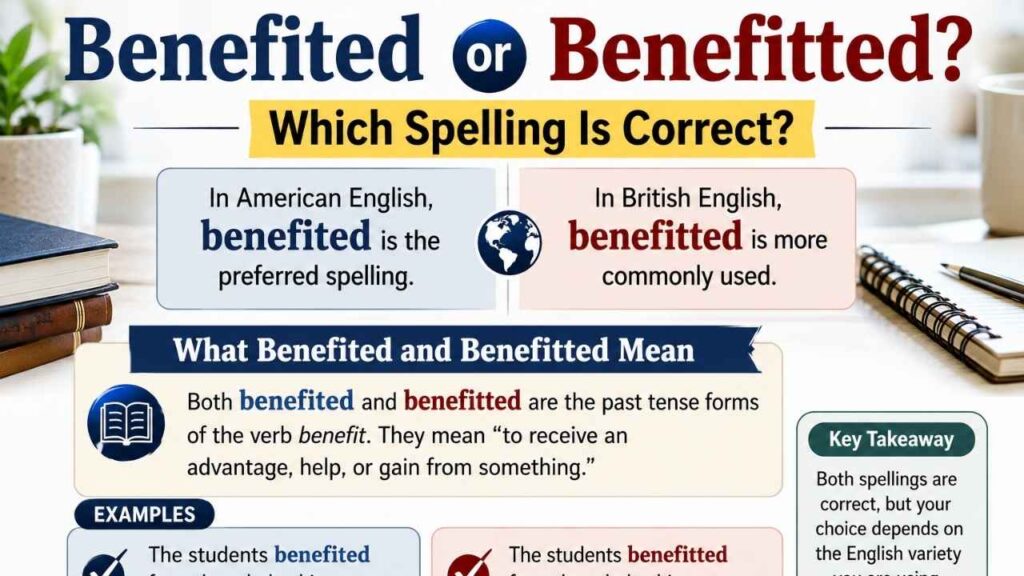
Both benefited and benefitted are past-tense forms of the verb benefit. They describe receiving help, value, profit, or improvement from something.
For example, someone might say, “The students benefited from extra tutoring.” Another writer could use, “The company benefitted from lower costs.” In both cases, the meaning stays the same.
The verb itself comes from the noun benefit, which refers to something helpful or advantageous. Over time, English speakers naturally turned the noun into a verb. That process is common in English and happens with words like email, text, and impact.
How the Verb Functions
The verb usually appears after a subject and before a phrase showing the source of advantage. For example, “She benefited from the program” follows a standard English sentence structure.
The word can also appear in formal, academic, business, and casual communication. Because of that, it is extremely common in modern English writing.
Why Americans Usually Write “Benefited”
In the United States, benefited is considered the standard spelling. Most American dictionaries, newspapers, schools, and publishers prefer it.
This preference follows a broader American spelling pattern. Many American English words avoid doubling a final consonant unless the stress falls on the last syllable.
The word benefit has stress on the first syllable: BEN-uh-fit. Because the final syllable is not stressed, American spelling rules usually keep a single “t” before adding -ed or -ing.
Examples in American English
| Context | Correct Usage | Example | Notes |
| Academic writing | benefited | Students benefited from tutoring. | Standard US form |
| Business writing | benefited | The company benefited financially. | Preferred in US publications |
| Everyday speech | benefited | We benefited from the advice. | Common in conversation |
| Informal texting | benefited | I really benefited from that class. | Most natural US spelling |
Today, American readers generally expect this spelling. Using benefitted in the United States may look unusual, although most readers still understand it.
Why “Benefitted” Still Exists
Even though Americans prefer benefited, the spelling benefitted did not disappear. In fact, it still appears in many English-speaking regions.
British English often doubles consonants more readily before adding endings. Because of that pattern, British writers sometimes use benefitted and benefitting.
However, British usage is not completely uniform. Some British publications also use the shorter spelling. That means modern English allows variation depending on editorial style and regional preference.
British and International Influence
Historically, British spelling preserved more doubled consonants than American spelling. Words like travelling, labelled, and cancelled show this pattern clearly.
As a result, many writers naturally extended the same rule to benefitted. Although it is less common globally today, it still appears in books, websites, and professional documents outside the United States.
The Grammar Rule Behind the Spelling
The confusion becomes easier once you understand consonant doubling rules.
In English, a final consonant is often doubled before adding -ed or -ing when three conditions happen together:
The word has one syllable or stress on the last syllable, the word ends in a consonant-vowel-consonant pattern, and the ending begins with a vowel.
For example:
“Stop” becomes “stopped.”
“Prefer” becomes “preferred.”
However, words with stress earlier in the word often do not double the consonant in American English.
Why Benefit Is Different
The stress in benefit falls at the beginning, not the end. Because of that, American spelling rules usually produce:
benefited
benefiting
This pattern also appears in words like:
“targeted” instead of “targetted”
“profited” instead of “profitted”
British English sometimes applies consonant doubling more broadly. That explains why benefitted still appears there.
Historical Background of the Word
The word benefit entered English through Latin and French influences. It ultimately traces back to the Latin word beneficium, meaning a favor, kindness, or good deed.
By the Middle English period, the word was already used as a noun. Later, English speakers began using it as a verb as well. That change reflected a broader English trend where nouns gradually became verbs.
The spelling debate emerged much later. During the eighteenth and nineteenth centuries, English spelling became more standardized. American and British systems slowly developed separate preferences.
Noah Webster and American Simplification
American spelling reforms strongly influenced modern usage. Lexicographer Noah Webster encouraged simpler and more consistent spelling forms in the United States.
Although Webster did not create the exact spelling rule for benefited, his work helped establish broader American patterns that avoided unnecessary doubled consonants.
Because of that influence, forms like benefited, traveled, and canceled became more common in American English.
Benefited vs Benefitted in Modern American English
Today, American English strongly favors benefited in nearly every setting.
Major newspapers, universities, business organizations, and publishers usually use the single-“t” form. Grammar checkers and style tools also tend to flag benefitted as nonstandard in US writing.
However, language is flexible. Readers still understand both forms easily because pronunciation stays identical.
Formal Writing Expectations
In formal American writing, consistency matters most. Academic papers, business reports, resumes, and professional emails usually follow standard American spelling conventions.
For that reason, writers in the United States should generally choose benefited and use it consistently throughout a document.
Benefitted in British English
British English allows more variation with consonant doubling. Because of that, benefitted appears more naturally to many British readers.
The same pattern appears in:
“travelling”
“modelling”
“counselling”
Still, modern British publishers are not completely consistent. Some now prefer shorter spellings because global English increasingly influences editorial style.
Which Form Is More Common Globally?
Across the internet and international publishing, benefited now appears more frequently overall. American media, technology companies, and online platforms have increased the visibility of American spelling worldwide.
As a result, many international writers choose benefited even outside the United States.
Common Mistakes People Make
One common mistake is mixing spelling styles within the same piece of writing. For example, a writer might use benefitted in one paragraph and benefited later.
That inconsistency can make writing look less polished. Therefore, it is best to choose one style based on your audience.
Another mistake involves confusing spelling rules entirely. Some learners believe every verb ending in “t” must double the consonant before adding -ed. English spelling does not work that way.
Confusing Pronunciation With Spelling
The pronunciation of both forms sounds almost identical. Because of that, many people assume both spellings are equally common everywhere.
In reality, audience expectations matter. American readers usually expect benefited, while some British readers may find benefitted more familiar.
Benefited and Benefitting
The same spelling pattern affects the -ing form of the verb.
In American English, the preferred spelling is:
benefiting
In some British usage, writers may use:
benefitting
Again, the difference reflects regional spelling habits rather than meaning changes.
Everyday Examples
American English examples:
“She is benefiting from the new schedule.”
“The city is benefiting economically.”
British-style examples:
“She is benefitting from extra support.”
“The region is benefitting from tourism.”
Both forms communicate the same idea clearly.
How the Word Appears in Real Life
This word appears often in education, healthcare, finance, politics, and social media discussions. People frequently discuss who benefited from a policy, investment, decision, or opportunity.
In casual conversation, most speakers never notice the spelling difference because pronunciation remains stable.
Online Communication and Digital Writing
Digital communication has also influenced spelling habits. Many people now rely on spell-check tools, predictive text, and grammar software.
Because most US-based software prefers benefited, American users increasingly adopt that form automatically. However, international software settings may suggest benefitted instead.
Is One Form More Correct Than the Other?
Technically, both forms are accepted English spellings. Still, regional standards determine which form looks most natural.
In the United States, benefited is overwhelmingly preferred. Therefore, American students and professionals should normally use that spelling.
In contrast, British and some Commonwealth writers may still choose benefitted, especially in traditional publishing contexts.
Modern Usage Trends
Language changes over time. Today, shorter spellings often spread faster because of global communication and digital publishing.
That trend explains why benefited continues gaining wider international acceptance.
Why English Has So Many Spelling Variations
English spelling developed from many language influences, including Latin, French, Germanic languages, and regional dialects. Because of that history, English often allows multiple accepted forms.
American and British English separated further after the eighteenth century. Over time, spelling systems became partly independent.
Words like these reflect that history:
“color” and “colour”
“traveled” and “travelled”
“canceled” and “cancelled”
The difference between benefited and benefitted belongs to the same broader pattern.
When You Should Use Benefited
If you write mainly for an American audience, choose benefited. It matches modern US spelling expectations and appears most often in schools, workplaces, and publications.
If you write for British or international audiences, check the preferred style guide. Some organizations still favor benefitted, while others now prefer the shorter form.
The Most Practical Choice
For global communication, benefited is often the safest option because it is widely recognized and increasingly dominant online.
Still, consistency matters more than arguing over which form is absolutely right.
FAQs
Is benefited correct in American English?
Yes. Benefited is the standard spelling in modern American English. Most US dictionaries and style guides prefer it.
Is benefitted wrong?
No. Benefitted is still considered an accepted variant, especially in some British and international usage.
Why doesn’t benefit double the final “t” in American English?
American spelling rules usually avoid doubling consonants when the stress is not on the final syllable. Since benefit stresses the first syllable, Americans typically write benefited.
Which spelling is more common online?
Today, benefited appears more frequently overall, especially because American English strongly influences global digital communication.
Do pronunciation differences exist between benefited and benefitted?
No significant pronunciation difference exists. Most speakers pronounce both forms the same way.
Should students worry about using the wrong form?
Students mainly need to match their audience and stay consistent. In American schools, benefited is usually the safest choice.
Conclusion
The debate over Benefited or Benefitted reflects the fascinating differences between American and British spelling traditions. Both forms are accepted, but modern American English strongly favors benefited.
Understanding the stress rule behind the spelling also helps explain why Americans usually avoid doubling the final “t.” At the same time, British English sometimes keeps the doubled form because of different spelling habits.
In everyday communication, the most important goal is clarity and consistency. If you write for an American audience, benefited will almost always look natural and correct.