

To Inquire About Something: Meaning, Grammar Usage & Example
When we talk about “to inquire about something”, we are using a formal English phrase that simply means to ask for information in a polite and professional way. Many learners search for the meaning of inquire about, or ask whether it is correct to say “I would like to inquire about something,” especially in emails and official messages.
In everyday English, people often compare inquire about vs ask about, because both express the idea of requesting information, but the tone is different. “Inquire about” sounds more formal and professional, while “ask about” is more casual and common in daily speech.
In this guide, you will clearly understand the grammar of inquire about, how to use it in a sentence, and when it fits best in business or formal communication. We will also explore examples, common mistakes, and natural alternatives to help you use it confidently.
Quick Answer
“To inquire about something” means to politely request information in a formal way. It is commonly used in business emails, academic writing, and professional communication. This phrase is more formal than “ask about” and is used when seeking details, making official requests, or writing respectful inquiries in English.
What Does “To Inquire About Something” Mean?
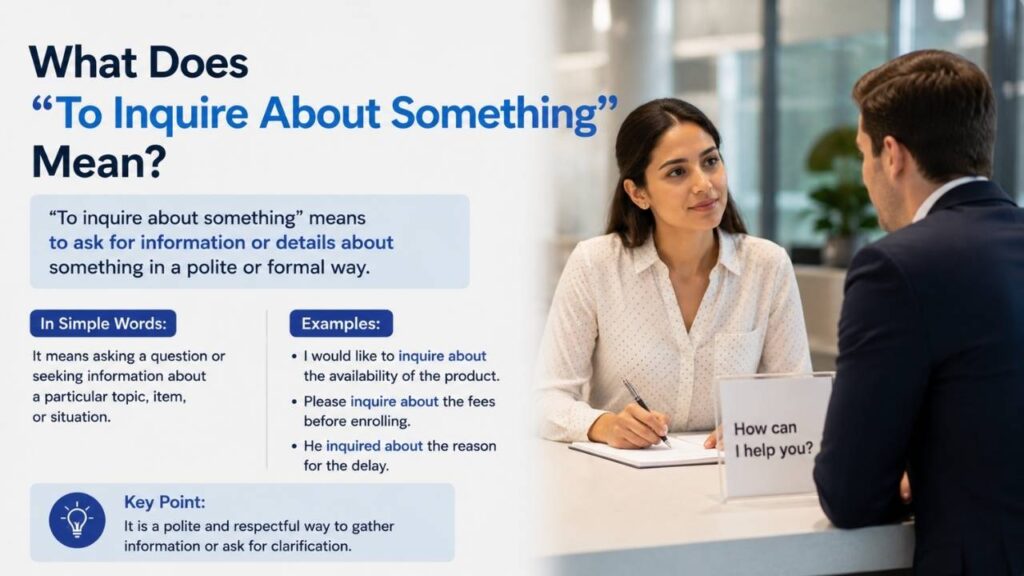
The phrase “to inquire about something” means to formally ask for information in a polite and professional way. It is widely used in business communication, academic writing, and official messages. When someone wants details about a job, service, course, or product, they often use this phrase instead of a casual question.
The meaning of inquire about is similar to “ask about,” but it carries a more respectful and formal tone. For example, a student may inquire about admission requirements, or a customer may inquire about pricing or services.
This makes it an important expression in professional English usage. It helps speakers and writers sound more polite, structured, and appropriate in formal situations where clear communication is required.
Grammar Breakdown of “Inquire About”
The phrase “inquire about” follows a simple and standard English structure: verb + preposition + object. Here, “inquire” is the main verb, and “about” is the preposition that connects the action to the topic being discussed. The correct pattern is always inquire + about + something, which is important for proper sentence formation.
For example, “I would like to inquire about the job opening” or “She inquired about the course details.” This structure is essential for understanding the grammar of inquire about in English. Learners often confuse it with other prepositions, but only “about” is correct in this context.
Mastering this pattern helps improve formal writing, sentence accuracy, and professional communication skills, especially in emails, academic writing, and business contexts where correct grammar is important.
When and Where to Use “Inquire About”
You should use “inquire about” in situations that require formal and respectful communication. It is commonly used in business emails, academic inquiries, customer service messages, and official requests. For example, a job seeker may inquire about available positions, or a student may inquire about admission requirements.
This phrase is ideal when you need to sound polite and professional instead of casual. It is often used in formal inquiry expressions where clarity and respect are important. You may also use it when contacting organizations, companies, or institutions to request detailed information.
In everyday conversations, people usually prefer simpler phrases like “ask about,” but in professional settings, “inquire about” is more suitable. Using it correctly improves your professional English writing style and communication tone.
“Inquire About” vs “Ask About”
The difference between “inquire about” and “ask about” lies mainly in tone and formality. “Inquire about” is more formal, polite, and professional, while “ask about” is more casual and commonly used in daily conversations.
For example, in a business email, you might say, “I would like to inquire about your services,” but in everyday speech, you would say, “I want to ask about your services.” Both expressions are correct in grammar, but the choice depends on the situation.
“Inquire about” is preferred in business communication, academic writing, and official messages, where a respectful tone is required. On the other hand, “ask about” is used in friendly or informal settings. Understanding this difference helps improve your formal vs informal English usage and makes your communication more natural and appropriate.
Politeness and Tone in English Inquiry Expressions
In English communication, politeness and tone are very important, especially when using phrases like “inquire about”. This expression already sounds formal, but you can make it even more polite by using softening phrases such as “I would like to,” “Could you please,” or “I am writing to.”
These structures are commonly used in formal inquiry emails and professional communication. For example, instead of saying “I inquire about the job,” it is better to say “I would like to inquire about the job opportunity.”
This makes the sentence sound more respectful and natural. Using polite tone expressions helps you build better communication in business, academic, and customer service contexts, where professionalism is important. It also improves clarity and creates a positive impression in formal writing situations.
Real-Life Examples of “Inquire About”
The phrase “inquire about” is commonly used in real-life professional and formal situations. For example, a person may call a company to inquire about job openings, or a student may send an email to inquire about admission details.
It is also widely used in customer service, where people inquire about product availability, pricing, or delivery options. In daily professional communication, you might say, “I would like to inquire about your services,” or “She inquired about the course schedule.” These examples show the real usage of inquire about in sentences across different contexts.
It is especially useful in business communication and formal writing, where clarity and politeness are required. Using this phrase correctly helps you sound more professional and improves your English communication skills.
Formal Email Examples Using “Inquire About”
The phrase “inquire about” is widely used in formal email writing for professional communication. In a job inquiry email, you might write, “I am writing to inquire about available positions in your company.” For product-related communication, you can say, “I would like to inquire about your product pricing and delivery options.”
In academic settings, a student may write, “I am writing to inquire about admission requirements for your program.” These examples show how the phrase is used in different formal contexts.
It helps maintain a respectful and professional tone, which is important in business communication and official messages. Using “inquire about” in emails improves clarity and shows politeness, making your writing more effective and appropriate for formal situations.
Common Mistakes with “Inquire About”
Learners often make mistakes when using “inquire about”, especially with prepositions. The most common errors include saying “inquire on something” or “inquire for something,” which are incorrect in English. The correct structure is always “inquire about + object.”
Another mistake is using this phrase in very casual conversations, where “ask about” would be more natural. For example, saying “I inquire about your plans” in a friendly chat sounds too formal. It is important to understand the grammar of inquire about and use it in the right context.
This phrase should mainly be used in formal writing, business communication, and professional emails. Avoiding these common mistakes will improve your English accuracy and communication skills, especially in structured writing situations.
Natural Alternatives to “Inquire About”
There are several natural alternatives to “inquire about” that you can use depending on the tone of your sentence. The most common alternative is “ask about,” which is used in everyday English. Other options include “request information about,” “seek details regarding,” and “find out about.”
These phrases help improve your English expression variety and writing style. For example, instead of saying “I would like to inquire about the course,” you can say “I want to ask about the course” or “I would like to request information about the course.”
Each phrase carries a slightly different tone, with “inquire about” being the most formal. Using these alternatives correctly helps you sound more natural and flexible in both formal and informal communication.
British vs American English Usage
In English usage, “inquire” and “enquire” can vary depending on region. In American English, “inquire” is more commonly used in formal writing, especially in business and academic contexts.
In British English, both “inquire” and “enquire” are accepted, but “enquire” is sometimes preferred for general questions, while “inquire” is used for official investigations or formal requests. However, in modern usage, the difference is becoming less strict, and both forms are widely understood.
The phrase “inquire about” remains standard in professional communication across regions. Understanding this variation helps improve your formal English writing and communication skills, especially when writing for international audiences. Using the correct form based on context ensures clarity and professionalism.
Collocations with “Inquire About”
The phrase “inquire about” is commonly used with specific words to form natural combinations called collocations. These include “inquire about pricing,” “inquire about availability,” “inquire about services,” “inquire about details,” and “inquire about opportunities.”
Such combinations are widely used in business communication, customer service, and professional writing. For example, customers often inquire about pricing or product availability, while job seekers may inquire about opportunities. Learning these collocations helps improve your English fluency and natural expression patterns.
It also makes your writing sound more professional and native-like. Using correct collocations is important in formal inquiry expressions because it ensures clarity and improves communication effectiveness in real-world situations.
FAQ
Is “inquire about” formal or informal?
It is formal and used in professional, academic, and business communication.
What does “to inquire about something” mean?
It means to politely ask for information in a respectful and formal way.
Is it correct to say “inquire about something”?
Yes, it is grammatically correct and commonly used in formal English.
What is the difference between “inquire about” and “ask about”?
“Inquire about” is formal, while “ask about” is more casual and used in daily speech.
How do you use “inquire about” in a sentence?
Use the structure inquire + about + object, for example: I want to inquire about the job.
Can I use “inquire about” in emails?
Yes, it is widely used in formal business and academic emails.
What are alternatives to “inquire about”?
Common alternatives include ask about, request information about, and seek details regarding.
Is “inquire about something” too formal for daily conversation?
Yes, it sounds formal, so “ask about” is better for casual conversation.
What mistakes should I avoid with “inquire about”?
Avoid incorrect forms like inquire on or inquire for, as they are not correct in English.
Is “inquire” used differently in British and American English?
Yes, American English prefers inquire, while British English sometimes uses enquire.
Conclusion
The phrase “to inquire about something” is an important part of formal English communication. It is used when you need to politely ask for information in business, academic, or professional settings. Unlike “ask about,” which is more casual, “inquire about” carries a respectful and official tone.
Understanding its grammar structure (inquire + about + object) helps you use it correctly in sentences and emails. It is commonly used when requesting details about jobs, services, courses, or products.
Learning its alternatives, collocations, and correct usage improves your English writing and communication skills. Overall, mastering this phrase helps you sound more professional, clear, and confident in formal situations.