
Wracking My Brain vs Racking My Brain: Which Is Correct?
Have you ever stopped while writing and wondered, “Is it Wracking My Brain vs Racking My Brain?” You’re not alone. Many English speakers use both expressions, which often creates confusion. Because rack vs wrack is one of the most common examples of commonly confused words, writers frequently question which phrase is correct.
The expression “racking my brain” means thinking very hard to remember something, solve a problem, or find an answer. However, some people also write “wracking my brain,” leading many to ask whether it is a spelling mistake, a valid variation, or simply a different form of the same idiom.
In this grammar guide, you’ll learn the difference between rack and wrack, discover the origin of the phrase, explore modern English usage, and find out which version works best in formal and everyday writing.
Quick Answer: Is It “Wracking My Brain” or “Racking My Brain”?
The Short Answer
If you’re wondering, “Is it racking my brain or wracking my brain?”, the safest choice is racking my brain.
Most dictionaries, editors, and style guides recognize racking my brain as the preferred form of this well-known idiom. It means putting intense mental effort into remembering something or solving a problem.
Although some dictionaries acknowledge wracking my brain, it appears less often in modern writing. As a result, many readers view racking my brain as the more familiar and standard expression.
Which Version Do Most Style Guides Prefer?
Most modern style guides favor racking my brain because it has become the accepted usage in contemporary English. If you’re writing for school, work, business, or publication, this version will usually meet reader expectations.
Which Form Should You Use in Formal Writing?
For formal writing, choose racking my brain. It is the preferred spelling in professional writing, academic writing, journalism, and business communication.
What Does “Racking My Brain” Mean?
Definition
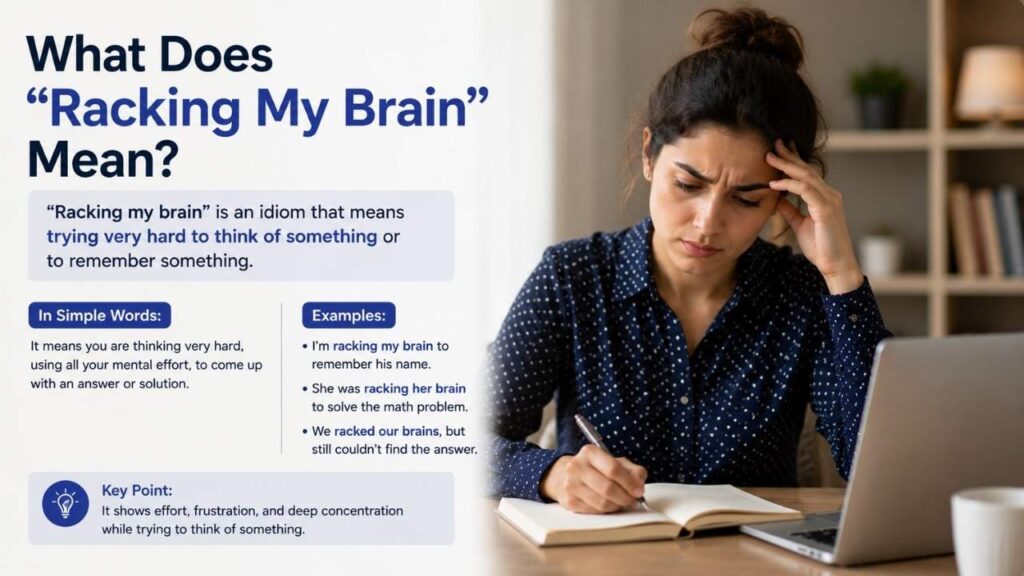
The phrase racking my brain means thinking very hard to find an answer, remember information, or solve a difficult problem.
People often use this expression when they experience mental effort, cognitive strain, or intense thinking.
Common Situations Where People Use the Phrase
You might say:
- “I’m racking my brain trying to remember her name.”
- “We’ve been racking our brains for a solution.”
- “He spent hours racking his brain over the puzzle.”
In each case, the speaker is making a strong effort to retrieve information or solve a challenge.
Synonyms for “Racking My Brain”
Some alternatives include:
- Thinking hard
- Searching my memory
- Puzzling over something
- Trying to remember
- Working it out
- Figuring something out
Is “Wracking My Brain” Wrong?
Why Some Dictionaries Accept It
The answer is more complicated than a simple yes or no.
Several dictionaries acknowledge wracking my brain because the words rack and wrack have shared meanings throughout parts of their history. Over time, the two words became closely connected in certain expressions.
Why Many Editors Still Prefer “Racking”
Even though wracking my brain appears in some dictionaries, editors usually recommend racking my brain. This version is more common, more familiar to readers, and easier to recognize.
Modern Usage Trends
Today, racking my brain dominates published writing. You will encounter it far more often in books, newspapers, websites, and professional documents.
For that reason, most language experts recommend using racking my brain whenever possible.
Rack vs Wrack: What’s the Difference?
Meaning of Rack
Historically, rack referred to a framework or device. Over time, it also developed figurative meanings involving strain, stress, and intense effort.
This connection helps explain why people say rack one’s brain when thinking hard.
Meaning of Wrack
The word wrack traditionally relates to destruction, ruin, damage, or suffering. It appears in expressions such as:
- Wrack and ruin
- Storm-wracked
- Wracked with pain
- Wracked with guilt
How Their Meanings Overlap
Language changes over time. Because the meanings of rack and wrack overlapped for centuries, writers sometimes used them interchangeably.
Why the Confusion Started
The confusion exists because both words sound exactly alike. Since most people hear the phrase before seeing it written, many naturally assume either spelling works.
The Origin of “Racking My Brain”
The Historical Meaning of Rack
The expression comes from the idea of putting something under strain. Historically, a rack stretched or stressed whatever was placed on it.
How the Idiom Developed
Writers eventually began using rack one’s brain figuratively. Instead of physically stretching something, people mentally stretched themselves while searching for answers.
Early Recorded Usage
English speakers have used variations of this phrase for centuries. Over time, racking my brain became the dominant form in modern English usage.
Why Do People Say “Wracking My Brain”?
Pronunciation Similarities
The biggest reason is pronunciation. Rack and wrack sound identical, making them difficult to distinguish in speech.
Historical Mixing of Rack and Wrack
For many years, writers mixed the two spellings because dictionaries and style guides treated them differently.
Influence of Other Expressions
Expressions such as wracked with pain and wrack and ruin may encourage writers to choose wracking my brain, even when racking my brain is the preferred form.
Examples of “Racking My Brain” in Sentences
Everyday Examples
- I was racking my brain trying to remember the password.
- She’s been racking her brain all morning.
- We’re racking our brains to find a solution.
Professional Writing Examples
- The team spent weeks racking their brains for a better strategy.
- Engineers were racking their brains to solve the technical issue.
Academic Writing Examples
- Researchers were racking their brains to explain the unexpected results.
- The student was racking his brain before the exam.
Examples of “Wracking My Brain” in Sentences
Accepted Contexts
Although less common, some writers still use:
- I’ve been wracking my brain all day.
- She was wracking her brain for an answer.
Contexts Where Editors May Change It
Many editors would revise those examples to racking my brain because that spelling aligns with current editorial preferences.
Racking My Brain vs Wracking My Brain Comparison Table
| Feature | Racking My Brain | Wracking My Brain |
| Modern Preference | Yes | Less Common |
| Formal Writing | Recommended | Usually Avoided |
| Dictionary Recognition | Yes | Sometimes |
| Reader Familiarity | High | Lower |
| Editorial Preference | High | Moderate |
| Common Usage | Very Common | Less Common |
Related Expressions You Should Know
Nerve-Racking vs Nerve-Wracking
Both forms appear in English, but nerve-racking traditionally follows the same pattern as racking my brain.
Wrack and Ruin vs Rack and Ruin
Most modern references favor wrack and ruin, although both versions appear in historical texts.
Wracked With Pain
This expression means suffering intense pain.
Example:
- He was wracked with pain after the injury.
Wracked With Guilt
This phrase describes strong feelings of regret.
Example:
- She felt wracked with guilt after the mistake.
How Major Dictionaries Treat Rack and Wrack
Dictionary Perspectives
Major dictionaries recognize that rack and wrack have overlapping histories.
Why Dictionary Entries Differ
Language evolves over time. Different dictionaries emphasize different historical and modern usage patterns.
What Writers Should Take Away
Even when dictionaries acknowledge both forms, racking my brain remains the safest and most widely accepted choice.
Which Form Appears More Often in Modern English?
Publishing Trends
Modern publications overwhelmingly favor racking my brain.
Editorial Preferences
Editors generally choose the spelling readers expect to see.
Usage Frequency Insights
In books, articles, blogs, and professional writing, racking my brain appears far more frequently than wracking my brain.
Common Mistakes to Avoid
Assuming Wracking Is Always Wrong
While less common, wracking my brain is not necessarily incorrect in every context.
Mixing Rack and Wrack Randomly
Use each word according to its accepted modern meaning.
Using Rare Forms in Professional Writing
When clarity matters, choose the version most readers recognize.
Quick Memory Trick
Think of rack as something associated with strain or pressure.
When you put your brain under mental strain to solve a problem, you’re racking your brain.
If you remember rack = mental effort, you’ll choose the preferred form more easily.
FAQs
Is wracking my brain grammatically correct?
Some dictionaries accept it, but racking my brain is generally preferred.
Why is racking my brain more common?
Modern usage, publishing trends, and editorial standards favor it.
What does rack your brains mean?
It means thinking very hard to find an answer.
Is wrack the same as rack?
Not exactly. Their meanings overlap in some situations, but they are not always interchangeable.
Which spelling should I use?
For most situations, use racking my brain.
Conclusion
The debate over wracking my brain vs racking my brain continues because rack and wrack share a long and complicated history. However, modern English usage strongly favors racking my brain. While some dictionaries recognize wracking my brain, most editors, publishers, and style guides recommend the more common form.
If you want the safest choice for formal writing, academic work, business communication, or everyday content, use racking my brain. It is the standard expression, the preferred spelling, and the version most readers expect to see.