
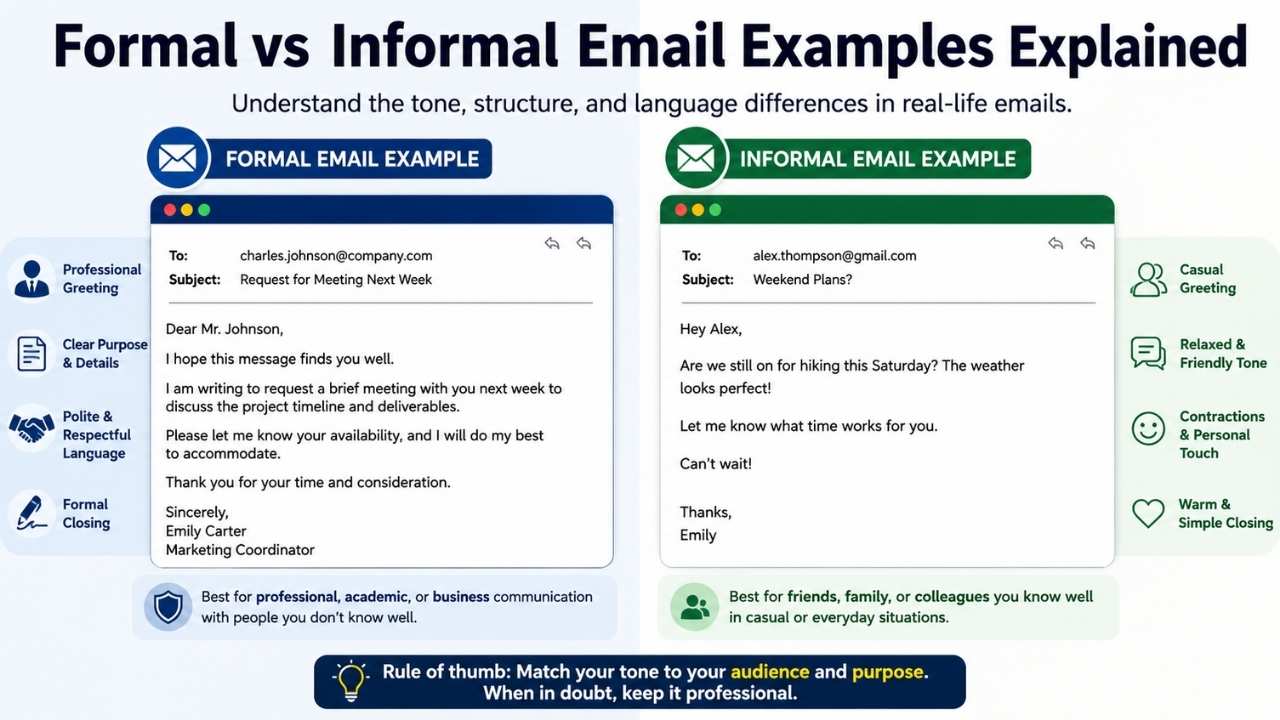
Formal vs Informal Email Examples Explained
Formal and informal emails shape how people communicate every day. They appear in workplaces, schools, customer service messages, and personal conversations. Because email remains one of the most common forms of written communication, understanding tone matters more than ever.
Many writers struggle to choose the right style. Some emails sound too stiff, while others feel too casual. As a result, people often search for formal vs informal email examples to understand what changes between the two styles.
Today, email language is also changing quickly. Workplace communication has become more conversational in the United States, especially since remote work and digital messaging expanded during the 2020s. However, professional expectations still matter in many settings.
Quick Answer
Formal vs informal email examples show how tone, word choice, greetings, and sentence structure change depending on the relationship and situation. Formal emails use polite, structured language, while informal emails sound more relaxed and conversational.
TL;DR
- Formal emails are common in professional and academic settings.
- Informal emails are used with friends, family, or close coworkers.
- Greetings and closings often reveal the email style immediately.
- American English now favors slightly warmer professional emails.
- Context matters more than strict grammar rules alone.
- Clear communication matters more than sounding overly formal.
Understanding Formal and Informal Emails
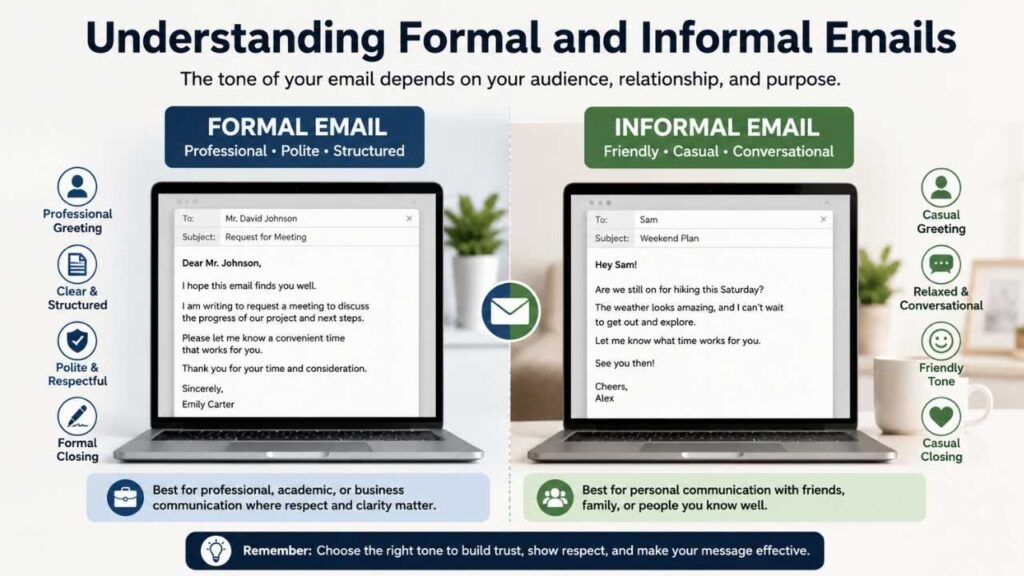
Emails differ mainly in tone and purpose. A formal email usually communicates respect, professionalism, or authority. In contrast, an informal email focuses on familiarity and comfort.
Formal writing often uses complete sentences and careful wording. Informal writing allows contractions, relaxed phrasing, and conversational expressions. However, both styles still require clarity.
What Makes an Email Formal?
Formal emails usually appear in workplaces, universities, government communication, and customer support. They follow a more organized structure and avoid overly casual wording.
Writers often use polite greetings like “Dear Mr. Johnson” or “Hello Professor Lee.” They also avoid slang, emojis, and vague abbreviations.
What Makes an Email Informal?
Informal emails sound more personal and natural. They often appear between friends, relatives, or trusted coworkers.
These emails may begin with greetings like “Hey,” “Hi,” or even no greeting at all. Shorter sentences and conversational language are common.
The History of Email Tone in English
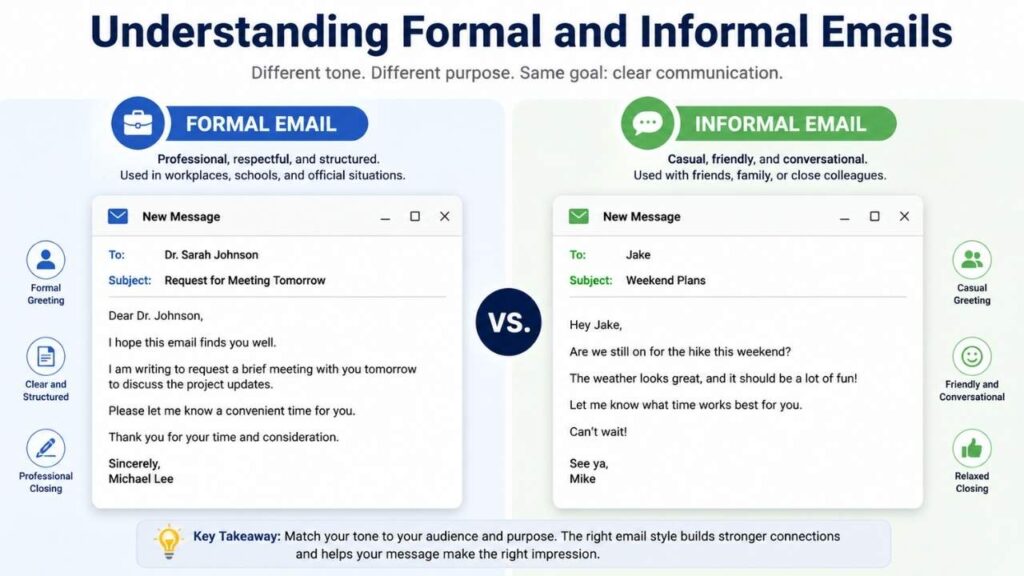
Email writing developed from traditional letter writing. Early business emails in the 1980s and 1990s closely copied printed business letters. Writers used highly formal greetings and long paragraphs.
However, internet culture gradually changed communication habits. By the early 2000s, faster messaging encouraged shorter and friendlier writing styles. Smartphone communication also influenced email tone.
From Letters to Digital Communication
Traditional English letters once followed strict formatting rules. People used phrases like “To Whom It May Concern” or “Yours faithfully” regularly.
Today, American workplace culture often prefers warmth and efficiency. While formality still exists, modern professional emails usually sound less rigid than older business letters.
The Rise of Conversational Professional English
During 2025–2026, many American companies favor communication that sounds human and approachable. Emails now balance professionalism with friendliness.
For example, “I hope you’re doing well” remains common, even in business writing. Yet extremely formal language may now sound distant or outdated in some industries.
Core Differences Between Formal and Informal Emails
The biggest difference involves audience awareness. Writers adjust tone depending on who will read the message.
The table below shows how email language changes across situations.
| Context | Correct Usage | Example | Notes |
| Job application | Formal | “Dear Hiring Manager” | Shows professionalism |
| Friend invitation | Informal | “Hey Sam!” | Sounds natural and friendly |
| Customer complaint | Formal | “I’m writing regarding…” | Maintains respectful tone |
| Team update | Semi-formal | “Hi everyone,” | Common in US workplaces |
| Family message | Informal | “Just checking in” | Relaxed communication |
Greetings and Openings
Formal greetings usually include titles and surnames. Writers may use “Dear Dr. Carter” or “Hello Ms. Rivera.”
Informal greetings sound shorter and more conversational. “Hey Jake” or “Hi Mom” feels natural in personal communication.
Sentence Structure and Vocabulary
Formal emails often contain complete, carefully organized sentences. Writers avoid slang and internet shorthand.
Informal emails allow relaxed wording like “Thanks a lot” or “Can’t wait to see you.” However, clarity still matters in both styles.
Formal Email Examples in Everyday American English
Formal emails remain important across the United States. Employers, teachers, clients, and institutions still expect professional communication in many situations.
American formal emails today usually sound polite but not overly stiff. Most professionals avoid language that feels excessively ceremonial.
Job Application Example
A formal job application email may begin with a respectful greeting and a clear purpose statement. The writer introduces themselves professionally and explains why they are contacting the employer.
For example, a candidate might write, “I am writing to apply for the marketing coordinator position listed on your company website.” This wording sounds direct and professional.
Workplace Request Example
Employees often use formal emails when requesting schedule changes, approvals, or important information. Professional tone helps avoid misunderstandings.
An employee may write, “Could you please confirm whether the meeting has been rescheduled?” The wording stays respectful while remaining clear.
Informal Email Examples in Daily Communication
Informal emails appear constantly in personal life. Friends, relatives, and close colleagues often prefer relaxed communication.
Today’s informal American English values speed and authenticity. Writers frequently use contractions and conversational wording.
Friendly Catch-Up Email
A casual email might begin with “Hey Alex” and quickly move into personal updates. The writer may use shorter sentences and everyday expressions.
This style helps communication feel warm and natural rather than distant.
Informal Workplace Communication
Modern offices sometimes use semi-informal email language internally. Coworkers who know each other well may write more casually.
Still, tone depends on company culture. A technology startup may allow relaxed communication, while a law firm may prefer greater formality.
How American English Uses Email Tone Today
American English often favors approachable professionalism. Many workplaces now encourage communication that feels polite but human.
As a result, extremely formal language can sometimes sound unnatural in modern business settings.
The Shift Toward Friendly Professionalism
In older business English, writers often used very formal expressions. Today, phrases like “Please be advised” may sound outdated in casual industries.
Instead, many Americans prefer simpler language like “Just wanted to let you know.”
Remote Work and Digital Influence
Remote work changed communication habits significantly. Because employees now interact digitally more often, tone became more conversational.
However, professionalism still matters during interviews, client communication, and official announcements.
British vs American Email Style Differences
British and American email writing share many similarities. However, some tone differences still appear.
British English sometimes sounds slightly more formal in professional writing. American English usually prefers shorter and more direct phrasing.
Greetings and Closings
Americans commonly use “Hi” in professional emails. British writers may still use “Dear” more frequently in formal situations.
Closing phrases also differ slightly. Americans often use “Best” or “Thanks,” while British writers may prefer “Kind regards.”
Indirect vs Direct Language
British English sometimes uses softer indirect phrasing. American English usually values concise communication.
For example, Americans may write, “Can you send the report today?” British writers may phrase the same request more cautiously.
Common Mistakes in Formal and Informal Emails
Many writers accidentally mix tones. This can confuse readers or create the wrong impression.
Problems often appear when writers sound too casual in professional settings or too formal in personal communication.
Overly Casual Professional Emails
Using slang or abbreviations in business communication may seem unprofessional. Phrases like “LOL” or “thx” can weaken credibility.
Similarly, missing greetings or closings may appear careless in workplace settings.
Overly Formal Personal Emails
Some writers sound robotic in casual communication. Extremely formal wording may feel cold between friends or relatives.
For example, “I hope this message finds you well” might sound strange in a casual family email.
Real-Life Email Tone in Digital Communication
Email style changes depending on platform and audience. Modern communication often blends formal and informal elements.
Many people now use semi-formal emails that combine professionalism with friendliness.
Email and Texting Influence
Text messaging changed written English significantly. Shorter sentences and quicker responses now influence email habits too.
However, professional emails still require clearer structure than text messages.
Social Media and Workplace Language
Social media introduced more conversational writing styles into business communication. Companies often want brands to sound approachable.
As a result, some workplace emails now include warmer wording and lighter tone choices.
Confusing Areas Between Formal and Informal Writing
Some email situations fall into gray areas. Writers may not know how formal they should sound.
Tone depends heavily on relationship, workplace culture, and purpose.
Semi-Formal Communication
Many modern emails are neither fully formal nor fully informal. They sit somewhere in the middle.
For example, coworkers often use polite but relaxed language. This style balances professionalism with friendliness.
Tone Misinterpretation
Digital communication lacks facial expressions and voice tone. Because of this, emails can sometimes sound harsher than intended.
Short replies may appear rude even when the writer simply wanted efficiency.
Grammar Features That Affect Email Tone
Grammar choices strongly influence email style. Small wording changes can make communication sound more formal or more relaxed.
Sentence structure, punctuation, and vocabulary all shape reader perception.
Contractions and Formality
Formal emails traditionally avoided contractions like “don’t” or “can’t.” However, modern American business writing now accepts many contractions.
Still, highly official communication may remain more formal.
Punctuation and Style
Informal emails sometimes use exclamation points or sentence fragments. Formal emails usually maintain more controlled punctuation.
However, excessive punctuation may appear emotional or unprofessional in business writing.
How Email Etiquette Has Changed Over Time
Email etiquette continues evolving. Older expectations no longer fully match modern communication habits.
Today’s readers often value brevity and clarity more than rigid formatting rules.
Shorter Emails Became Standard
Long business emails once appeared normal. Today, many professionals prefer concise communication.
As a result, writers now often place the main point near the beginning.
Formality Became More Flexible
Modern workplaces increasingly accept conversational language. However, flexibility depends on industry and audience.
Professionalism still matters most when communicating with unfamiliar readers.
Choosing the Right Email Tone Naturally
Good writers match tone to situation. They consider audience, purpose, and relationship before writing.
The best email style usually sounds respectful, clear, and appropriate for the context.
Questions to Ask Before Writing
Writers should consider who will read the email and why. They should also think about how well they know the recipient.
These choices help determine whether the message should sound formal, informal, or somewhere in between.
Why Context Matters Most
No single rule fits every situation. Tone expectations change across workplaces, age groups, and industries.
Because language evolves constantly, effective communication often matters more than strict traditional formality.
FAQs
What is the difference between formal and informal email writing?
Formal email writing sounds professional and structured. Informal email writing sounds conversational and relaxed. The difference mainly depends on audience and purpose.
Are contractions acceptable in formal emails?
Yes, many modern American workplaces now accept contractions. However, highly official communication may still avoid them for a more traditional tone.
Is “Hi” professional in business emails?
In most American workplaces, “Hi” is considered professional today. Still, more formal situations may require “Dear” instead.
Can informal emails still be grammatically correct?
Absolutely. Informal emails often use relaxed wording, but they should still remain clear and understandable.
Why do some formal emails sound cold?
Overly rigid language can feel distant or impersonal. Modern professional communication often balances politeness with warmth.
Should workplace emails always be formal?
Not always. Internal team communication may sound semi-formal or casual depending on company culture and relationships.
Conclusion
Understanding formal vs informal email examples helps writers communicate more effectively in everyday life. Email tone influences how readers perceive professionalism, friendliness, confidence, and respect.
Modern American English now blends professionalism with conversational style more than in the past. However, choosing the right tone still depends on audience and context.
The strongest emails usually sound clear, natural, and appropriate for the situation. When writers understand both formal and informal styles, they can adjust their communication confidently in any setting.