

Smooth or Smoothe: What’s the Difference?
Many English learners and native speakers alike wonder whether they should write smooth or smoothe. The confusion is understandable because both forms appear in dictionaries, yet they do not serve the same purpose.
In modern American English, one form is far more common than the other. However, understanding why both exist can help you avoid mistakes and write with greater confidence.
The difference is not simply a spelling preference. Instead, it involves grammar, word class, and the history of English vocabulary.
Quick Answer
Smooth is the standard adjective that means even, flat, polished, or free from roughness. Smoothe is a much less common verb form meaning “to make smooth,” though modern English usually prefers smooth as both the adjective and the verb.
TL;DR
- Smooth is the standard modern spelling.
- Smooth can be an adjective or a verb.
- Smoothe exists as a verb but is uncommon.
- Most American writers use smooth instead of smoothe.
- Using smoothe in everyday writing may appear old-fashioned.
- Understanding the grammatical role helps prevent confusion.
Understanding Smooth and Smoothe
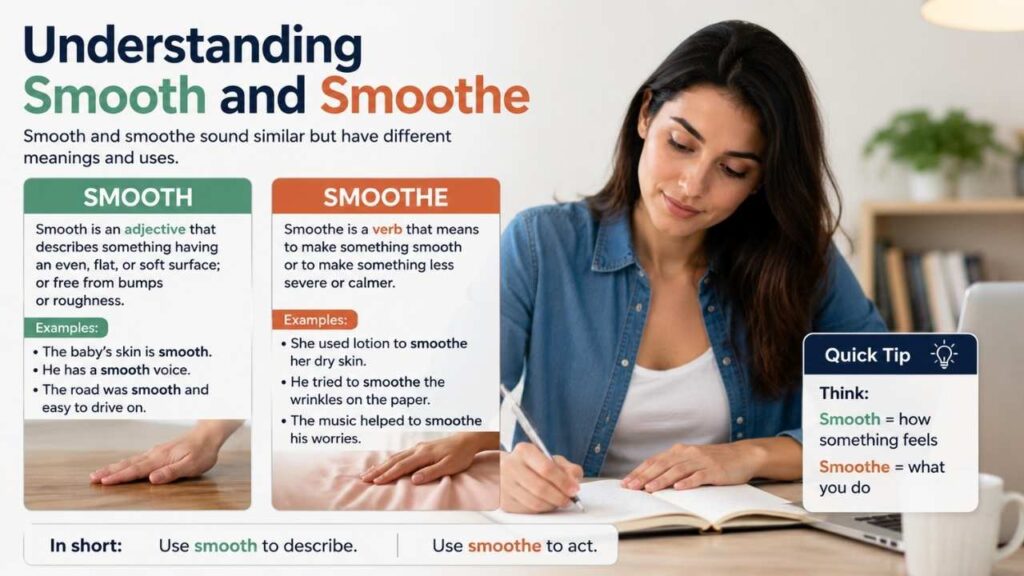
English contains many words that change form depending on how they function in a sentence. Smooth and smoothe are an example of this pattern.
Today, most people encounter smooth as an adjective. It describes something that lacks bumps, roughness, interruptions, or difficulties. For example, a smooth road is easy to drive on, and a smooth presentation proceeds without problems.
Smooth as an Adjective
As an adjective, smooth describes a quality or condition. It can refer to physical surfaces, sounds, movements, conversations, or processes.
For example, someone might describe a smooth table, a smooth voice, or a smooth transition between topics. In each case, the word describes a characteristic.
Smoothe as a Verb
Historically, smoothe developed as a verb meaning “to make smooth.” Although it remains a recognized word, it is rare in modern American English.
Most contemporary writers use smooth as the verb instead. As a result, many people never encounter smoothe outside dictionaries or older texts.
The Historical Background of Smooth and Smoothe
The story of these words begins in Old English. The adjective smooth traces its roots to early Germanic languages, where related words described flat or even surfaces.
Over centuries, English speakers naturally created verbs from adjectives. This process produced forms that meant “to make something become” the quality described by the adjective.
How Smoothe Developed
During earlier periods of English, adding a final -e sometimes helped distinguish a verb from an adjective. This pattern appeared in several word pairs.
As English spelling became more standardized, many of these distinctions disappeared. Eventually, speakers began using smooth itself as both the adjective and the verb.
Why the Older Form Survived
Although usage shifted, dictionaries continued recording smoothe because it had historical legitimacy. However, its frequency steadily declined.
Today, most Americans recognize smooth immediately but may never have seen smoothe in ordinary writing.
How Smooth Is Used in American English
Modern American English strongly favors smooth. It appears in everyday speech, journalism, business communication, academic writing, and digital content.
Because it functions naturally as both an adjective and a verb, there is little practical need for a separate spelling.
Smooth as a Verb Today
When Americans want to express the idea of making something smoother, they usually write sentences such as:
“He tried to smooth the wrinkles from the fabric.”
“The company worked to smooth the transition.”
These examples sound completely natural to contemporary readers.
Smooth in Everyday Communication
The word appears in countless situations. People discuss smooth skin, smooth roads, smooth software updates, and smooth customer experiences.
Because the adjective is so common, it has become deeply embedded in modern communication.
Why People Get Confused About Smoothe
The confusion often begins when writers assume that verbs require a different spelling from adjectives.
English sometimes follows that pattern. For instance, some words gain extra letters when they change grammatical roles.
However, English is not always consistent. In this case, the simpler form eventually became dominant.
Dictionary Discoveries
Many people first notice smoothe when checking a dictionary. Seeing both forms can create uncertainty.
The key point is that the existence of a word does not guarantee equal usage. Some words remain technically correct while becoming uncommon in everyday language.
Similar-Looking Word Pairs
English contains several historical spellings that survived in dictionaries despite falling out of widespread use.
As a result, learners occasionally encounter forms that are grammatically valid but rarely used.
Smooth as an Adjective
The adjective remains the most common use of the word by a wide margin.
It describes physical texture, behavior, movement, sound, communication, and performance.
Physical Descriptions
A smooth surface lacks rough edges or bumps. Examples include polished wood, glass, and calm water.
Writers frequently use the word to create vivid descriptions because readers instantly understand the image.
Figurative Meanings
The adjective also carries metaphorical meanings. A smooth negotiation proceeds without conflict. A smooth speaker communicates effortlessly.
These figurative uses are especially common in American English.
Smooth as a Modern Verb
Although many people think only of the adjective, smooth regularly functions as a verb.
In this role, it means making something less rough, less difficult, or more orderly.
Physical Actions
Someone might smooth a blanket, smooth their hair, or smooth a sheet of paper.
The action removes irregularities and creates a more even appearance.
Abstract Actions
Organizations often smooth business processes. Teachers smooth transitions between lessons. Friends sometimes smooth disagreements.
These uses demonstrate how the verb has expanded beyond physical surfaces.
When Is Smoothe Still Used?
The verb smoothe has not completely disappeared. Some writers choose it for stylistic or historical reasons.
However, such usage remains uncommon in contemporary American writing.
Literary and Historical Contexts
Older books occasionally use smoothe because it reflected accepted spelling conventions of their time.
Modern readers may encounter it when reading historical documents or literature.
Specialized Preferences
A small number of writers still prefer smoothe to emphasize the verbal function. Nevertheless, this preference remains rare.
Most style guides and editors favor smooth.
Smooth vs Smoothe in Modern Writing
The practical difference today is largely one of frequency and reader expectations.
Most readers expect smooth regardless of whether the word acts as an adjective or a verb.
Which Form Sounds Natural?
For contemporary audiences, smooth sounds natural and familiar.
By contrast, smoothe may look unusual or even incorrect to many readers.
Editorial Preferences
Publishers generally choose the spelling readers recognize most easily. Consequently, smooth dominates newspapers, magazines, websites, and books.
This preference reinforces its position as the standard form.
Common Mistakes Writers Make
One frequent mistake is assuming that smoothe is the correct verb and smooth is only an adjective.
In reality, modern English widely accepts smooth as a verb.
Adding an Unnecessary E
Some writers add the final e because they believe the verb requires a separate spelling.
This assumption often comes from patterns found elsewhere in English.
Overcorrecting
After learning that smoothe exists, some people begin using it everywhere. However, doing so can make writing seem dated or inconsistent.
In most situations, smooth is the safer choice.
Examples of Correct Usage
The following table shows how modern English typically uses these words.
| Context | Correct Usage | Example | Notes |
| Adjective | Smooth | The marble felt smooth. | Standard modern form |
| Verb | Smooth | Please smooth the paper. | Most common usage |
| Business Writing | Smooth | We need to smooth the process. | Preferred style |
| Historical Writing | Smoothe | He sought to smoothe the cloth. | Less common today |
| Everyday Speech | Smooth | The meeting went smoothly. | Modern usage |
Formal and Informal Usage
One interesting aspect of this topic is that the distinction does not strongly depend on formality.
Both formal and informal American English usually favor smooth.
Professional Writing
Business documents, reports, and academic writing overwhelmingly use smooth.
Writers value clarity and familiarity, which the standard spelling provides.
Casual Communication
Text messages, emails, and social media posts follow the same pattern.
Most users never consider the alternative spelling.
British and American Differences
Unlike many spelling questions, this one does not create a major divide between American and British English.
Both varieties generally prefer smooth today.
Shared Modern Preference
Readers in both countries commonly encounter smooth as both an adjective and a verb.
Therefore, switching between American and British audiences rarely requires any adjustment.
Historical Variation
Earlier British texts may contain smoothe more often than modern publications. Even so, the trend toward smooth occurred across the English-speaking world.
How Usage Has Changed Over Time
Language constantly evolves. The relationship between smooth and smoothe reflects that process.
Over time, English often simplifies competing forms.
Movement Toward Simplicity
As speakers repeatedly used smooth for multiple functions, the separate verb form became less necessary.
Eventually, the simpler system won out.
What Is Considered Standard Today?
Current dictionaries still acknowledge smoothe, but standard usage strongly favors smooth.
As a result, most writers can safely rely on the simpler spelling.
FAQs
Is smoothe a real word?
Yes. Smoothe is a recognized verb meaning “to make smooth.” However, it is uncommon in modern American English.
Which is correct: smooth or smoothe?
Both exist, but smooth is the standard choice in contemporary writing. It functions as both an adjective and a verb.
Why do dictionaries include smoothe?
Dictionaries record historical and current usage. Since smoothe has a documented history, it remains listed even though it is rare.
Do professional writers use smoothe?
Most professional writers prefer smooth. The alternative spelling appears only occasionally.
Is smoothe old-fashioned?
Many readers perceive it as old-fashioned because it appears far less often in modern writing.
Should English learners use smoothe?
Generally, no. Learning smooth as both an adjective and a verb matches modern usage and avoids confusion.
Conclusion
The distinction between Smooth or Smoothe is simpler than it first appears. While both forms exist in English, smooth has become the standard choice for modern American usage.
Today, smooth works naturally as both an adjective and a verb. Although smoothe survives in dictionaries and occasional historical contexts, it is rarely needed in everyday writing.When in doubt, choose smooth. Doing so aligns with current English usage and ensures your writing feels clear, natural, and familiar to modern readers.