
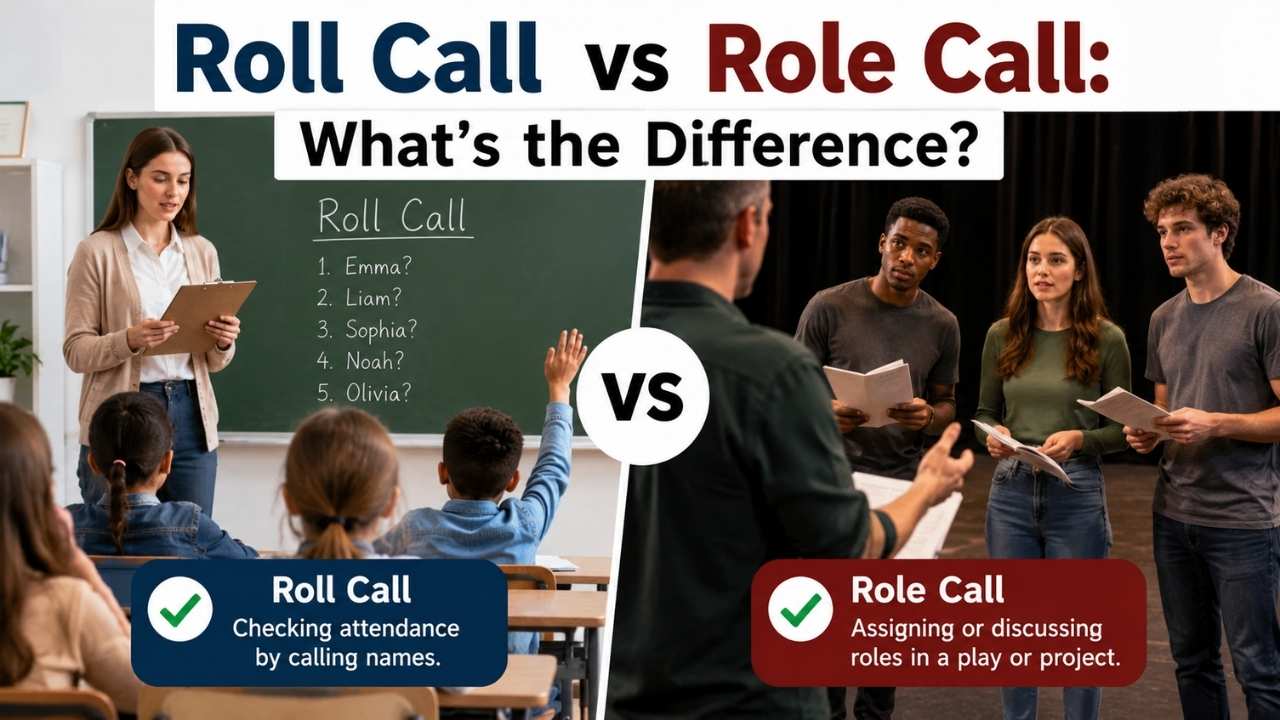
Roll Call vs Role Call: What’s the Difference?
Many English learners and native speakers alike get confused by roll call vs role call. The two phrases sound exactly the same when spoken, but they have very different meanings. Because they are homophones—words that share pronunciation but differ in spelling and meaning—they are often mixed up in writing.
Today, confusion between these terms appears in emails, social media posts, workplace communication, and even published content. Understanding the distinction helps you write more clearly and avoid a common mistake.
Although the difference is simple once explained, the history and usage of each phrase reveal interesting details about how English develops and how similar-sounding words can create confusion.
Quick Answer
Roll call vs role call comes down to meaning. Roll call is the correct phrase when referring to checking attendance or calling names from a list. Role call is generally considered incorrect in standard English unless someone is intentionally referring to calling out or discussing roles in a performance or organization.
TL;DR
- Roll call means checking attendance or reading names from a list.
- Role call is usually a spelling mistake.
- The words roll and role sound identical.
- American English strongly favors roll call for attendance situations.
- Understanding the meaning of each word prevents confusion in writing.
Understanding Roll Call and Role Call
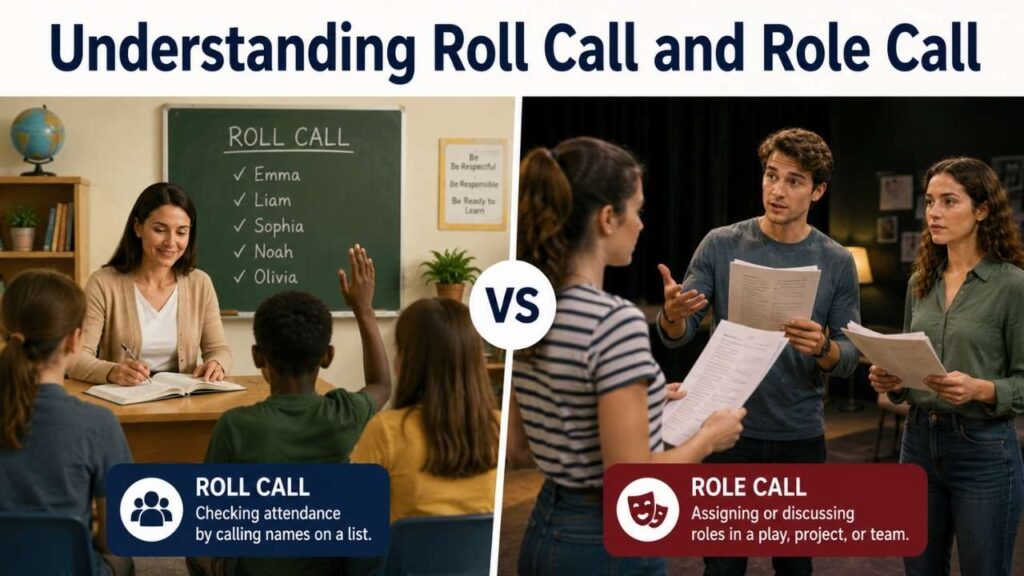
The confusion starts because roll and role are pronounced the same way in modern English. However, they come from different origins and serve different purposes.
Roll call is a fixed expression. It refers to the act of reading names from an official list and recording who is present. Schools, military units, legislative bodies, and workplaces commonly use the term.
Role call, on the other hand, is not recognized as a standard expression in modern American English. When people write it, they usually mean roll call but mistakenly choose the wrong spelling.
What Is a Roll Call?
A roll call occurs when a person reads names from a roster and individuals respond to show they are present.
For example:
“Mrs. Johnson completed roll call before beginning class.”
In this sentence, the teacher checks attendance by reading student names.
Why People Write Role Call
The error happens because role is a familiar word connected with jobs, functions, and acting parts.
Someone might write:
“The teacher took role call.”
Although common online, this usage is considered incorrect because attendance is connected to a roll, not a role.
The Meaning of Roll in Roll Call
To understand the phrase, it helps to examine the word roll itself.
Historically, official records were often written on sheets of parchment that were rolled into scrolls. These documents became known as rolls. Government records, military lists, and membership records frequently appeared in this format.
Over time, a roll came to mean an official list of names. The phrase roll call developed from the practice of reading names from such lists.
From Scrolls to Attendance Lists
Centuries ago, administrators maintained records on rolled documents rather than bound books.
Because names were recorded on a roll, calling those names naturally became known as a roll call.
Even though paper rolls disappeared long ago, the expression survived.
The Meaning of Role in English
The word role has a completely different history.
English borrowed it from French, where it referred to a part performed by an actor. Over time, the meaning expanded to include a person’s function, responsibility, or position.
For example:
“She plays an important role in the company.”
Here, role refers to duties or responsibilities rather than a list of names.
Common Uses of Role
The word appears frequently in professional and everyday communication.
Examples include:
“He accepted a leadership role.”
“Parents play a major role in education.”
“The actor rehearsed his role.”
None of these meanings involve attendance or reading names.
Historical Background of Roll Call
The phrase roll call has military roots dating back centuries.
Military officers needed a reliable way to determine whether soldiers were present and ready for duty. Reading names from official rolls became standard practice.
As governments, schools, and organizations expanded, the same method spread into civilian life.
Military Influence on Modern Usage
Many attendance-related terms originated in military administration.
Because armies required accurate records, procedures such as roll calls became formalized and eventually entered everyday English.
Today, Americans still associate the phrase with both classrooms and military settings.
Roll Call in Modern American English
In the United States, roll call remains the standard term for attendance checks.
Teachers conduct roll call at the start of class. Legislatures hold roll-call votes. Organizations may use roll calls during meetings.
The phrase appears in both formal and informal communication.
Everyday Examples
A teacher might say:
“We’ll begin with roll call.”
A meeting organizer might announce:
“After roll call, we’ll review the agenda.”
A legislative reporter might write:
“The bill passed during a roll-call vote.”
In each case, the phrase refers to identifying who is present or how individuals responded.
Is Role Call Ever Correct?
In rare situations, role call could be interpreted literally.
For example, a theater director might jokingly refer to actors announcing their assigned parts as a “role call.” However, this would be creative wordplay rather than standard English usage.
Most dictionaries and style guides do not recognize role call as an established expression.
Therefore, when discussing attendance, roll call is almost always the correct choice.
Literal Versus Standard Usage
Language sometimes allows creative combinations of words.
However, a phrase being understandable does not make it standard. Most readers expect roll call whenever attendance is involved.
Roll Call in Schools, Government, and Business
Different environments use roll call for different purposes.
Schools use it to track attendance. Government bodies use it to record votes. Businesses may use it to verify participation during meetings or training sessions.
The core meaning remains consistent across contexts.
| Context | Correct Usage | Example | Notes |
| School | Roll call | The teacher completed roll call. | Attendance check |
| Military | Roll call | Soldiers reported during roll call. | Personnel accountability |
| Government | Roll-call vote | Senators participated in a roll-call vote. | Records individual votes |
| Workplace | Roll call | The manager conducted roll call. | Confirms attendance |
| Theater | Role | The actor learned his role. | Refers to a character part |
Common Mistakes People Make
The most frequent error is substituting role for roll because both words sound identical.
Spell-checkers may not catch the mistake because role is a correctly spelled English word. As a result, the error can slip into professional writing.
Why Homophones Cause Problems
English contains many homophones.
Examples include:
- Their, there, and they’re
- To, too, and two
- Role and roll
Because pronunciation provides no clue, writers must rely on meaning to choose the correct spelling.
Memory Trick
Think about a roll as a list of names.
If people are being checked for attendance, use roll call.
If someone has responsibilities or acts in a play, use role.
Formal and Informal Usage Differences
The distinction between roll and role remains the same in both formal and informal English.
A government report, classroom notice, text message, and social media post should all use roll call when discussing attendance.
Informal writing does not change the standard spelling.
Digital Communication
Online communication has increased spelling confusion because people often type quickly.
Social media posts frequently contain phrases like:
“We did role call today.”
Even though such usage is common, standard written English still considers it incorrect.
British and American English Usage
There is little difference between American and British English regarding these terms.
Both varieties use roll call for attendance checks and recognize role as a person’s function or acting part.
As a result, the distinction is largely universal across English-speaking countries.
Shared Standard Usage
Whether someone writes in New York or London, attendance is generally recorded through a roll call, not a role call.
This consistency makes the phrase relatively stable across dialects.
How Context Helps You Choose the Right Word
Context provides the easiest way to determine which spelling is correct.
Ask yourself what the sentence is discussing.
If the topic involves attendance, names, presence, or voting records, choose roll.
If the topic involves duties, responsibilities, characters, or functions, choose role.
Comparing Sentences
“The professor conducted a roll call.”
This sentence concerns attendance.
“The professor’s role includes mentoring students.”
This sentence concerns responsibilities.
The surrounding meaning immediately identifies the correct spelling.
How Usage Has Changed Over Time
The meaning of roll call has remained remarkably stable.
Many English expressions change dramatically over centuries. However, roll call still refers to reading names from an official list, much as it did hundreds of years ago.
What has changed is the frequency of spelling confusion.
The Impact of Digital Writing
Modern communication encourages speed.
Because people type quickly and rely on pronunciation, homophone errors occur more often. Consequently, mistaken uses of role call appear more frequently online than in older published texts.
Despite this trend, major dictionaries and usage guides continue to recognize roll call as the standard form.
Why the Confusion Persists
Several factors keep this mistake alive.
First, the two words sound identical. Second, role appears often in modern workplace language. Third, many writers encounter the phrase more often in speech than in writing.
As a result, people sometimes choose the spelling that looks more familiar.
Fortunately, understanding the history and meaning behind each word makes the distinction much easier to remember.
FAQs
Is role call grammatically correct?
In most situations, no. When referring to attendance or reading names from a list, roll call is the correct expression.
Why is it called a roll call?
The phrase comes from historical rolls, or official lists of names, that were read aloud to verify attendance.
What does roll call mean in school?
It refers to a teacher reading student names and recording who is present or absent.
What is the difference between roll and role?
Roll can refer to a list of names or various other meanings. Role refers to a function, responsibility, or acting part.
Do Americans say roll call or attendance?
Both are used. However, roll call specifically describes the process of checking attendance.
Is role call ever accepted?
Only in rare cases of intentional wordplay or literal discussion of roles. It is not the standard phrase for attendance.
Conclusion
The difference between roll call vs role call is straightforward once you understand the meanings behind the two words. Roll call refers to checking attendance by reading names from an official list, while role refers to a person’s function, responsibility, or acting part.
The confusion exists because the words sound identical, but their histories and meanings are completely different. Although mistakes appear frequently online, standard American English continues to favor roll call for attendance-related situations.
When in doubt, focus on the context. If names are being checked, use roll call. If responsibilities or characters are involved, use role. Keeping that simple distinction in mind will help you write with greater confidence and accuracy.