
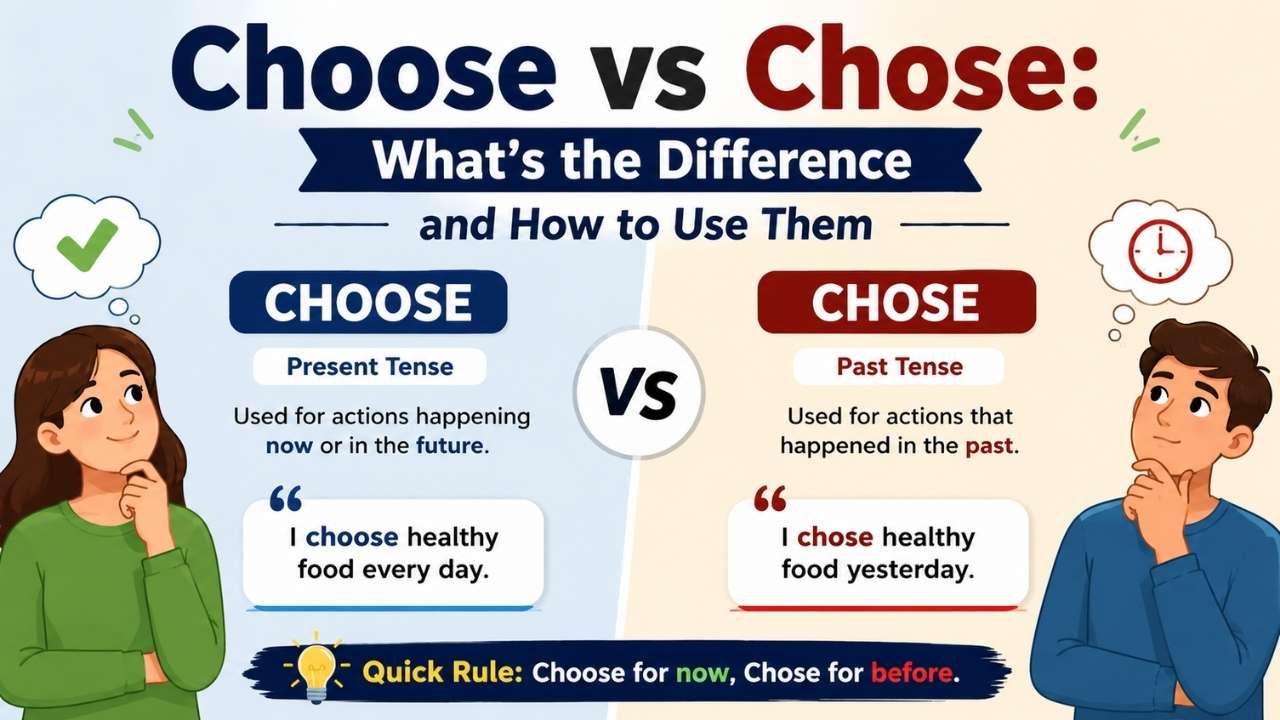
Choose vs Chose: What’s the Difference and How to Use Them
Many English learners get confused between choose vs chose, but the difference is actually simple once you understand verb tense. The word choose is the present tense form of the verb, which means to select something now or in general situations.
For example, “I choose my clothes carefully every morning.” On the other hand, chose is the past tense of choose, used when the action already happened. For example, “Yesterday, I chose a new phone.”
Understanding this difference helps you avoid common grammar mistakes in writing and speaking. Many people search for “choose or chose” or “difference between choose and chose” because they are unsure which form fits their sentence. In simple terms: use choose for present or future actions and chose for completed actions in the past. This basic rule is the foundation for using this verb correctly in everyday English.
Quick Answer
The difference between choose vs chose is simple. Choose is the present tense of the verb, used for current or future actions, while chose is the past tense, used for completed actions. For example, “I choose my outfit daily” (present) and “I chose my outfit yesterday” (past). Use choose for now and chose for before.
Choose vs Chose: The Core Difference Explained
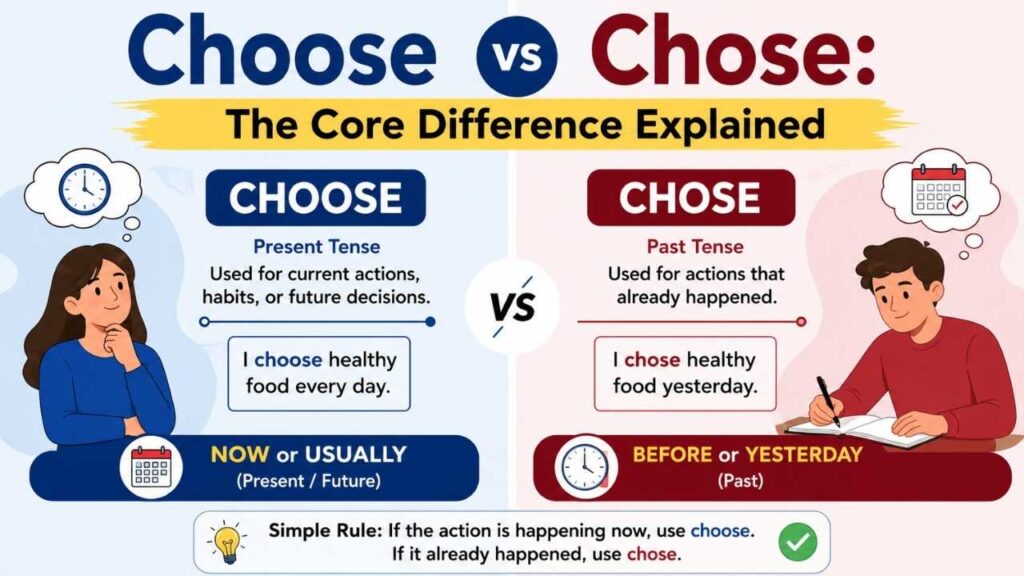
The main difference between choose vs chose comes down to time (tense) and action. The verb choose means to select or pick something in the present or future, while chose means the action already happened in the past tense.
In simple terms, choose = now or general habit, and chose = already done action. This is why people often search for “choose meaning” and “chose meaning” when learning grammar rules.
For example:
- I choose healthy food every day. (present habit)
- I chose a healthy meal yesterday. (completed action)
This difference is small but very important in English grammar, especially for writing correct sentences in school, work, or daily communication.
Verb Tense Breakdown (Present vs Past)
To understand choose vs chose, you must first understand verb tense. English verbs change form based on time.
- Choose (Present Tense): used for current actions, habits, or future decisions
- Chose (Past Tense): used for completed actions in the past
Many learners also ask about “present tense of choose” and “past tense of choose”, and this is the correct structure.
Example:
- I always choose my words carefully. (present)
- I chose the wrong answer yesterday. (past)
Important rule: English does NOT use “choosed.” The correct past form is always chose, because it is an irregular verb. This is a key grammar rule for verb tense accuracy.
Why “Choosed” Is Incorrect
One common mistake learners make is saying “choosed.” However, English does not follow a simple “add -ed” rule for all verbs.
The verb choose is irregular:
- choose → chose → chosen
So, the correct past form is chose, not “choosed.” This is why understanding irregular verbs is important in English grammar.
Choose vs Chose vs Chosen (Complete Verb Family)
To fully master this word, you must understand its full verb family:
- Choose → present tense (I choose)
- Chose → past tense (I chose)
- Chosen → past participle (I have chosen)
- Choosing → present participle (I am choosing)
This is why many learners search for “choose chose chosen difference” or “choose verb forms.”
Example:
- I choose my path carefully.
- I chose a different path last year.
- I have chosen a better option now.
- I am choosing my career today.
Understanding this full structure improves your grammar accuracy in both speaking and writing.
Choose or Chose? How to Decide in a Sentence
If you are confused between choose or chose, use this simple rule:
Ask yourself: Is the action happening now or already finished?
- If it is now or repeated habit, use choose
- If it is already completed, use chose
Examples:
- I ___ my team yesterday → chose
- I always ___ the best option → choose
This simple method helps answer common searches like “when to use choose” and “when to use chose.”
Choose vs Chose Examples (Side-by-Side Comparison)
Examples help you clearly understand choose vs chose examples in real life.
| Present (Choose) | Past (Chose) |
| I choose healthy food. | I chose healthy food yesterday. |
| We choose our subjects carefully. | We chose our subjects last year. |
| She chooses her friends wisely. | She chose her friends in school. |
These examples show how verb tense changes meaning in a sentence.
Common Mistakes with Choose and Chose
Many learners make similar grammar mistakes when using choose and chose.
Common errors:
- Using “choosed” instead of chose
- Using chose for present tense
- Mixing choose vs chose grammar rules
These mistakes often happen because learners do not fully understand irregular verb patterns.
ESL Learners’ Most Common Error Patterns
For ESL learners, confusion often comes from:
- Translating directly from their native language
- Ignoring time words like yesterday, today, now
- Not learning verb conjugation rules
This is why choose vs chose ESL confusion is very common.
Choose vs Chose in Real-Life Writing
You use choose vs chose in many real situations:
- Emails: I choose this option for the project
- Reports: We chose a new strategy last quarter
- Daily speech: I choose tea in the morning
Correct usage improves clarity and professionalism in writing.
Memory Trick to Never Confuse Choose and Chose Again
Here is a simple trick to remember:
NOW = choose
BEFORE = chose
Think of time like a line:
- Present (now) → choose
- Past (before) → chose
This mental shortcut helps you avoid confusion in everyday writing.
Quick Practice (Test Yourself)
Fill in the blanks:
- I always ___ the best option.
- She ___ a new phone yesterday.
- We ___ our seats carefully.
Answers:
- choose
- chose
- choose
FAQs
Is it choose or chose?
Use choose for present tense and chose for past tense.
Is chose past tense of choose?
Yes, chose is the simple past tense of choose.
What is the past participle of choose?
The past participle is chosen.
Why is it not “choosed”?
Because choose is an irregular verb, so its past form is chose, not “choosed.”
How do you use choose in a sentence?
“I choose healthy food every day.”
How do you use chose in a sentence?
“I chose a new laptop yesterday.”
Summary
To summarize, choose vs chose is all about time. Use choose for present actions and chose for past actions. Once you understand this simple rule, you can avoid common grammar mistakes and use English more confidently in daily communication.
Conclusion
In conclusion, the difference between choose vs chose depends on time and tense. You use choose for present or repeated actions and chose for actions that already happened in the past. Many learners also search for “choose or chose,” “choose vs chose examples,” and “when to use choose and chose” because the rule feels confusing at first, but it becomes easy with practice.
Remember this simple rule: choose = now, chose = before. Once you understand this pattern, you can avoid common grammar mistakes like using “choosed” and improve your English grammar accuracy in both writing and speaking.