
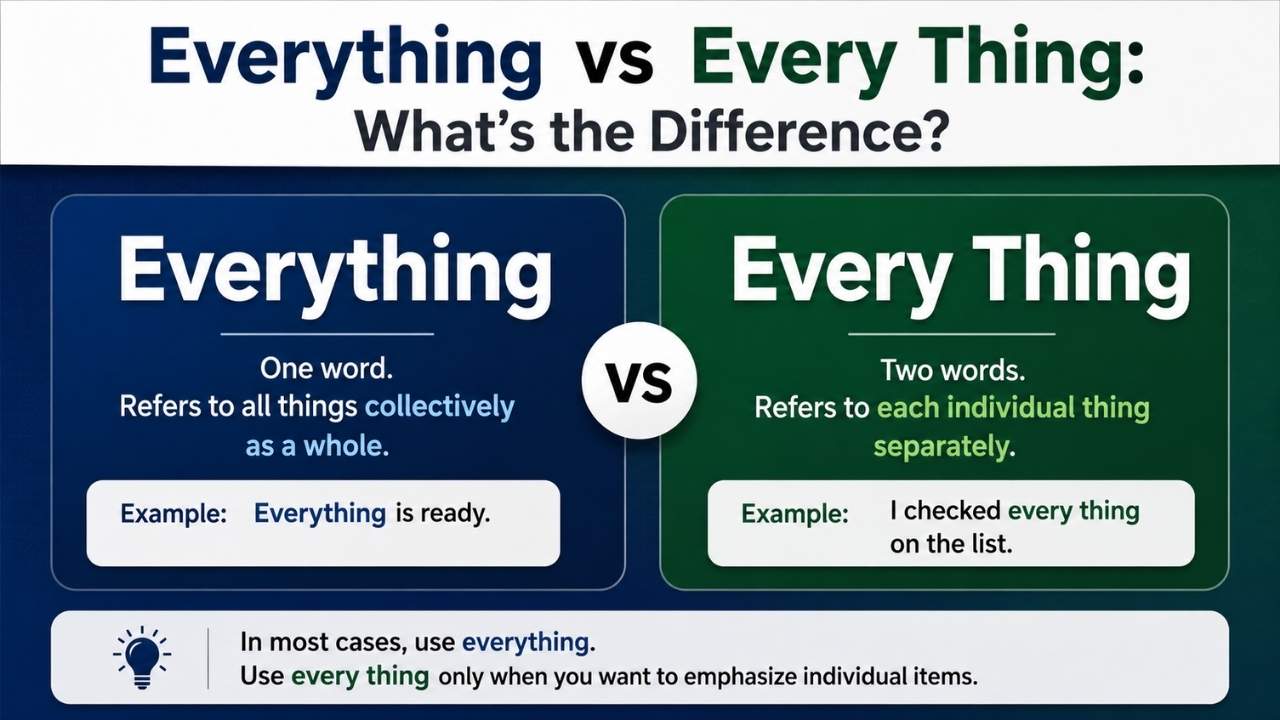
Everything vs Every Thing: What’s the Difference?
Many English learners and native speakers wonder about Everything vs Every Thing. At first glance, the two forms seem identical because they contain the same words. However, modern English treats them differently.
Today, everything is one of the most common indefinite pronouns in the language. In contrast, every thing as two separate words appears only in specific situations and is much less common.
Understanding the difference helps you write more naturally and avoid awkward phrasing. It also reveals an interesting story about how English words evolve over time.
Quick Answer
When comparing Everything vs Every Thing, the correct choice in almost all modern situations is everything. It functions as a single word meaning “all things” or “the entirety of what exists, happens, or is involved.” Every thing appears only when writers intentionally emphasize each individual item separately.
TL;DR
- Everything is the standard modern form.
- It means “all things” or “the whole of something.”
- Every thing is rare in contemporary English.
- Writers may use every thing for special emphasis.
- American English strongly favors everything.
- In everyday writing, choose everything unless a specific stylistic reason exists.
Overview of Everything and Every Thing
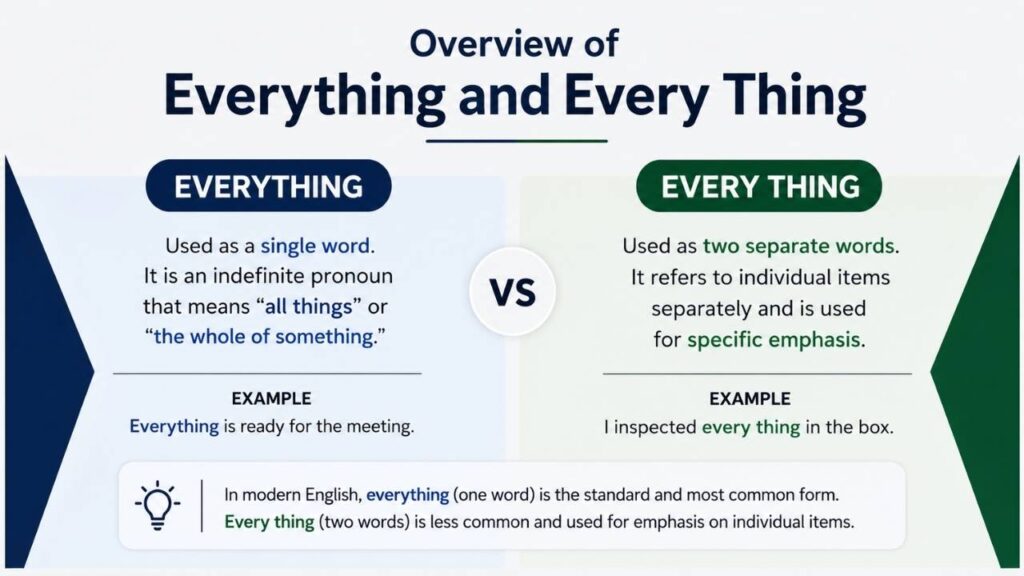
The distinction begins with how English forms compound words. Over time, words that frequently appear together often merge into a single unit.
The word everything is now considered an indefinite pronoun. It refers collectively to all things within a group, situation, or context.
What Does Everything Mean?
In modern English, everything means all things together as a whole. It usually refers to objects, ideas, events, or circumstances collectively.
For example, someone might say, “Everything is ready for the meeting.” Here, the speaker refers to all necessary preparations as a single group.
What Does Every Thing Mean?
The phrase every thing separates the determiner every from the noun thing. This structure emphasizes individual items rather than a collective whole.
For example, a writer might say, “I examined every thing in the box.” The focus falls on each separate object.
Today, however, most writers would simply choose “everything in the box.”
The Historical Development of the Word
English has a long history of combining frequently used word pairs into single words. Many modern compounds began as separate words centuries ago.
Words such as someone, anyone, everybody, and everything followed a similar path. Earlier forms often appeared as two separate words before becoming standardized compounds.
Early English Usage
In older stages of English, writers frequently used phrases that would later become single words. Spelling conventions were less standardized, so variation was common.
As printing expanded and dictionaries became more influential, certain spellings gained preference. Eventually, everything emerged as the accepted standard.
Standardization in Modern English
By the twentieth century, most style guides, dictionaries, and educational materials treated everything as the correct form for ordinary usage.
As a result, every thing became increasingly rare outside literary, historical, or stylistic contexts.
Why Everything Became the Preferred Form
Language tends to favor efficiency. When people repeatedly use the same word combination, it often becomes a single unit.
The phrase “every thing” was used so frequently that speakers began treating it as one concept rather than two separate words.
This process occurs throughout English. Similar examples include:
| Older Form | Modern Form | Meaning |
| every body | everybody | all people |
| any one | anyone | any person |
| some body | somebody | an unspecified person |
| every thing | everything | all things |
The change reflects how speakers naturally process common expressions.
How Everything Functions in Modern Grammar
Today, everything acts as an indefinite pronoun. It stands in for an entire set of things without naming each item individually.
Because it functions as a singular pronoun, it usually takes a singular verb.
Subject Position
When everything serves as the subject, singular verbs follow it.
For example, “Everything looks perfect today.”
Although the word refers to many things collectively, English grammar treats it as singular.
Object Position
The word can also function as an object.
For example, “She packed everything before leaving.”
In this sentence, everything receives the action of the verb.
After Prepositions
The word frequently appears after prepositions.
For example, “We talked about everything during dinner.”
This usage is extremely common in both spoken and written American English.
When Every Thing Is Still Used
Although uncommon, every thing has not disappeared completely.
Writers sometimes separate the words to emphasize individual items rather than a collective whole. This creates a subtle difference in meaning.
Emphasis on Individual Objects
Imagine a person checking inventory.
The sentence “I inspected everything” treats all items collectively.
However, “I inspected every thing” highlights each object one by one.
The distinction is slight, but some writers find it useful.
Literary and Stylistic Writing
Authors occasionally separate the words for rhythm, emphasis, or historical effect.
In older texts, readers may encounter every thing far more often than in contemporary writing.
Modern readers generally view the two-word form as unusual.
Everything in American English
American English overwhelmingly prefers everything as one word.
You will see it in newspapers, books, websites, business communication, text messages, and social media posts.
Everyday Conversation
Americans frequently use sentences such as:
“Everything went well.”
“Everything is under control.”
“Everything changed after that.”
These examples sound natural and standard.
Professional Writing
Business documents and academic writing also favor the single-word form.
Using every thing in professional contexts may appear outdated or unnecessarily formal.
British and American Usage Differences
Unlike some grammar topics, this one shows very little difference between British and American English.
Both varieties overwhelmingly prefer everything.
Shared Standard Form
Modern dictionaries on both sides of the Atlantic recognize everything as the standard spelling.
As a result, writers rarely face regional uncertainty.
Minor Stylistic Variations
Occasionally, literary authors in either variety may choose every thing for emphasis.
However, this remains a stylistic decision rather than a regional preference.
Common Mistakes Writers Make
The most common mistake involves assuming that every thing is equally acceptable in ordinary writing.
Because the phrase seems logical, some writers separate the words without realizing modern English generally combines them.
Overusing Every Thing
Many learners believe that because every and thing are separate words, they should stay separate.
In reality, standard usage favors the compound form.
Misunderstanding Meaning
Some people assume the two forms have completely different meanings.
Actually, both relate to the idea of “all things.” The difference mainly involves emphasis and style.
Everything in Digital Communication
Digital communication often accelerates language change. Interestingly, it has strengthened the dominance of everything.
People prefer shorter, familiar forms when texting, emailing, and posting online.
Text Messages
Messages such as “Everything okay?” appear constantly in texting.
The single-word form feels natural and efficient.
Social Media
Social media users almost always choose everything.
The two-word version can look accidental or outdated to modern readers.
Real-Life Examples of Correct Usage
Examining everyday examples makes the distinction clearer.
Everyday Speech
“Everything tastes great.”
“Everything worked perfectly.”
“Everything happens for a reason.”
These sentences sound natural in modern American English.
Writing and Communication
“Thank you for everything.”
“I reviewed everything before submission.”
“Everything appears correct.”
These examples reflect standard contemporary usage.
Situations Where Every Thing May Sound Better
Although rare, certain situations can justify the two-word form.
The key factor is individual emphasis.
Careful Examination
Consider the sentence: “She labeled every thing on the shelf.”
The writer may want readers to imagine each item being labeled separately.
Deliberate Contrast
A writer could say, “Not everything was damaged, but every thing made of glass was broken.”
Here, the distinction helps create a specific contrast.
Even so, many modern writers would still choose the compound form.
How Usage Has Changed Over Time
The movement from every thing to everything reflects a broader pattern in English.
Frequently paired words often become compounds. Over time, speakers stop thinking of them as separate elements.
From Phrase to Pronoun
Originally, every thing functioned as a normal phrase.
Gradually, it became a fixed expression.
Today, most speakers recognize everything as a single pronoun.
Current Standard
In contemporary American English, dictionaries, educational materials, and style guides consistently recommend everything for ordinary use.
The two-word version survives mainly for special rhetorical purposes.
Quick Comparison Table
| Context | Correct Usage | Example | Notes |
| Everyday conversation | Everything | Everything is fine. | Standard form |
| Business writing | Everything | Everything has been approved. | Preferred choice |
| Texting | Everything | Everything okay? | Most natural |
| Literary emphasis | Every thing | Every thing was inspected. | Rare stylistic use |
| Historical texts | Every thing | Found in older writing | Less common today |
FAQs
Is everything one word or two?
In modern English, everything is usually one word. This is the standard form used in writing and speech.
Is every thing ever correct?
Yes. Writers sometimes use every thing when emphasizing individual items. However, this usage is uncommon today.
Which form should students use?
Students should generally use everything. It matches modern grammar standards and reader expectations.
Do Americans use every thing?
Rarely. Most Americans use everything in nearly all contexts.
Is every thing old-fashioned?
It can sound old-fashioned in many situations. Readers often associate it with older texts or literary styles.
Does everything take a singular verb?
Yes. Although it refers to many things, everything is grammatically singular and takes singular verbs.
Conclusion
The distinction between Everything vs Every Thing is simpler than it first appears. In modern American English, everything is the standard form and functions as an indefinite pronoun meaning “all things” collectively.
While every thing still appears occasionally for emphasis or stylistic effect, it is rare in everyday communication. When in doubt, choose everything. Doing so will make your writing sound natural, modern, and consistent with current English usage.