

Sans in English: Meaning, Usage, and Grammar Guide
The word Sans in English is one of those terms that appears simple but carries a rich linguistic history. Although it is not among the most common words in everyday conversation, it frequently appears in writing, advertising, journalism, and digital communication.
In modern English, sans usually means “without.” Writers often choose it because it sounds concise, stylish, or slightly more formal than the word without. However, many people wonder whether it is proper English, when it should be used, and whether it belongs only in formal writing.
Understanding how sans works can help you read and write more naturally. It also prevents common mistakes that occur when people treat it as a trendy expression rather than a grammatical word with a long history.
Quick Answer
Sans means “without.” It functions as a preposition and is commonly used before a noun or noun phrase to indicate the absence of something. While it originated in French, it has become an accepted part of modern English vocabulary.
TL;DR
- Sans means without.
- It is usually used as a preposition.
- The word entered English from French centuries ago.
- American English accepts it in both formal and informal writing.
- It often creates a concise or stylish tone.
- Most grammar experts consider it standard English.
Overview of Sans
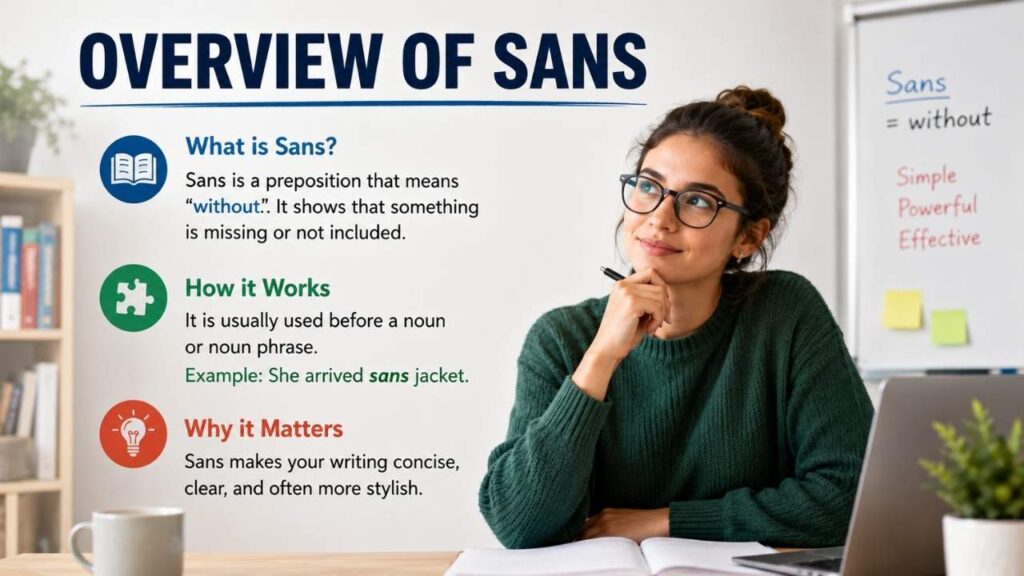
The word sans functions primarily as a preposition. Its purpose is to show that something is missing, absent, or excluded. In most cases, it can be replaced directly with the word without.
What Does Sans Mean?
The basic meaning of sans is simple: it indicates the absence of something. For example, a writer might describe a room as “sans furniture.” The phrase means the room contains no furniture.
Because the meaning is straightforward, readers usually understand it immediately. However, the choice of sans instead of without often creates a slightly different tone.
How Does Sans Function Grammatically?
Grammatically, sans behaves much like without. It introduces a noun, noun phrase, or occasionally a pronoun that identifies what is missing.
For example, “She arrived sans jacket” means she arrived without a jacket. The word directly connects the action to the missing item.
Why Do Writers Use It?
Many writers choose sans because it is shorter and more distinctive than without. It can create a polished, literary, journalistic, or humorous effect depending on the context.
Today, it is especially common in headlines, advertisements, fashion writing, and social media posts where brevity matters.
Historical Background of Sans
The story of sans begins long before modern English. Its roots can be traced to Old French, where it functioned as a common preposition meaning “without.”
Origins in French
French contributed thousands of words to English after the Norman Conquest of 1066. During this period, French heavily influenced government, law, literature, and vocabulary.
Although many French borrowings became fully integrated into English, sans retained its distinctly French appearance.
Entry into English
English writers began using sans several centuries ago. It often appeared in literary works and educated writing where French expressions were considered fashionable.
Over time, readers became familiar with the term, allowing it to survive long after many other borrowed expressions disappeared.
Literary Influence
Classical literature helped preserve the word. Writers frequently employed sans for rhythm, style, or elegance.
As a result, the term gradually shifted from being viewed as a foreign expression to being recognized as a legitimate English word.
Core Rules at a Glance
Although sans is relatively simple, understanding a few key rules helps ensure correct usage.
Use It Before Nouns
The most common structure places sans directly before a noun or noun phrase.
For example, “The apartment was rented sans appliances” is considered standard usage. The noun phrase follows immediately after the preposition.
Treat It Like Without
In many situations, you can mentally replace sans with without. If the sentence still makes sense, the usage is likely correct.
This substitution test helps writers avoid awkward constructions.
Keep the Structure Simple
Because sans is concise, it works best in concise sentences. Long or complicated phrases after the word can feel unnatural.
Most effective examples involve short noun phrases rather than lengthy clauses.
Usage in Modern American English
American English has fully accepted sans as part of its vocabulary. However, its frequency varies across contexts.
Everyday Writing
In casual writing, people often use sans humorously or for emphasis. Social media users may write phrases such as “coffee sans sugar” or “vacation sans stress.”
These examples demonstrate how naturally the word fits into modern communication.
Journalism and Headlines
Journalists frequently use sans because headlines benefit from short wording. A headline might describe a team competing “sans its star player.”
The word saves space while remaining easy to understand.
Professional Communication
In professional writing, sans appears occasionally but less often than without. Business writers usually choose the simpler option unless a specific stylistic effect is desired.
Even so, educated readers generally recognize and understand the term.
Formal vs Informal Usage
One interesting aspect of sans is its flexibility across different levels of formality.
Formal Contexts
In formal writing, sans can create an elegant or literary tone. Academic writers sometimes use it sparingly when discussing historical texts, cultural topics, or stylistic analysis.
However, excessive use may appear affected or overly decorative.
Informal Contexts
In casual speech and writing, sans often adds humor or sophistication. People may intentionally use it to sound playful or witty.
This dual role explains why the word remains popular despite being less common than without.
Choosing the Right Tone
The choice between sans and without often depends more on style than grammar. Both are generally correct, but each creates a slightly different impression.
British and American Variations
Both American and British English recognize sans. The meaning remains essentially identical on both sides of the Atlantic.
American Preferences
American writers frequently use sans in media, fashion writing, and advertising. The word often carries a modern, streamlined feel.
Readers rarely perceive it as unusual.
British Preferences
British English also uses sans, though some contexts may favor more traditional wording. Nevertheless, the term remains widely understood.
Differences between the two varieties are generally minor.
Shared Understanding
Because the word has existed in English for centuries, both American and British readers interpret it similarly. Confusion is uncommon.
Common Mistakes With Sans
Despite its simplicity, several errors appear regularly.
Using It for Style Alone
Some writers insert sans repeatedly because it sounds sophisticated. Overuse can make writing seem unnatural.
Like any stylistic choice, moderation usually produces the best results.
Combining It Incorrectly
Writers sometimes create awkward phrases by pairing sans with structures that do not fit naturally after a preposition.
Keeping the following phrase concise usually improves clarity.
Assuming It Is Not English
A common misconception is that sans remains purely French. In reality, it has been part of English vocabulary for centuries.
Modern dictionaries recognize it as an English word.
Real-Life Examples of Sans
The best way to understand sans is through practical examples.
| Context | Correct Usage | Example | Notes |
| Conversation | Missing item | She arrived sans umbrella. | Means without an umbrella. |
| Journalism | Missing person | The team played sans its captain. | Common in headlines. |
| Fashion | Style description | The design is elegant sans decoration. | Often used stylistically. |
| Social Media | Casual tone | Coffee sans cream today. | Informal and concise. |
| Business Writing | Limited use | The proposal was submitted sans revisions. | Less common but acceptable. |
In Emails
An employee might write that a report was submitted sans attachments. Most readers will immediately understand the meaning.
In Advertising
Advertisers often use sans to emphasize simplicity. A slogan may describe a product as “luxury sans compromise.”
In Online Communication
Digital platforms encourage brevity, making sans particularly attractive for short messages and captions.
Sans in Popular Expressions
Certain expressions have helped keep sans visible in modern English.
Sans Serif
Perhaps the most famous example appears in typography. The term sans serif describes fonts that lack decorative strokes at the ends of letters.
Many modern digital fonts belong to this category.
Fashion and Design Language
Fashion writers frequently use sans to describe minimalist styles. The word conveys absence while maintaining elegance.
This usage contributes to the term’s stylish reputation.
Creative Writing
Novelists and journalists often use sans to create rhythm or variety. Because it differs from ordinary vocabulary, it can draw attention to a phrase.
Misunderstandings and Usage Debates
Like many borrowed words, sans occasionally sparks discussion among language enthusiasts.
Is Sans Pretentious?
Some readers view sans as overly sophisticated. Others see it as a practical and concise alternative to without.
Neither perspective is universally accepted. The effect depends largely on context and audience.
Should Writers Avoid It?
Most grammar experts do not recommend avoiding sans entirely. Instead, they encourage writers to use it naturally and purposefully.
When it fits the tone, it can be highly effective.
Is It Still Foreign?
Historically, the word came from French. Today, however, it functions as a recognized English vocabulary item.
Most modern dictionaries no longer treat it as unfamiliar.
How Usage Has Changed Over Time
The role of sans has evolved significantly.
Early English Usage
Earlier writers often employed French expressions to demonstrate education or cultural refinement. During these periods, sans sometimes felt more foreign than it does today.
Twentieth-Century Development
As English became more global, many borrowed words became normalized. Sans gradually shifted from literary language into journalism and everyday writing.
Modern Trends
Today, the word appears across print, digital media, advertising, and social platforms. Its continued popularity shows that concise expressions remain valuable in modern communication.
Why Sans Remains Popular Today
Language tends to preserve words that serve a useful purpose. Sans continues to survive because it offers both efficiency and style.
Brevity Matters
Modern communication often rewards shorter wording. Because sans contains only four letters, it conveys meaning quickly.
This advantage helps explain its frequent appearance in headlines and captions.
Distinctive Tone
Unlike without, sans can add personality to a sentence. Writers use it when they want language to feel slightly more polished or creative.
Easy Recognition
Most educated readers recognize the term immediately. This familiarity allows writers to use it without creating confusion.
FAQs
Is sans a real English word?
Yes. Although it originated in French, sans has been used in English for centuries. Modern dictionaries classify it as part of English vocabulary.
Does sans always mean without?
Yes. In standard usage, sans means “without” or “lacking.” The two terms are often interchangeable.
Is sans formal or informal?
It can be both. Writers use it in formal contexts, but it also appears in casual conversation, social media, and advertising.
Can I use sans in academic writing?
You can, but use it carefully. Many academic writers prefer without because it sounds more neutral.
What is the difference between sans and without?
The meaning is essentially the same. The main difference involves tone and style rather than grammar.
Is sans common in American English?
Yes. American English uses sans regularly, especially in journalism, advertising, and digital communication.
Conclusion
Sans is a concise and versatile word that means without. Although it entered English from French, centuries of usage have made it a recognized and accepted part of modern English vocabulary.
Today, writers use sans in journalism, advertising, literature, business communication, and everyday conversation. While without remains more common, sans offers a shorter and sometimes more stylish alternative.
Understanding how sans functions allows you to recognize it confidently and use it naturally. When chosen thoughtfully, it can add clarity, variety, and precision to everyday English communication.