
Where They Are vs Where They Are At: Which Is Correct?
Many English learners and native speakers wonder whether they should say Where They Are vs Where They Are At. Both expressions appear in everyday conversation, yet they are not always treated the same way in grammar guides.
The confusion comes from the small word at. Some people consider it unnecessary, while others use it naturally in speech. Because both forms are common, many writers want to know which one is considered correct and when each should be used.
Understanding this difference can help you sound more natural and choose the right wording for formal writing, casual conversation, emails, and social media.
Quick Answer
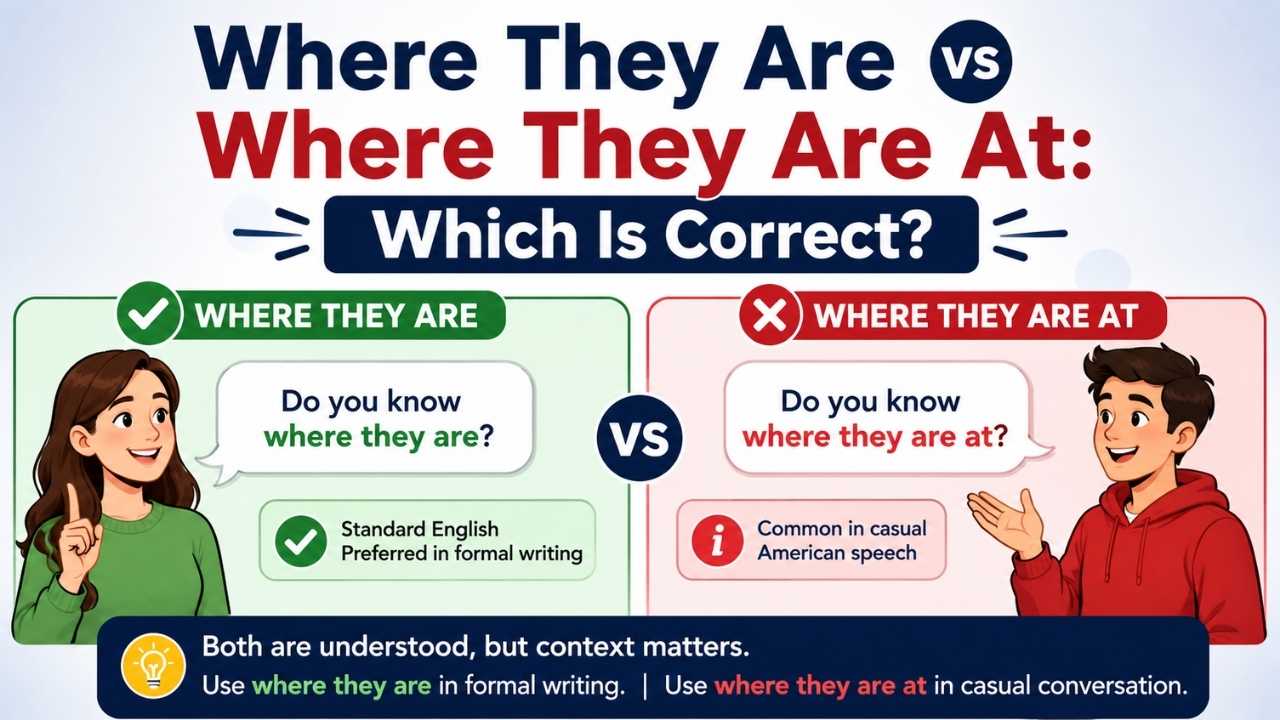
When comparing Where They Are vs Where They Are At, where they are is the standard and preferred form in formal English. Where they are at is common in informal American speech and often adds emphasis, but many style guides still consider the at unnecessary in formal writing.
TL;DR
- Where they are is grammatically standard.
- Where they are at is common in casual American English.
- Formal writing usually prefers where they are.
- The extra at often adds emphasis rather than meaning.
- Both forms are widely understood by native speakers.
- Context determines which version sounds most natural.
Understanding Where They Are and Where They Are At
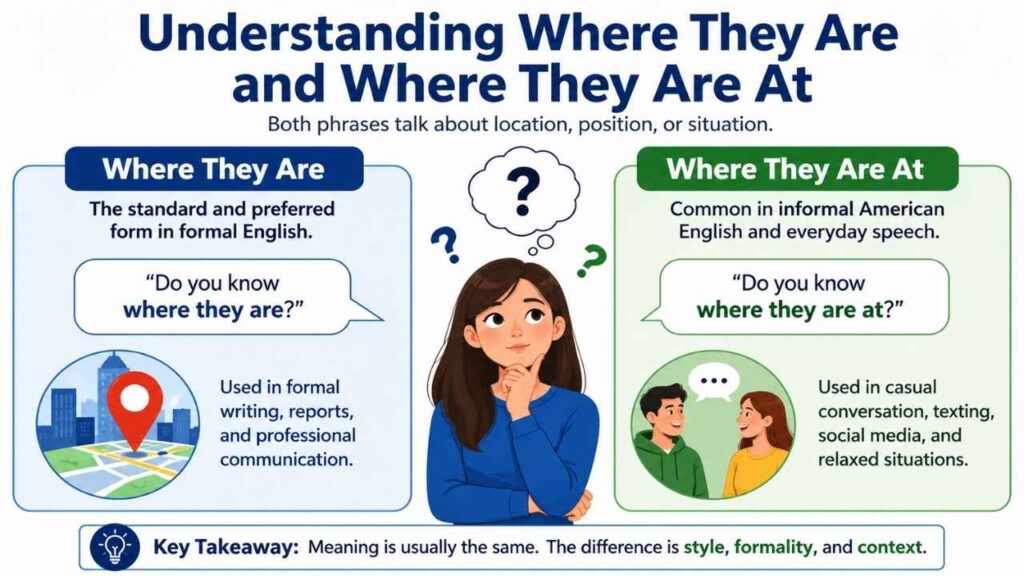
Both expressions refer to a person’s location, position, condition, or situation. In many conversations, they communicate essentially the same idea.
For example, someone might ask, “Do you know where they are?” Another speaker might ask, “Do you know where they are at?” Most listeners understand both questions without difficulty.
The difference is not usually about meaning. Instead, it involves style, formality, and regional speaking habits. That is why grammar discussions often focus on preference rather than strict correctness.
Literal Location
When discussing physical location, both versions can point to the same place.
“Nobody knows where they are.”
“Nobody knows where they are at.”
In everyday speech, the second version often sounds more conversational.
Figurative Meaning
The phrase can also describe progress, status, or understanding.
For example, a manager might say, “Let’s see where they are in the project.” Another speaker might say, “Let’s see where they are at in the project.”
In these cases, the expression refers to a situation rather than a physical location.
The Core Grammar Rule
Traditional grammar generally favors where they are because where already functions as a location word.
The argument is simple. Since where already indicates place, adding at may seem redundant. According to this view, the sentence contains an unnecessary extra preposition.
Consider this example:
“Tell me where they are.”
The word where already expresses location, so many editors see no need for at.
However, actual language use does not always follow the shortest possible structure. Speakers frequently add words for rhythm, emphasis, or regional style. As a result, where they are at continues to appear in everyday conversation.
Why Some People Object to At
The criticism comes from the idea of double marking location. Both where and at relate to place.
Because of that overlap, some teachers and editors recommend removing at in formal contexts.
Why Many Speakers Use At Anyway
Language is influenced by habits, regional traditions, and spoken rhythm.
For many Americans, where they are at sounds natural and conversational. They may not even notice the extra preposition.
Historical Background of the Expression
The debate is older than many people realize. Similar constructions have appeared in English speech for centuries.
Historically, English speakers often used additional prepositions that modern grammar books later discouraged. Over time, some forms disappeared while others remained common in spoken language.
The phrase where … at survived largely because people continued using it in everyday conversation. Even when grammar experts criticized it, ordinary speakers kept saying it.
As a result, the expression became part of many regional dialects and informal speech patterns across the United States.
Earlier English Usage
Older forms of English frequently contained structures that modern writers would consider redundant.
Because spoken language evolves differently from written language, certain patterns remained popular long after formal standards changed.
Modern Development
Today, most grammar authorities recognize that where … at exists in natural speech, even if they prefer where alone in formal writing.
How Americans Use It Today
In modern American English, both forms appear regularly, but they serve slightly different purposes.
Formal documents, academic writing, news articles, and professional communication usually favor where they are.
Casual conversation, interviews, podcasts, and everyday speech often include where they are at.
Many Americans use the longer form without considering it incorrect. Instead, they see it as part of natural spoken English.
Professional Contexts
A business report would normally say:
“We need to understand where they are in the process.”
This version appears cleaner and more concise.
Casual Conversations
Friends speaking informally might say:
“Do you know where they are at right now?”
The wording feels relaxed and conversational.
Is Where They Are At Grammatically Wrong?
This question creates much of the debate.
Strictly speaking, many traditional grammar guides label the at as unnecessary. From that perspective, where they are is the better choice.
However, modern linguists often distinguish between formal standards and actual usage. Since millions of native speakers use where they are at, it is difficult to call it completely wrong.
Instead, many experts describe it as an informal feature of spoken English.
Prescriptive View
The prescriptive approach focuses on established grammar rules and style recommendations.
Under this view, removing at creates a cleaner sentence.
Descriptive View
The descriptive approach examines how people actually speak.
From this perspective, where they are at is a legitimate part of many English dialects.
Formal vs Informal Usage
Understanding formality helps determine which version to choose.
In formal settings, simplicity usually wins. Writers often remove words that do not add essential meaning.
In informal settings, speakers may choose expressions that feel natural rather than strictly economical.
| Context | Preferred Usage | Example | Notes |
| Academic writing | Where they are | We analyzed where they are in the process. | Most formal |
| Business reports | Where they are | The team reviewed where they are. | Professional tone |
| Casual conversation | Where they are at | Do you know where they are at? | Common in speech |
| Text messages | Either form | Where are they at now? | Informal setting |
| Social media | Either form | Here’s where they are at today. | Style varies |
Regional Differences Across the United States
Not all Americans use these expressions equally.
Certain regions show a stronger preference for where … at constructions. In other areas, speakers tend to omit the extra preposition.
These differences often reflect local speech traditions rather than educational background.
A person may grow up hearing where are you at? every day and consider it completely normal. Another speaker may rarely hear the phrase and find it unusual.
Because of these regional patterns, reactions to the expression vary considerably.
British English vs American English
American English generally shows greater acceptance of where they are at in conversation.
British English tends to prefer where they are and often treats the extra at as unnecessary.
Even so, British speakers may occasionally use similar constructions in informal speech. The difference is mainly one of frequency rather than absolute correctness.
When writing for an international audience, choosing where they are is usually the safest option.
Common Mistakes and Confusion
Many learners struggle because they assume the two forms have completely different meanings.
In reality, the meaning usually stays the same. The main difference involves style and formality.
Another mistake is using where they are at in highly formal writing when a simpler version would work better.
Some writers also remove at from expressions where it actually belongs. The correct choice depends on the sentence structure rather than a blanket rule.
Confusing Grammar with Style
A phrase may be stylistically informal without being unintelligible or incorrect.
Understanding this distinction helps avoid unnecessary confusion.
Overcorrecting
Some people become so focused on removing extra words that they edit natural speech patterns unnecessarily.
Context matters more than rigid rules.
Real-Life Examples in Everyday Communication
Everyday English provides many examples of both forms.
In a workplace meeting, someone might ask, “Can we review where they are with the project?” This sounds professional and direct.
During a casual phone call, a friend might ask, “Do you know where they are at?” The sentence feels natural and conversational.
Social media posts frequently contain both versions because users tend to write the way they speak.
As digital communication becomes more informal, spoken-language patterns often appear in writing.
Why the Debate Continues
The discussion continues because grammar involves both rules and usage.
Editors often prioritize clarity, consistency, and efficiency. Speakers often prioritize natural rhythm and familiar expressions.
As a result, the two groups sometimes evaluate the same phrase differently.
Neither side is entirely ignoring English. They simply focus on different aspects of how language works.
Today, many language experts acknowledge that where they are at exists as a common informal expression while still recommending where they are for formal writing.
How Usage Has Changed Over Time
Language rarely stays fixed.
Expressions once criticized as improper sometimes become widely accepted. Others gradually disappear.
The phrase where they are at has remained remarkably persistent despite criticism from some grammar authorities. Its survival suggests that speakers find it useful or natural.
Modern English generally accepts a wider range of informal speech patterns than previous generations did. As a result, many writers now view the phrase as a matter of style rather than a serious grammar error.
Choosing the Best Option
The best choice depends on your audience and purpose.
If you are writing a report, essay, article, or professional email, where they are is usually the strongest option. It is concise and widely accepted.
If you are speaking casually with friends, family members, or coworkers, where they are at may sound perfectly natural.
The key is understanding the expectations of the situation rather than treating one version as universally right or wrong.
FAQs
Is “where they are at” incorrect English?
Not necessarily. Many grammar guides prefer where they are, but where they are at is common in informal American speech and is widely understood.
Which version is more formal?
Where they are is generally considered more formal. It is the preferred choice for professional and academic writing.
Why do people add “at” after “where”?
The extra at often adds conversational rhythm or emphasis. In most cases, it does not change the meaning.
Do Americans commonly say “where they are at”?
Yes. The expression appears frequently in casual American English, especially in speech.
Is the phrase common in business communication?
Formal business writing usually avoids it. However, it may appear in informal workplace conversations.
Does British English use “where they are at”?
British speakers generally prefer where they are, although the longer version can still appear in informal contexts.
Conclusion
The debate over Where They Are vs Where They Are At is less about meaning and more about style. Both expressions communicate the same basic idea, but they carry different levels of formality.
In formal writing, where they are remains the preferred choice because it is concise and widely accepted. In casual American speech, where they are at continues to be common and natural for many speakers.
The practical takeaway is simple: choose the version that fits your audience. Understanding both forms allows you to communicate confidently in any situation.